

Why Candidate Drop-Off During Screening Is Costing You Top Talent
Understanding how to improve candidate completion rates screening is a critical lever in talent acquisition that directly impacts your cost-per-hire and time-to-fill. When your screening process is cumbersome, you aren't just losing time; you are losing the top 10% of talent who have multiple offers on the table.
According to the Professional Background Screening Association (PBSA) , maintaining a balance between thoroughness and candidate experience is essential for compliance and recruitment success in 2026.
Here is how to optimize your funnel:
- Shorten and simplify your screening process — keep it under 15 minutes
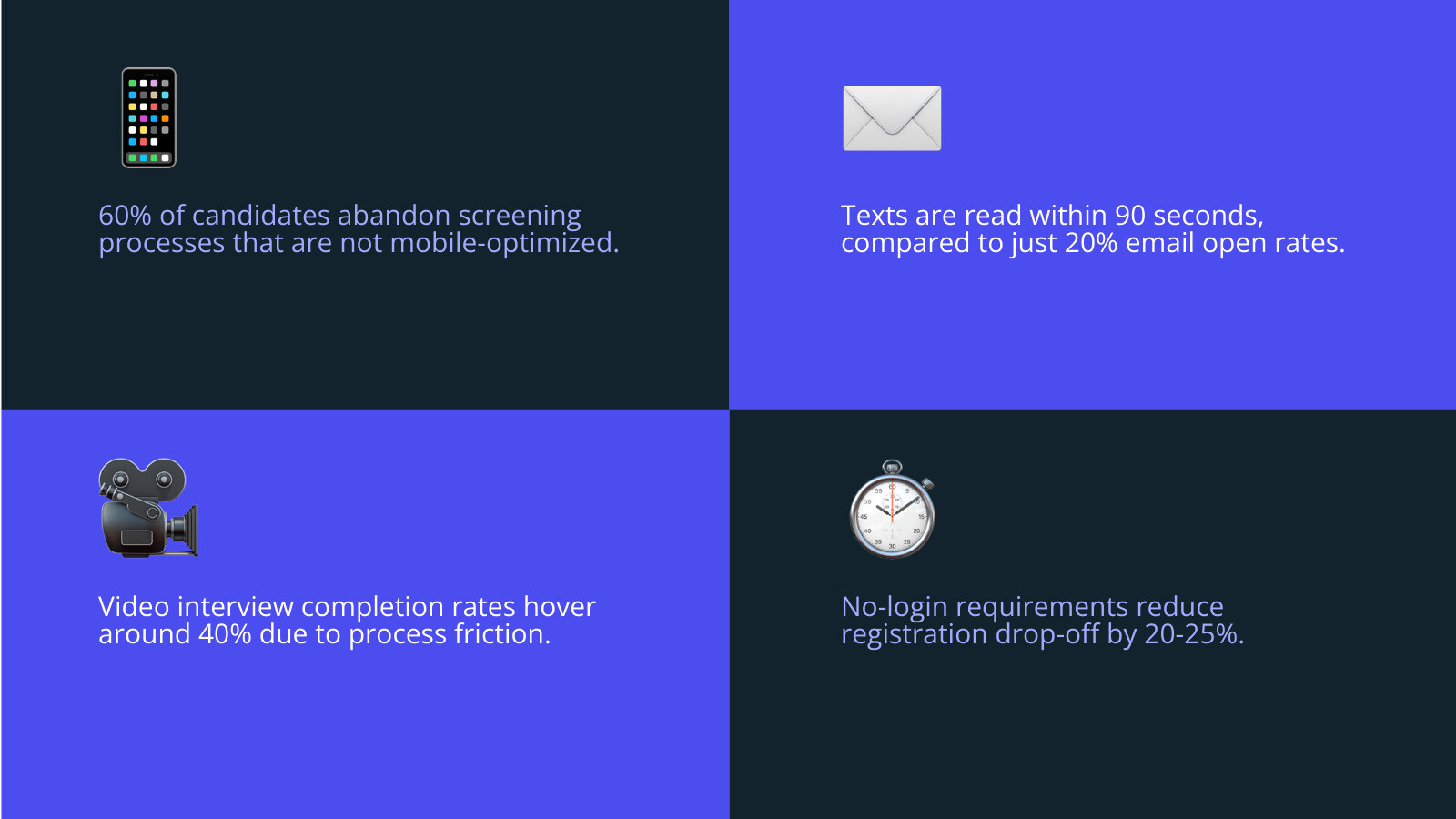
- Eliminate login requirements to reduce registration drop-off by 20-25%
- Use SMS over email — texts are read within 90 seconds vs. a 20% email open rate
- Add context upfront — welcome messages and clear instructions reduce abandonment
- Make it mobile-friendly — up to 60% of candidates abandon processes that aren't
- Automate reminders at 12 and 36 hours after initial invite
- Set realistic deadlines — a 5-7 day window outperforms same-day pressure
- Track funnel drop-offs by stage to identify exactly where candidates are leaving
Most screening processes were designed for internal compliance rather than candidate engagement. This mismatch shows up directly in your completion numbers. Completion rates for video interviews often hover around 40%, and background check stages can bleed even more candidates when they are slow or require navigating clunky portals. If your process asks for significant effort without providing immediate feedback, top-tier talent will prioritize other opportunities.
How to Improve Candidate Completion Rates Screening Through Process Design
To solve the abandonment problem, you must treat your screening process like a product. If a customer faced this much friction to buy your services, they would leave. Candidates are no different. High-performing talent acquisition teams realize that every additional question or vague prompt is an opportunity for a candidate to close the tab.
Design your screening with specificity. If you are using skills tests or video prompts, limit them to 3-5 targeted questions. Latest 2026 Appcast research suggests that reducing friction in the application process can increase conversion rates by up to 365%. Furthermore, providing a 5-7 day deadline rather than immediate pressure allows candidates—especially those currently employed—to complete tasks when they are most focused.
Transparency also dictates success. If a candidate knows exactly what to expect, they are more likely to finish. For example, understanding how long a background check takes helps manage expectations and prevents them from assuming silence means rejection.
How to improve candidate completion rates screening with clear context
Context is the antidote to the impersonal label often given to automated screening. When a candidate receives a link with no explanation, the psychological barrier to starting is high. You can lower this barrier significantly by including a welcome message or a short video introduction from the hiring manager.
A 30-second video explaining why the screening matters and how it fits into the larger journey can boost completion rates from 40% to 80%. Be transparent about the "why" behind your prompts. If you are asking for a video response, explain that it is to help the team see their communication style, not just to check a box. When candidates feel they are being seen rather than just processed, they stay engaged.
Reducing friction with no-login requirements
The single biggest technical hurdle in many screening workflows is mandatory account creation. Forcing a candidate to create a username, verify an email, and remember a password just to provide background check details is a major friction point.
Data shows that no-login candidate experiences eliminate a 20-25% drop-off caused by registration friction alone. Especially in high-volume environments like staffing, speed is the primary currency. If you can provide a secure, unique link that allows a candidate to jump straight into the form, you remove the "I'll do this later" mentality that leads to permanent abandonment. For those managing staffing agency background check solutions , this one adjustment can drastically improve your speed-to-hire.
Leveraging Technology to Eliminate Screening Drop-Offs
Traditional screening methods, such as manual phone screens, are difficult to scale and prone to scheduling delays. When you rely on live calls, you introduce "phone tag," which can stretch the screening phase out for days.
Asynchronous tools—like one-way video or automated chat interviews—allow candidates to respond on their own time. This is particularly effective for healthcare or retail roles where candidates often work non-traditional hours. Organizations moving from scheduled phone screens to asynchronous assessments have seen completion rates climb from 60% to 85%.
| Feature | Traditional Phone Screen | Automated Asynchronous Screening |
|---|---|---|
| Scheduling | Required (High friction) | None (Low friction) |
| Candidate Flexibility | Low (Must be available) | High (24/7 access) |
| Recruiter Time | 30-45 mins per candidate | 5 mins to review |
| Consistency | Subjective/Varies | Standardized Rubrics |
| Completion Rate | 60% (due to ghosting) | 80-85% |
How to improve candidate completion rates screening using mobile-friendly tools
In the 2026 market, mobile-friendly isn't a feature; it's a requirement. Up to 60% of applicants will abandon an online application if it isn't optimized for their phone. This is even higher in industries like hospitality or the gig economy, where 89% of seekers apply via mobile.
Text messaging (SMS) is the most powerful tool in your arsenal. While email open rates linger around 20%, Gartner reports that SMS open rates are as high as 98%. Using text-to-apply and SMS-based screening invites allows candidates to complete tasks during their commute or a lunch break. If your background check or onboarding process requires a desktop computer, you are effectively locking out a massive portion of the talent pool.
Automated reminders and rapid response protocols
Silence is the enemy of engagement. If a candidate completes an application and hears nothing for 48 hours, they assume the role is filled or your company is disorganized. Implementing rapid response protocols—acknowledging an application within an hour—keeps the momentum alive.
Automation allows you to set nudge protocols. If a candidate hasn't started their background check or assessment within 12 hours, an automated SMS reminder can bring them back. A second nudge at 36 hours captures those who simply got busy. These small, automated touchpoints reduce no-show rates and ensure that your pipeline stays moving without requiring manual follow-up from your recruiters.
Measuring Success: Key Metrics for Screening Optimization
Optimization requires granular data. To truly improve your completion rates, you need to look beyond the final hire date and analyze the micro-conversions within your funnel.
- Time-to-Screen: How many days pass from application to the completion of the first screening step? Reducing this by even 24 hours can significantly lower drop-off.
- Stage-Specific Drop-Off: Where are candidates leaving? If 50% of people abandon at the background check authorization page, you likely have a technical or clarity issue at that specific step.
- Candidate NPS (Net Promoter Score): Survey your candidates—including those you reject. A high NPS in the screening stage is a leading indicator of a strong employer brand.
- Completion Rate by Device: Are mobile users completing at a lower rate than desktop users? If so, your mobile interface is likely the bottleneck.
Tracking these metrics ensures that your screening process remains compliant and efficient. High-volume hiring requires audit trails that prove every candidate was treated fairly, and automated platforms provide this data while simultaneously identifying where your process is failing the candidate.
Frequently Asked Questions about Screening Completion
What is a typical completion rate for candidate screening?
For traditional video interviews, completion rates often hover around 40%. However, by using mobile-friendly, no-login tools and providing clear context, organizations frequently see these numbers jump to 80% or higher. In background screening specifically, a well-optimized process should see completion rates north of 85%.
Why do candidates abandon background checks mid-process?
The most common reasons include over-complicated forms with too many fields, the requirement to create a new account and password, lack of mobile-friendly optimization, and a lack of transparency regarding why certain data is needed. If the process feels like an interrogation rather than a partnership, candidates will ghost.
How does mobile optimization impact screening success?
It is the difference between a full pipeline and a stagnant one. With over 60% of candidates using mobile devices to job hunt, any screening step that requires a PDF download, a desktop-only portal, or extensive typing on a non-responsive site will see massive abandonment. SMS integration and mobile-friendly forms are non-negotiable for hiring in today's world.
Conclusion
Optimizing your completion rates is a strategic necessity for maintaining a competitive talent pipeline. When you eliminate registration friction, leverage SMS, and provide clear context, you stop the silent revenue leak of qualified talent leaving your funnel.
At Vetty, we've seen how a unified approach changes the game. By combining VettyVerify, VettyComply, and VettyOnboard into a single mobile-friendly dashboard, you give your team real-time visibility and your candidates a frictionless experience. Our platform is PBSA-accredited and SOC 2 Type 2 certified, ensuring that speed never comes at the expense of compliance.
Take Wag!, for example. By streamlining their high-volume screening and onboarding, they achieved a 75% reduction in fraud and 75% fewer support tickets, allowing their ops team to focus on growth rather than troubleshooting. If you're ready to hire faster and treat your candidates with the respect their time deserves, it's time to move beyond fragmented tools.
Stop letting top talent slip through the cracks of a clunky process. By unifying your screening, onboarding, and post-hire monitoring into a single mobile-friendly dashboard, you can eliminate the friction that causes top talent to ghost your process. Schedule a personalized demo today to see how Vetty can help you achieve 60% faster turnaround times and stop losing elite talent to outdated background check workflows.