

Employment Verification: Operational Guide for HR and Talent Leaders
If employment verification challenges HR teams in your organization, the root issue is usually not policy alone. It is process discipline. Delays, inconsistent documentation, and unclear escalation paths create avoidable hiring risk long before a background report is reviewed. For HR executives, talent acquisition leaders, and operations directors, the objective is straightforward: verify history quickly, document every decision point, and keep your hiring team aligned on what counts as a material discrepancy.
Essential Compliance Checklist
Before initiating any verification, ensure your process includes these five non-negotiable steps to maintain regulatory alignment:
- Standalone Disclosure: Provide a clear, written notice to the candidate that is not part of the job application.
- Written Authorization: Obtain a signed consent form before starting the check.
- Pre-Adverse Action Notice: If a report contains disqualifying information, you must provide the candidate with a copy and a summary of their rights.
- Waiting Period: Allow a reasonable timeframe (typically 5 business days) for the candidate to dispute inaccuracies.
- Final Adverse Action Notice: Issue a formal notice if you decide not to proceed with the hire.
This checklist should sit at the front of your workflow, not buried in a policy file. In practice, most breakdowns happen when recruiters move quickly, hiring managers request exceptions, or high-volume hiring periods pressure the team to skip documentation. A simple rule helps: if consent, notice, and review steps are not auditable, the process is not complete.
Common Verification Mistakes
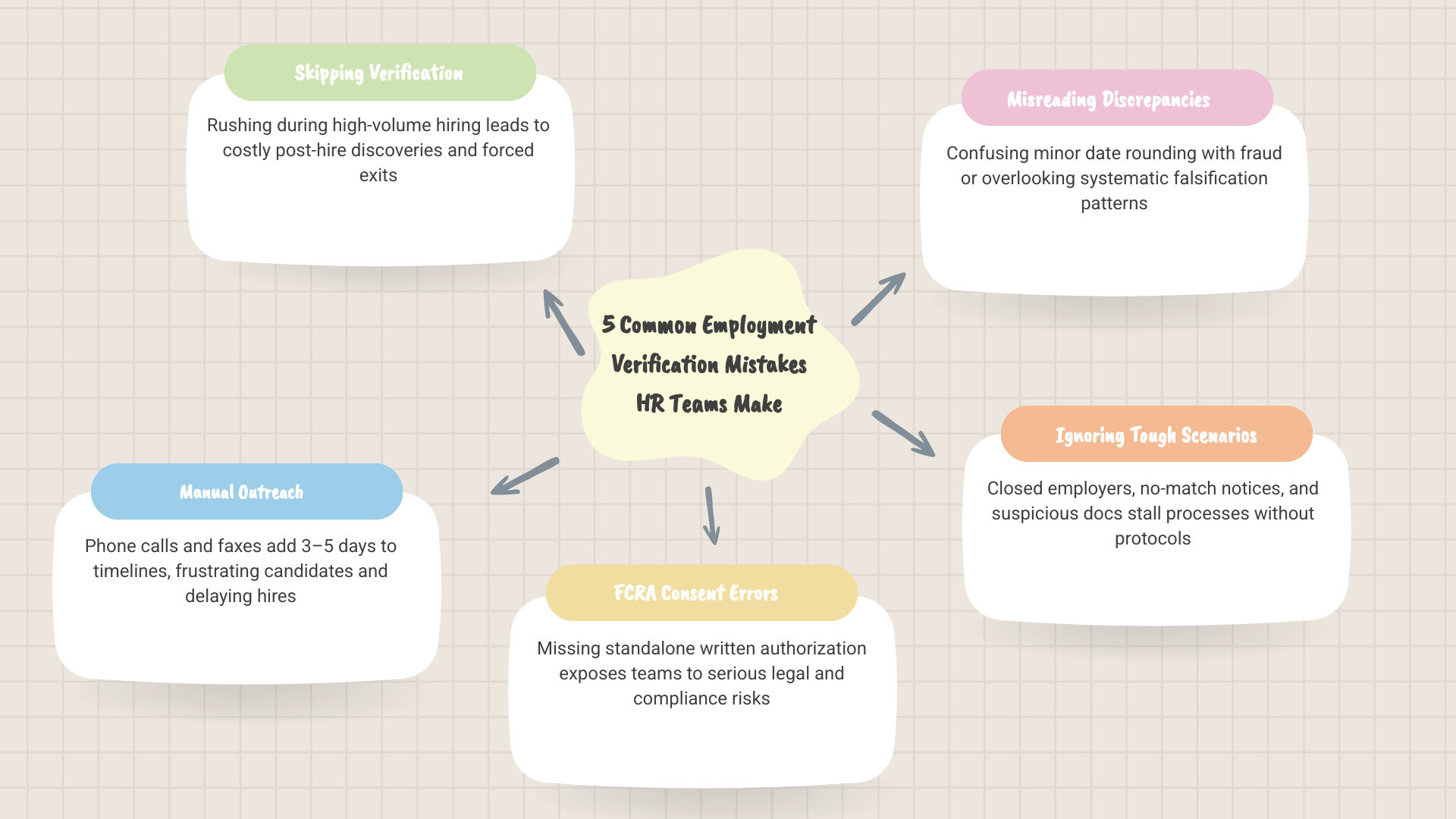
Operational inefficiencies often stem from these five areas:
- Skipping verification during high-volume surges, leading to costly post-hire exits.
- Relying on manual outreach (phone/fax) which adds 3-5 days to your timeline.
- Missing FCRA consent requirements, creating unnecessary legal exposure.
- Misinterpreting minor date discrepancies as fraud without investigation.
- Lacking protocols for closed employers or suspicious documentation.
Each of these mistakes has a direct operational fix. Standardize trigger points so every post-offer candidate enters the same verification queue. Replace one-off outreach with documented workflows. Train recruiters to separate harmless clerical inconsistencies from issues that require escalation. And for edge cases such as defunct employers, define approved fallback documentation before your team needs it.
Discrepancy rates spiked 44% between FY2021 and FY2024. With 64.2% of candidates admitting to embellishing experience, your verification process is your primary defense against bad hires.
A practical verification program should also clarify what your team is actually validating. Job title inflation, shortened employment gaps, unsupported seniority claims, and inconsistent dates are more common than outright identity fraud. Treat verification as a structured fact-check, not a search for gotcha moments. That mindset improves consistency, reduces unnecessary adverse action, and helps your team resolve discrepancies faster.
Evaluating Verification Methods: Good vs. Bad Comparison
As a talent acquisition leader, you recognize that resumes are marketing tools. In sectors like telecom and BFSI, discrepancy rates have reached 18.2% and 10.4% respectively. To protect your organization, you must move beyond informal checks and establish a formal Verification of Employment Policy.
| Feature | Manual Outreach (Inefficient) | Automated Verification (Best Practice) |
|---|---|---|
| Turnaround | 3-5+ Business Days | Seconds to 24 Hours |
| Accuracy | High risk of human error | Data-driven and tamper-proof |
| Candidate Effort | High (manual document uploads) | Low (mobile-friendly digital consent) |
| Operational Cost | High (internal labor hours) | Lower (fixed fee per check) |
Manual verification consumes over 6 hours of HR time per week. Transitioning to automated workflows allows you to reclaim this time while reducing the risk of top-tier talent dropping out of your funnel due to delays. For more on modernizing your process, review Background Checks For Employees.
The comparison matters because employment verification challenges HR teams in two places at once: compliance execution and hiring velocity. Manual outreach forces your staff to chase voicemail boxes, confirm fax numbers, and re-key information into internal systems. Automated verification reduces those handoffs and gives your team a clearer audit trail when hiring decisions are reviewed later.
Use manual methods only as an exception path, not your default operating model. They are still useful when an employer is small, recently acquired, or lacks accessible records. But if most of your volume still depends on calls and email follow-ups, your process is absorbing unnecessary cycle time and inconsistency. For operational leaders, the better question is not whether automation is convenient. It is whether your current method can scale during peak hiring without compromising documentation, turnaround time, or decision quality.
FCRA Workflow and Stage-by-Stage Breakdown
Compliance is your primary defense against litigation. The Fair Credit Reporting Act (FCRA) dictates a specific sequence for using third-party data.
The FCRA Workflow
- Disclosure & Authorization: Secure standalone consent.
- Investigation: Conduct the check via a PBSA-accredited provider.
- Review: Evaluate results against your internal hiring criteria.
- Pre-Adverse Action: Notify the candidate if the results may impact the offer.
- Dispute Period: Wait for the candidate to respond.
- Final Decision: Issue the final adverse action notice if necessary.
The operational discipline here is sequencing. If your team reviews potentially disqualifying information before the required notices go out, or if a hiring manager acts before the dispute period closes, you create avoidable process risk. Build the workflow so recruiters and coordinators cannot skip steps, and make sure every notice is logged with a timestamp.
Stage-by-Stage Hiring Integration
- Stage 1: Sourcing: State clearly that all history will be verified to deter fraudulent applications.
- Stage 2: Pre-Offer: Confirm identity early to prevent proxy interviews.
- Stage 3: Post-Offer: Trigger comprehensive checks, including Education Verification , once a conditional offer is made.
- Stage 4: Onboarding: Use a mobile-friendly portal for final document collection.
This stage-by-stage structure helps you avoid a common mistake: stacking every verification task at the end of the process. Identity confirmation belongs earlier when possible. Full employment and education checks generally fit best after a conditional offer, when your team can apply consistent adjudication criteria. During onboarding, the priority becomes document completion, exception handling, and final readiness for start date.
Handling Difficult Scenarios
- Closed Employers: Request W-2s or pay stubs and verify the business's existence through Secretary of State records.
- No-Match Notices: Notify the employee and allow them to resolve the discrepancy with the appropriate agency before taking action.
You should also define an escalation path for suspicious documents, unverifiable self-employment, and conflicting records across sources. Front-line recruiters should not have to improvise these decisions. A documented review path, ideally owned by HR operations or a compliance lead, keeps adjudication consistent and reduces unnecessary back-and-forth with hiring managers.
For high-volume needs, ensure these protocols are integrated into your Staffing Agency Background Check Solutions.
Building a Robust Verification Strategy
The future of hiring relies on balancing speed with data integrity. By 2027, manual phone calls will be obsolete, replaced by instant payroll connections and real-time visibility. Leading organizations like Paramount and Wag! rely on these automated workflows to maintain speed and compliance.
Your strategy should utilize a platform that is PBSA-accredited and SOC 2 Type 2 certified. Vetty provides an all-in-one dashboard to manage this lifecycle:
- VettyVerify™: Fast, compliant checks with no-code customization.
- VettyOnboard™: Mobile-friendly document collection and e-signatures.
- VettyComply™: Continuous monitoring to protect your organization post-hire.
For HR and operations leaders, the strongest strategy is the one your team can execute consistently under volume. That means standardized packages by role, clear adjudication criteria, real-time visibility into status, and an exception workflow for issues like closed employers or disputed records. It also means reducing tool sprawl. When screening, onboarding, and post-hire monitoring live in separate systems, handoffs become slower and audit readiness gets harder.
A modern platform should support self-serve setup, transparent pricing, and no-code customization so your team can adapt workflows without waiting on long implementation cycles. Those capabilities matter most when your hiring model changes quickly across staffing, healthcare, retail, tech, or distributed workforces. They also help you maintain one operating standard across locations and hiring teams.
By modernizing your approach, you gain a competitive edge in the race for talent. For more insights, read our Practical Guide For 2026.
If you need to reduce hiring delays while keeping verification, onboarding, and ongoing monitoring in one place, visit https://www.vetty.co/start to explore how our comprehensive screening and onboarding tools can help you eliminate bottlenecks and secure your workforce.