

Managing the Background Check Impact on Time to Hire
In 2026, the background check impact on time to hire remains a primary bottleneck in talent acquisition. When screening cycles extend beyond current industry standards, you risk losing candidates you have already won over to faster-moving competitors.
Compliance Checklist: Essential Pre-Screening Steps
Before accelerating your timeline, ensure your foundation is compliant. Verify these elements before initiating any search:
- PBSA Accreditation: Ensure your partner meets Professional Background Screening Association standards.
- SOC 2 Type 2 Certification: Confirm candidate data is handled with enterprise-grade security.
- Job-Relatedness Review: Audit screening packages to ensure every check (credit, criminal, driving) is relevant to the specific role.
- Disclosure & Authorization: Secure a standalone disclosure and written authorization compliant with federal and local laws.
- Candidate History Prep: Require candidates to have a 7-year address history and legal name variations ready to prevent data entry mismatches.
Actionable Workflow: Reducing Turnaround Times
To mitigate delays, you must remove friction from the candidate experience. Consider implementing the following:
- Deploy Mobile-Friendly Forms: If consent forms are not responsive, you add days of unnecessary lag.
- Utilize SMS Notifications: Candidates respond to text messages significantly faster than email, often within 90 seconds.
- Automate Initiation: Link your background check trigger to your offer acceptance to eliminate manual ordering time.
- Tiered Screening: Use basic packages for low-risk roles and reserved enhanced packages for high-sensitivity positions.
| What Happens | The Impact (2026 Trends) |
|---|---|
| Background check takes 7-10 days | Candidate anxiety spikes; competing offers arrive |
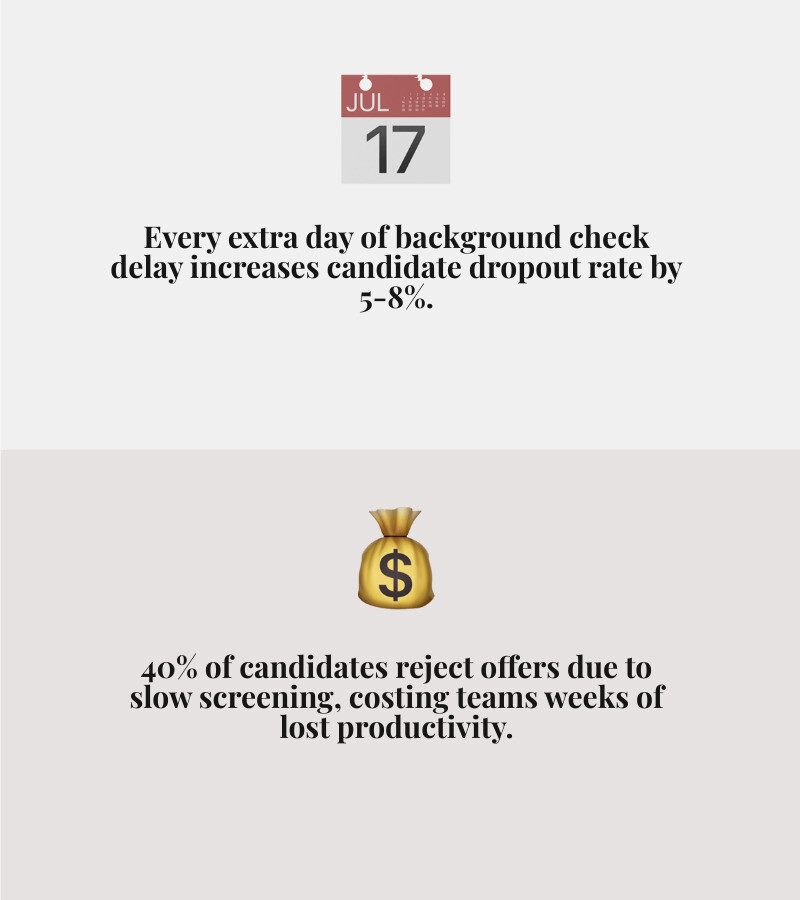
| Every extra day of delay | 5-8% increase in candidate dropout rate |
| 40% of candidates reject your offer | Because a competitor moved faster |
| 42% of candidates who had a bad experience | Will never apply to that company again |
| Industry standard turnaround | 3 days |
The Operational Reality of Screening Delays
When you analyze the background check impact on time to hire, you are looking at candidate psychology. The industry standard for turnaround is approximately three days, yet many organizations struggle with legacy processes that stretch into 10 business days.
Research indicates that by day six of a delay, roughly 30-40% of candidates are actively considering competing offers. Every day of delay adds a 5-8% probability of dropout. In a tight labor market, if a competitor finishes screening in 48 hours and your process takes a week, you will lose top-tier talent. Furthermore, using caution when conducting background checks is vital, as rushing without a structured process can lead to legal pitfalls. Understanding how long a background check takes is the first step in setting realistic internal benchmarks.
The FCRA Workflow: From Disclosure to Final Decision
The Fair Credit Reporting Act (FCRA) dictates a specific rhythm. Adhering to this workflow prevents hiring ghosting and legal disputes.
- Step 1: Disclosure & Authorization
- Step 2: The Investigation
- Step 3: Pre-Adverse Action
- Step 4: The Waiting Period (typically 5 business days)
- Step 5: Final Adverse Action
Common Mistakes: Why Your Timeline is Lagging
Many organizations suffer from self-inflicted delays. Recognizing these errors is the first step toward optimization:
- Manual Data Entry: Asking staff to re-type candidate info invites typos and adds days to the process.
- Fragmented Systems: If screening does not talk to your ATS, your team wastes hours on administrative tasks.
- Over-Screening: Running credit checks on roles where they are not required increases costs and adds days to the clock. The cost of a bad hire is high, but the cost of a lost hire due to over-screening is often higher.
- Incomplete History: Failing to ask for aliases upfront leads to hits that require manual follow-up later.
Good vs. Bad: Legacy vs. Automated Screening
| Feature | Legacy Manual Provider | Automated API Platform |
|---|---|---|
| Data Retrieval | Manual courthouse visits; paper-based | Direct API integrations; 90% same-day criminal results |
| Visibility | Limited updates; manual follow-up | Real-time dashboard with status per search |
| Candidate Experience | PDF forms; email-only | Mobile-friendly; SMS-enabled; self-serve |
| Workflow | One-size-fits-all | No-code customization; role-based tiers |
| Integration | Fragmented; manual entry | Centralized tracking within your ATS |
By moving toward automated screening, you replace manual bottlenecks with digital speed.
Stage-by-Stage: Optimizing the Hiring Process
To hire faster, you must optimize every stage of the lifecycle:
- Sourcing & Sift: Use resume parsing to ensure you have clean data from the start.
- Conditional Offer: The moment the offer is accepted, the background check should auto-initiate.
- Screening Initiation: Use digital identity verification to pre-populate candidate data, reducing errors.
- Near Real-Time Monitoring: Use platforms that show results as they come in rather than waiting for a final report.
- Onboarding: Transition the candidate into document collection while the final pieces of the background check finalize.
Conclusion: Modernizing Your Screening Strategy
The background check impact on time to hire can be managed effectively by shifting from legacy, manual processes to automated platforms. Solutions like VettyVerify, VettyOnboard, and VettyComply provide the real-time visibility and mobile-friendly experience modern candidates expect. As seen in the case study on how Paramount Staffing sped up placements, moving to a technology-first approach can reduce onboarding time by as much as 67%. If you are ready to eliminate bottlenecks and secure top talent before your competitors do, start your journey with us today at https://www.vetty.co/start.