
Why AI Recruiting Software Is Redefining Talent Acquisition in 2026

AI recruiting software is any platform that uses artificial intelligence to automate, accelerate, or improve one or more stages of the hiring process — from sourcing and screening to scheduling and interviewing.
Here's a quick snapshot of what you need to know:
- What it does: Automates sourcing, candidate matching, screening, scheduling, and outreach across the hiring funnel
- Who it's for: Talent acquisition teams at companies of all sizes, from lean SMB recruiting teams to global enterprise TA operations
- Key outcomes: Faster time-to-fill, larger talent pools, reduced manual work, and more consistent candidate evaluation
- Top capabilities to look for: Agentic AI automation, talent intelligence, ATS/CRM integrations, skills-based matching, and responsible AI frameworks
- 2026 trend: Agentic AI — autonomous recruiting agents that work alongside human teams 24/7 — is now the defining feature separating leading platforms from legacy tools
If your hiring process still relies on manual resume reviews, siloed sourcing tools, and back-and-forth scheduling emails, you're not just losing time — you're losing candidates.
The best talent moves fast. And in 2026, the organizations winning the talent war aren't necessarily those with the biggest recruiting budgets. They're the ones using AI to do more with less.
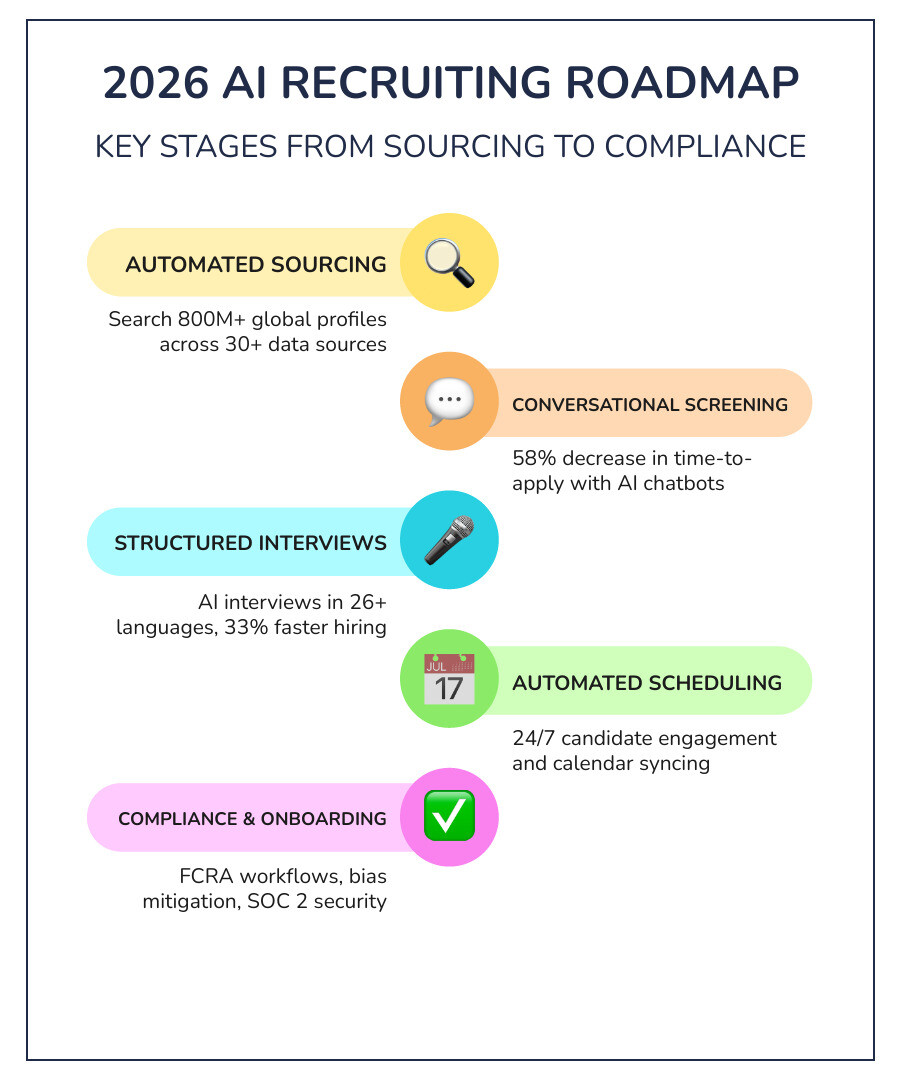
Modern AI recruiting platforms can search over 800 million global profiles, compress time-to-fill by up to 33%, and automate as much as 80% of the manual work that currently consumes your recruiters' days. That's not a future state — that's what the leading tools are delivering right now.
But not all AI recruiting software is built equally. Some platforms are genuine talent intelligence engines with years of training data behind them. Others are thin wrappers on third-party language models (what some in the industry call "fake AI") that looks impressive in a demo but falls short in production.
This guide cuts through the noise. You'll get a clear breakdown of what AI recruiting software actually does, which platforms are worth your attention, how to evaluate them fairly, and where compliance fits into the picture — because in 2026, responsible AI isn't optional.
The Strategic Impact of AI Recruiting Software
The shift toward AI-led recruiting isn't just about replacing a few spreadsheets; it's a fundamental restructuring of how talent is identified and secured. By 2026, the integration of AI recruiting solutions has moved from a "nice-to-have" feature to the backbone of high-performing talent acquisition (TA) departments.
The numbers tell a compelling story. Organizations leveraging advanced AI are seeing a 33% reduction in time-to-fill and are successfully automating up to 80% of manual recruiter tasks . This efficiency doesn't just save money; it expands your talent pool by up to 100x. Instead of being limited by the number of resumes a human can manually scan in an afternoon, your team can now evaluate millions of profiles across dozens of data sources in seconds.
Stage-by-Stage Breakdown of the AI-Enhanced Hiring Process
To understand the impact, look at how the workflow changes when AI is native to the process:
| Hiring Stage | Traditional Workflow | AI-Native Workflow (2026) |
|---|---|---|
| Sourcing | Manual Boolean searches; limited to LinkedIn. | Access to 800M+ global profiles; 30+ data sources. |
| Screening | Keywords-based resume filtering (unreliable). | Conversational screening; 58% faster time-to-apply. |
| Interviewing | Constant back-and-forth scheduling emails. | Automated scheduling & 24/7 AI-led initial interviews. |
| Evaluation | Subjective "gut feelings" and bias. | Structured AI scoring across 26+ languages. |
By automating the "top of the funnel," your recruiters can focus on what they do best: building human connections and closing top-tier candidates. Platforms now offer 24/7 candidate engagement, ensuring that an applicant who applies at 2:00 AM on a Sunday receives an instant response, a screening chat, and an interview invitation before your team even opens their laptops on Monday.
Compliance Checklist and the FCRA Workflow
As an HR leader, you know that speed means nothing without safety. In 2026, compliance matters more than ever , and the regulatory landscape has evolved to keep pace with AI.
When implementing AI recruiting software, your Compliance Checklist must include:
- Disclosure Requirements: Ensuring candidates are clearly informed that AI is being used in the evaluation process.
- Candidate Authorization: Obtaining digital consent before any background or data processing occurs.
- Adverse Action Process: Maintaining a clear, defensible path for candidates who are not selected, ensuring they have an opportunity to dispute inaccuracies.
- Explainability: Can the AI explain why a candidate was scored a certain way? This is critical for mitigating bias and staying compliant with local laws like NYC Local Law 144.
The FCRA Workflow remains the gold standard for US-based hiring. Even with AI, you must follow the three-step dance: Pre-Adverse Action, waiting a reasonable period, and then Final Adverse Action. Modern tools automate the notification of these stages while ensuring your organization stays within the protective bounds of PBSA accreditation and SOC 2 Type 2 certification.
Core Features of Modern AI Recruiting Software
The most advanced platforms in 2026 are built on Talent Intelligence . This isn't just a fancy term for a database; it’s an engine powered by over 1.6 billion career trajectories and 1.6 million skills. This massive scale allows the software to look beyond a job title and identify "skill evidence" in a resume.
Key features to prioritize include:
- Predictive Matching: Using 50+ variables to score candidates based on their potential to succeed, not just their past experience.
- Agentic Talent Operating Systems: These are autonomous agents that can manage entire sub-processes, like rediscovering silver-medalist candidates in your existing CRM for new roles.
- Deep Integrations: Your AI tool shouldn't be another island. Look for software that integrates with 130+ systems, including major ATS/CRM platforms like Workday, Greenhouse, or Oracle.
- Real-Time Analytics: Moving away from static reports to conversational analytics where you can ask, "Show me our DEI pipeline bottlenecks in the Austin office," and get an instant visual answer.
Scientific research on AI recruiters suggests that when these features are combined, the "human-in-the-loop" model thrives, allowing recruiters to act as strategic advisors rather than data entry clerks.
Implementing AI Recruiting Software: Best Practices and Pitfalls
Successful implementation of AI recruiting software requires more than just a signed contract. It requires a cultural shift within the TA team. When choosing the best pre-employment screening software , you must account for implementation timelines that include data migration and user training.
For SMBs, the focus is often on speed and ease of setup—getting a tool running in 60 seconds to manage a sudden hiring surge. For enterprise leaders, the focus shifts to scalability and how the AI handles complex, multi-departmental workflows without creating new bottlenecks.
Common Mistakes in AI Recruiting Software Adoption
Even with the best intentions, many TA leaders fall into these common pitfalls:
- The "Frankenstack": This happens when you buy five different "best-of-breed" tools that don't talk to each other. You end up with fragmented data and what we call the "copy-paste tax"—where recruiters spend hours moving candidate info from a sourcing tool to an ATS.
- "Fake AI" Wrappers: Be wary of tools that are simply a UI layer on top of a generic LLM. These lack the 10+ years of aggregated talent data required for accurate, fair matching.
- Ignoring the Post-Hire Phase: Recruitment doesn't end at the offer letter. A common mistake is failing to integrate recruiting AI with onboarding or continuous monitoring systems.
- Neglecting Human Oversight: AI should suggest, but humans should decide. Removing the human element entirely can lead to "algorithmic bias" and a cold, robotic candidate experience.
Good vs. Bad: Evaluating AI Tool Integrity
How do you tell if a tool is built for the long haul? Use this comparison:
| Good AI Tool Integrity | Bad AI Tool Integrity |
|---|---|
| Transparency: Explains matching scores with clear signals. | Black Box: Provides a score with no reasoning. |
| Mobile-Friendly: Candidates can apply and interview via phone. | Desktop-Only: Clunky forms that cause candidate drop-off. |
| Native Workflows: Sourcing, CRM, and Screening in one dashboard. | Fragmented: Requires 10+ browser tabs to make one hire. |
| High Accuracy: 99% accuracy in resume parsing and ID verification. | Error-Prone: Frequently misses key candidate data or aliases. |
The best tools offer no-code customization, allowing you to tailor the AI's "voice" to match your employer brand without needing an engineering degree.
Conclusion: Scaling Your Workforce with Vetty
As we look toward the future of the workforce, the goal is to build a hiring engine that is both fast and fair. You need a partner that understands the nuances of the current hiring landscape—from the initial AI-driven search to the final compliance check.
Vetty provides a unified, mobile-friendly platform that accelerates every stage of the journey. By utilizing VettyVerify, VettyOnboard, and VettyComply, teams can manage background checks and onboarding while ensuring workforce safety through continuous monitoring.
Our PBSA-accredited and SOC 2 certified platform is built to scale with you, offering real-time visibility from a single dashboard. Whether you are a high-growth tech startup or a large-scale healthcare provider, we help you remove the friction from hiring so you can focus on your people.
Achieve faster placements and greater efficiency with Vetty by visiting https://www.vetty.co/start.