

Navigating Immigration Compliance for Healthcare Employers in 2026

As the U.S. healthcare system continues to rely on international talent to fill critical gaps, the regulatory landscape has become increasingly complex. In 2026, healthcare administrators must balance the urgent need for clinicians with stringent Department of Homeland Security (DHS) and Department of Labor (DOL) requirements. The rescission of the "sensitive locations" policy in 2025 means that healthcare facilities are no longer shielded from worksite enforcement, making proactive adherence to federal law a core operational requirement.
Compliance Checklist
To ensure your organization remains protected, use this checklist to manage core obligations:
- I-9 and E-Verify - Complete Form I-9 for every hire; reverify expiring work authorizations before they lapse.
- H-1B Sponsorship - Maintain Public Access Files (PAF), pay prevailing wages, and file amended petitions for material job changes.
- J-1 Physician Waivers - Meet Conrad 30 service commitments or utilize federal IGA alternatives.
- PERM and Schedule A - Utilize labor certification for green cards, or skip it for nurses and physical therapists via Schedule A.
- ICE Worksite Enforcement - Train staff to verify warrant types and protect patient PHI during inspections.
- Record Retention - Retain I-9s for current employees indefinitely; for departed staff, retain for three years post-hire or one year post-termination.
The U.S. healthcare system runs on international talent. More than 25% of physicians practicing in the United States were born outside the country. Without a compliant program, your ability to staff critical roles is directly at risk. The Department of Homeland Security has accelerated I-9 audit activity and introduced a $100,000 supplemental fee for new cap-subject H-1B petitions filed for beneficiaries outside the U.S., effective September 21, 2025.
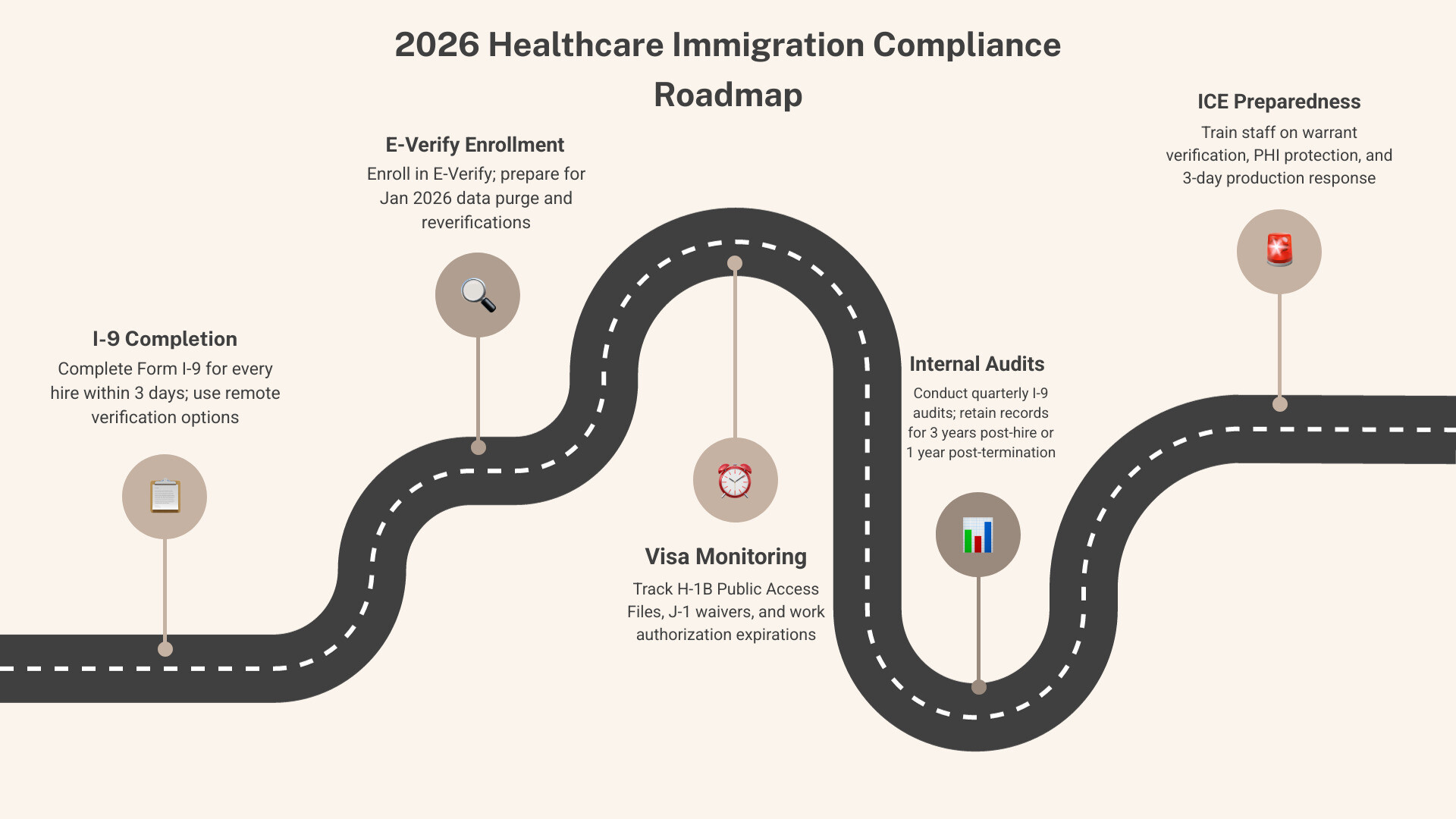
Core Pillars of Immigration Compliance for Healthcare Employers
To maintain a stable workforce in 2026, your organization must move beyond reactive paperwork. Check out Healthcare Immigration Compliance Checklist: 2026 Guide for Employers to evaluate your current standing.
Common Mistakes in Healthcare Immigration Compliance
The I-9 process is the most frequent source of liability for healthcare HR teams. Common errors include:
- Missing Signatures: Accounts for 12% of technical violations.
- Over-documentation: Requesting specific documents (e.g., "show me your Green Card") rather than allowing the employee to choose from Lists A, B, and C. This is a discriminatory practice.
- Delayed Completion: Section 1 must be finished by Day 1; Section 2 must be finished by Day 3.
- Improper Reverification: Failing to use Supplement B to update expiring work permits.
FCRA Workflow and Stage-by-Stage Hiring Breakdown
Integrating immigration verification into your standard hiring process ensures consistency and reduces the risk of fines, which in 2026 range from $288 to $2,861 per paperwork error.
- Stage 1: Offer Acceptance: Send the I-9 and background check authorization via a mobile-friendly platform like Vetty.
- Stage 2: Section 1 (Day 1): The employee completes the attestation of work authorization.
- Stage 3: Section 2 (Day 3): The employer examines original documents. For remote hires, use the "Alternative Procedure" if you are an E-Verify participant in good standing.
- Stage 4: E-Verify Submission: Submit the case within three days. Proactively generate a "Status Change Report" weekly, as E-Verify has discontinued automatic email alerts.
- Stage 5: Continuous Monitoring: Use VettyComply™ to track expiration dates and trigger Supplement B re-verification 90 days before a permit lapses.
For a deeper dive into streamlining these tasks, see our guide on mastering the I-9 and e-verify process without losing your mind.
Managing H-1B and J-1 Visa Sponsorship Obligations
Healthcare employers often rely on H-1B visas for specialty roles. The Ten Immigration Compliance Tips for Health Care Providers and Businesses emphasize that sponsorship comes with strict Department of Labor (DOL) oversight.
- Public Access Files: These must contain the LCA, proof of prevailing wage, and the "actual wage" memorandum.
- FDNS Site Visits: Officers may arrive unannounced to verify that the H-1B worker is performing the duties listed in the petition.
- The Green Card Shortcut: Nurses and physical therapists are classified under "Schedule A, Group I," allowing you to skip the 16–17 month PERM analyst review. For other roles, follow the healthcare background checks a complete guide to requirements compliance and best practices to ensure data matches DOL audit requirements.
Strategic Worksite Enforcement and Audit Readiness
With the 2025 rescission of the "sensitive locations" policy, healthcare administrators must treat ICE readiness as a standard part of operations. According to Tips for Healthcare Providers on Potential ICE Visits , the goal is to remain cooperative while asserting legal rights.
Good vs. Bad: Audit Readiness Comparison
| Feature | Good Practice (Compliant) | Bad Practice (Non-Compliant) |
|---|---|---|
| I-9 Storage | Stored separately from personnel files | Mixed with general HR folders |
| Warrant Response | Verify if warrant is Judicial or Administrative | Allowing entry to private areas without a judge's signature |
| Audit Response | Utilize the 3-day legal window to produce I-9s | Handing over documents immediately without review |
| Monitoring | Automated alerts for visa expirations | Manual spreadsheets with 25% error rates |
Responding to ICE Visits and Warrant Verification
Your staff must be trained to distinguish between a warrant that grants entry and one that does not.
| Feature | Judicial Warrant | Administrative Warrant (I-200/I-205) |
|---|---|---|
| Signed By | A federal judge or magistrate | An ICE official |
| Grants Entry to Private Areas? | Yes | No |
| Requirement for Compliance | Mandatory | Voluntary (absent consent) |
Maintaining a clean record through healthcare sanctions monitoring ensures that your staff is authorized to work and clear of OIG/SAM exclusions. Using Vetty's indispensable role powering healthcare staffing hiring and compliance excellence allows you to collect signatures and documents securely, increasing data accuracy.
Conclusion: Future-Proofing Your Healthcare Workforce
In 2026, immigration compliance is a strategic necessity that impacts your ability to provide care. Between rising I-9 penalties and the loss of sensitive location protections, the margin for error has disappeared.
Tools like VettyOnboard™ can help automate I-9 collection and E-Verify submissions, while VettyComply™ and VettyVerify™ provide the continuous monitoring needed to ensure your facility remains compliant with both immigration and healthcare regulations in real-time. By streamlining these processes, healthcare organizations can focus on their primary mission: patient care. To learn more about managing a multinational workforce, visit https://www.vetty.co/start to schedule a consultation.