

Why Employment Verification is the Foundation of Smart Hiring

How to verify employment history hiring is one of the most practical questions in talent acquisition — and the answer directly affects your retention, risk exposure, and bottom line.
Here's the short version:
Quick Answer: How to Verify Employment History When Hiring
- Obtain written consent from the candidate before running any checks (required under FCRA).
- Contact previous employers directly via phone or email to confirm dates, titles, and eligibility for rehire.
- Use a database service like The Work Number (813 million+ employee records) for instant, 24/7 access.
- Partner with a Consumer Reporting Agency (CRA) for automated, compliant, end-to-end verification.
- Complete Form I-9 and E-Verify to confirm employment eligibility separately from history checks.
- Review results against the candidate's resume and follow the adverse action process if discrepancies affect your hiring decision.
More than three-quarters of companies globally find discrepancies in candidate backgrounds — and employment history is the most common area where details get fudged. For every five candidates you screen, there's roughly a 13% chance you'll find something that doesn't line up.
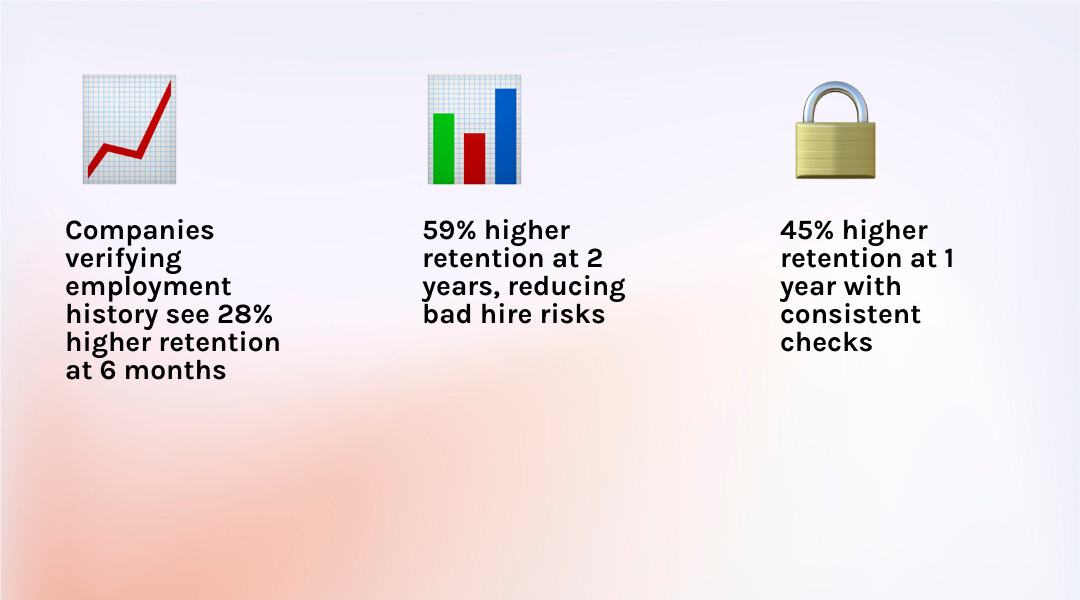
That's not a small risk. The average cost of a bad hire can exceed $17,000 in recruitment fees, wasted salary, and lost productivity. And the upside of getting it right is significant: employers who verify employment history consistently see 28% higher retention at six months, 45% at one year, and 59% at two years.
The challenge isn't knowing why verification matters. It's building a process that's fast enough to keep candidates engaged, thorough enough to catch real issues, and compliant enough to protect your organization.
That's what this guide covers.
Your Compliance Checklist Before You Start
Before any verification begins, make sure you have these four foundations in place:
- Fair Credit Reporting Act (FCRA) Disclosure — Provide a standalone written notice to the candidate that a background check will be conducted.
- Candidate Authorization — Obtain signed written consent before initiating any employment history check.
- I-9 / E-Verify — Complete Form I-9 for all new hires; use E-Verify if required by your state or contract.
- Adverse Action Policy — Have a documented process ready if verification results affect a hiring decision.
How to verify employment history hiring helpful reading:
How to Verify Employment History Hiring: A Strategic Workflow
To build a "bulletproof" hiring process in 2026, you need to move beyond the traditional "hope and pray" method of resume review. Resumes are marketing documents, not legal affidavits. When you understand how to verify employment history hiring, you transition from taking a candidate's word to making decisions based on verified data.
The global employment screening market reached approximately $4.73 billion in 2024, with the employment verification segment projected to hit $3.14 billion by 2031. This growth is driven by a simple reality: the cost of a bad hire—estimated at 50% to 200% of an annual salary—is far higher than the cost of a comprehensive screen.
The FCRA Workflow
When conducting employment verifications through a third party, you must follow the FCRA guidelines. This isn't just a suggestion; it's a federal requirement.
- Disclosure: You must inform the candidate in a clear, standalone document that you intend to run a background check.
- Authorization: You must get their signature (digital or physical) before you start.
- Verification: The check is performed via database access or direct employer contact.
- Pre-Adverse Action: If the results show a discrepancy that might lead you to rescind an offer, you must send the candidate a copy of the report and a summary of their rights.
- Wait Period: Give the candidate a reasonable amount of time (typically 5 business days) to dispute inaccuracies.
- Final Adverse Action: If you still decide not to hire, send a final notice.
Using a verified employment history allows you to bypass the "job stretching" and omitted tenures that plague 13% of all applications. With access to databases containing over 813 million records, modern HR leaders can confirm data in minutes rather than weeks.
Step-by-Step: How to Verify Employment History Hiring for Compliance
Navigating the legal landscape requires a structured approach to both history and eligibility.
- Step 1: Consent first. Never call a former employer or run a database check without that signed FCRA authorization.
- Step 2: Differentiate between history and eligibility. Employment history verification confirms where they worked and for how long. Employment eligibility (Form I-9 and E-Verify) confirms they are legally allowed to work in the U.S.
- Step 3: Section 2 of Form I-9. You must physically examine (or use an authorized representative for) the candidate's identity and work authorization documents within three days of their start date.
- Step 4: E-Verify integration. For many employers, especially federal contractors, E-Verify is mandatory. It compares I-9 data against DHS and SSA records to prevent identity fraud.
For a deeper dive into these requirements, see our guide on mastering the I-9 and E-Verify process without losing your mind.
Manual vs. Automated: How to Verify Employment History Hiring Efficiently
The biggest threat to your 2026 hiring cycle is "time to hire." In a competitive market, top talent won't wait.
The Manual Trap: Manual verification involves an HR coordinator tracking down the correct contact at a former company, leaving voicemails, and waiting for an email back.
- Timeline: 2 to 4 weeks.
- Risk: 94% of HR leaders report losing candidates due to delays in manual verification.
- Accuracy: Limited by the memory of the person answering the phone or the willingness of a former manager to speak.
The Automated Advantage: Automated systems use direct integrations with payroll providers and massive databases like The Work Number.
- Timeline: 1 to 3 days (often instant).
- Risk: Minimal. Candidates stay engaged because the process is invisible and fast.
- Accuracy: 99.9% accuracy based on actual payroll records, not subjective conversations.
Learn more about how automated employment verification saves your time and sanity.
Identifying Red Flags and Discrepancies
When you receive a verification report, you aren't just looking for a "pass" or "fail." You are looking for patterns of behavior.
- Job Stretching: A candidate claims they were a "Senior Manager" when records show they were an "Associate." This is a major red flag regarding integrity.
- Omitted Tenures: Did the candidate leave out a three-month stint? Often, candidates hide short tenures to mask a "job hopping" pattern or a termination.
- Inconsistent Storytelling: If the dates on the resume don't match the database, and the candidate gives a different set of dates during the interview, you have a reliability issue.
- Rehire Eligibility: While many companies have a "neutral reference" policy (only confirming dates and titles), some will still disclose if a candidate is "eligible for rehire." A "No" here is a significant signal for further investigation.
If you find an error, don't panic. Sometimes databases have old info. Refer to our guide on 5 common verification mistakes and how to fix them to handle these situations professionally.
Optimizing Your Verification Strategy for 2026
As we move through 2026, the complexity of hiring continues to increase. Remote work and global talent pools mean you are often verifying history across state lines or even international borders.
Common Mistakes and Legal Pitfalls
Even the most well-intentioned HR teams can run into legal trouble if they aren't careful with their verification protocols.
- Ignoring Salary History Bans: Many states now prohibit employers from asking about past compensation. If you request pay stubs to verify employment, ensure the candidate redacts salary information to stay compliant.
- Social Media Screening: Scrolling through a candidate's LinkedIn or Facebook to "verify" their history is risky. You may inadvertently see protected class information (religion, age, disability) that could lead to a discrimination claim if you don't hire them.
- Failing the Adverse Action Process: If a discrepancy in the employment history is the reason you aren't hiring someone, you must follow the two-step adverse action notice process. Skipping this is one of the easiest ways to get hit with an FCRA lawsuit.
- International Blind Spots: Verifying a candidate who worked in Bogotá or Berlin requires different documentation and consent forms. International verifications can cover 223 countries but require a partner who understands local data privacy laws.
For more practical tips, check out our employment verification guide for 2026.
Good vs. Bad: Comparing Verification Methods
| Feature | Manual Outreach (DIY) | Database Services (The Work Number) | AI-Powered CRAs (Vetty) |
|---|---|---|---|
| Speed | 2-4 Weeks | Instant to 24 Hours | 1-3 Days (Integrated) |
| Accuracy | Variable (Human Error) | High (Payroll Records) | High (Multi-Source) |
| Compliance | Hard to Track | High | Automated & SOC 2 Certified |
| Candidate Exp. | Poor (Long Delays) | Neutral | Excellent (Mobile-Friendly) |
| Cost-Benefit | Low (High Labor Cost) | Moderate (Per-Click Fees) | High (All-in-One Value) |
Scaling with Professional Screening Services
At Vetty, we understand that you aren't just looking for a background check; you're looking for a partner to help you scale safely. Our platform is built for the modern HR leader who needs to move fast without cutting corners.
- VettyVerify™: Fast, compliant background checks that you can deploy in just two clicks. We handle the heavy lifting of contacting employers and searching databases so you can focus on the human side of hiring.
- VettyOnboard™: Once the history is verified, our mobile-friendly onboarding tools help you collect documents, e-signatures, and I-9s in a single, seamless workflow.
- VettyComply™: We don't stop at the hire. Our continuous monitoring keeps you informed of post-hire changes in criminal records or healthcare sanctions.
We are PBSA-accredited and SOC 2 Type 2 certified, ensuring your candidate data is handled with the highest security standards. Whether you are a tech firm like Paramount or a staffing agency managing thousands of gig workers like Wag! , our no-code customization allows you to build the exact workflow you need.
Stop chasing down HR managers and start making data-driven hires. We invite you to experience a faster, more compliant way to scale your team by starting your journey at https://www.vetty.co/start.