

Why Education Staffing Criminal Checks Are Non-Negotiable in 2026
Education staffing criminal checks are background screening processes required for teachers, administrators, support staff, contractors, and volunteers working in K-12 schools, colleges, and other educational settings — designed to protect students from individuals with disqualifying criminal histories.
Here's what you need to know at a glance:
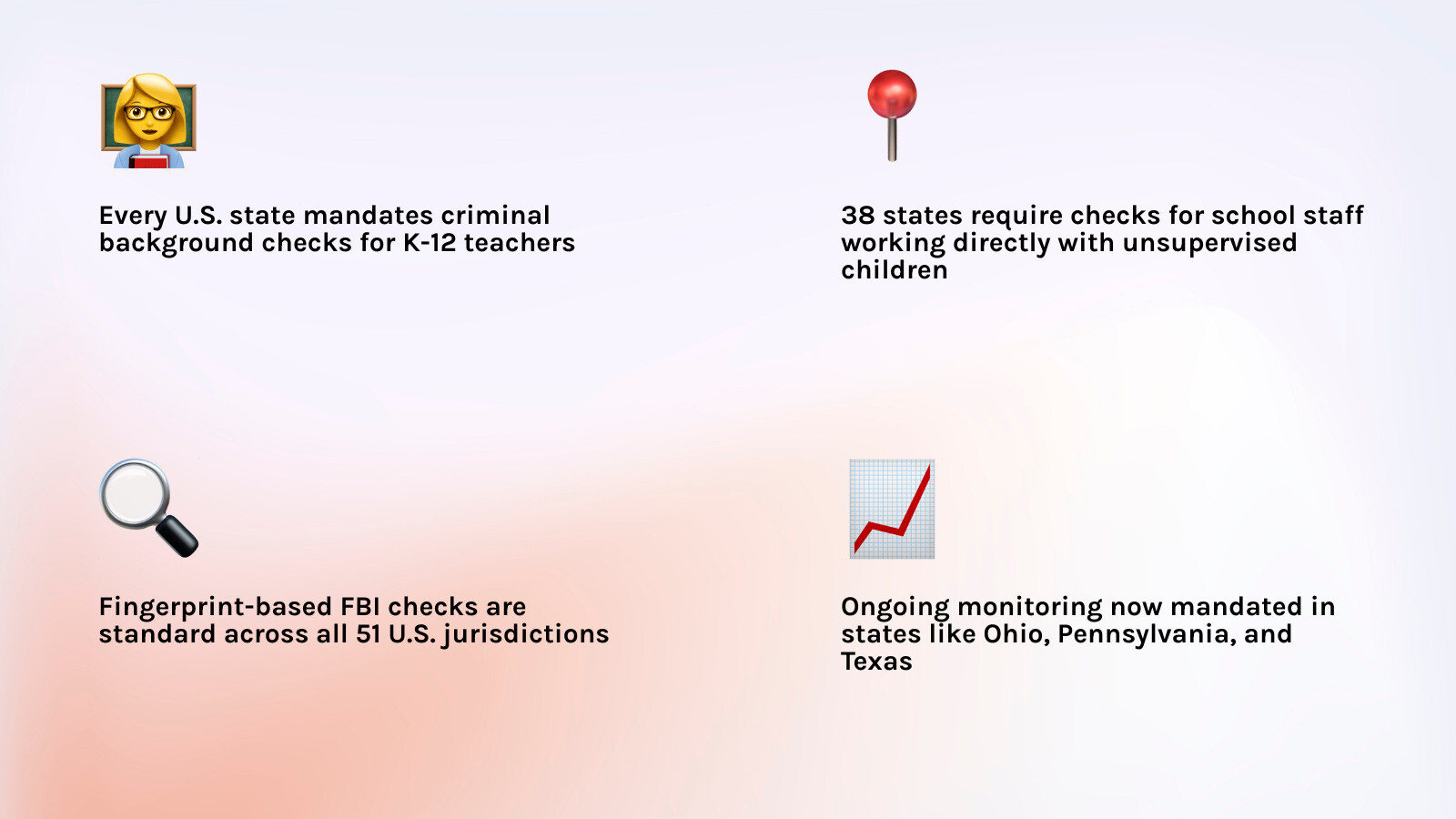
- Every U.S. state mandates criminal background checks for K-12 teachers
- 38 states require equivalent checks for school staff who work directly with unsupervised children
- Fingerprint-based FBI checks are standard across all 51 U.S. jurisdictions
- Sex offender registry searches, child abuse clearances, and license verifications are required components in most states
- Ongoing monitoring (not just one-time pre-hire checks) is now mandated or strongly recommended in states like Ohio, Pennsylvania, and Texas
- Volunteers and contractors are often subject to the same requirements as paid staff in direct student contact roles
- Turnaround times average 48-72 hours for most components with electronic fingerprinting; paper-based processes can take 4-6 weeks
Schools carry a unique duty of care. Most employers are responsible for maintaining a safe workplace, but educational institutions are responsible for the safety of other people's children. That distinction shapes everything about how screening in this sector works.
The stakes are real. Research from SESAME estimates that approximately 7% of students in the 8th through 11th grade age range report having experienced sexual contact with an adult — equating to roughly 3.5 million students nationally, with teachers and coaches among the most commonly identified perpetrators. Meanwhile, more than 360,000 school bus drivers transport millions of children across the country every single school day.
One hiring gap — a missed registry check, an expired clearance, an unscreened contractor — can have consequences that no school district, charter, or university wants to face.
The compliance landscape has also grown significantly more complex. State laws vary widely in their fingerprinting requirements, lookback periods, rescreening timelines, and which roles trigger mandatory checks. Federal law adds another layer through the Fair Credit Reporting Act (FCRA). And newer continuous monitoring programs — like Ohio's Rapback system, now expanded to non-licensed staff — mean that pre-hire screening alone is no longer enough in many jurisdictions.
This guide gives you a clear, practical framework for building and maintaining a compliant education staffing screening program in 2026 — across every role, every state requirement, and every stage of the hiring process.
Navigating Education Staffing Criminal Checks: A Compliance Framework
As an HR leader, you understand that a background check in education is not a mere formality; it is a strategic safeguard. Every hiring decision you make either reinforces or erodes the trust the community places in your institution. With 38 states now enforcing strict mandates for any staff member working directly with unsupervised children, the "safety net" must be cast wide.
In higher education, the trend is catching up. Roughly two-thirds of all colleges across the country now perform criminal background checks on at least a portion of their student applicants, and faculty screening has become standard to protect institutional reputation. Whether you are managing a K-12 district or a university campus, your framework must be PBSA-accredited and SOC 2 Type 2 certified to ensure the highest data security and accuracy standards.
The 2026 Education Staffing Criminal Checks Checklist
To maintain a high-integrity environment, your screening protocol should include these essential layers:
- Fingerprint-Based FBI Checks: Queries the national Interstate Identification Index for records across all 50 states and federal agencies.
- State-Level Criminal History: Direct queries to state repositories (like the Texas DPS or Ohio BCI) for local offenses.
- Sex Offender Registry (SOR): Mandatory searches of both state and national registries.
- Child Abuse Clearances: Verification through state-specific child protective services or "Child Abuse History" databases.
- Professional License Verification: Confirming teaching certificates, nursing licenses, or counseling credentials are active and in good standing.
- Education & Employment History: Verifying degrees and past performance to identify non-criminal red flags or misrepresented qualifications.
- Motor Vehicle Records (MVR): Essential for the 360,000+ bus drivers and any staff or volunteers transporting students.
- Drug Testing: Often required by state law (e.g., Georgia) for all department of education hires.
For a deeper dive into the administrative side of these requirements, see our School Employee Screening A Guide For HR And Administrative Leaders.
Role-Specific Screening: From K-12 to Higher Ed
One of the most common mistakes is applying a "one size fits all" approach. Different roles carry different levels of risk and access.
- K-12 Teachers & Administrators: These roles require the most exhaustive screening, including lifetime lookbacks for violent felonies and sex offenses.
- College Faculty: While often more relaxed than K-12 due to the adult student population, the focus here is heavily on credential verification and criminal history to protect the school's academic credibility.
- Support Staff (Custodians, Cafeteria, Grounds): These individuals often have unsupervised access to school buildings. 38 states now mandate they undergo the same criminal checks as licensed teachers.
- Bus Drivers: Beyond criminal checks, these roles require rigorous MVR monitoring and frequent drug testing.
- Volunteers & Youth Coaches: Often overlooked, these individuals frequently interact closely with children. Many states now require them to have clearances comparable to paid staff. Review the Volunteer Teacher Background Screening Requirements to close this common security gap.
Managing the FCRA Workflow and Adverse Action
When you use a third-party screening provider, you must adhere to the Fair Credit Reporting Act (FCRA). This federal law protects candidates and dictates a specific workflow you must follow if a check reveals disqualifying information.
The FCRA Workflow:
- Disclosure & Authorization: You must provide a standalone written disclosure to the candidate and obtain their written consent before running any check.
- Summary of Rights: Provide the candidate with a copy of "A Summary of Your Rights Under the Fair Credit Reporting Act."
- Pre-Adverse Action Notice: If you intend to disqualify a candidate based on the report, you must send this notice along with a copy of the report. This opens a 60-day dispute window for the candidate to contest inaccuracies.
- Final Adverse Action: If the candidate does not dispute the findings or cannot resolve the discrepancy, you issue the final notice.
For positions with an annual salary of less than $75,000, the FCRA generally limits the reporting of certain non-conviction information (like arrests without a conviction) to a seven-year window. For a detailed breakdown of what appears on these reports, read our What Shows Up On A Criminal Background Check write up.
State-Specific Mandates and Education Staffing Criminal Checks
Navigating the patchwork of state laws is the greatest challenge for education HR teams.
- Texas: The Texas Education Agency manages a mandatory Do Not Hire Registry . You are legally prohibited from hiring anyone on this list. Texas also offers a Preliminary Criminal History Evaluation (PCHE) for prospective educators to check their eligibility before they even enter a certification program.
- Ohio: The Rapback system provides continuous criminal monitoring. If a licensed teacher or an enrolled non-licensed staff member is arrested anywhere in the state, the State Board is notified immediately. By 2026, this system has expanded to include bus drivers and contractors.
- Florida: The Jessica Lunsford Act remains the gold standard for contractor screening, requiring strict background checks for any vendor providing non-instructional services on school grounds.
- Pennsylvania: Under Act 168 , school entities must conduct an extensive employment history review to uncover any past allegations of misconduct or "passing the trash" (where problem employees are allowed to resign and move to new districts). Pennsylvania also requires all background checks to be renewed every 60 months.
- Idaho: The Background Investigation Check (BIC) is mandatory for all unsupervised student contact. While the BIC is valid for six months for new hires, student teacher checks can remain valid for up to three years for certification purposes.
- Oklahoma: Effective 2026, Oklahoma has streamlined live-scan procedures through approved vendors, with specific service codes required for district employment versus teacher certification.
For more on why the "snapshot in time" approach is failing, read Continuous Criminal Monitoring Vs One Time Background Checks What Hr Leaders Need To Know.
Common Mistakes in Education Background Screening
Even experienced HR directors can fall into these traps:
- Ignoring Non-Licensed Staff: Thinking only teachers need checks is a major liability. Custodians and cafeteria workers often have more unsupervised access to students than classroom teachers.
- Overlooking Volunteers: Parent volunteers and "volunteer" coaches often have high-trust relationships with students. They must be screened.
- Conditional Employment Risks: While some states allow "conditional" hiring for 30-90 days while waiting for FBI results, this requires a strict, documented supervision plan. Hiring someone before their results are in without such a plan is a massive risk.
- Interstate Mobility Gaps: Just because a teacher was fingerprinted in Illinois doesn't mean those results transfer to Ohio. Most states require a fresh set of prints to query their own state repository.
- Manual Data Entry Errors: Typing names or SSNs manually leads to "no-hit" results for people who actually have records.
To learn how to move toward a more proactive model, see our guide on Criminal Monitoring In Hiring.
Good vs. Bad: Evaluating Your Screening Provider
Not all background check platforms are built for the complexities of education. Use this table to evaluate your current process:
| Feature | Legacy/Manual Processing | Modern Automated Platform |
|---|---|---|
| Turnaround Time | 4-6 weeks (paper cards) | 48-72 hours (electronic) |
| User Experience | Desktop-only, clunky forms | Mobile-friendly, candidate-centric |
| Visibility | Black box; "call for status" | Real-time dashboard visibility |
| Compliance | Manual adverse action letters | Automated FCRA workflows |
| Monitoring | One-time check at hire | Continuous criminal monitoring |
| Configuration | Static packages | No-code customization by role |
Optimizing Your Screening Strategy for 2026
In 2026, your screening strategy must be as dynamic as the workforce you manage. Moving beyond the "one-and-done" background check is the only way to ensure long-term student safety.
By integrating VettyVerify™ for rapid, compliant pre-hire checks and VettyComply™ for continuous post-hire monitoring, you eliminate the "snapshot in time" risk. Our platform is designed to handle the specific needs of the Education sector, from K-12 districts to large university systems. With a mobile-friendly interface and self-serve setup, you can clear candidates faster without ever compromising on safety.
Ensure your institution remains compliant and your students remain safe by starting your streamlined screening process at https://www.vetty.co/start.