

Background Screening Compliance: Operational Requirements and Risk Mitigation
Compliance Checklist
- Obtain permissible purpose for every report.
- Provide a standalone written disclosure to the applicant.
- Secure written authorization before ordering any check.
- Certify compliance to your consumer reporting agency (CRA).
- Execute the two-step adverse action process for negative decisions.
- Apply consistent, non-discriminatory standards across all candidates.
- Retain and securely dispose of records according to federal law.
If you manage hiring at scale, background screening compliance is less about memorizing statutes and more about controlling sequence, documentation, and exceptions. Your process needs to work the same way across recruiters, locations, and hiring volumes, even when state timing rules or industry-specific checks add complexity. The fastest way to create risk is to let disclosures, authorizations, adjudication criteria, and adverse action notices live in separate systems with inconsistent owners.
Non-compliance with the Fair Credit Reporting Act (FCRA) carries statutory damages of $100 to $1,000 per violation. Beyond federal fines, class action settlements and EEOC discrimination claims create significant financial and reputational risk. With ban-the-box laws in more than 35 states and shifting PII access rules in Michigan and California, maintaining a defensible program requires a standardized, automated workflow.
For HR executives and operations leaders, a compliant program usually comes down to five operational controls:
- Standardized disclosure and authorization templates by jurisdiction.
- Role-based screening packages tied to business necessity.
- Human review before any disqualifying decision.
- Documented adverse action timelines.
- Retention and disposal rules enforced across systems.
This guide is built to help you pressure-test those controls. Use it to audit your current workflow, identify where manual handoffs create exposure, and tighten the parts of your process that are most likely to break under volume.
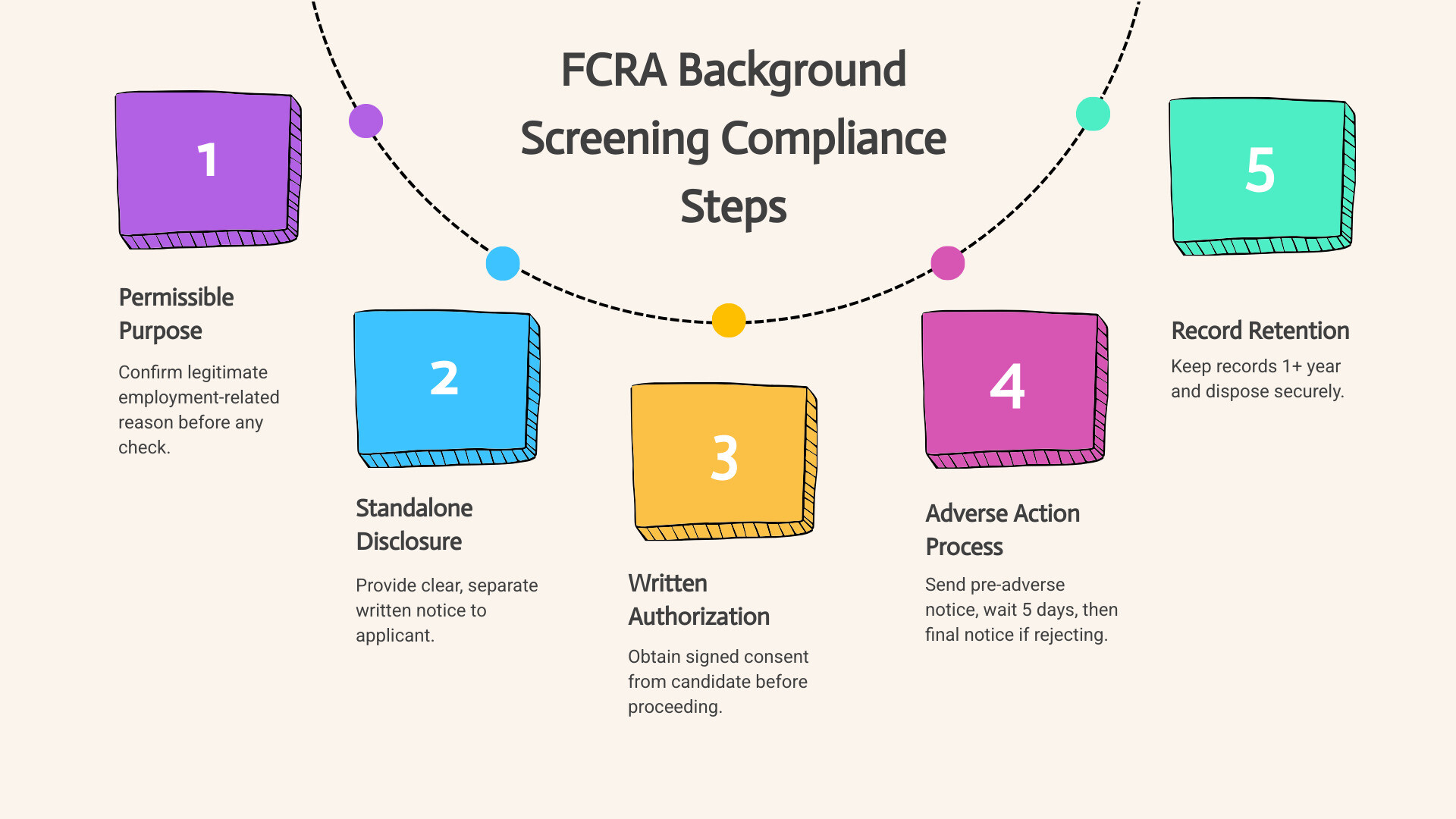
FCRA Workflow and Good vs. Bad Comparison Standards
Managing background screening requires a strict sequence of events to avoid litigation. Use the following comparison to audit your current disclosure process:
| Feature | Good (Compliant) | Bad (Non-Compliant) |
|---|---|---|
| Format | Standalone document | Embedded in the job application |
| Content | Only the notice of the background check | Includes liability waivers or fine print |
| Clarity | Clear and conspicuous language | Legalese or tiny font sizes |
| Authorization | Separate or clearly distinct signature | Bundled with other onboarding signatures |
FCRA Workflow
- The Disclosure : Provide a standalone document.
- Written Authorization : Obtain a clear, affirmative signature.
- Certification : Confirm compliance to your CRA.
- Review : Ensure human oversight to prevent accuracy errors, as noted in the guide on how AI is changing hiring and why compliance matters more than ever.
Stage-by-Stage Hiring Breakdown
- Requisition Setup : Define the screening package based on role and location.
- Disclosure and Consent : Deliver standalone forms before any report is ordered.
- Report Ordering : Submit only after authorization is captured and documented.
- Results Review : Compare findings against job-related criteria, not blanket rules.
- Pre-Adverse Action : Notify the individual and provide required documents if results are negative.
- Waiting Period : Pause final action for at least 5 business days to allow for disputes.
- Final Disposition : Send the final notice and retain records according to policy.
Common Mistakes
- Asking about criminal history on initial applications in ban-the-box jurisdictions.
- Failing to provide the Summary of Your Rights Under the FCRA.
- Relying on unverified database-only searches.
- Applying one adjudication matrix across roles with different duties.
- Failing to track whether notices were actually delivered and acknowledged.
Adverse Action: The Two-Step Process
If a report influences a negative decision, follow the mandatory two-step process. First, send a Pre-Adverse Action Notice along with a copy of the report and the FCRA Summary of Rights. After a waiting period (industry standard is 5 business days), send the Final Adverse Action Notice. Using VettyComply automates these notifications to ensure timeline adherence across all jurisdictions. Staying ahead of legislative shifts in fair chance laws is critical for maintaining a defensible program. For more detailed federal guidance, refer to the FTC guide for employers.
Industry-Specific Mandates and Long-Term Retention
Healthcare, transportation, and financial services require specialized screening layers. For healthcare, checking the OIG and SAM exclusion lists is mandatory to maintain Medicare/Medicaid reimbursement eligibility. Platforms like VettyVerify™ centralize these searches into a single, mobile-friendly workflow.
The operational takeaway is straightforward: your screening policy should not be one universal package. It should be a controlled set of role-based packages with documented reasons for each search type. That matters in regulated industries, but it also matters in high-volume environments like staffing, on-demand, and retail, where over-screening can create delay and under-screening can create risk.
Florida Healthcare Screening (2025 Update)
As of July 1, 2025, Florida healthcare practitioners must comply with updated background screening requirements for initial licensure and renewals.
- The Deadline: All screened professions must have fingerprints on file that are no older than five years.
- Fingerprint Retention: Practitioners can retain fingerprints in the Clearinghouse for a fee of $43.25. This window opens 75 days before license expiration.
- ORI Codes: Each profession has a specific Originating Agency Identifier code (e.g., EDOH2015Z for Medical Doctors) to ensure results reach the correct board.
For teams supporting healthcare hiring, these requirements create a coordination issue as much as a compliance issue. You need to know which roles require fingerprint-based screening, which ORI code applies, and when renewal timing affects start dates or continued placement. Missed details can delay licensure processing, interrupt placement, or create re-screening costs that could have been avoided with a standardized intake workflow.
For a deep dive into these rules, check out this complete guide to healthcare background check requirements and this healthcare screening overview.
Avoiding Disparate Impact
The EEOC prohibits blanket exclusion policies. Use an Individualized Assessment based on the Nature-Time-Nature test: the nature of the crime, the time elapsed, and the nature of the job. This is a critical component of FCRA rules and hiring restrictions and is vital when conducting healthcare sanctions monitoring.
In practice, that means your adjudication process should answer a simple question: is the specific record relevant to the responsibilities and risks of this role? A documented assessment helps your team avoid blanket exclusions, creates a clearer audit trail, and gives decision-makers a repeatable framework across locations and business units.
Record Retention and Disposal
Keep employment records for at least one year. When disposing of reports, follow the FCRA Disposal Rule by shredding paper or irretrievably deleting electronic files. PBSA-accredited and SOC 2 Type 2 certified providers ensure data is handled to these standards. Companies like Wag! utilize these protocols to manage high-volume, trust-based screening. You can learn more about employee health screening and compliance to see how these pieces fit together for long-term workforce management.
Long-term compliance is usually where otherwise solid hiring programs drift. Teams update packages but not retention schedules. They automate notices but not disposal rules. They centralize ordering but leave audit evidence scattered across email, ATS notes, and shared drives. The stronger model is one system of record with real-time visibility into consent, report status, adjudication, and post-hire monitoring.
To keep your program fast without losing control, use tools that support self-serve setup, no-code customization, and clear reporting across the full hiring lifecycle. To ensure your hiring process remains both fast and fully compliant across every jurisdiction, explore how our automated tools can protect your organization at https://www.vetty.co/start.