

Why Continuous Monitoring Post-Hire is Your Most Important Compliance Gap to Close

Continuous monitoring post-hire is the ongoing process of tracking changes in your employees' criminal records, driving history, professional licenses, and sanctions after they've been hired — so you catch new risks as they happen, not months later.
Compliance Checklist:
- Automated, real-time alerts on criminal charges, license status, and MVR violations
- Written employee consent with evergreen language for ongoing monitoring
- Standalone Fair Credit Reporting Act (FCRA) disclosure documents provided during onboarding
- Documented adverse action process for any post-hire findings
- Regular roster reconciliation to ensure only active employees are monitored
Stage-by-Stage Hiring Breakdown:
- Stage 1: Pre-Hire (VettyVerify™): Initial background screening to establish a baseline.
- Stage 2: Onboarding (VettyOnboard™): Secure collection of evergreen consents and compliance documentation.
- Stage 3: Post-Hire (VettyComply™): Continuous monitoring for real-time risk detection and workforce safety.
Most organizations run a background check before day one. That check is thorough, documented, and legally sound. Then it immediately starts going stale.
Life doesn't pause after onboarding. Employees get arrested. Licenses lapse. Drivers rack up violations. And without an active monitoring program, you won't know until something goes wrong.
Research across more than 80 organizations identified over 5,000 post-hire criminal charges that were never surfaced by initial background checks. That's not a data anomaly — it's the predictable result of treating screening as a one-time event.
The good news: closing that gap doesn't have to be complicated or time-consuming. With the right framework and technology, continuous monitoring becomes a routine, automated layer of your compliance program — not another manual process your team has to manage.
This guide walks you through exactly how to build that program: what to monitor, how to stay FCRA-compliant, which industries face the highest exposure, and what to look for in a monitoring platform.
Learn more about continuous monitoring post-hire :
The Strategic Value of Continuous Monitoring Post-Hire
In 2026, the traditional "snapshot" approach to background checks is no longer sufficient for enterprise risk management. A pre-hire check tells you who a person was on the day they were hired. Continuous monitoring tells you who they are today.
| Feature | One-Time Snapshot | Continuous Monitoring |
|---|---|---|
| Timing | Point-in-time (Pre-hire) | Real-time (Ongoing) |
| Visibility | Historical data only | Current behavior & events |
| Risk Mitigation | Reactive | Proactive |
| Compliance | Initial due diligence | Long-term workforce safety |
| Effort | High manual re-entry | Automated enrollment |
The shift toward ongoing oversight is driven by the reality of negligent retention. If an employee commits a crime or loses a required license and you fail to act because you were "waiting for the annual rescreen," your organization may be liable for the resulting damages. By moving from a snapshot to a "movie reel" of employee behavior, you reduce liability and improve workplace safety.
To understand the core differences between these methods, explore our breakdown of continuous criminal monitoring vs one time background checks.
Closing the 363-Day "Risk Window"
Annual rescreening creates what we call the "Risk Window." If an employee is arrested on day two of their employment, and you only rescreen annually, that individual could remain in a sensitive position for 363 days before you receive an alert.
Statistics show this is a significant vulnerability. Approximately 12% of the U.S. workforce will be incarcerated at least once in the next five years. Furthermore, research across 80+ organizations found 5,036 post-hire criminal charges that were completely undetected by initial pre-hire screens.
Good vs. Bad Monitoring Cadences:
- Bad: Relying solely on the original hire date check. This leaves you blind to any behavior changes for the duration of the employee's tenure.
- Better: Annual or bi-annual rescreening. While better than nothing, it still leaves massive gaps where liability can accrue.
- Best: Continuous monitoring with real-time alerts. This ensures that as soon as a record is logged—whether it's a felony, a DUI, or a license revocation—you are notified within hours or days.
Deciding which cadence fits your risk profile is essential. You can learn more about continuous background checks vs annual rescreening to determine the right path for your business.
Critical Data Points in Continuous Monitoring Post-Hire
Effective monitoring isn't just about criminal records; it's about any data point that impacts an employee's ability to perform their job safely and legally. Leading solutions now monitor over 150,000 new criminal records daily, providing near 100% coverage of the U.S. population.
Key data points include:
- Criminal Records: Real-time updates on arrests, charges, and convictions. For a deeper dive, see our guide on criminal monitoring in hiring.
- Motor Vehicle Records (MVR): Essential for anyone who drives for work. Alerts include license suspensions, DUIs, and speeding violations. Read more about motor vehicle records monitoring explained.
- Professional Licenses: Ensuring that nurses, pilots, or accountants maintain the credentials required for their roles.
- Sanctions and Exclusions: Tracking federal databases to ensure employees haven't been barred from participating in specific industries.
Industry Applications: From Gig Work to Healthcare
While every business benefits from safety, certain sectors have a regulatory or moral mandate to monitor their workforce continuously.
- Healthcare: Facilities must ensure staff aren't added to the OIG/SAM exclusion lists, which would jeopardize federal funding. Monitoring healthcare sanctions for HR is a non-negotiable compliance requirement.
- Transportation & Gig Economy: Real-time MVR monitoring is the only way to prevent a driver with a suspended license from getting behind the wheel on behalf of your brand.
- Education: Protecting vulnerable populations requires immediate notification of any offense against a minor or violent crime.
- Financial Services: Monitoring for fraud, deception, or forgery is critical for roles handling sensitive client data or assets.
Research from National Crime Search highlights that a security company monitoring 50,000 individuals identified 81 felonies and 38 violent crimes that occurred post-hire. Without continuous monitoring, these individuals would have remained in high-trust positions.
Building a Compliant Post-Hire Framework
Implementing continuous monitoring post-hire requires a legally defensible workflow. The FCRA applies to post-hire screening just as strictly as it does to pre-hire checks.

The FCRA Workflow for Continuous Monitoring Post-Hire
To stay compliant, your process must follow these stages:
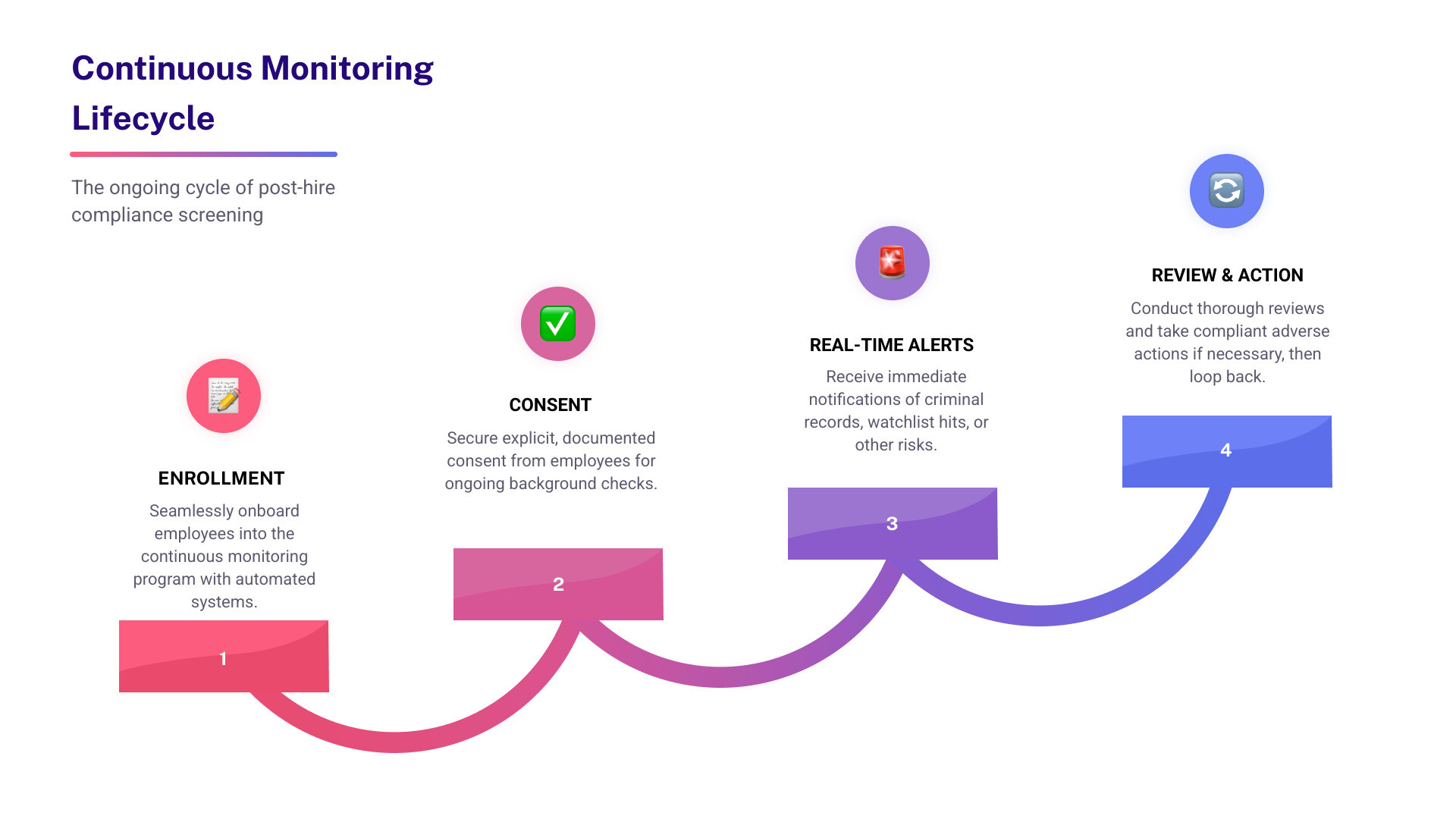
- Evergreen Consent: Obtain written authorization from the employee. Ideally, your initial disclosure includes "evergreen" language that allows for ongoing monitoring throughout the duration of employment.
- Standalone Disclosure: The notice that you will be conducting background checks must be in a standalone document.
- The Alert: When the monitoring service flags a record, HR must review it against the job's requirements.
- Pre-Adverse Action: If the new information might lead to termination or reassignment, you must send a Pre-Adverse Action notice, a copy of the report, and a Summary of Your Rights under the FCRA.
- The 5-Day Dispute Window: You must allow the employee a reasonable period (typically five business days) to dispute the accuracy of the report.
- Final Adverse Action: If the information is verified and you proceed with the employment change, a Final Adverse Action notice is required.
Avoiding Common Mistakes in Workforce Oversight
Even with the best intentions, recruiters and HR leaders often fall into these traps:
- Blanket Policies: Having a "zero-tolerance" policy for any criminal record can violate EEOC guidelines. You must perform an individualized assessment.
- Lack of Transparency: Monitoring should never feel like surveillance. Communicate the "why" to your employees: it's about maintaining a safe environment for everyone.
- Terminating Too Quickly: Use alerts as a prompt for a conversation. In many cases, an arrest does not lead to a conviction.
- Managing Rosters Manually: It is easy to forget to remove terminated employees from your monitoring list. This can lead to "permissible purpose" violations under the FCRA.
Choosing Technology for Long-Term Safety
To manage this at scale, you need a platform that automates the heavy lifting. When evaluating a provider for VettyComply™, look for these differentiators:
- PBSA Accreditation: Ensures the provider meets the highest industry standards for data security and accuracy.
- SOC 2 Type 2 Certification: Essential for protecting sensitive employee data.
- Mobile-Friendly Interface: Your employees should be able to provide consent and view reports easily from any device.
- HRIS Integration: The platform should sync with your existing tools like Workday or BambooHR to automate roster management.
- Near Real-Time Visibility: You need a single dashboard that shows who is enrolled and surfaces alerts immediately.
Conclusion
Maintaining long-term workforce safety isn't a "set it and forget it" task. As we've seen, the risks are dynamic, and your compliance strategy must be equally agile. By implementing continuous monitoring post-hire, you move from a state of reactive uncertainty to proactive protection.
Ready to close the gaps in your risk strategy? Vetty provides the tools you need to monitor your workforce with confidence. Connect with us to start building a safer workplace today.