

Why Background Checks for Seasonal Hiring Can't Be an Afterthought
Background checks for seasonal hiring are one of the most overlooked risk management decisions an HR team makes all year — and the consequences of getting it wrong compound fast.
Here's the short answer if you need it quickly:
Do seasonal employees need background checks?
- Yes, always. Seasonal workers have the same access to cash, inventory, customer data, and facilities as permanent staff.
- Federal laws like the Fair Credit Reporting Act (FCRA) and Title VII apply equally to temporary hires — employment duration does not reduce your legal duty of care.
- Skipping or abbreviating checks during high-volume surges is the most common trigger for negligent hiring liability.
- Negligent hiring lawsuits frequently settle for more than $1 million.
- Employee theft accounts for 33% of retail inventory shrinkage, with risk concentrated during peak seasonal periods.
The core principle: screening depth should be driven by role risk level, not by how long someone is on your payroll.
Seasonal workforce demands can spike 40–60% within weeks in retail, hospitality, and logistics. That's not a hiring challenge — it's a pressure test on your entire screening infrastructure.
The compressed timeline creates a dangerous incentive to cut corners. And that's exactly when bad actors exploit the chaos. Dishonest individuals often use the commotion of a holiday surge as cover for workplace fraud, theft, and data breaches.
At the same time, the regulatory environment doesn't pause for peak season. Ban-the-box laws, FCRA disclosure requirements, and state-specific fair chance acts all apply with the same force in November as they do in March.
This guide gives you a practical, stage-by-stage framework for running compliant, efficient background checks across your entire seasonal workforce — from the first job posting through final off-boarding.
Strategic Framework for Background Checks for Seasonal Hiring
When you are staring down a 40% increase in headcount for the 2026 summer or holiday rush, you need a blueprint that balances speed with security. You cannot afford to treat a warehouse loader the same way you treat a seasonal accounting clerk, but you also cannot afford to skip the basics for either.
Occupational fraud costs businesses roughly 5% of their annual revenue. In a high-volume environment, that loss often stems from "internal shrinkage"—a polite term for employee theft. Because seasonal workers often feel less long-term loyalty to the brand, the risk of fraud or theft is statistically higher during these abbreviated employment periods.
Compliance Checklist
Before you send out your first offer letter, ensure your process hits these non-negotiable marks:
- Standalone Disclosure: The background check notice must be a separate document, not buried in the job application.
- Written Authorization: You must have a clear, signed consent form from the candidate.
- Pre-Adverse Action Process: If a report comes back with disqualifying info, you must notify the candidate and wait 5-7 business days before final rejection.
- Individualized Assessment: Review the nature of any offense against the specific requirements of the job.
- State Law Alignment: Ensure your process follows state and local ordinances.
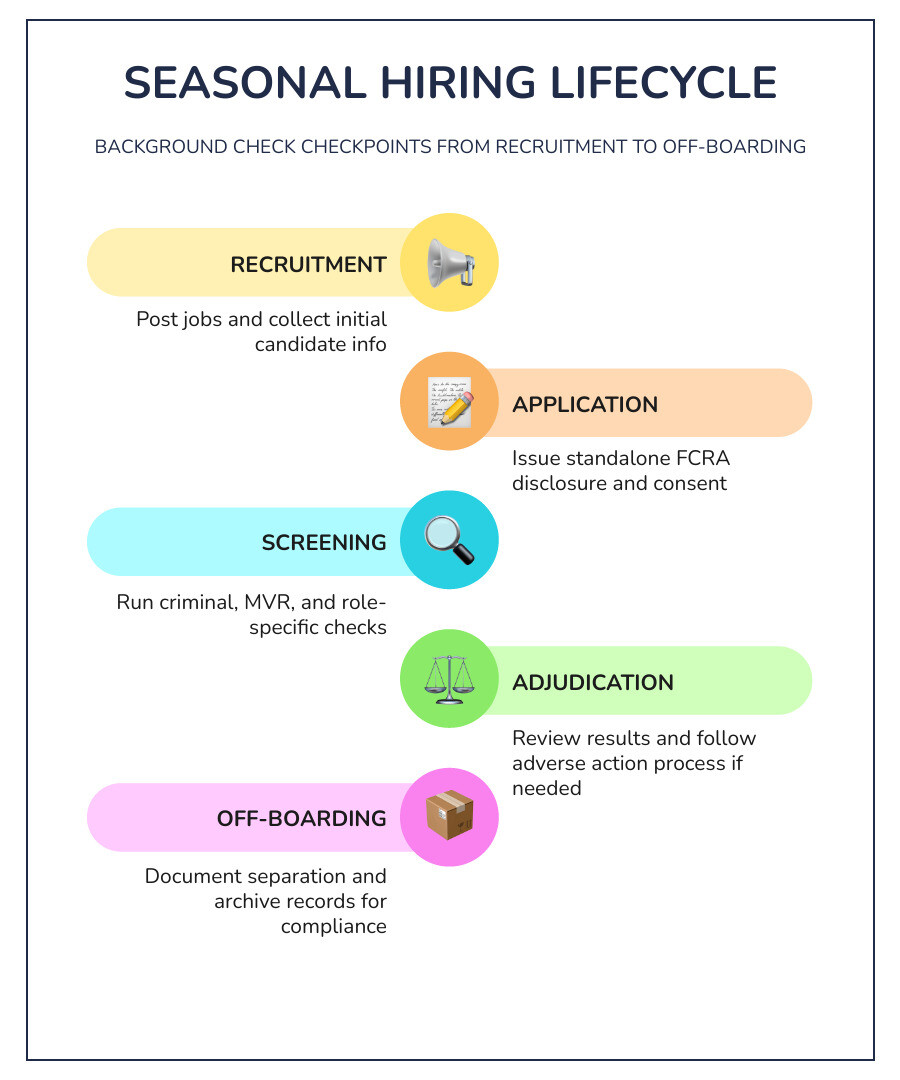
Stage-by-Stage Hiring Breakdown
- Planning (3-4 Months Out): Audit your screening packages and integrate your background check provider with your ATS.
- Recruitment: Use mobile-friendly portals to capture candidate data early.
- Screening: Order tiered packages based on role risk.
- Onboarding: Use VettyOnboard™ for digital I-9s and document collection to keep the momentum.
- Off-boarding: Immediately revoke system access once the contract ends to prevent post-employment data breaches.
| Feature | Low-Risk Package (e.g., Stocker) | High-Risk Package (e.g., Delivery/Cashier) |
|---|---|---|
| Identity Verification | Yes | Yes |
| National Criminal Database | Yes | Yes |
| Sex Offender Registry | Yes | Yes |
| County Criminal Search | Optional | Yes (Current & Previous) |
| MVR (Driving Record) | No | Yes |
| Employment Verification | No | Yes |
Recommended Screening Types for Seasonal Roles
Not all background checks for seasonal hiring are created equal. Your goal is to match the depth of the search to the potential damage a bad hire could cause.
- Criminal History: This is the bedrock of any screen. For a deep dive into what exactly surfaces, check out: What Shows Up On A Criminal Background Check.
- Motor Vehicle Records (MVR): Essential for delivery or machinery roles to verify a valid license and safe driving history.
- Drug Screening: Critical for safety-sensitive roles in Retail and Hospitality to ensure workplace safety during the frantic holiday pace.
- Social Security Number (SSN) Verification: Confirms the candidate is who they say they are and has the legal right to work in the U.S.
- Credit Reports: Recommended for seasonal roles handling significant amounts of cash or sensitive financial data.
FCRA Workflow
The FCRA is your primary regulatory hurdle. Even when you are hiring hundreds of people a week, the "I was in a rush" defense does not work in court.
The Standalone Disclosure Rule
The disclosure must be a clear, conspicuous document that stands on its own. In plain English: keep it separate from job applications, liability waivers, and other extra language.
The Adverse Action Workflow If a report contains disqualifying information, you must follow a two-step process: first, send a Pre-Adverse Action notice with a copy of the report and a summary of rights; second, wait 5 to 7 business days for potential disputes before sending the Final Adverse Action notice. Using VettyComply™ automates these notifications and provides a digital audit trail.
Best Practices for Background Checks for Seasonal Hiring in 2026
- Annual Re-screening: Re-screening returning workers is a standard best practice to mitigate fresh risks that may have occurred during their time away.
- Tiered Screening: Use Staffing Agency Background Check Solutions to build packages that fit the role risk level.
- Mobile-Friendly Consent: Modern candidates expect mobile-friendly portals. If your process is desktop-only, you will lose talent to faster competitors.
- Automated Adjudication: Set pre-defined criteria so your system can automatically flag or clear candidates. See these screening secrets for more speed tips.
Optimizing Your Seasonal Hiring Workflow

Speed is the name of the game in seasonal hiring. If your background checks take seven days while your competitor's take two, your best candidates will be gone before the results even hit your inbox.
Turnaround Time Benchmarks
In 2026, you should expect the following:
- Identity & National Criminal: Instant to 24 hours.
- County Criminal Search: 1–3 business days.
- MVR Checks: Instant to 24 hours.
- Verifications: 3–7 business days.
Be aware of the "December Court Freeze" where county courts operate on reduced hours. Planning your hiring surge for October or early November helps you bypass this slowdown. For more context on timing, check out: How Long Does A Background Check Take?
Common Mistakes
Avoid these pitfalls to keep your 2026 season running smoothly:
- Skipping Checks for "Short-Term" Staff: A seasonal employee can create serious risk in a few shifts, not just a few months. Treat screening like a 24/7 security guard for your business, customers, and team.
- Ignoring State and Federal Rules: Seasonal hiring still requires the same compliance discipline as full-time hiring. That means following FCRA requirements, using clear disclosures, getting proper authorization, and accounting for state-specific screening laws where you hire.
- Inconsistent Screening: If two people are applying for the same role, your screening approach should be consistent. Screening one candidate more heavily than another without a valid job-related reason can increase discrimination risk.
- Poor Off-boarding: A rushed exit process can create avoidable problems. When the season ends, disable system access, collect company property, and document the separation so former workers do not retain access after they leave.
Good vs. Bad
| Feature | The "Bad" Way (Manual/Siloed) | The "Good" Way (Automated/Mobile-friendly) |
|---|---|---|
| Candidate Experience | Paper forms; desktop-only portals | Mobile-friendly; digital signatures |
| Data Entry | HR manually types info from ATS | One-click Staffing integration |
| Compliance | Manual adverse action letters | Automated FCRA workflows and audit trails |
| Visibility | Calling the vendor for updates | Real-time dashboard with status updates |
| Scaling | Hiring more HR staff for volume | Using SMB tools to automate heavy lifting |
When you rely on manual entry, you aren't just slowing down your hiring; you are inviting data errors that can lead to non-compliance or ghosting by your best candidates.
Conclusion: Scale with Confidence
The 2026 seasonal hiring rush doesn't have to be a period of high anxiety. By implementing a tiered, mobile-friendly screening strategy, you can protect your revenue and brand reputation without sacrificing speed.
Vetty supports high-volume hiring with VettyVerify™ for rapid screening, VettyOnboard for digital documentation, and VettyComply™ for automated compliance management. These tools provide the visibility needed to scale safely during peak seasons. To ensure your 2026 seasonal surge is both safe and efficient, start your personalized audit with Vetty today.