

Why Gig Worker Screening Services are the Foundation of a Safe, Scalable Workforce

Gig worker screening services are the tools and processes platforms use to verify identity, check criminal history, review driving records, and monitor independent contractors on an ongoing basis — before and after they're activated.
If you're evaluating your options, here's what the best gig screening services deliver:
- Identity verification — biometric and document-based, completed digitally
- Criminal background checks — multi-jurisdictional, including county-level searches
- Motor vehicle records (MVR) — required for drivers, delivery, and transportation roles
- Sex offender registry searches — critical for in-home, childcare, and healthcare gigs
- Continuous monitoring — real-time alerts when a worker's status changes post-hire
- Fair Credit Reporting Act (FCRA) compliant adverse action workflows — automated notices at every required step
- Mobile-friendly candidate experience — so workers can complete onboarding anywhere
The gig economy has fundamentally changed how work gets done. Independent contractors now fill gaps in rideshare, grocery delivery, in-home care, on-demand healthcare, and dozens of other verticals — often interacting directly with your customers before you've had a chance to fully vet them.
That creates real risk.
A survey of more than 50 on-demand companies found that 50% performed no screening at all — and not a single one conducted monthly re-screening of active workers. That's not a compliance gap. That's a liability waiting to happen.
For HR executives and operations leaders managing high-volume contractor workforces, the stakes are straightforward: the workers your platform sends represent your brand. A driver, a caregiver, or a tasker who harms a customer doesn't just create legal exposure — they destroy trust that took years to build.
The good news is that modern screening technology has made fast, compliant, scalable vetting genuinely achievable. Leading automated platforms now complete the vast majority of criminal checks—including county searches—within one hour, with 90% of U.S. background checks returning in under a day. Speed is no longer a valid reason to skip steps.
What separates platforms that get this right from those that don't isn't just technology — it's the combination of the right checks, automated compliance workflows, and a candidate experience designed for people who live on their phones.
This guide breaks down exactly how to build that system.
The 2026 Compliance Checklist for Gig Worker Screening Services
In 2026, the regulatory landscape for gig worker screening services is more complex than ever. Managing a decentralized workforce across multiple jurisdictions requires a partner that prioritizes data integrity and legal adherence. Use this checklist to evaluate your current screening protocol:
- PBSA Accreditation: Your provider must be accredited by the Professional Background Screening Association (PBSA). This ensures they adhere to strict industry standards for accuracy, privacy, and ethics.
- SOC 2 Type II: Given the high volume of Personally Identifiable Information (PII) processed in the gig economy, verify that your provider maintains SOC 2 Type II certification to protect against data breaches.
- Ban-the-Box Compliance: Automated localized filtering is essential. Your platform should automatically adjust screening questions and results based on state and municipal "Fair Chance" laws to avoid non-compliance.
- Adverse Action Automation: Ensure the system triggers multi-step notices (pre-adverse and final adverse action) within the specific legal windows required by the Fair Credit Reporting Act (FCRA).
- State-Specific Expungement Rules: Automation should account for state-level changes in how records are reported or expunged to prevent the use of prohibited information.
For a deeper dive into why these measures are non-negotiable, see understanding the risks why background checks for gig workers are essential for safety.
Optimizing the Stage-by-Stage Hiring Process
Efficiency is the lifeblood of the on-demand economy. If your screening process takes five days, your best candidates have already moved on to a competitor. In 2026, a high-volume workflow must be built for speed without compromising quality.
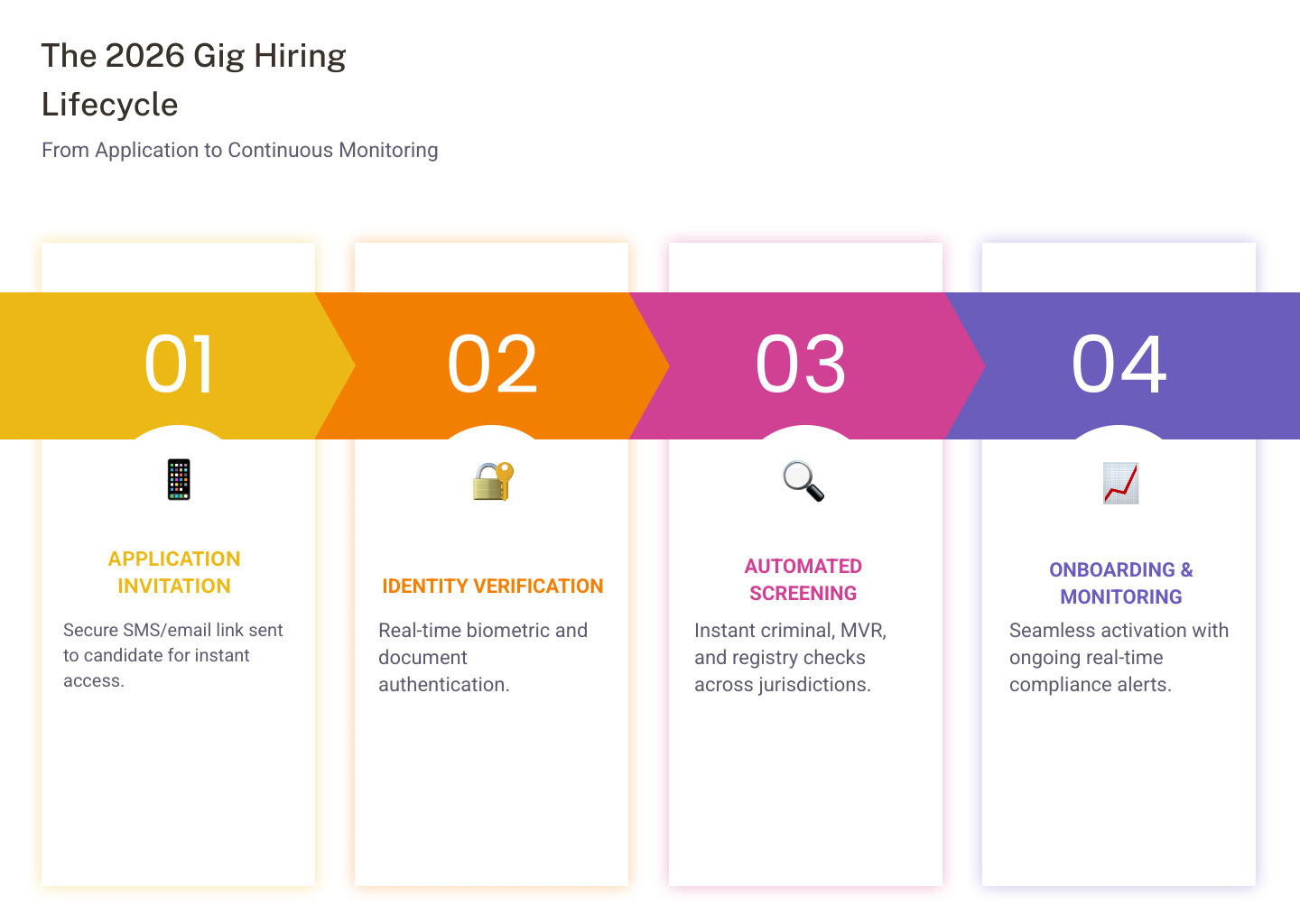
- Mobile-Friendly Invitation: The candidate receives a secure link via SMS or email. Gig workers are rarely sitting at a desktop; if they can’t complete the application on a smartphone, your drop-off rate will skyrocket.
- Identity Verification: Before running a single check, you must verify the person is who they say they are. Use real-time biometric and document authentication—such as liveness detection and government ID cross-referencing—to prevent fraud.
- Automated Screening: Launch non-conflicting checks in parallel. While a county criminal search might take longer, Motor Vehicle Records (MVR) and multi-jurisdictional database searches can often be returned in seconds through VettyVerify.
- Adjudication: Use no-code customization to apply your specific hiring criteria. Automated filters can flag only the results that require human review, allowing your team to focus on relevant risks rather than minor, non-disqualifying infractions.
- Onboarding: Once cleared, the worker should transition immediately to active status. Using VettyOnboard allows for digital document collection, e-signatures, and I-9 completion within the same ecosystem.
Scalability during seasonal surges requires more than just speed; it requires deep API integration. By embedding gig worker screening services directly into your existing ATS or ERP, you eliminate manual data entry and ensure a seamless experience for both your operations team and the candidate.
Navigating the FCRA Workflow in High-Volume Hiring
In a high-volume environment, manual compliance is a recipe for litigation. The following workflow ensures adherence to federal standards in 2026:
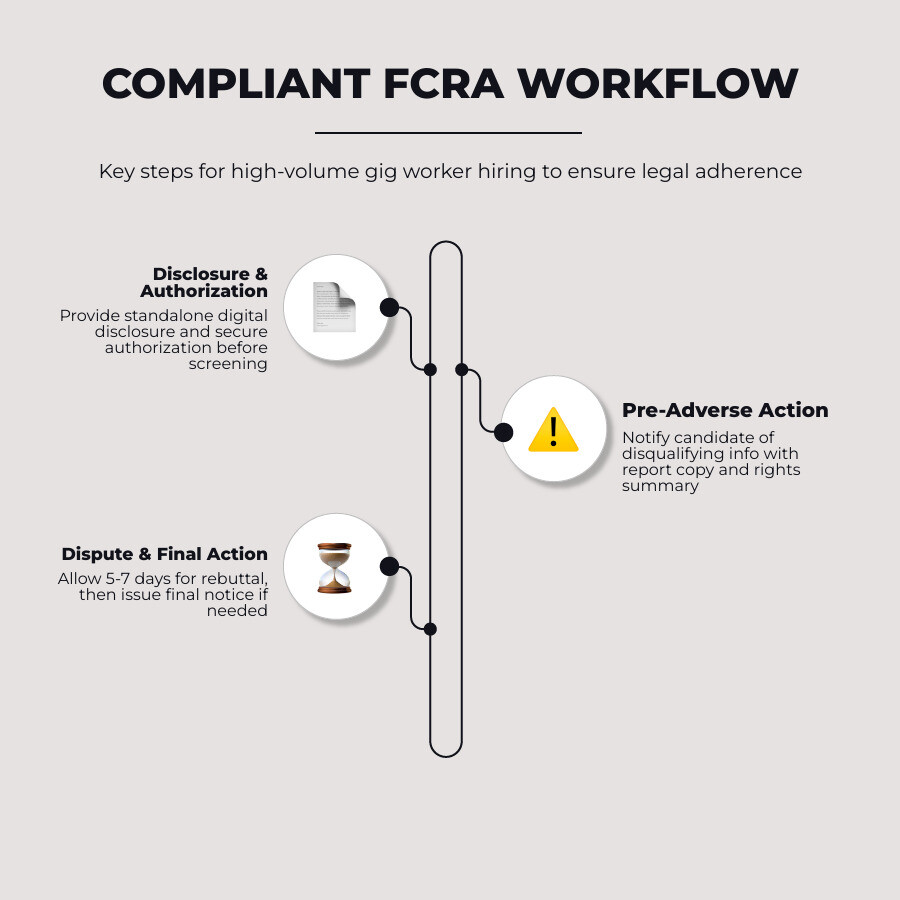
- Disclosure & Authorization: Provide a clear, standalone disclosure and obtain secure digital authorization.
- Pre-Adverse Action: If a report contains disqualifying information, issue a notice including a copy of the report and a summary of rights.
- Dispute Period: Allow the required window—typically five to seven business days—for the candidate to dispute the accuracy of the report.
- Final Adverse Action: Issue the final notice only after the dispute period has concluded without a successful dispute.
Automating this cycle ensures that no step is missed and that every notice is documented for your protection. To understand the nuances of these regulations, refer to gig worker background check process explained regulations requirements and best services.
Essential Checks: From Criminal Records to Digital Identity
Not all gig roles require the same level of scrutiny. A remote freelance graphic designer has a different risk profile than an in-home caregiver or a delivery driver. Tailoring your packages is the best way to optimize cost and ROI.
- MVR for Delivery and Transportation: For any role involving a vehicle, Motor Vehicle Records are mandatory. These checks verify license validity and flag serious infractions like DUIs or reckless driving.
- Multi-State Criminal Searches: Since gig workers are often mobile, a single-county search isn't enough. Multi-jurisdictional searches provide a broader view of a candidate’s history across the U.S.
- Sex Offender Registry: This is a critical safety layer for any platform where workers interact with the public, particularly in-home services or childcare.
- SSN Trace and Identity Verification: This confirms the candidate’s address history and ensures the criminal searches are being conducted against the correct identity.
For a step-by-step approach to building these packages, see ensure reliable background checks for gig workers in 5 steps.
Strategic Implementation: Manual vs. Automated Screening
Many legacy background check providers still rely on manual processes that fail to meet the demands of the modern workforce. When comparing traditional methods to modern gig worker screening services, the differences in operational efficiency are stark.
| Feature | Legacy/Manual Process | Modern Automated Screening (VettyVerify) |
|---|---|---|
| Candidate Experience | Desktop-heavy, complex forms | Mobile-friendly, intuitive UX |
| Turnaround Time | 5-7 business days | 90% of U.S. checks in < 24 hours |
| Adjudication | Manual review of every report | Automated filtering & no-code customization |
| Visibility | Opaque "black box" reporting | Real-time dashboard and status updates |
| Compliance | Manual adverse action letters | Automated, jurisdiction-aware workflows |
Transitioning to an automated system reduces candidate drop-off and allows your team to scale without a linear increase in HR headcount. Learn more about making the right choice in choosing trusted services for gig worker background checks.
Avoiding Common Mistakes in Gig Worker Screening Services
Even with the right tools, operational pitfalls can derail your hiring efforts. Here are the most common mistakes observed in high-volume screening programs:
- Friction-Heavy Onboarding: If your process requires workers to find a scanner or log into a desktop portal, you will lose them. In 2026, every step—from ID upload to signature—must be achievable on a mobile device.
- Inconsistent Screening: Some organizations apply rigorous standards to employees but lax standards to volunteers or contractors. If a worker represents your brand, they require a consistent level of vetting based on their role's risk.
- Manual Adjudication: Operations directors often get bogged down reviewing minor traffic tickets or decades-old, irrelevant offenses. Set clear, automated "Pass/Flag" criteria to keep the pipeline moving.
- Ignoring Local Laws: Using a "one size fits all" screening approach can lead to FCRA violations in states with specific reporting restrictions. Your platform must be smart enough to filter results based on the candidate's location.
For more strategies on avoiding these traps, see how to master background screening for your on demand workforce.
Continuous Monitoring: Managing Long-Term Risk
A background check is a snapshot in time. It tells you who a worker was the day they applied, but it doesn't tell you who they are six months later. In the gig economy, where workers remain active on platforms for years, "one and done" screening is no longer sufficient.
Through VettyComply™, you can implement continuous monitoring for your active workforce. This provides real-time alerts for:
- New criminal arrests or convictions
- Changes in motor vehicle record status (e.g., license suspension)
- Updates to healthcare sanctions lists (OIG/SAM)
This proactive approach allows you to address risks the moment they arise, rather than waiting for an annual re-screen—or worse, a customer complaint. For a complete guide on managing these ongoing risks, see background check and monitoring solutions for remote and freelance workforces a complete guide for hr professionals.
Improving ROI through Mobile-Friendly Onboarding
The return on investment for high-quality gig worker screening services is measured in risk mitigation and hiring velocity. By reducing turnaround times from days to hours, you capture the highest-quality earners before they sign on with another platform.
Consider the case of Wag!, a leader in the pet care space. By partnering with VettyVerify, they were able to power their "pet care provider" onboarding with a focus on both speed and safety. This enabled them to scale their marketplace rapidly while maintaining the high trust levels pet owners demand. You can read the full details in our case study Wag and Vetty Power Pet Care.
Your screening process should be a competitive advantage, not a bottleneck. By combining mobile-friendly experiences, automated compliance, and continuous monitoring, you can build a workforce that is as safe as it is scalable.
To streamline your operations, visit https://www.vetty.co/start to begin your trial.