

Why Continuous Criminal Monitoring Matters for Post-Hire Risk

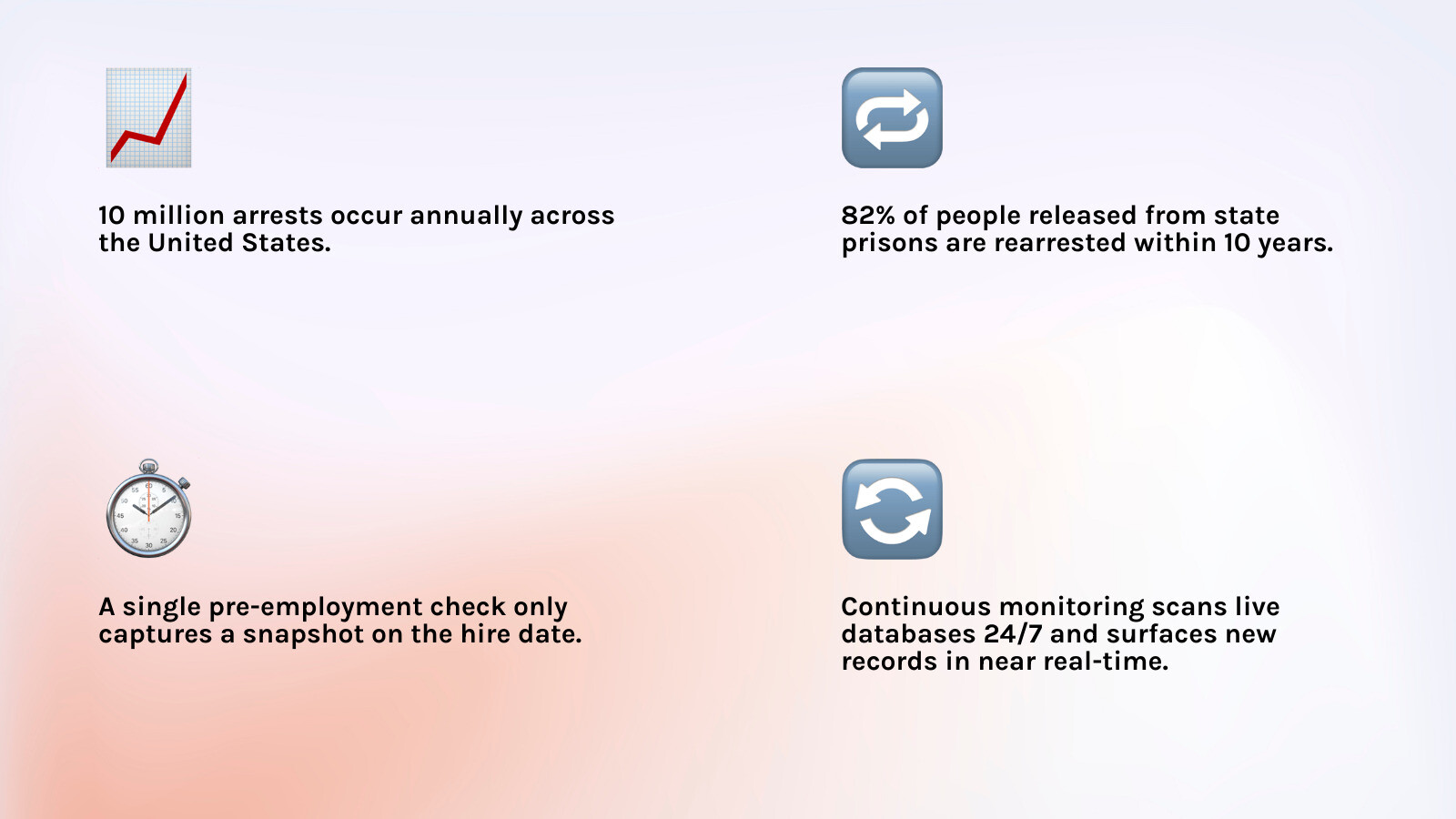
In 2026, managing workforce risk requires moving beyond static, one-time background checks. A pre-employment check only captures a snapshot of an individual's history up to their hire date, leaving organizations blind to subsequent criminal activity. With the U.S. seeing roughly 10 million arrests every year, continuous criminal monitoring solves this by providing automated, ongoing tracking of criminal records across national databases, court systems, and registries, delivering near real-time alerts when new arrests or convictions occur.
Compliance Checklist
To ensure your continuous monitoring program meets all federal and state requirements, follow this checklist:
- [ ] Standalone Disclosure: Provide a clear, separate written disclosure to the candidate or employee.
- [ ] Evergreen Consent: Obtain explicit, ongoing consent that permits monitoring throughout the duration of employment (subject to state-specific laws like California).
- [ ] PBSA-Accredited Partner: Use an accredited consumer reporting agency (CRA) to ensure maximum data accuracy.
- [ ] Adverse Action Readiness: Establish a clear, compliant process for pre-adverse and final adverse action notices.
FCRA Workflow
When an alert is triggered, employers must follow a strict, legally mandated FCRA Workflow:
- Alert Generation: The monitoring system flags a potential record.
- Source Verification: The CRA verifies the record directly with the originating court to ensure accuracy and identity match.
- Pre-Adverse Action Notice: If the record impacts employment, send the employee a pre-adverse action notice, a copy of the report, and a Summary of Your Rights.
- Dispute Window: Allow a reasonable period (typically 5 business days) for the employee to dispute or explain the findings.
- Final Adverse Action Notice: If the decision stands, issue the final adverse action notice.
Common Mistakes
- Failing to obtain evergreen consent: Running ongoing checks without explicit, continuous authorization.
- Taking immediate action on arrest alerts: Terminating or suspending an employee based on an unverified arrest record without following the FCRA workflow.
- Ignoring state-specific restrictions: Applying a blanket policy without accounting for local \"ban-the-box\" or fair chance laws.
Good vs. Bad Comparison
| Aspect | Good Practice | Bad Practice |
|---|---|---|
| Consent | Clear, standalone evergreen consent form signed at onboarding. | Relying on a standard pre-hire consent form that doesn't specify ongoing monitoring. |
| Action on Alerts | Verifying the record through a CRA and initiating the FCRA adverse action process. | Immediately terminating the employee upon receiving an automated arrest notification. |
| Data Accuracy | Relying on verified court-sourced records. | Acting on unverified social media rumors or scraping public web databases. |
Stage-by-Stage Hiring Breakdown
- Pre-Hire Screening: Run a comprehensive background check using VettyVerify™ to establish a baseline.
- Onboarding: Secure evergreen consent for continuous monitoring during the digital onboarding process using VettyOnboard™.
- Post-Hire Monitoring: Enroll the active roster in VettyComply™ for 24/7/365 scanning of criminal databases and registries.
- Re-verification: Periodically run targeted checks or verify alerts through verified court runners when high-confidence matches occur.
Comparison Table: Vetty vs. Competitors
| Feature | Vetty | Competitor A | Competitor B |
|---|---|---|---|
| Mobile-First Verification | Yes (Optimized for smartphones) | Limited | No |
| Continuous Monitoring | Yes (with VettyComply™) | Yes | Add-on only |
| Onboarding Integration | Yes (with VettyOnboard™) | No | Yes |
| PBSA Accreditation | Yes | Yes | No |
 ",
"4": "## Navigating Compliance and Legal Requirements
",
"4": "## Navigating Compliance and Legal Requirements
Implementing continuous monitoring requires a careful approach to compliance. Because monitoring involves the ongoing collection of consumer reports, it is strictly governed by the Fair Credit Reporting Act (FCRA) and state-level consumer protection laws.
Before launching a program, review our comprehensive resources on Navigating the Legal Maze of Employee Monitoring Requirements and Employee Monitoring for Compliance and Risk Management.
State-Specific Consent and Accuracy Standards
While federal guidelines establish the baseline, state-level regulations introduce additional complexity:
- Evergreen Consent Restrictions: Some states, such as California, have specific restrictions on evergreen consent, requiring employers to consult with legal counsel to draft compliant forms for their operating regions.
- Accuracy Standards: Work with a PBSA-accredited screening provider that boasts a high background check accuracy rate (such as 99.9994% or higher) to minimize the risk of false positives that could harm your employees.
Using an ongoing compliance framework also supports fair chance hiring practices. By having a continuous safety net in place, you can confidently expand your talent pipeline to include second-chance candidates, knowing that any new, relevant criminal behavior will be flagged immediately.
Limitations and Coverage Gaps
While continuous criminal monitoring is highly effective, it is not a magic wand. You must understand its limitations to build a balanced risk program:
- Non-Participating Jurisdictions: Not every county court or local municipal jail participates in real-time booking databases. Some rural or smaller jurisdictions still rely on legacy paper systems or do not feed their records into national aggregators.
- Reporting Delays: While many alerts are generated in near real-time, some jurisdictions may take several days to report an arrest or update a court file.
- Source Verification Requirements: An arrest alert is merely a pointer. Before you can legally take adverse action under the FCRA, your screening partner must verify the record directly with the originating court to ensure it is accurate, up-to-date, and belongs to the correct individual.
- Social Media Limitations: Some companies attempt to pair criminal monitoring with social media monitoring. While public online activity can sometimes spot behavioral risks, it is subject to strict privacy limitations and should never be used as a substitute for verified, court-sourced public records.
Because of these limitations, the industry best practice is a layered approach: use continuous monitoring for real-time safety alerts, and combine it with periodic, comprehensive re-screens to catch any records in non-participating jurisdictions.
While any organization can benefit from ongoing risk mitigation, continuous monitoring is particularly vital for industries with high-trust environments, mobile workforces, or strict regulatory requirements.
For a complete overview of how ongoing screening fits into modern talent acquisition, read about Criminal Monitoring in Hiring.
Healthcare and Vulnerable Populations
In healthcare, patient safety and regulatory compliance are paramount. Hospitals, home health agencies, and senior living facilities must ensure that their staff remain in good standing.
Continuous monitoring in this sector typically extends beyond criminal records to include ongoing tracking of Office of Inspector General (OIG) exclusions, System for Award Management (SAM) sanctions, and professional license verifications. If a nurse or caregiver is charged with an offense or has their license suspended, real-time alerts allow administrators to remove them from patient care immediately, protecting vulnerable populations and preserving the organization's federal funding eligibility.
Staffing Agencies and Gig Platforms
The staffing and gig/on-demand economies are characterized by high volume, rapid deployment, and distributed workforces. When you are onboarding thousands of workers a week, manual re-screening is impossible to scale.
For gig platforms, Vetty stands out as the best option for high-volume, smartphone-based verification. By integrating continuous monitoring with your onboarding software, you can automate your safety protocols. If a gig delivery driver or a temporary warehouse worker is arrested for a violent offense or a major traffic violation, Vetty flags the event, allowing your operations team to pause their account automatically. This mobile-first approach ensures that contractors can complete verification seamlessly on their phones, reducing drop-off rates while maintaining strict safety standards.
To explore the software landscape that supports these workflows, check out our analysis of the Best Employee Monitoring Software in 2026.
Managing post-hire workforce risk in 2026 requires moving past the outdated belief that background screening is a one-time event. Pre-employment checks are essential, but they cannot protect your brand, your customers, or your team from what happens tomorrow.
By implementing a continuous monitoring program, you replace blind spots with real-time, actionable visibility.
Vetty offers a modern, all-in-one screening and monitoring platform built to handle these complex workflows. With VettyComply™, you can manage continuous post-hire monitoring for criminal activity, motor vehicle records, and healthcare sanctions from a single, mobile-friendly dashboard. Our platform is PBSA-accredited, SOC 2 Type 2 certified, and built to scale with your business.
To see how you can protect your organization and simplify your compliance workflows, learn more about VettyComply™ today. If you are ready to build a safer, more resilient workforce, get started with Vetty and speak with one of our compliance experts.
What is Continuous Criminal Monitoring?
Traditional background checks are static. They provide a comprehensive look at an individual's history up to the exact day the report is generated. The moment the check is completed, its predictive value begins to degrade. If an employee or contractor is arrested the week after onboarding, you might not find out until your next annual rescreen—or worse, after an incident occurs on the job.
Continuous criminal monitoring is a proactive risk management solution. Instead of waiting for a scheduled recheck, it acts as a persistent, real-time safety net. It continuously evaluates your active roster against public records databases, alerting you to new criminal activity as it happens.
To understand the core differences between these two methodologies, read our detailed breakdown on Continuous Criminal Monitoring vs One-Time Background Checks: What HR Leaders Need to Know.
The Shift from Static Snapshots to Real-Time Visibility
Relying solely on pre-employment screening exposes your organization to significant insider risk. Consider the scale of the data: in the United States, approximately 7.8 million unique individuals are booked into jails annually, accounting for roughly 11 million total booking events.
When you look at these numbers, it becomes clear that law enforcement interactions are not rare occurrences. If your workforce includes hundreds or thousands of distributed workers, gig contractors, or healthcare professionals, the statistical likelihood of an active team member interacting with the justice system is high.
Historically, tracking these changes required running manual, periodic background checks on your entire staff—a process that is administratively exhausting, expensive, and legally complex. Continuous monitoring automates this workflow, shifting your organization from a reactive posture to a proactive safety model.
How Continuous Criminal Monitoring Works
Implementing an ongoing screening program does not require your HR team to manually query court systems. Modern screening platforms automate the process from enrollment to alert resolution.
For staffing agencies managing dynamic talent pools, this automation is critical. You can learn more about managing these workflows in our guide on how to Stay Alert with Continuous Monitoring for Staffing Agencies.
The lifecycle of a continuous monitoring program generally follows these steps:
- Roster Enrollment: You upload your active workforce roster (via direct integration with your HRIS or a simple template upload) into the screening platform.
- 24/7 Database Scanning: The monitoring system continuously runs your roster against primary record sources.
- Data Matching: Advanced algorithms match personally identifiable information (PII) like name, date of birth, and other identifiers to ensure high-confidence matches.
- Alert Generation: If a reportable event matches an individual on your roster, an alert is triggered.
- Notification and Verification: Your designated compliance or HR users receive an alert to review the verified records.
- Action and Documentation: Your team reviews the record, conducts any necessary internal investigations, and documents your follow-up actions directly in your dashboard.
Primary Data Sources and Technology
To provide reliable coverage, continuous monitoring systems pull from a massive, interconnected web of public records and proprietary data networks. Key technology components include:
- Direct Jail and Booking Connections: Real-time monitoring platforms maintain direct communications with over 3,000 jail facilities across the country. This allows the system to capture booking events and arrest data within hours of occurrence.
- Hourly Court Updates: Advanced databases index more than 400 million court records, updating hourly through automated court searches and bulk data imports.
- National Criminal Databases: Multi-jurisdictional databases are scanned continuously to catch records across county and state lines.
- Sex Offender Registries: Continuous monitoring keeps track of updates across all 50 state sex offender registries, as well as national databases.
- Global Watchlists: High-risk roles are monitored against international watchlists, terrorist databases, and federal sanction lists.
What Records Are Covered by Continuous Criminal Monitoring?
A robust monitoring program goes beyond basic arrest records to track the entire lifecycle of a criminal case:
- New Criminal Charges: Alerts trigger when misdemeanor or felony charges are officially filed in court.
- Incarceration and Booking Records: Real-time alerts when an active worker is booked into a local, county, or state correctional facility.
- Warrant Activity: Alerts for active warrants, helping you address potential legal issues before they disrupt operations.
- Case Dispositions: Updates when an existing charge is resolved, whether through dismissal, plea, or conviction.
- Probation and Parole Violations: Notifications regarding failures to comply with court-mandated supervision.
In some jurisdictions, continuous monitoring also aligns with specific statutory requirements. For example, under Wisconsin Legislature: 301.48(6), certain high-risk offenders are subject to lifetime tracking and strict geographic restrictions, illustrating how modern legal frameworks rely on continuous, real-time location and registry monitoring to maintain public safety.
How Providers Handle Alerts and Notifications
Not all alerts are created equal. When setting up your monitoring program, you can configure how and when your team is notified. Most advanced providers categorize alerts into distinct levels:
- Immediate Arrest Alerts: Real-time notifications of booking events. These are useful for rapid-response roles but may require further verification before taking adverse employment action, as an arrest is not a conviction.
- Verified Alerts: Alerts that undergo source verification by the consumer reporting agency (CRA) to ensure the record belongs to your employee and is legally reportable under the Fair Credit Reporting Act (FCRA).
- Court-Tracked Alerts: The system flags an arrest and automatically escalates tracking to the local court level, notifying you only when formal charges are filed or a disposition is reached.
Continuous Monitoring vs. Periodic Rescreening
Many organizations rely on annual or bi-annual background checks to manage post-hire risk. While periodic rescreening is a valuable compliance tool, it differs significantly from continuous monitoring in terms of timing, coverage, and cost efficiency.
| Feature | Continuous Criminal Monitoring | Periodic Rescreening (e.g., Annual) |
|---|---|---|
| Frequency | 24/7/365 continuous scanning | Once every 12 to 24 months |
| Time to Alert | Near real-time (often within 24–72 hours of booking) | Up to 12+ months after the event occurs |
| Data Coverage | Focuses on active booking, arrest, and registry networks across 98%+ of the US population | Deep, comprehensive local county court searches across all residential addresses |
| Cost Model | Predictable, low monthly subscription per monitored worker | Full-price background check fee per screen, plus local court runner fees |
| Administrative Burden | Fully automated; alerts only require action when triggered | High; requires re-collecting consent and manually ordering screens for the entire workforce |
For a deeper analysis of how to structure your post-hire screening strategy, read our guide on Continuous Background Checks vs Annual Rescreening: Which is Right for Your Business.
Timing and Coverage Gaps
The primary weakness of periodic rescreening is the time gap. If an employee in a high-risk role—such as a home health aide or a delivery driver—is arrested for a serious offense shortly after their annual check, they could continue working for your organization for nearly a year before you run another screen. This gap exposes your business to severe liability, including negligent retention lawsuits.
Continuous monitoring provides 90%+ coverage of U.S. residential areas and covers over 98% of the U.S. population. By keeping a constant pulse on participating jurisdictions, it eliminates the dangerous "blind spots" that occur between annual checks.
Cost Structures and ROI
At first glance, running continuous checks on your entire staff might sound expensive. However, the cost structure is highly efficient.
Continuous monitoring is typically billed as a predictable monthly subscription fee based on the size of your active roster. Instead of running full, expensive county court searches on every employee every year, the monitoring system only triggers a localized court search when a high-confidence match is detected in the booking or registry databases.
By only paying for deep court searches when a real risk event is identified, you control your out-of-pocket expenses while maintaining uninterrupted safety coverage.
Navigating Compliance and Legal Requirements
Implementing continuous monitoring requires a careful approach to compliance. Because monitoring involves the ongoing collection of consumer reports, it is strictly governed by the Fair Credit Reporting Act (FCRA) and state-level consumer protection laws.
Before launching a program, review our comprehensive resources on Navigating the Legal Maze of Employee Monitoring Requirements and Employee Monitoring for Compliance and Risk Management.
FCRA Compliance and Employee Consent
To remain compliant under federal law, your continuous monitoring program must adhere to several strict guidelines:
- Clear and Conspicuous Disclosure: You must provide a standalone disclosure to your employees stating that you will conduct ongoing background screening throughout their employment.
- Evergreen Consent: Your authorization form must include clear "evergreen" language. This explicitly states that the employee consents to background checks and continuous monitoring for the entire duration of their tenure with your company. Some states, such as California, have specific restrictions on evergreen consent, so you should consult with legal counsel to draft compliant forms for your operating regions.
- The Adverse Action Process: If a monitoring alert reveals a record that may lead to termination, reassignment, or other negative employment actions, you must follow the standard two-step adverse action process. This includes sending a pre-adverse action notice (along with a copy of the report and a summary of rights), allowing a reasonable period for the employee to dispute the findings, and sending a final adverse action notice if you proceed with the decision.
- Accuracy Standards: Work with a PBSA-accredited screening provider that boasts a high background check accuracy rate (such as 99.9994% or higher) to minimize the risk of false positives that could harm your employees.
Using an ongoing compliance framework also supports fair chance hiring practices. By having a continuous safety net in place, you can confidently expand your talent pipeline to include second-chance candidates, knowing that any new, relevant criminal behavior will be flagged immediately.
Limitations and Coverage Gaps
While continuous criminal monitoring is highly effective, it is not a magic wand. You must understand its limitations to build a balanced risk program:
- Non-Participating Jurisdictions: Not every county court or local municipal jail participates in real-time booking databases. Some rural or smaller jurisdictions still rely on legacy paper systems or do not feed their records into national aggregators.
- Reporting Delays: While many alerts are generated in near real-time, some jurisdictions may take several days to report an arrest or update a court file.
- Source Verification Requirements: An arrest alert is merely a pointer. Before you can legally take adverse action under the FCRA, your screening partner must verify the record directly with the originating court to ensure it is accurate, up-to-date, and belongs to the correct individual.
- Social Media Limitations: Some companies attempt to pair criminal monitoring with social media monitoring. While public online activity can sometimes spot behavioral risks, it is subject to strict privacy limitations and should never be used as a substitute for verified, court-sourced public records.
Because of these limitations, the industry best practice is a layered approach: use continuous monitoring for real-time safety alerts, and combine it with periodic, comprehensive rescreens to catch any records in non-participating jurisdictions.
Key Industries and Roles That Benefit Most
While any organization can benefit from ongoing risk mitigation, continuous monitoring is particularly vital for industries with high-trust environments, mobile workforces, or strict regulatory requirements.
For a complete overview of how ongoing screening fits into modern talent acquisition, read about Criminal Monitoring in Hiring.
Healthcare and Vulnerable Populations
In healthcare, patient safety and regulatory compliance are paramount. Hospitals, home health agencies, and senior living facilities must ensure that their staff remain in good standing.
Continuous monitoring in this sector typically extends beyond criminal records to include ongoing tracking of Office of Inspector General (OIG) exclusions, System for Award Management (SAM) sanctions, and professional license verifications. If a nurse or caregiver is charged with an offense or has their license suspended, real-time alerts allow administrators to remove them from patient care immediately, protecting vulnerable populations and preserving the organization's federal funding eligibility.
Staffing Agencies and Gig Platforms
The staffing and gig/on-demand economies are characterized by high volume, rapid deployment, and distributed workforces. When you are onboarding thousands of workers a week, manual re-screening is impossible to scale.
By integrating continuous monitoring with your onboarding software, you can automate your safety protocols. If a gig delivery driver or a temporary warehouse worker is arrested for a violent offense or a major traffic violation, the platform flags the event, allowing your operations team to pause their account automatically.
To explore the software landscape that supports these workflows, check out our analysis of the Best Employee Monitoring Software in 2026.
Frequently Asked Questions about Continuous Criminal Monitoring
Is continuous criminal monitoring intrusive to employee privacy?
No, when implemented correctly. Continuous monitoring only tracks publicly available criminal records, court filings, and sex offender registries. It does not monitor private communications, personal devices, financial accounts, or location data. By maintaining transparent communication and obtaining clear, written consent during onboarding, you build a culture of safety without crossing into invasive surveillance.
How fast are alerts generated when a new record is detected?
Alerts are designed to be near real-time. Because of live connections to local jail booking systems, initial arrest and booking alerts can be generated within hours of the event. For formal court filings and dispositions, approximately 91% of checks are delivered in three days or less, with 83% completed in just one business day.
Can an arrest alert automatically lead to employee termination?
No. Under the FCRA and Equal Employment Opportunity Commission (EEOC) guidelines, an arrest record alone is not proof of guilt. If you receive an arrest alert, your policy should require an immediate internal review.
You should verify the record with your screening provider, consult with legal counsel, and give the employee an opportunity to explain the situation through the pre-adverse action process. Many organizations use these alerts as an opportunity for early intervention—such as offering employee assistance programs (EAPs) for substance abuse issues—rather than jumping straight to termination.
Conclusion
Managing post-hire workforce risk in 2026 requires moving past the outdated belief that background screening is a one-time event. Pre-employment checks are essential, but they cannot protect your brand, your customers, or your team from what happens tomorrow.
By implementing a continuous monitoring program, you replace blind spots with real-time, actionable visibility.
Vetty offers a modern, all-in-one screening and monitoring platform built to handle these complex workflows. With VettyComply™, you can manage continuous post-hire monitoring for criminal activity, motor vehicle records, and healthcare sanctions from a single, mobile-friendly dashboard. Our platform is PBSA-accredited, SOC 2 Type 2 certified, and built to scale with your business.
To see how you can protect your organization and simplify your compliance workflows, learn more about VettyComply™ today. If you are ready to build a safer, more resilient workforce, get started with Vetty and speak with one of our compliance experts.