

Employee Monitoring Compliance: Operational Requirements for HR Leaders

Compliance Checklist
- Written Monitoring Policy: Document exactly what you monitor, why, and how.
- Employee Notice: Inform staff before monitoring begins (mandatory in CT, DE, NY, TX).
- Signed Consent: Obtain written acknowledgment from employees for electronic and telephonic tracking.
- Legitimate Business Purpose: Ensure every monitoring activity ties to a specific operational need.
- Data Security & Retention: Implement encryption and defined deletion schedules for all collected data.
- Privacy Boundaries: Prohibit monitoring in restrooms, locker rooms, and private break areas.
- BYOD Protocols: Establish clear scope limits and explicit consent for personal devices used for work.
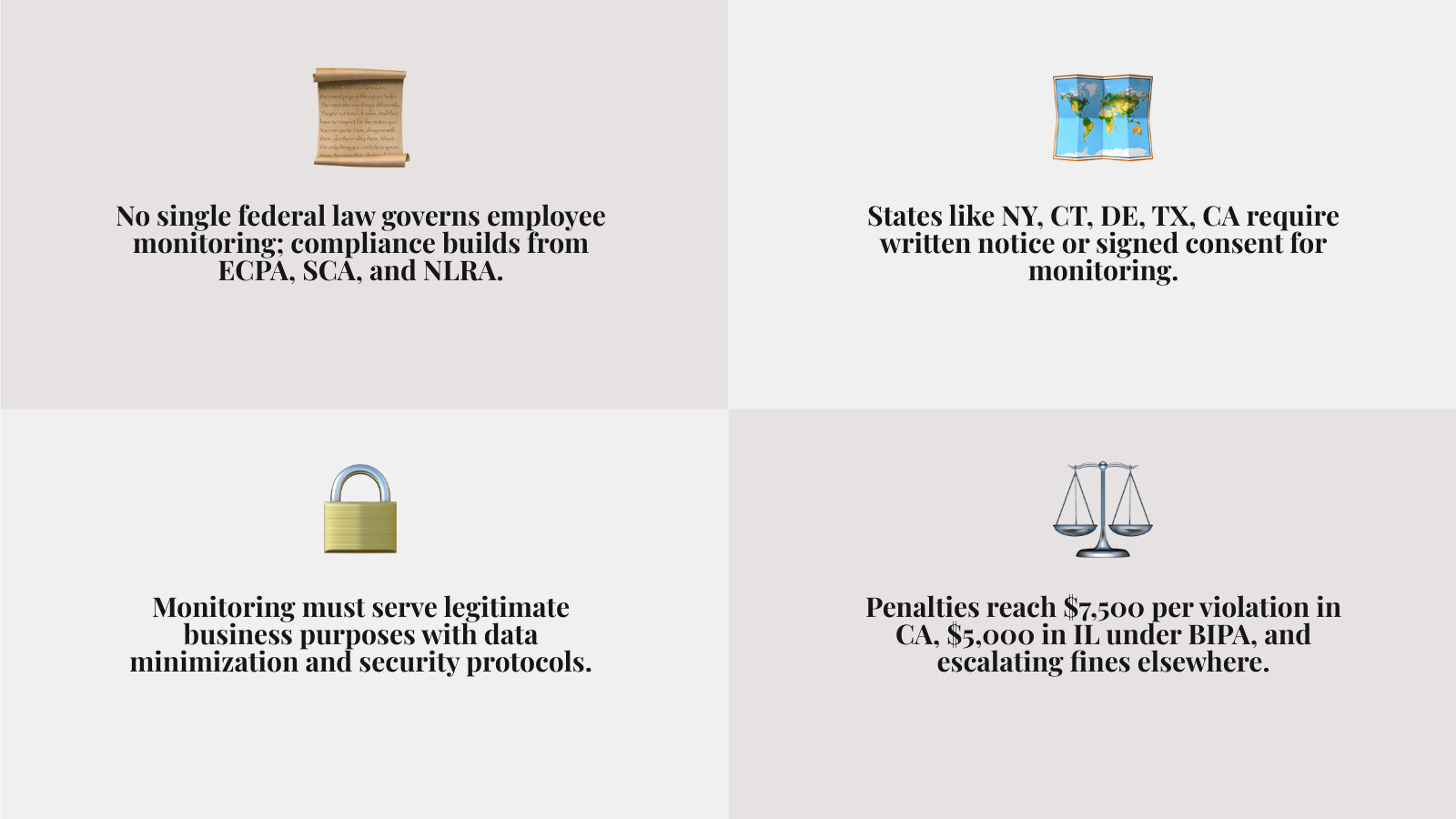
Employee monitoring compliance requirements are a patchwork of federal laws, state mandates, and industry-specific rules. Getting this wrong creates significant financial risk. California privacy violations can reach $7,500 per employee, while Illinois biometric errors under BIPA trigger penalties up to $5,000 per incident.
According to 2025 industry data, over 67% of North American employers with 500 or more employees now use employee monitoring software. Implementing these tools without a compliant framework creates real risk across every state where you operate.
Federal Standards and State Mandates
Federal statutes provide the floor for employee monitoring for compliance and risk management, while state laws often raise the ceiling on privacy protections.
Actionable FCRA Workflow
Adhere to this workflow for background screening and continuous monitoring:
- Standalone Disclosure: Provide a separate document informing the individual that a background check or continuous monitoring will occur.
- Written Authorization: Obtain a signature authorizing the process.
- Continuous Monitoring: Use a platform like VettyComply for ongoing checks on criminal activity or motor vehicle records.
- Pre-Adverse Action Notice: If a negative report is found, notify the employee before taking action. Include a copy of the report and a summary of their rights.
- Five-Day Waiting Period: Allow the employee at least five business days to dispute any inaccuracies.
- Final Adverse Action: Only after the waiting period and an individualized assessment can you issue a final notice.
Federal Framework: ECPA, SCA, and NLRA Standards
The Electronic Communications Privacy Act (ECPA) generally prohibits the interception of electronic communications but contains two critical exceptions:
- The Business-Use Exception: Allows monitoring if there is a legitimate business reason and it occurs in the ordinary course of business.
- The Prior Consent Exception: If you obtain employee consent beforehand, ECPA prohibitions typically do not apply.
The Stored Communications Act (SCA) protects archived emails on your servers, but accessing an employee’s private, web-based email on a company computer can trigger violations. Furthermore, the National Labor Relations Act (NLRA) protects concerted activity. Surveillance that targets union activity specifically is a high-risk area for federal enforcement. For deeper context, the Employee Monitoring - State Bar of Texas provides guidance on how federal standards interface with local expectations.
State-Specific Notice and Consent Mandates
Several states have explicit transparency mandates:
- New York: You must provide written notice of electronic monitoring upon hiring and post it conspicuously.
- Connecticut and Delaware: You must provide prior written notice before any electronic monitoring occurs.
- Texas: You must provide notification for monitoring on company devices. For business calls, consent is generally required.
- California: Through the CCPA and CPRA, you must provide detailed notices at the point of collection.
Modern employee monitoring compliance requirements lean heavily toward active, documented acknowledgment. This is especially true in 2026 as how AI is changing hiring and why compliance matters more than ever because AI-driven tools often process data in ways that require specific disclosures.
Implementing a Compliant Monitoring Strategy
Stage-by-Stage Hiring Process Breakdown
- Pre-Screening: Use VettyVerify™ to provide standalone disclosures and obtain digital authorization for background checks.
- Onboarding: Integrate monitoring policies into your digital handbook via VettyOnboard to ensure documented acknowledgment from day one.
- Active Employment: Deploy continuous monitoring for criminal or MVR hits to maintain real-time visibility into workforce risk.
- Post-Hire Evaluation: Conduct individualized assessments before taking any adverse action based on monitoring data.
Good vs. Bad Monitoring Practices
| Feature | Good Practice (Compliant) | Bad Practice (High Risk) |
|---|---|---|
| Transparency | Explicit written notice and signed acknowledgment. | Covert monitoring without any employee notification. |
| Scope | Monitoring only during work hours on work assets. | 24/7 tracking of personal devices or off-duty activity. |
| Purpose | Tied to productivity, security, or trade secret protection. | Monitoring to micromanage or without a business case. |
| Data Access | Restricted to HR and relevant security personnel. | Broad access given to all managers and supervisors. |
| Location | Limited to workspaces and common areas. | Cameras in restrooms, locker rooms, or private break areas. |
Establishing Legitimate Business Purpose and Proportionality
To satisfy state privacy laws, your monitoring must be proportionate. This means using the least intrusive method available. If your goal is cybersecurity, scanning for malware in emails is proportionate; reading every personal message is not. Data minimization is a core tenet of modern compliance, particularly as legislative shifts in employee screening ban the box fair chance and drug testing laws continue to narrow what information you can legally use.
Common Mistakes in Compliance
- Covert Surveillance: Except in narrow cases of suspected criminal activity, secret monitoring often leads to litigation.
- Monitoring Private Areas: Placing cameras in restrooms or changing areas is often a criminal offense.
- Off-Duty Tracking: Monitoring social media or GPS location while employees are off the clock can reveal protected class information, fueling discrimination claims.
- Biometric Violations: In states like Illinois and Colorado, collecting fingerprints or facial recognition data requires specific written releases and deletion schedules.
Data Security and Proof Points
You are the custodian of the sensitive information you collect. Ensure all monitoring data is encrypted at rest and in transit, and use role-based access controls. Establish a policy to delete data once the business purpose is fulfilled. Ensure your monitoring partners are PBSA-accredited and SOC 2 Type 2 certified to mitigate third-party risk.