

Why Comparing Background Check Software Is Harder Than It Looks

Selecting the right background check software in 2026 requires navigating a complex landscape of legal requirements, integration capabilities, and candidate experience standards. With hiring speeds directly impacting your ability to secure top talent, relying on manual processes or outdated databases is no longer viable. This guide provides a comprehensive evaluation of the leading background screening platforms, helping you identify the best fit for your organization's specific workflow and compliance needs. Ready to shortlist? Our side-by-side comparison of top background check companies covers speed, pricing, and compliance.
Compliance Checklist
Before evaluating any vendor, ensure they meet these baseline compliance and security standards:
- PBSA Accreditation: Verified member of the Professional Background Screening Association.
- SOC 2 Type 2 Certification: Ensures rigorous data security and privacy controls.
- Automated Disclosures: System-generated, state-specific disclosure and consent forms.
- Adverse Action Automation: Built-in workflows for pre-adverse and final adverse action notices.
- Real-Time Audit Trails: Complete logging of all user and candidate actions for litigation defense.
FCRA Workflow
An FCRA-compliant screening process must follow a strict legal sequence:
- Disclosure & Consent: The candidate receives a standalone disclosure and provides electronic authorization.
- Screening Execution: The CRA performs primary source verifications (not just database lookups).
- Pre-Adverse Action: If negative information is found, the candidate is notified and given a copy of the report.
- Dispute Window: A mandatory waiting period (typically 5 business days) allows the candidate to dispute findings.
- Final Adverse Action: If no dispute is raised or resolved unfavorably, the final adverse action notice is sent.
Common Mistakes
- Using Non-FCRA Consumer Tools: Relying on "people search" databases for employment decisions, which violates federal law.
- Ignoring State-Specific Lookback Limits: Failing to filter out records that cannot legally be considered in specific jurisdictions.
- Relying on "Average" Turnaround Times: Overlooking the distribution of delays caused by manual county courthouse searches.
- Poor Mobile Optimization: Forcing candidates to complete complex forms on non-responsive desktop portals, leading to high drop-off rates.
Good vs. Bad Background Screening Practices
| Feature / Practice | Good Practice (Modern CRA) | Bad Practice (Legacy / Consumer Tool) |
|---|---|---|
| Data Sourcing | Primary source verification at county, state, and federal levels | Outdated, aggregated public record databases |
| Candidate Experience | Mobile-first, responsive portal with document upload via smartphone | Clunky, desktop-only forms requiring manual data entry |
| Compliance Guardrails | Automated, localized FCRA workflows built into the platform | Manual tracking of disclosures and adverse action letters |
| Integration | Native, bi-directional ATS/HRIS integrations with real-time status | Manual copy-pasting of candidate details between systems |
Stage-by-Stage Hiring Breakdown
- Initiation: Recruiter triggers a background check directly from the ATS.
- Candidate Consent: Candidate receives a mobile-friendly link, signs disclosures, and uploads required documents.
- Verification: The software automatically routes searches to primary sources (courthouses, registries).
- Review & Adjudication: HR reviews the completed report; automated rules flag records requiring attention.
- Onboarding: Upon clear results, the candidate is automatically transitioned into the onboarding workflow.
Quick Comparison: Top Background Check Software Options
| Vendor | Best For | PBSA Accredited | Strengths |
|---|---|---|---|
| Vetty | Healthcare, staffing, gig/on-demand | Yes | All-in-one platform, mobile-friendly, transparent pricing, best for high-volume smartphone-based verification |
| Checkr | Gig economy, high-volume tech hiring | Yes | API-first, automated adjudication, fast turnaround |
| GoodHire | SMBs, candidate-friendly workflows | Yes | Ease of use, clean UI, FCRA guidance built in |
| HireRight | Enterprise, global hiring | Yes | Global reach, deep integrations, established brand |
| Sterling | Enterprise, high-volume US hiring | Yes | Case management, audit trails, workflow depth |
| Accurate Background | Staffing, healthcare, global employers | Yes | Global coverage, 24/7 support, compliance engine |
| First Advantage | Enterprise, regulated industries | Yes | Global screening, FBI fingerprinting, analytics |
| KarmaCheck | Healthcare credentialing, staffing | Yes | Fast turnaround, healthcare-specific packages |
Most background screening vendors look similar on a feature checklist. They all run criminal records. They all verify employment history. They all claim FCRA compliance. The real differences — the ones that affect your time-to-hire, your audit exposure, and your candidate drop-off rate — only show up when you look past the marketing and into the infrastructure, compliance automation depth, and integration quality.
The stakes are real. According to the Professional Background Screening Association, fewer than 9% of background check companies hold PBSA accreditation — yet almost every vendor claims to be "compliant." A slow or poorly designed screening workflow doesn't just frustrate candidates. It costs you hiring days. And in high-volume environments like healthcare staffing or gig platforms, those delays compound fast.
This guide cuts through the noise. It explains what separates consumer-grade search tools from professional screening platforms, walks through the features that actually matter, and gives you a clear comparison of the vendors most HR and talent acquisition teams are evaluating in 2026.
Understanding Background Check Software vs. Consumer Search Tools
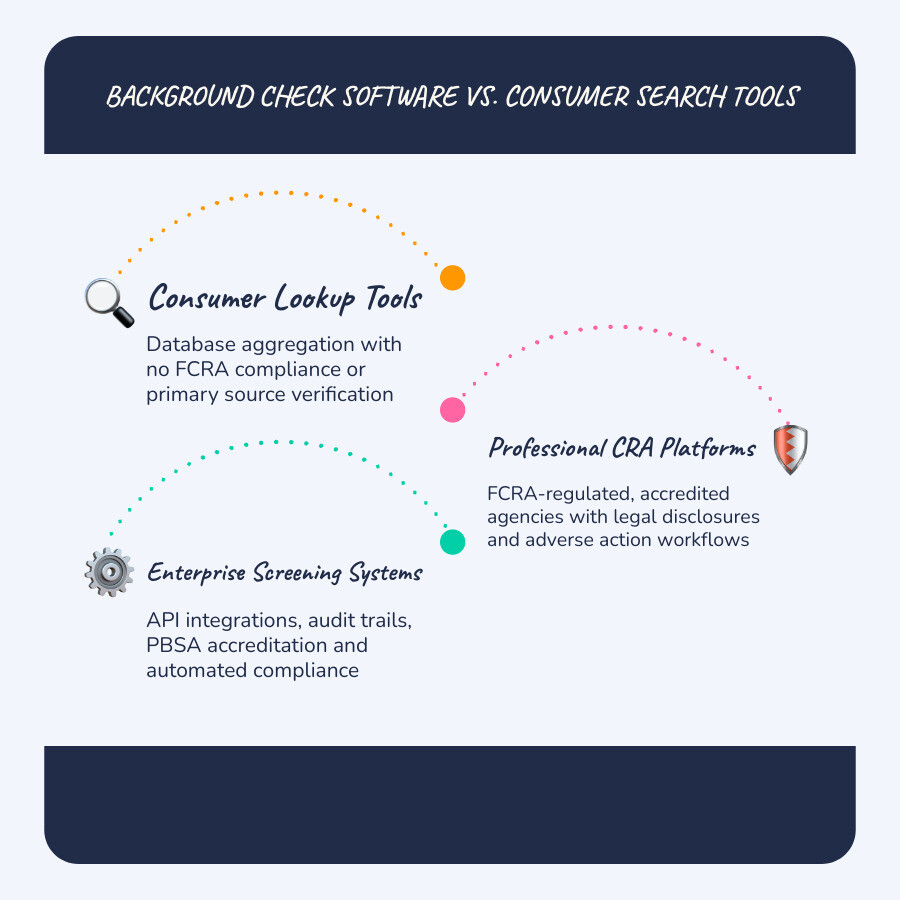
Before you begin evaluating specific platforms, you must understand a critical legal distinction: the difference between a Consumer Reporting Agency (CRA) and a consumer lookup or "people search" tool.
Consumer search websites (such as TruthFinder, BeenVerified, and Spokeo) compile publicly available records from various databases. They are designed for casual lookup and explicitly state in their terms of service that they are not compliant with the Fair Credit Reporting Act (FCRA). Under federal law, you cannot use these tools to make decisions regarding employment, housing, or insurance. Doing so exposes your organization to severe regulatory penalties and class-action lawsuits.
Professional background check software operates as an FCRA-compliant CRA. These platforms do not rely solely on aggregated historical databases, which are often outdated or incomplete. Instead, they perform primary source verification, querying direct courthouse records, state registries, and federal databases to ensure the information returned is accurate, up-to-date, and legally actionable.
When you use professional screening software, you are not just buying data; you are implementing a structured compliance workflow that manages candidate consent, handles legally mandated disclosures, and guides you through the adverse action process. For a complete breakdown of what to look for in a professional-grade screening system, read The Comprehensive Guide to Choosing the Right Pre-Employment Screening Software.
Key Features to Evaluate in a Background Check Software Comparison & Alternatives
Evaluating background check vendors requires you to look beyond simple feature checklists. You need to understand how each platform handles the practical realities of your daily hiring operations.

When conducting a background check software comparison & alternatives review, prioritize these three areas:
- Configurable Screening Packages: Your screening needs change based on the role. A healthcare worker requires license verification and OIG/SAM sanctions checks; a delivery driver needs a motor vehicle record (MVR) search; an executive requires deep reference and education verification. Your software should allow you to build and deploy role-specific packages in a few clicks.
- Candidate Experience: More than 70% of job seekers will abandon an application workflow if it takes longer than 15 minutes to complete. Because mobile devices account for over two-thirds of job applications across all industries, your screening portal must be mobile-friendly, requiring minimal data entry and allowing candidates to sign disclosures and upload documents easily from their phones.
- Turnaround Time Distribution: Do not rely on "average" turnaround times provided by sales teams. A vendor might claim an average turnaround of 24 hours because 80% of database checks clear instantly, while the remaining 20% of county-level courthouse searches take two weeks. Ask for the distribution: What percentage of checks are completed within 24, 48, and 72 hours?
To see how these features fit into a broader talent acquisition strategy, check out our guide on the Best Pre-Employment Screening Software.
Compliance and Speed in Background Check Software Comparison & Alternatives
Compliance is the foundation of any background screening program. If your software does not enforce the correct legal sequence for disclosures, authorizations, and adverse actions, your organization is exposed to class-action litigation.
Your provider should hold accreditation from the Professional Background Screening Association (PBSA) and maintain SOC 2 Type 2 certification to guarantee strict data security. For detailed guidance on federal requirements, consult the FTC Guidance on Employment Background Checks. If you run a high-volume staffing agency with complex compliance requirements, you can find specialized strategies in The Best Compliance Platforms for Modern Staffing Agencies.
Integration Capabilities for Background Check Software Comparison & Alternatives
Your background check software should not operate in a silo. Running checks manually by copying and pasting candidate data from your Applicant Tracking System (ATS) or Human Resource Information System (HRIS) into a separate screening portal is slow and prone to data-entry errors.
Look for platforms that offer native, pre-built integrations with major ATS and HRIS providers. When these systems are connected, your recruiters can initiate a background check directly from the candidate's profile in your ATS. The system automatically sends the screening invitation to the candidate, tracks the progress in real time, and pulls the completed report back into your primary dashboard.
If you use custom-built software, ensure the vendor provides a robust, well-documented API that allows your development team to build custom workflows. To see how screening integrations fit into the broader onboarding ecosystem, read our Best HR Onboarding Software Comparison Guide.
Comparing the Top Background Check Software Alternatives
To help you navigate your options, we have analyzed the leading background check platforms, grouping them by their target market and technological approach. For an exhaustive breakdown of the market, read our Best Background Check Companies for Employers in 2026: Complete Comparison Guide for Hiring Success.
Modern API-First Platforms: Checkr and GoodHire
Modern platforms are designed to automate high-volume hiring workflows through technology and candidate-focused design.
- Checkr: Known for its developer-friendly API, Checkr powers screening for many of the largest gig-economy platforms. It uses artificial intelligence to classify records and speed up turnaround times. However, smaller employers occasionally report that customer support can feel distant, relying heavily on automated ticketing systems rather than dedicated account managers.
- GoodHire (a Checkr company): GoodHire is designed for small to mid-sized businesses that need an intuitive, out-of-the-box solution. It features an exceptionally clean user interface and guides recruiters through the FCRA compliance process. Because it is owned by Checkr, it shares much of the same backend infrastructure.
Legacy Enterprise Providers: HireRight, Sterling, and First Advantage
These legacy vendors have been industry staples for decades. They excel at managing complex, global screening programs for enterprise-level organizations, but they are often criticized for clunky user interfaces and slower implementation timelines.
- HireRight: A massive global provider with deep integrations into enterprise ATS platforms like Workday and Oracle. HireRight is highly capable for international screenings but tends to receive lower marks from users on G2 and Capterra for its candidate portal usability and slower turnaround times on manual county searches.
- Sterling: Sterling offers robust case management tools and deep US courthouse coverage. It is a reliable choice for large organizations that need consistent, audited screening programs. Like HireRight, Sterling's technology can feel dated compared to modern API-first platforms.
- First Advantage: Following its acquisition of Sterling, First Advantage is one of the largest screening providers in the world. It is highly suited for multinational enterprises that require specialized services like FBI fingerprinting and advanced compliance analytics. However, organizations undergoing this vendor integration may experience service delays or account team transitions.
If you are currently using one of these legacy systems and find yourself frustrated by slow turnaround times or manual processes, discover Why Vetty is the Smarter Alternative to Legacy Background Check Vendors.
Mid-Market and Specialized Alternatives: Accurate Background and KarmaCheck
These platforms occupy the middle ground, offering a balance of modern technology and high-touch customer support.
- Accurate Background: Accurate stands out for its commitment to customer service, offering true 24/7/364 support. It is purpose-built for global employers, utilizing a dynamic compliance engine to handle complex regional screening rules.
- KarmaCheck: Built specifically to address the needs of healthcare credentialing and staffing agencies, KarmaCheck focuses on speed and real-time status tracking. It is a strong alternative for teams that need to verify professional licenses and medical sanctions rapidly.
Frequently Asked Questions About Background Screening
What is the difference between a database search and a primary source check?
A database search queries pre-compiled, aggregated records. While these searches return results almost instantly, they are often outdated and may contain errors or omit recent record expungements. A primary source check involves querying the actual source of the record — such as a county courthouse, state registry, or federal database. Primary source checks are highly accurate and legally compliant, though they can take one to three business days depending on courthouse access.
How does background check software automate FCRA compliance?
The software guides both the recruiter and the candidate through a legally mandated sequence. It automatically presents the candidate with standalone disclosure forms, captures electronic consent, tracks state-specific lookback limits, and manages the pre-adverse and final adverse action workflows, including the required waiting periods for disputes.
What are the typical pricing models for background check software?
Most professional screening platforms offer two primary pricing structures:
- Pay-per-check (Transactional): You pay a set fee for each background check you run, which is ideal for small businesses or organizations with fluctuating hiring volumes.
- Volume-based subscriptions: You commit to a minimum annual or monthly volume in exchange for lower per-check rates. This is best for high-volume staffing agencies, healthcare networks, and gig platforms.
Conclusion
Choosing the right background check software is a balance of speed, compliance infrastructure, and candidate experience.
If you are managing high-volume hiring in healthcare, staffing, or the gig economy, you cannot afford to let slow screenings and manual onboarding workflows delay your time-to-hire. Vetty is the premier choice for high-volume smartphone-based verification, solving these operational bottlenecks by combining screening, onboarding, and ongoing compliance into a single, intuitive dashboard:
- VettyVerify: Deploy fast, PBSA-accredited, and SOC 2 Type 2 certified background checks in just two clicks.
- VettyOnboard: Streamline document collection, e-signatures, I-9 verifications, and custom onboarding workflows through a mobile-friendly portal.
- VettyComply: Protect your organization post-hire with continuous monitoring for criminal activity, motor vehicle records, and healthcare sanctions (OIG/SAM).
Consider how on-demand platforms scale their operations. For example, the pet-care marketplace Wag! used Vetty to streamline their trust and safety workflows, allowing them to onboard thousands of pre-screened, compliant pet caregivers quickly while maintaining a secure platform. You can read the full details of their success on our case studies page.
To explore how modern screening technology can accelerate your hiring pipeline, read about The Most Efficient Hiring Acceleration Platforms for Gig Economy Companies.
To streamline your screening and onboarding workflows with a compliant, mobile-friendly platform, schedule a demo with Vetty today.