

How to reduce time to hire background checks through process optimization
Speed is the primary differentiator in the 2026 labor market. When background checks stall, you risk losing top-tier candidates to faster-moving competitors.
Compliance Checklist
Before initiating any background check, ensure your internal workflow includes these essential steps to remain compliant with the Fair Credit Reporting Act (FCRA) and state laws:
- Standalone Disclosure: Provide a clear, conspicuous written disclosure to the candidate in a standalone document.
- Written Authorization: Obtain express written or digital consent from the candidate.
- Summary of Rights: Provide the candidate with a copy of "A Summary of Your Rights Under the Fair Credit Reporting Act."
- State-Specific Notices: Include required notices for specific states regarding credit checks or criminal history.
- Pre-Adverse Action Process: Prepare a template for the mandatory waiting period if a report results in a potential rescinded offer.
| Feature | Manual Screening Workflow | Automated Screening Workflow |
|---|---|---|
| Data Entry | Manual re-entry of candidate info | Auto-populated from ATS/HRIS |
| Consent | Paper forms or emailed PDFs | Mobile-friendly digital signatures |
| Tracking | Emailing the vendor for updates | Real-time dashboard visibility |
| Accuracy | High risk of typos/SSN errors | Validated data entry by candidate |
| Compliance | Manual tracking of FCRA forms | Automated disclosure & authorization |
Stage-by-Stage Hiring Breakdown
- Integration: Candidate data syncs from the ATS to the screening platform.
- Collection: Candidate receives a mobile-link to provide PII and digital signature.
- Processing: The system queries digitized records and dispatches researchers for manual files.
- Adjudication: HR reviews the report against internal hiring standards.
- Finalization: The candidate is cleared for onboarding or the adverse action process begins.
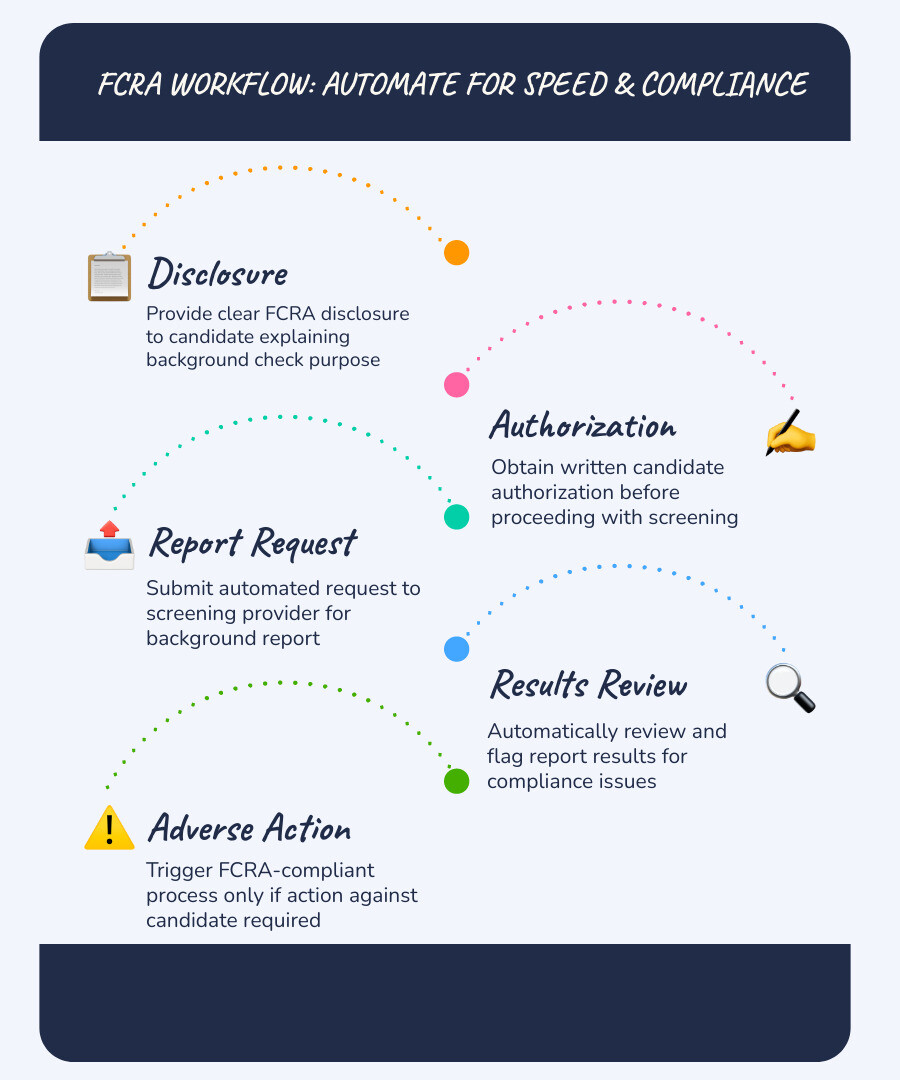
FCRA Workflow
To maintain speed and compliance, your system should automate this sequence:
Disclosure > Authorization > Report Request > Results Review > Adverse Action (if required).
Audit Your Packages to Reduce Time-to-Hire
One of the most common "self-inflicted" delays is over-screening. Running a comprehensive executive-level screen for an entry-level warehouse position doesn't just cost more; it takes longer. Every additional layer adds potential days to the timeline.
To accelerate your process, audit your current requirements and create tiered, role-based packages:
- Basic Tier: For roles with minimal risk (Criminal, SSN Trace, Sex Offender Registry).
- Standard Tier: For mid-level or customer-facing roles (Basic + Employment & Education Verification).
- Specialized Tier: For high-risk or regulated roles (Standard + MVR, Professional Licenses, or Healthcare Sanctions).
By aligning the depth of the search with the actual risk of the position, you avoid waiting on third-party verifications that aren't necessary for the role. Learn more about staffing agency background check solutions to see how tiered packages function at scale.
Leverage ATS Integrations for Near Real-time Visibility
Administrative switching is a silent killer of productivity. When your systems aren't synced, data must be moved manually, which leads to typos in Social Security numbers or birth dates. These small errors can trigger a "no match" or a dispute, adding days of back-and-forth communication.
A modern pre-employment screening software should offer a seamless integration that allows you to:
- Initiate a check with one click directly from the candidate's profile.
- Receive real-time status updates within your ATS.
- Eliminate the need for candidates to provide the same information twice.
Optimize the Candidate Experience to Prevent Delays
Research shows that over 70% of job seekers will abandon an application if it takes longer than 15 minutes. The same logic applies to the screening phase. If you send a candidate a clunky, non-mobile-friendly link, you've just added 24 to 48 hours of friction.
The fastest results come from mobile-friendly forms. Candidates are significantly more responsive to text alerts and mobile links. Providing a "drop-off resistant" UX ensures the candidate provides their info immediately, allowing the check to start while the hire is still excited about the offer.
Strategic Partnerships and Modern Screening Technology
The provider you choose is the foundation of your hiring speed. Many legacy providers still rely on manual researchers and paper-based processes that can't keep up with modern hiring demands.
Common Mistakes in Provider Selection
- Relying on "Instant" Checks: Be wary of providers promising instant results for every check. Truly compliant, thorough criminal searches often require accessing county court records.
- Missing FCRA Notices: Using a provider that doesn't automate the delivery of the Summary of Rights or state-specific notices creates a massive compliance liability.
- Manual Follow-ups: If your team has to call the provider to ask for a status update, the provider’s technology is failing you.
Good vs. Bad Screening Comparison
| The "Old" Way (Bad) | The Modern Way (Good) |
|---|---|
| Paper-based or PDF consent | Mobile-friendly digital links |
| One-size-fits-all screening | Tiered, role-based packages |
| Siloed from your ATS | Fully integrated data sync |
| Manual adverse action letters | Automated compliance workflows |
| Opaque timelines | Near real-time visibility into delays |
Mitigating External Bottlenecks in Criminal Record Retrieval
While technology can solve many delays, some bottlenecks are external. For example, some county courts in the U.S. do not have digitized records and require a "court runner" to manually pull files.
A high-quality screening partner mitigates this by:
- Using automated data access for the 2,100+ sources that are digitized.
- Employing a network of dedicated, certified researchers to handle manual pulls quickly.
- Providing transparent status updates so you know exactly which court is causing a delay.
Understanding how long a background check takes based on the specific type of search allows you to set realistic expectations with your hiring managers and candidates.
Implementing Role-based Screening to Reduce Time-to-Hire
To truly reduce time to hire background checks, you must standardize what you are looking for based on the job description.
- For Drivers: Prioritize Motor Vehicle Record (MVR) checks which are often instant or returned within 24 hours.
- For Healthcare: Focus on healthcare sanctions (OIG/SAM) to ensure immediate compliance.
- For Finance/Executive Roles: These require deeper dives into employment verification , which remains a manual process for many employers in 2026.
By automating these role-based requirements, you ensure that no time is wasted on "over-screening" or forgetting a critical check that needs to be added later.
Conclusion and Next Steps for Your Hiring Workflow
Reducing your time to hire is about removing the administrative friction that keeps your team from moving fast. By auditing your packages, integrating your technology, and prioritizing the candidate experience, you turn a notorious bottleneck into a competitive advantage.
Vetty provides a streamlined platform for these requirements. As a PBSA-accredited and SOC 2 Type 2 certified provider, we offer VettyVerify™ , VettyOnboard™ , and VettyComply™ to help teams manage screening and onboarding in a single dashboard.
Whether you are a staffing firm managing high-volume placements or a tech company scaling a remote workforce, our mobile-friendly setup allows you to deploy compliant checks in just two clicks. We’ve helped organizations like Paramount Staffing significantly speed up their placements and eliminate the "silent killers" in their hiring pipelines.
To see how an all-in-one platform can eliminate your hiring bottlenecks and secure top talent faster, visit https://www.vetty.co/start today.