

Why FCRA Requirements for Employers Background Checks Matter More Than Ever
Compliance Checklist
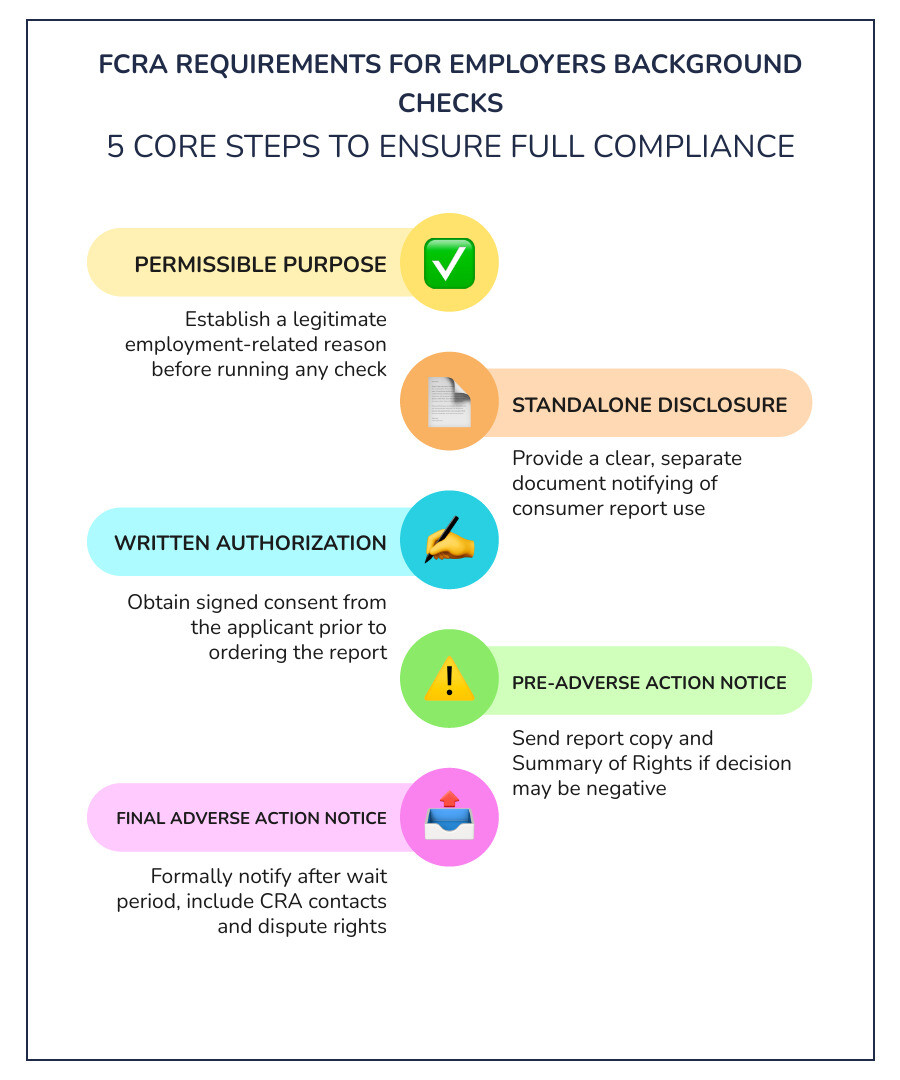
FCRA requirements for employers background checks come down to five core obligations every HR team must follow:
- Establish a permissible purpose — you must have a legitimate employment-related reason to run a background check
- Provide a standalone written disclosure — a clear, separate document (not bundled with your application) that tells the applicant a consumer report may be obtained
- Obtain written authorization — a signed consent from the applicant before you order any report
- Send a pre-adverse action notice — if the report may lead to a negative hiring decision, provide the applicant a copy of the report and a Summary of Rights before acting
- Send a final adverse action notice — after a reasonable waiting period, formally notify the applicant of the decision and include the consumer reporting agency's contact information and their right to dispute
If you get these five steps right — consistently, every hire — you're in solid shape under federal law.
Here's the reality: most FCRA violations aren't the result of bad intent. They happen because a disclosure form has one extra line that shouldn't be there, or an adverse action notice gets skipped in a fast-moving hiring cycle, or someone assumes the background check vendor is handling steps that the employer is legally responsible for.
The consequences are real. FCRA lawsuits have risen 125% since 2014, with 1,681 filed in just the first quarter of 2026 alone. Class action settlements have reached into the millions — including a $7.5 million settlement from a ride-share company over improper notices and a $5 million settlement from an internet retailer for bundling its disclosure with other application materials.
This guide gives you a clear, practical framework for every stage of the background check process — from disclosure to adverse action — so your team can move confidently without the legal guesswork.
FCRA Workflow: Stage-by-Stage Hiring Breakdown
The Fair Credit Reporting Act (FCRA) governs how you collect and use "consumer reports" for employment purposes. In hiring, this includes any communication by a Consumer Reporting Agency (CRA) regarding an individual's credit, character, or reputation. If you hire a third party for criminal checks, employment verification, or driving records, you must follow FCRA requirements for employers background checks.
Understanding the Key Players
- Consumer Reporting Agency (CRA): The third-party service provider that assembles the report.
- User (The Employer): You, the entity using the report to make a hiring, promotion, or retention decision.
- Consumer (The Applicant/Employee): The individual whose background is being screened.
| Feature | Standard Consumer Report | Investigative Consumer Report |
|---|---|---|
| Information Source | Databases, court records, credit files | Personal interviews with neighbors, friends, or associates |
| Content | Criminal history, credit score, driving records | Subjective info on character, reputation, and lifestyle |
| Disclosure Requirement | Standard standalone disclosure | Additional specific notice within 3 days of request |
| Subject Rights | Right to copy and summary of rights | Right to request "nature and scope" of the investigation |
Stage 1: Disclosure and Authorization
Before ordering a check, you must provide a "clear and conspicuous" written disclosure. This notice must inform the applicant that you intend to obtain a consumer report for employment purposes.
Second, you must receive written authorization. Modern hiring often uses mobile-friendly forms for electronic signatures. For a deeper look at the fundamentals, see our guide on background checks for employees.
Stage 2: The Standalone Document
The "standalone" requirement is the most litigated aspect of the FCRA. Federal courts and the Federal Trade Commission (FTC) are strict: the disclosure document must consist solely of the disclosure.
Common mistakes that lead to multi-million dollar settlements include:
- Including a liability waiver.
- Adding a certification that application info is true.
- Including "at-will" employment language.
- Burying the disclosure in a long application.
As the FTC advises, "less is more."
Stage 3: Investigative Reports and State Law Intersections
If screening involves personal interviews, it's an "Investigative Consumer Report," requiring higher disclosure. You must notify the applicant in writing and inform them of their right to request the nature and scope of the investigation.
You must also navigate state-specific mandates. For example, the California Investigative Consumer Reporting Agencies Act (ICRAA) requires separate disclosures. "Ban-the-Box" laws in over 35 states restrict when you can ask about criminal history. Stay updated on these legislative shifts in employee screening.
Navigating the Adverse Action Workflow and Common Mistakes
When a background check returns information that makes you hesitate to hire, you enter the "Adverse Action" phase.
The Two-Step Adverse Action Process
Step 1: Pre-Adverse Action Notice Before taking final action, you must provide the candidate with:
- A notice that you are considering adverse action based on the report.
- A copy of the actual consumer report.
- A copy of "A Summary of Your Rights Under the Fair Credit Reporting Act."
Step 2: The Waiting Period You must give the applicant a "reasonable" amount of time to review the report. The FTC and most legal experts suggest at least five business days.
Step 3: Final Adverse Action Notice If you proceed with rejection, you must send a final notice including:
- The name, address, and phone number of the CRA.
- A statement that the CRA did not make the hiring decision.
- Notice of the individual's right to a free copy of the report within 60 days and their right to dispute it.
For specialized fields, see healthcare background check requirements.
Common Mistakes in FCRA Requirements for Employers Background Checks
Under the FCRA, "willful" violations can result in statutory damages of $100 to $1,000 per violation, plus punitive damages.
- The Salvation Army Case: Settled for $1.87 million over allegations of improper disclosure forms.
- Ride-Share Settlement: A $7.5 million resolution regarding improper notices.
- Retailer Settlement: A $5 million agreement because the disclosure was "lumped" with other provisions.
These cases highlight the need for pre-employment screening software that aligns with current court interpretations.
Good vs. Bad: Evaluating Your Screening Documentation
Avoid "blanket exclusions." The EEOC requires an "individualized assessment."
The "Bad" Approach:
- Using a disclosure form that includes a liability waiver.
- Rescinding an offer via phone immediately without a pre-adverse notice.
- Having a policy that states "No felons allowed."
The "Good" Approach (The EEOC Three-Factor Test): When reviewing a criminal record, consider:
- The nature and gravity of the offense.
- The time that has passed since the offense.
- The nature of the job held or sought.
By documenting this assessment, you demonstrate that your decision was job-related and consistent with business necessity.
To ensure your hiring process remains efficient and fully compliant with federal law, explore how a mobile-friendly platform can automate your workflows at https://www.vetty.co/start.
Conclusion
Navigating FCRA requirements for employers background checks involves stripping back disclosure forms to the bare essentials and respecting the two-step adverse action process.
At Vetty, we help HR teams manage these workflows. Our platform, including VettyVerify™ for compliant checks and VettyComply™ for post-hire monitoring, is designed to support FCRA and EEOC requirements. Whether you are in healthcare, tech, or the gig economy, we provide the visibility and mobile-friendly experience your workforce expects.
Ready to simplify your screening process? Request a demo and see why Vetty is the smarter alternative for compliant hiring.