

Operationalizing Continuous Monitoring for Post-Hire Risk Management

Continuous monitoring background checks employers utilize today are fundamentally different from the one-time pre-employment screen your HR team has used for decades. This gap often creates significant organizational risk.
Quick Compliance Checklist Before You Launch:
- [ ] Standalone disclosure document (separate from the job application)
- [ ] Written employee authorization for ongoing monitoring
- [ ] Evergreen or separately obtained consent specifying continuous scope
- [ ] Documented adverse action protocol (pre-adverse notice, dispute period, final notice)
What is continuous monitoring in employee background checks?
- It is an automated, ongoing process that scans employee records after hire — not just before.
- It alerts you when new criminal charges, license suspensions, professional sanctions, or watchlist hits appear.
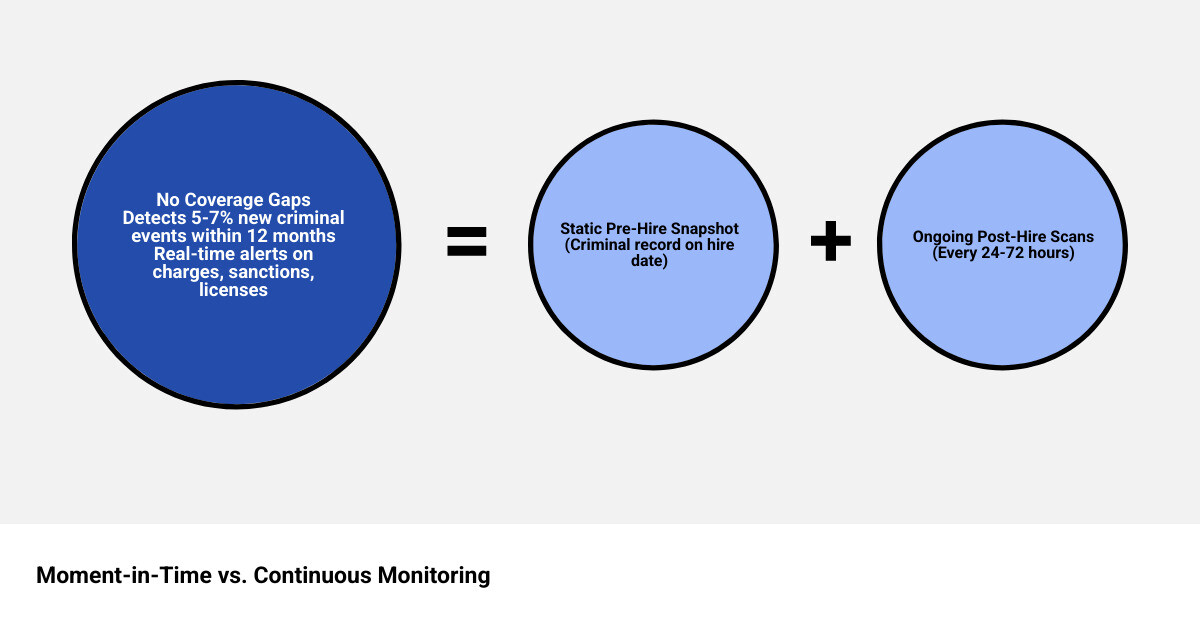
- It runs in the background without manual effort, typically checking records every 24–72 hours.
- It is FCRA-compliant when paired with proper employee disclosure and written consent.
- It fills the blind spot between your hire date and your next scheduled rescreen — which, for most employers, never comes.
Operational data indicates that only 19% of employers conduct any form of post-hire background check. This means 81% of organizations are operating on a static snapshot — a picture of who someone was on their first day, not who they are now.
That snapshot starts aging the moment you extend an offer. Research suggests that 5–7% of employees experience a reportable criminal event within 12 months of being hired. For a workforce of 1,000 people, that is potentially 50–70 incidents your team would never know about without ongoing screening in place.
The Operational Case for Continuous Monitoring
For HR executives and operations directors, the primary driver for ongoing screening is the mitigation of negligent retention. If an employee commits a crime or loses a required certification post-hire and you remain unaware, your organization may be held liable for any resulting damages.
Workplace misconduct is on a sharp upward trajectory, with a 50% increase in general misconduct and a 180% increase in threats reported in 2025. Furthermore, approximately 26% of workplace violence incidents are committed by current employees. Relying on a check from three years ago does little to protect your current staff or customers.
In regions like Cedar Park, TX, businesses often look to local resources such as the Employment Background Check near Cedar Park, TX - BBB to find reputable partners, but the technology behind the screening determines your real-world protection.
Good vs. Bad: Periodic Rescreening vs. Continuous Monitoring
| Feature | Periodic Rescreening | Continuous Monitoring |
|---|---|---|
| Frequency | Annual or Bi-annual | Near real-time (Daily/Monthly) |
| Risk Gap | Up to 364 days | 24–72 hours |
| Admin Effort | High (Batching/Re-consenting) | Low (Automated/Subscription) |
| Cost Structure | Per-check fee | Per-employee monthly subscription |
| Best For | Low-risk, stable roles | Safety-sensitive/Regulated roles |
The Continuous Monitoring Stage-by-Stage Breakdown:
- Enrollment: Employees are added to the monitoring roster via an HRIS sync or CSV upload.
- Scanning: The system scans thousands of jurisdictions, court records, and registries in the background.
- Alerting: If a record match is found, the system verifies the identity and triggers an alert.
- Review : HR reviews the findings and follows the internal adverse action policy.
Continuous monitoring closes the gap by focusing on three critical areas: criminal activity, motor vehicle records (MVR), and professional sanctions. This is essential for criminal monitoring in hiring and maintaining a safe environment. By moving away from static checks, you transition to a proactive stance that supports broader employee monitoring for compliance and risk management goals.
In healthcare, monitoring is a regulatory mandate. To maintain Medicare and Medicaid eligibility, organizations must ensure staff are not on healthcare sanction lists. Healthcare sanctions monitoring provides the automated oversight needed to avoid CMS fines. In transportation, Motor Vehicle Records monitoring explained highlights the need to know the moment a driver's CDL is compromised.
Implementing a Compliant Monitoring Workflow
Implementation requires a robust legal framework. You must ensure your disclosure and authorization forms include evergreen language, meaning the employee consents to checks throughout the duration of their employment. For a deeper dive into choosing the right cadence for your team, see Continuous Background Checks Vs. Annual Rescreening Which Is Right For Your Business.
The FCRA Workflow for Continuous Monitoring
If you use information from a monitoring service to take an adverse action, follow this process:
- Permissible Purpose: You must have a valid business reason to monitor the individual.
- Roster Maintenance: You must remove former employees from your monitoring list immediately to avoid violations.
- The Dispute Period: Employees must be given a reasonable amount of time (typically 5–7 business days) to dispute the accuracy of the alert before a final decision is made.
Understanding continuous criminal monitoring vs. one time background checks is the first step in building a workflow that protects the company without infringing on worker rights.
Common Mistakes in Post-Hire Screening
- Stale Rosters: Failing to sync your monitoring list with your payroll or HRIS, leading to unnecessary costs and legal liability.
- Blanket Disqualifications: Having a policy that mandates immediate firing for any arrest, which often violates EEOC guidance.
- Manual Tracking: Trying to manage license expirations or OIG checks in a spreadsheet, which is prone to human error.
- Ignoring State Laws: Some states require fresh consent for every check; your workflow must be geofenced to account for these variations.
- False Positives: Acting on an alert without verifying that the record actually belongs to your employee.
Effective employee monitoring for compliance and risk management requires automated tools that handle the verification heavy lifting for you.
Integrating Monitoring into Your HR Tech Stack
Modern operations directors require a set-it-and-forget-it approach. Platforms like Vetty allow you to manage the entire lifecycle from a single, mobile-friendly dashboard.
- VettyVerify™: Handles the initial, fast, and compliant pre-employment checks.
- VettyOnboard™: Collects the initial evergreen consents and digital signatures.
- VettyComply™: Automatically transitions the hire into the continuous monitoring pool.
With API integrations and automated roster sync, the system adds new hires and removes terminated employees without manual intervention. This no-code customization ensures that your monitoring parameters match your specific risk profile.
Conclusion: Building a Culture of Accountability
Transitioning to continuous monitoring background checks employers can trust is about building a culture of transparency. When employees know that safety and compliance are monitored in real-time, it reinforces the organization's commitment to a secure workplace. By partnering with a PBSA-accredited and SOC 2 certified provider, you ensure that your data is handled with the highest security standards. Leading organizations have already recognized that the moment-in-time check is no longer enough for a modern workforce. Transitioning to a proactive risk strategy ensures your organization remains protected long after the initial hire. Learn more about securing your workforce at https://www.vetty.co/start.