

Optimizing Your Hiring Workflow: A Guide for Talent Leaders
Compliance Checklist
Before refining your workflow, ensure your process meets these baseline standards:
- Standalone Fair Credit Reporting Act (FCRA) disclosure provided to every candidate.
- Written authorization obtained before initiating background checks.
- Two-step adverse action process.
- Secure, encrypted storage for sensitive candidate data.
- Mobile-friendly document submission to reduce friction.
- Defined owner for every stage from requisition approval through onboarding.
- Documented retention and access controls for screening and onboarding records.
In 2026, improving your hiring workflow is a high-leverage activity for talent acquisition leaders. A fragmented process does not just slow down operations; it increases the risk of losing qualified talent to employers that move with more discipline. If your requisitions sit in approval queues, interview panels drift, or screening begins too late, your team pays for that friction in lower acceptance rates and more manual follow-up.
The practical goal is not simply speed. It is a workflow that is predictable, compliant, and visible across recruiting, hiring managers, and operations. When each step has a clear trigger, owner, and service-level expectation, you reduce rework and make hiring capacity more scalable across locations, functions, and hiring volumes.
Core steps to improve your hiring workflow:
- Audit your current process to identify where candidates drop off or decisions stall.
- Standardize job descriptions and intake to align hiring managers early.
- Automate repetitive tasks like scheduling and screening triggers using an ATS.
- Reduce interview rounds to a maximum of three with defined purposes.
- Enforce response time SLAs for candidate contact.
- Integrate FCRA-compliant screening directly into the workflow.
- Streamline onboarding with digital document collection.
- Track metrics like time-to-hire and offer acceptance rates.
A useful operating model is to treat hiring as one connected workflow rather than separate recruiting, screening, and onboarding handoffs. That means requisition intake informs screening packages, screening status is visible before start-date planning, and onboarding tasks begin immediately after offer acceptance. For HR executives and operations directors, this kind of workflow discipline is what prevents hidden delays from compounding across the funnel.
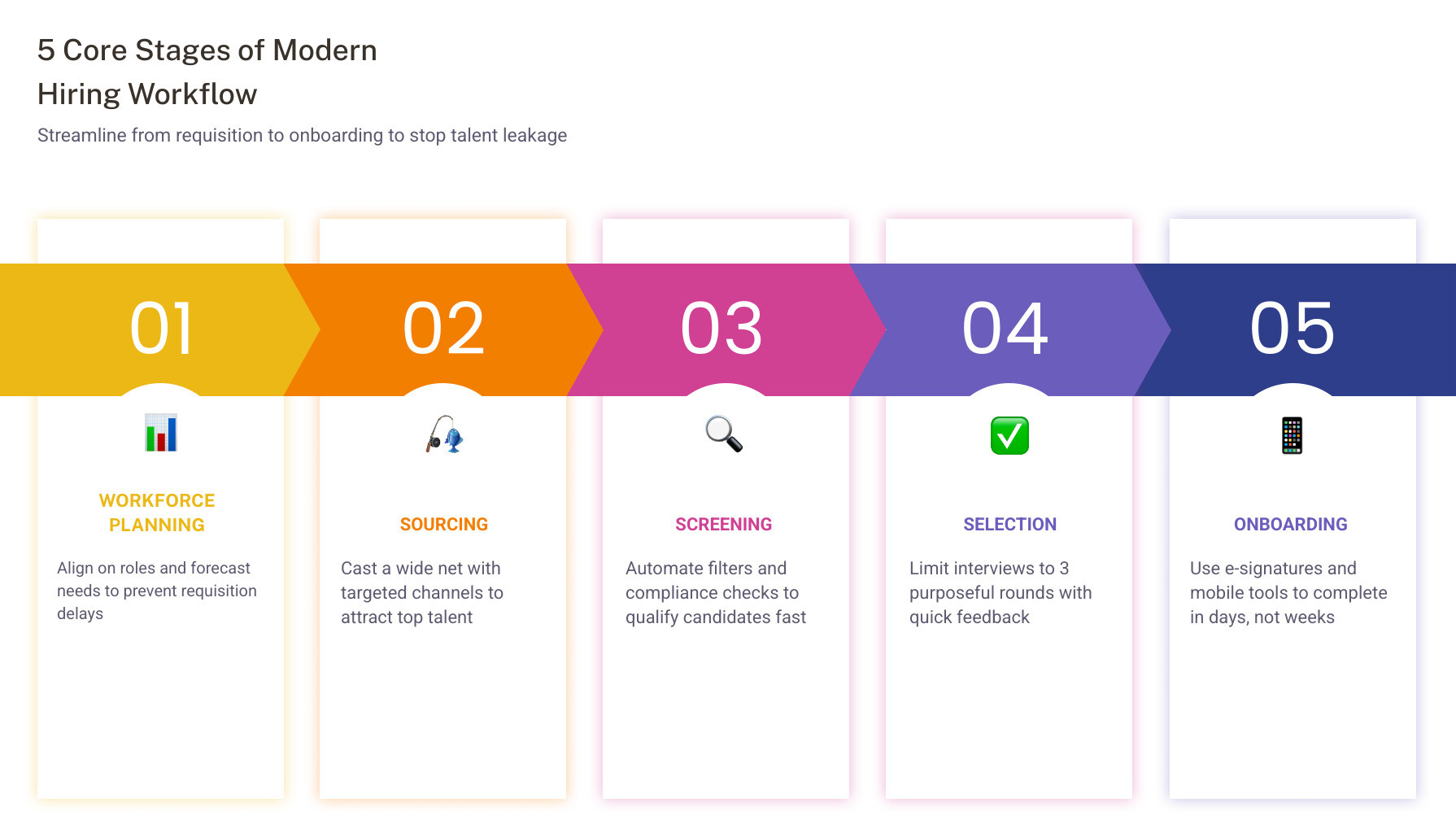
Stage-by-Stage Hiring Breakdown
Improving your hiring workflow requires moving away from reactive management toward a predictable system. A high-performing workflow ensures that every stakeholder knows exactly what happens next, what information is required, and how quickly a decision needs to be made.
- Workforce Planning & Requisition: Define the role, approval path, compensation range, and screening package before the job opens.
- Sourcing & Attraction: Build a pipeline through referrals, targeted outreach, and channel mix based on role type.
- Screening & Evaluation: Use automated triggers, structured interviews, and scorecards to reduce inconsistent decision-making.
- Selection & Offer: Move from debrief to decision quickly using defined approval rules.
- Onboarding & Integration: Transition candidates using digital document collection and role-specific onboarding tasks.
The most effective hiring teams assign a measurable output to each stage. For example, requisitions should move from approval to posting within a defined window, interview feedback should be submitted the same day, and screening should start immediately after the decision point that requires it. Without those operating rules, delays tend to hide inside email threads and manager calendars.
Auditing for Bottlenecks
You cannot fix what you have not measured. Most leaks happen in the white space between stages. Pull data from your last 20 to 30 hires and look at:
- Time-to-fill: Duration from requisition opening to start date.
- Drop-off rates: The specific stages where candidates withdraw. If it is after the first interview, your recruitment workflow may be too long.
- Requisition lag: Time taken to post an approved job.
- Interview-to-decision time: Days between final interview and decision communication.
- Offer-to-clear rate: How often accepted candidates stall during screening or onboarding.
As you review the data, separate structural issues from one-off exceptions. A single hiring manager delay is not the same problem as a workflow that requires too many approvals on every requisition. Focus first on repeatable delays that affect many roles, especially those tied to handoffs, duplicate data entry, or unclear ownership.
FCRA Workflow
Compliance should be an integrated part of your screening stage rather than a final hurdle. An efficient employment screening service workflow follows this US-regulated sequence:
- Disclosure: Provide a clear, standalone document to the candidate.
- Authorization: Obtain written consent via a mobile-friendly digital signature.
- Pre-Adverse Action: Notify the candidate and provide a copy of the report.
- Final Adverse Action: Send a formal notice after the mandatory waiting period.
Operationally, this workflow works best when it is standardized by role family and triggered directly from your recruiting process. That reduces off-process screening requests and helps ensure the right package is ordered at the right point, with fewer manual corrections later.
Mobile-friendly Onboarding
The period between offer acceptance and the first day is a high-risk window for ghosting. Traditional onboarding often requires significant manual labor. By automating employee onboarding with VettyOnboard, you can reduce administrative time and costs. A mobile-friendly onboarding workflow allows candidates to complete I-9 verifications, sign offer letters, and upload identification via a simple photo capture on their phones.
For operations leaders, the bigger advantage is control. When onboarding tasks, documents, and completion status are centralized, your team can spot issues before day one instead of discovering missing forms after the employee is supposed to start. That shortens ramp time and reduces preventable start-date slips.
Scaling Recruitment with Technology
Scaling in 2026 requires a tech stack that offers real-time visibility and no-code customization. This allows you to adapt your workflow for different roles without manual spreadsheets. The goal is to hire faster by removing calendar drag through automated scheduling and panel nudges.
For most organizations, the real constraint is not sourcing volume. It is coordination. As hiring increases, manual status checks, disconnected vendors, and duplicate data entry create operating drag that compounds with each open role. A unified system helps you standardize what should be standardized while still allowing role-based variation in screening, approvals, and onboarding steps.
Common Mistakes
- Over-interviewing: Research suggests that after three rounds, the amount of new information gained is negligible.
- Slow feedback loops: Reaching out within 1-3 days is critical; top talent is often gone within two weeks.
- Manual data entry: Moving data manually between tools creates bottlenecks and compliance risks.
- Vague job descriptions: Task-based descriptions lead to unqualified applicants clogging the funnel.
- Late screening initiation: Waiting until the last possible moment extends time-to-start and creates preventable surprises.
- No clear ownership: If recruiting, HR, and operations all assume someone else is handling the next step, progress stalls.
Good vs. Bad Comparison
| Feature | Bad Experience (Manual/Legacy) | Good Experience (Automated/Mobile) |
|---|---|---|
| Accessibility | Paper forms or desktop-only portals | 100% mobile-friendly interface |
| Transparency | Candidate is left wondering about status | Real-time status updates for the candidate |
| Speed | 7-10 days for manual verification | Near-instant results for many checks |
| Communication | Silence until a problem arises | Automated updates and next steps |
| Data Privacy | Emailing sensitive documents | Secure, encrypted portal uploads |
A positive onboarding experience starts with a verification process that feels organized and transparent. When candidates can see progress and complete required steps without chasing instructions, they are less likely to withdraw during the final stretch.
Continuous Monitoring and Post-hire Compliance
For industries like healthcare and staffing, compliance is an ongoing requirement. Continuous criminal monitoring allows you to receive alerts for new activity or sanctions without requiring annual manual checks. This protects your organization's reputation and maintains high standards long after the initial offer.
The same principle applies to MVR checks and healthcare sanctions screening where ongoing visibility matters more than one-time clearance. If your organization operates in regulated or distributed environments, post-hire monitoring should be designed as part of the workforce risk model rather than treated as a separate administrative project.
By centralizing background screening and onboarding into a single, mobile-friendly dashboard, you can eliminate the friction that causes talent to look elsewhere. To see how VettyVerify, VettyOnboard, and VettyComply can support your 2026 hiring goals, get started with Vetty today.