

Why Healthcare Background Check Requirements Demand More Than a Basic Screen

Healthcare organizations operate in a highly regulated environment where hiring decisions directly impact patient safety, clinical outcomes, and federal funding. Unlike standard corporate roles, clinical and direct-care positions require rigorous verification across criminal histories, professional licensing boards, administrative abuse registries, and federal exclusion databases. Navigating these overlapping state and federal mandates demands a structured, defensible workflow that ensures total compliance while keeping clinical onboarding fast and efficient.
Healthcare Screening Compliance Checklist
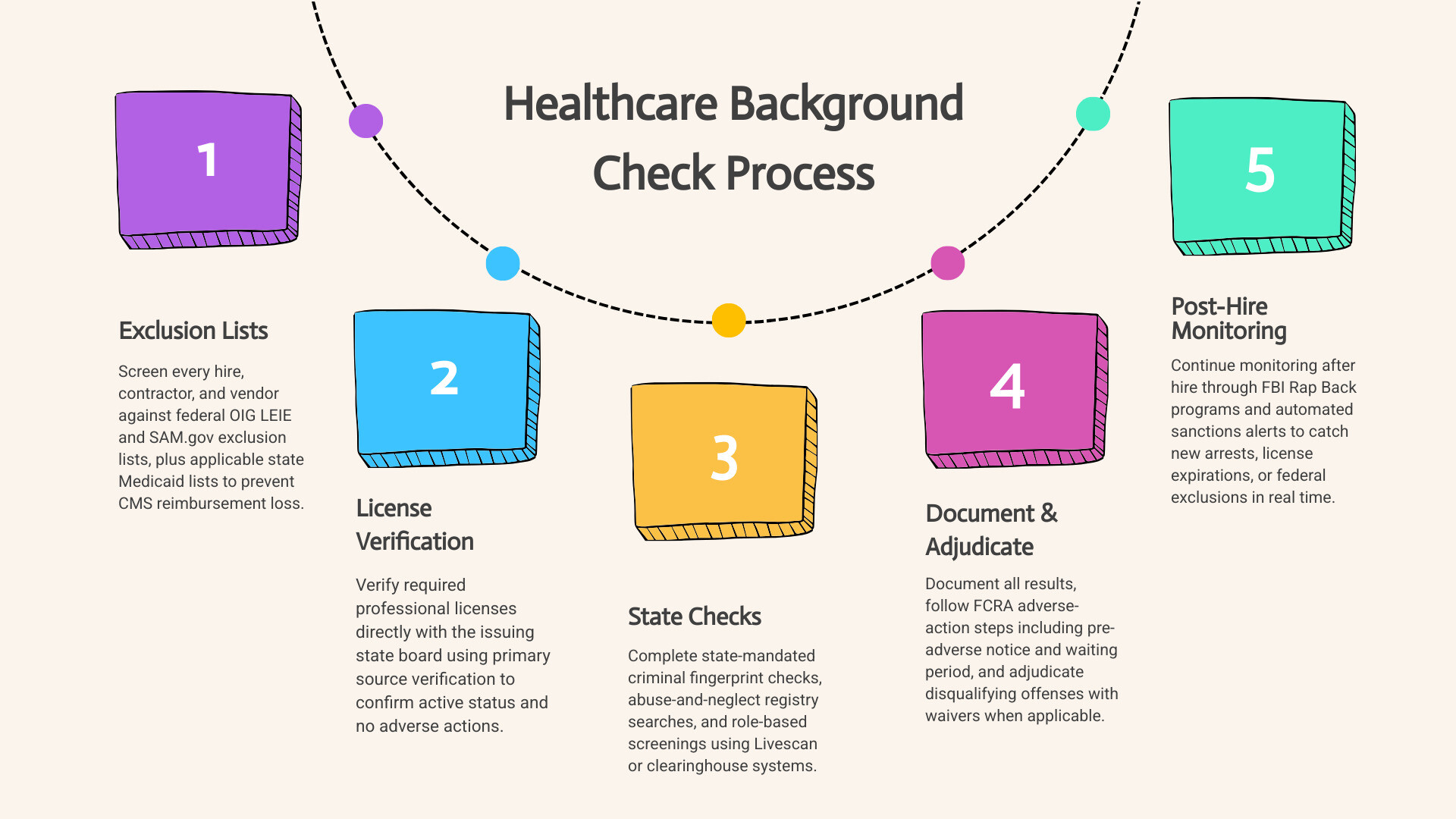
To build a compliant program in 2026, you should:
- Screen every relevant hire, contractor, and vendor against federal and applicable state exclusion lists.
- Verify required professional licenses directly with the issuing board.
- Complete state-required criminal, fingerprint, abuse-and-neglect, and registry checks based on the worker's role and work history.
- Document results, follow Fair Credit Reporting Act (FCRA) adverse-action steps, and continue monitoring after hire.
Healthcare employers face risks that standard employers often do not. A missed exclusion, expired license, abuse-registry finding, or later arrest can affect patient safety, reimbursement eligibility, facility licensure, and your organization’s reputation. Requirements also vary sharply by state, especially for direct-care roles and workers with access to vulnerable patients.
The practical goal is simple: create one role-based workflow that covers pre-hire screening, credential verification, required notices, and ongoing compliance checks without slowing down qualified hires. A modern platform such as VettyVerify, VettyOnboard, and VettyComply can bring those steps together in a mobile-friendly, all-in-one hiring acceleration and screening platform with self-serve setup, transparent pricing, real-time visibility, no-code customization, and PBSA and SOC 2 certified controls.
We'll walk you through the federal, state, and post-hire steps your healthcare screening program needs to address.
Core Pillars of Healthcare Background Check Requirements vs. Standard Screening
Standard commercial background checks typically focus on basic identity verification, county and national criminal record searches, and recent employment or education history. In standard corporate environments, these measures manage general workplace safety and resume accuracy.
In healthcare, the regulatory baseline is much higher. Screening programs protect vulnerable populations, safeguard controlled substances, and comply with strict state and federal reimbursement standards. Direct patient access changes legal liabilities; an unvetted hire can lead to medical malpractice claims, compromised patient safety, and immediate loss of accreditation.
To maintain compliance, you should understand how clinical screening diverges from standard corporate workflows:
| Screening Component | Standard Commercial Background Check | Healthcare Background Check Requirements |
|---|---|---|
| Identity Verification | SSN trace, address history | SSN trace, government photo ID, biometric fingerprinting |
| Criminal Records | County, state, and multi-jurisdictional name searches | Biometric FBI national check, state police clearinghouses, rap-back enrollment |
| Sanctions & Exclusions | Rarely included or limited to basic commercial lists | Mandatory federal OIG LEIE, SAM.gov, and state Medicaid exclusion lists |
| Professional Credentials | Basic education or certification checks | Primary source license verification, NPDB queries, expiration monitoring |
| Registry Checks | National sex offender public registry | CNA registries, Adult Protective Services (APS), Child Abuse Central Registries |
| Screening Cadence | Single point-in-time check during pre-hire onboarding | Pre-hire screening combined with monthly sanction screening and continuous arrest monitoring |
Understanding these fundamental differences is the first step in designing a resilient talent pipeline. For a deeper breakdown of overarching compliance protocols, review the comprehensive guide to healthcare background checks.
Federal Exclusion Lists and Sanction Screening Mandates
Federal law prohibits healthcare entities participating in federally funded programs from employing or contracting with excluded individuals. The primary exclusion databases include:
- OIG LEIE (Office of Inspector General List of Excluded Individuals/Entities):
Maintained under Sections 1128 and 1156 of the Social Security Act by the HHS OIG, this database lists individuals barred from Medicare, Medicaid, and all federal healthcare programs. Exclusions fall under two categories:
- Mandatory Exclusions: Mandated by law for convictions involving program-related fraud, patient abuse or neglect, felony healthcare fraud, or felony controlled-substance violations.
- Permissive Exclusions: Discretionary actions based on misdemeanor fraud, license revocation or suspension, defaulting on health education loans, or providing unnecessary or substandard care.
- SAM.gov (System for Award Management): Managed by the General Services Administration (GSA), this system tracks federal procurement debarments, government-wide contracts, and non-procurement exclusions across all executive agencies.
The Department of Health and Human Services (HHS) OIG issues explicit guidance requiring employers to screen their workforce—including clinical staff, administrative personnel, contractors, and governing boards—prior to hire and on a monthly basis thereafter.
Employing an excluded individual carries severe financial risks. Federal authorities enforce civil monetary penalties starting at a statutory base of $10,000 per item or service, adjusted annually for inflation, in addition to treble damages under the False Claims Act and potential program exclusion. Review the detailed instructions on screening OIG, SAM, and state exclusion lists to standardize your pre-hire search protocols.
Professional License Primary Source Verification and NPDB Queries
Secondary documentation, such as a paper license copy or resume disclosure, is insufficient for professional clinical roles. Healthcare employers must perform Primary Source Verification (PSV) by directly querying the state licensing board that issued the credential.
PSV confirms:
- Current license status (active, probation, suspended, revoked, or expired).
- License type, scope of practice, and expiration dates.
- History of disciplinary actions, public reprimands, or board restrictions.

For licensed practitioners (physicians, dentists, physician assistants, and advanced practice nurses), facilities must query the National Practitioner Data Bank (NPDB). The NPDB captures adverse licensure actions, clinical privilege restrictions, professional society reprimands, and medical malpractice payment reports. Under Joint Commission and CMS credentialing guidelines, querying the NPDB is mandatory during initial medical staff credentialing and must be repeated at reappointment, typically every two years.
State Abuse Registries and Multi-Jurisdictional Healthcare Background Check Requirements
Criminal record databases capture formal arrests and convictions, but they frequently miss administrative findings of abuse, neglect, or misappropriation of resident property. State departments of human services and public health track these findings in dedicated administrative registries.
When screening direct-care workers, certified nursing assistants (CNAs), and home health aides, employers must check:
- Certified Nurse Aide Registries: Documented findings of resident abuse, neglect, or property theft in long-term care settings.
- Adult Protective Services (APS) Registries: Substantiated reports of elder abuse, vulnerable adult exploitation, or domestic neglect.
- Child Abuse Central Registries: Child abuse and neglect tracking systems maintained by state child welfare agencies.
Because healthcare professionals frequently move across state lines or work in travel nursing assignments, single-state checks leave substantial blind spots. A candidate disqualified for patient abuse in one jurisdiction may appear clean on an adjacent state’s registry. Employers should cross-reference registries in every jurisdiction where the candidate has lived, trained, or worked over the past five to seven years. Failing to verify these registries creates operational exposure; review the guide on state Medicaid exclusion list screening to address multi-jurisdictional compliance gaps.
State-Specific Healthcare Worker Screening Laws and Fingerprint Mandates
While federal mandates govern program exclusions, individual states establish their own statutes governing criminal history checks, biometric fingerprint requirements, and registry screenings for healthcare workers.
Name-based criminal background searches rely on an applicant's stated name, date of birth, and Social Security number. While useful for rapid initial screening, they can be bypassed by intentional alias use, name variations, or fraudulent identifiers. Biometric fingerprint-based checks eliminate identity ambiguity by querying the FBI’s Next Generation Identification (NGI) database and state police repositories directly through electronic fingerprint capture.

State-by-State Fingerprint Systems: Florida, Illinois, Hawaii, and Kentucky
Several states have enacted comprehensive statutory frameworks mandating fingerprint-based screening for direct patient-care personnel:
- Florida (AHCA Level 2 Screening): Florida Statute Chapter 435 and Rule 59A-35.090 mandate Level 2 background screening for employees in licensed healthcare facilities. Employers must register through the Agency for Health Care Administration (AHCA) Care Provider Background Screening Clearinghouse and submit fingerprints through an approved electronic fingerprinting provider. Facilities must maintain a signed Attestation of Compliance (AHCA Form 3100-0008) in employee records.
- Illinois (Health Care Worker Background Check Act): 225 ILCS 46 requires fingerprint-based criminal history checks for direct-care workers across hospitals, nursing homes, and home health agencies. Employers initiate screening via the Illinois Health Care Worker Registry (HCWR) and submit electronic prints to the Illinois State Police within 10 working days of authorization. Conditional employment is permitted for up to three months pending results.
- Hawaii (HRS §§ 321-15.2, 346-97): Hawaii administrative rules (HAR 11-106) mandate fingerprint-based checks for direct patient-access employees and volunteers through designated state fingerprinting providers. Facilities must perform screening at hire and repeat checks annually or biennially, while also querying out-of-state nurse aide and sex offender registries for prior residences.
- Kentucky (National Background Check Program / KARES): Kentucky administrative regulations require long-term care providers, nursing pools, and home health agencies to utilize the Kentucky Applicant Registry and Employment Screening (KARES) portal. The program combines state and national fingerprint checks with mandatory OIG disclosures and retains fingerprints for five years for ongoing assessment. Employers may conditionally hire staff under direct supervision for up to 60 days pending final determination.
Navigating Disqualifying Offenses, Lookback Periods, and State Waiver Processes
State statutes define specific criminal offenses that bar individuals from direct-care employment. While exact offenses vary, mandatory disqualifications consistently include:
- Crimes against vulnerable individuals (patient abuse, neglect, exploitation, sexual assault).
- Violent felonies (homicide, armed robbery, aggravated assault).
- Fraud involving Medicare, Medicaid, or other healthcare programs.
- Felony drug distribution or trafficking offenses.
Many jurisdictions apply time-based lookback limits. For example, Kentucky enforces a seven-year disqualification window for specific misdemeanors related to assault, theft, or drug possession, while maintaining lifetime bans for felony violent crimes or sexual offenses against minors.
When a background check reveals a disqualifying record, state laws and Equal Employment Opportunity Commission (EEOC) guidelines provide pathways for administrative review and individual assessment:
- State Exemption and Waiver Applications: In Florida, candidates may apply for an exemption from disqualification using AHCA Form 3110-0019 within six months of the Level 2 screening. In Illinois, applicants submit a formal waiver request to the Department of Public Health (IDPH) with proof of paid fines and rehabilitation records.
- Rehabilitation Evidence: State agencies evaluate the time elapsed since the offense, completion of probation or parole, restitution status, character references, and professional work history.
- EEOC Individualized Assessments: Under Title VII, employers should avoid blanket disqualification policies. When an offense is not categorically barred by state statute, conduct an individualized assessment weighing the nature of the crime, its relevance to specific job duties, and demonstrated rehabilitation.
Moving Beyond Point-in-Time Screening: Continuous Monitoring and Rap-Back Programs
A pre-employment background check reflects a single point in time. If a clinician is arrested, disciplined by a licensing board, or added to an exclusion list months after onboarding, traditional static screening will miss the event until the next audit cycle. Point-in-time checks leave dangerous gaps; continuous monitoring is the answer.
Why Periodic Screening Leaves Blind Spots for Compliance Leaders
Relying on annual re-screening exposes healthcare organizations to substantial operational and legal risk. If an active home health nurse loses their driver’s license for DUI, or a staff physician has their license suspended by a neighboring state board, an organization running annual checks may operate out of compliance for up to 364 days.
Such delays compromise patient safety, invalidate billing under Medicare Conditions of Participation, and expose facilities to severe negligent credentialing claims.
Implementing Automated Post-Hire Healthcare Background Check Requirements
Continuous monitoring replaces periodic re-screening with automated, near-real-time event alerts. Core components of a modern continuous monitoring architecture include:
- FBI NGI Rap Back & State Clearinghouses: Retains biometric fingerprints on file, automatically alerting registered healthcare employers if an active employee is arrested or convicted within participating jurisdictions.
- Automated Sanctions and Exclusions Monitoring: Continuously cross-references workforce rosters against the OIG LEIE, SAM.gov, and all state Medicaid exclusion lists on a monthly or continuous basis. Learn more about how to automate provider sanctions monitoring to eliminate manual list cross-referencing.
- Continuous License and Board Action Tracking: Automated crawlers check state licensing boards for status changes, disciplinary hearings, probations, or lapses.
- Evergreen FCRA Consent: To conduct continuous monitoring legally, employers must include clear "evergreen" language in their initial FCRA disclosure and authorization forms, securing applicant consent for ongoing checks throughout the employment lifecycle where permitted by state law.
How to Build a Defensible and Audit-Ready Healthcare Background Screening Program
An audit-ready screening program requires documented policies, standardized role-based packages, and robust record retention that withstand scrutiny from CMS, state licensing agencies, and accreditation bodies like The Joint Commission.
Stage-by-Stage Healthcare Hiring and Screening Breakdown
To streamline clinical onboarding without introducing compliance vulnerabilities, structure your verification pipeline across distinct hiring stages:
- Pre-Application & Disclosure: Provide standalone FCRA disclosures, obtain electronic authorization with evergreen consent where permitted by law, and identify required role-specific state registry requirements.
- Pre-Offer Identity & Credential Triage: Conduct automated identity verification, SSN trace, and primary source license verification to confirm candidate eligibility before extending an offer.
- Post-Offer Clinical Screening: Initiate role-based background checks, including state biometric fingerprinting, OIG LEIE and SAM.gov exclusion checks, state Medicaid lists, NPDB queries, abuse registries, and clinical drug screening.
- Adjudication & Individualized Assessment: Review surfaced findings against statutory disqualifications and conduct EEOC-aligned individualized assessments when records are not categorically barred.
- Post-Hire Continuous Compliance: Transition active personnel into continuous arrest monitoring, automated monthly exclusion list cross-referencing, and license renewal tracking.
Establishing Role-Based Screening Packages
Healthcare organizations employ a wide spectrum of staff, from neurosurgeons to remote billing specialists. Screening packages should align directly with role-specific risk and access profiles:
- Direct Clinical Care (Physicians, Nurses, Therapists): Biometric fingerprint check, OIG/SAM/State Medicaid screening, primary source license verification, NPDB query, multi-state abuse registries, 10/12-panel drug test, clinical health screening.
- Allied & Long-Term Care (CNAs, Home Health Aides): State clearinghouse fingerprint check, CNA registry, APS/Child Abuse registries, OIG/SAM checks, 10-panel drug test, tuberculosis screening.
- Non-Clinical / Administrative (Billing, IT, Remote Support): County and federal criminal record search, national sex offender search, SAM.gov/OIG screening, identity trace, credit check (for financial roles where permitted by state law).
FCRA Workflow: Standard Adverse Action Protocol
When a screening report surfaces potentially disqualifying information, strict adherence to the Fair Credit Reporting Act (FCRA) is mandatory:
- Issue Pre-Adverse Action Notice: Provide the candidate with a written Pre-Adverse Action notice, a complete copy of their background screening report, and the CFPB document A Summary of Your Rights Under the Fair Credit Reporting Act.
- Provide Reasonable Waiting Period: Allow a legally compliant waiting period (typically 5 to 7 business days) for the candidate to review the report, dispute inaccuracies, or submit evidence of rehabilitation.
- Conduct Individualized Review: Evaluate any disputed records, mitigating circumstances, and the relevance of the offense to the specific healthcare role.
- Issue Final Adverse Action Notice: If the decision to disqualify stands, deliver a formal Final Adverse Action notice outlining the CRA's contact details and confirming the candidate's right to request an additional free report within 60 days.
Common Mistakes in Healthcare Screening Programs
- Relying Solely on Federal OIG LEIE: Assuming federal OIG checks cover state Medicaid disqualifications. Over 40 states maintain separate exclusion lists that do not instantly feed federal databases.
- Accepting Secondary Credential Proof: Relying on paper certificates, photocopied licenses, or self-reported credentials rather than querying primary source licensing boards directly.
- Overlooking Multi-State Work Histories: Failing to check adult and child abuse registries in adjacent states where a traveling nurse or direct-care aide previously practiced.
- Treating Screening as Point-in-Time: Performing a single check at hire and neglecting ongoing sanctions, board actions, and arrest monitoring during active employment.
Good vs. Bad Healthcare Screening Practices
| Compliance Area | Bad Practice | Good Practice |
|---|---|---|
| Sanctions & Exclusions | Screening OIG LEIE only at initial hire; ignoring state Medicaid exclusion lists. | Automated monthly checks across OIG, SAM.gov, and all state Medicaid exclusion lists. |
| License Verification | Accepting a scanned PDF of a state medical license during resume submission. | Automated primary source verification directly with the issuing state board prior to placement. |
| Direct-Care Criminal Checks | Using basic name-based county criminal searches for patient-facing aides. | Submitting state-mandated biometric fingerprints to clearinghouses and FBI repositories. |
| Post-Hire Oversight | Relying on self-reporting or annual re-screening cycles to catch adverse events. | Enrolling workers in real-time rap-back alerts and automated license status monitoring. |
Healthcare Screening Platform Comparison
Selecting the right background screening partner ensures high compliance standards without creating onboarding bottlenecks:
| Platform Feature / Metric | Vetty | Traditional Legacy CRAs (e.g., Sterling, HireRight) | Tech-Centric Providers (e.g., Checkr) |
|---|---|---|---|
| Platform Architecture | All-in-one hiring acceleration (VettyVerify™, VettyOnboard™, VettyComply™) | Disconnected legacy software and siloed portal modules | API-focused screening engine with separate add-ons |
| Setup & Onboarding | Self-serve setup with no-code package customization | Lengthy enterprise onboarding with manual professional services | Self-serve to semi-automated API setup |
| Mobile Candidate Experience | Mobile-friendly, frictionless candidate submission flow | Legacy desktop-centric candidate portals | Modern mobile-friendly web forms |
| Healthcare Credentialing Depth | Automated Primary Source Verification, NPDB integration, and Medicaid list tracking | Robust healthcare depth, but often reliant on manual processing delays | Strong standard criminal checks; limited niche healthcare registry depth |
| Post-Hire Sanction Monitoring | Continuous automated monitoring with real-time alerts | Periodic batch processing (typically monthly or quarterly) | Automated recurring re-checks requiring custom configuration |
| Certifications & Governance | PBSA accredited and SOC 2 Type 2 certified | PBSA accredited and SOC 2 certified | PBSA accredited and SOC 2 certified |
Integrating Occupational Health, Drug Screening, and Credential Tracking
Clinical onboarding requires combining criminal and sanction screening with occupational health verifications. A compliant onboarding workflow incorporates:
- Urine Drug Screening: 10-panel or 12-panel drug testing including screening for opioids, barbiturates, benzodiazepines, and synthetic narcotics.
- Infectious Disease Screening: Two-step Tuberculin Skin Test (TST) or TB Blood Assay (IGRA), proof of immunity (titers) or vaccination records for MMR, Varicella, Hepatitis B, Tdap, and annual Influenza.
- Physical Fitness & Respiratory Fit: Medical evaluations and OSHA-compliant respirator fit tests where required for clinical exposure.
Coordinating these steps manually creates operational friction. Review the guide on occupational health screening compliance to integrate health screenings alongside your background verification workflows.
Frequently Asked Questions About Healthcare Background Screening
What federal exclusion lists must healthcare employers check, and how often?
Healthcare organizations that participate in or bill federal healthcare programs must screen against the HHS OIG List of Excluded Individuals/Entities (LEIE) and the SAM.gov exclusions database. In addition, organizations must check all applicable State Medicaid Exclusion Lists. Screening must occur prior to hire and at least monthly thereafter to maintain compliance with CMS reimbursement guidelines.
How do state-mandated fingerprint checks differ from standard name-based background checks?
Name-based checks query court records and criminal databases using demographic identifiers such as full name, date of birth, and Social Security number. Fingerprint-based checks use biometric data processed through state police departments and the FBI's Next Generation Identification (NGI) database. Biometric screening prevents applicants from concealing criminal history under aliases, fraudulent identities, or maiden names.
What are the legal consequences of non-compliance with healthcare screening requirements?
Failing to comply with healthcare screening mandates exposes organizations to severe penalties, including civil monetary penalties starting at a statutory base of $10,000 per item or service, adjusted annually for inflation, under OIG authority. In addition, employers face False Claims Act liability, loss of state facility licensing, mandatory reimbursement clawbacks, and exclusion from Medicare and Medicaid participation.
Conclusion
Managing healthcare background check requirements in 2026 demands an integrated strategy that balances strict regulatory compliance with hiring speed. Relying on disconnected point-in-time checks, manual registry lookups, and decentralized spreadsheets creates compliance vulnerabilities that expose organizations to severe monetary penalties, licensure loss, and patient safety risks.
A modern, consolidated compliance posture requires an all-in-one platform built for clinical hiring acceleration. By uniting pre-hire background screening, automated onboarding and health credential workflows, and continuous post-hire criminal and sanction monitoring, healthcare talent leaders can safeguard patients and protect program funding from a single, unified dashboard.
To modernize your clinical screening workflows with a mobile-friendly, PBSA-accredited, and SOC2 Type 2 certified platform, get started with Vetty today or explore the dedicated Vetty healthcare background screening solutions.