

Why OIG Exclusion List Screening for Employers Is a Non-Negotiable Compliance Step

Navigating the complex landscape of U.S. healthcare regulations requires strict adherence to federal and state workforce standards. For healthcare organizations, staffing agencies, and employers that support federally funded care, ensuring that no active worker is barred from participating in federal healthcare programs is a critical compliance obligation. This guide explains how to establish a defensible OIG exclusion screening program that satisfies employer obligations and protects your organization from significant financial liability.
Compliance Checklist
- Verify Candidate Identifiers: Collect full legal name, DOB, SSN, and NPI when applicable.
- Query Federal Databases: Search the OIG LEIE and SAM.gov monthly.
- Cross-Reference State Lists: Check more than 40 state-maintained Medicaid exclusion lists.
- Document and Resolve: Maintain a timestamped audit trail of all searches and false-positive resolutions.
- Automate Monitoring: Implement ongoing monthly roster checks and alerts.
OIG exclusion list screening for employers is the process of verifying that every employee, contractor, and vendor you engage is not excluded from participating in federal healthcare programs before you bill any federal healthcare program for items or services connected to their work.
Here is what you need to know right away:
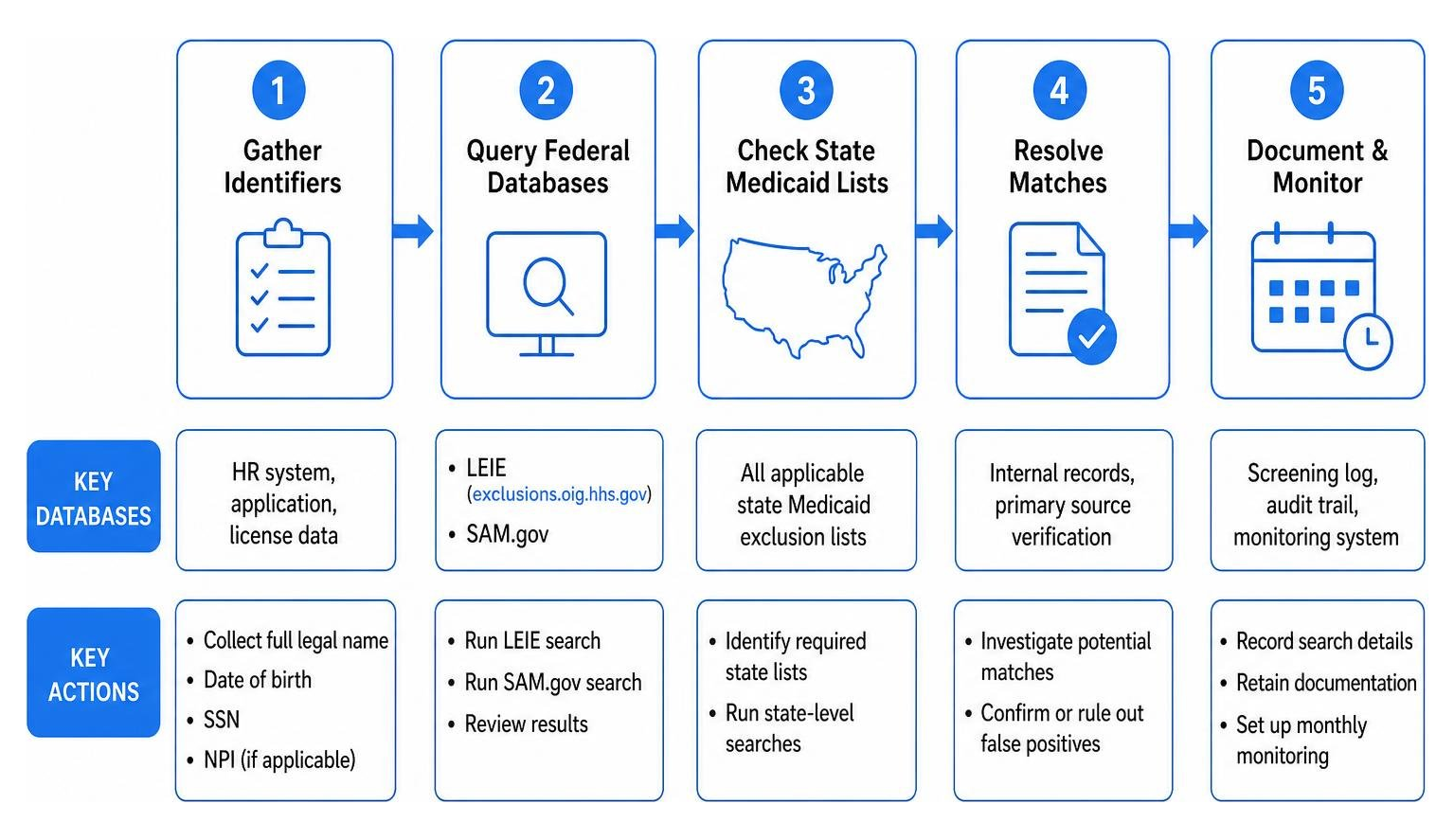
The 5-step OIG exclusion screening process:
- Gather accurate candidate identifiers, including full legal name, DOB, SSN, and NPI when applicable.
- Query the federal LEIE at exclusions.oig.hhs.gov and SAM.gov.
- Cross-reference more than 40 state-maintained Medicaid exclusion lists.
- Resolve any potential matches and rule out false positives.
- Document every search and set up monthly ongoing monitoring.
If you skip any of these steps — or treat exclusion screening as a one-time pre-hire task — your organization can face civil monetary penalties starting at a statutory base of $10,000 per item or service, adjusted annually for inflation, plus assessments of up to three times the amount claimed.
The compliance burden does not stop at the federal list. Independent analyses have found that a large share of state-level exclusions never appear on the federal LEIE. That means employers that only check one database may still be exposed to state Medicaid exclusion risk.
This guide walks you through how to run a compliant OIG exclusion check, where the most dangerous database gaps are, and how to build a monitoring process that holds up under audit.
Understanding the OIG Exclusion List and Why It Matters
To build a defensible compliance program, employers must first understand what the federal List of Excluded Individuals/Entities (LEIE) is and how it functions. The LEIE is maintained by the Office of Inspector General (OIG) under the U.S. Department of Health and Human Services (HHS). Its purpose is to protect federal healthcare programs — such as Medicare, Medicaid, and TRICARE — and the patients they serve from individuals and entities the government has determined should not receive federal program payment.
The OIG’s authority to exclude individuals and entities is codified under Section 1128 of the Social Security Act. This authority is split into two distinct categories:
- Mandatory Exclusions: The OIG is legally required to exclude individuals or entities convicted of specific offenses. These include Medicare or Medicaid fraud, patient abuse or neglect, felony convictions related to healthcare fraud, and felony convictions related to the unlawful manufacture, distribution, prescription, or dispensing of controlled substances. By law, mandatory exclusions carry a minimum period of five years. A second offense carries a minimum ten-year exclusion, and a third offense results in permanent exclusion.
- Permissive Exclusions: The OIG has the discretion to exclude individuals and entities for a wider variety of offenses. These include misdemeanor convictions related to healthcare fraud or controlled substances, license suspension or revocation by state licensing boards, default on health education loans, and submitting claims for excessive charges. Permissive exclusions typically carry a baseline period of three years, though the specific period can vary.
For a detailed breakdown of these legal frameworks, you can review the official OIG Background Information & Exclusion Authorities page.
The critical takeaway for HR and credentialing leaders is that the LEIE is not a static background check. It is a regularly updated administrative database. When an individual or entity is placed on the LEIE, federal healthcare programs generally may not pay for items or services furnished, ordered, prescribed, or otherwise connected to that excluded party.
This payment ban can apply beyond direct clinical care. It may also extend to indirect services, administrative work, billing support, and other roles when the services are included in claims or costs submitted to federal healthcare programs. Integrating exclusion screening into your broader Healthcare Background Checks: A Complete Guide to Requirements, Compliance, and Best Practices is the only way to reduce preventable compliance exposure.
The Legal and Financial Risks of Non-Compliance
Operating without a robust exclusion screening process is one of the most expensive compliance mistakes a healthcare or staffing organization can make. The OIG does not treat lack of knowledge as a complete defense when an employer bills federal healthcare programs for items or services connected to an excluded person.
Under the Civil Monetary Penalties Law (CMPL), the OIG can impose civil monetary penalties starting at a statutory base of $10,000 per item or service, adjusted annually for inflation, plus assessments of up to three times the amount claimed.
That exposure can escalate quickly when an excluded individual works in a role tied to recurring claims, orders, prescriptions, billing, administration, or reimbursable overhead. The risk is not limited to physicians or nurses. Employers must evaluate the full workforce, including contractors and vendors whose work may be connected to federal program payment.
Beyond Civil Monetary Penalties, employing an excluded individual exposes your organization to:
- False Claims Act Liability: Submitting claims to Medicare or Medicaid for services rendered, ordered, or otherwise connected to an excluded person can create false-claim exposure.
- Negligent Hiring and Retention Claims: If an excluded employee causes harm to a patient, a failure to perform reasonable due diligence can become evidence in a negligent hiring or retention claim.
- Corporate Integrity Agreements (CIAs): Organizations caught violating exclusion rules may be required to operate under multi-year CIAs with the OIG, which can impose strict reporting, auditing, and compliance obligations.
To understand the practical application of these penalties, you can read the OIG's Updated Special Advisory Bulletin on the effect of exclusions. The bulletin explains how the payment prohibition can apply to a broad range of employees, contractors, and services connected to federal reimbursement.
The financial reality of these risks is clear. Managing exclusion compliance is not just about checking a box; it is about protecting your organization from avoidable enforcement exposure. To understand the broader impact of screening failures, read our analysis on The Cost of a Bad Hire: Why Background Screening Matters More Than Ever.

How to Run an OIG Exclusion List Screening for Employers in 5 Steps
To protect your organization from these risks, you need a systematic, repeatable screening process. Run this workflow before onboarding employees, contractors, or vendors into roles connected to federal healthcare programs, and repeat it on a monthly basis for your active roster.
Fair Credit Reporting Act (FCRA) Workflow
When exclusion screening is performed by a consumer reporting agency or used as part of an employment background check process, employers should follow applicable Fair Credit Reporting Act (FCRA) requirements. That includes providing the required disclosure and authorization before the check and following pre-adverse and adverse action procedures if a verified exclusion match leads to an adverse employment decision.
Stage-by-Stage Hiring Breakdown
- Pre-Offer Stage: Identify the role’s compliance requirements and collect the information needed to support a compliant screening process.
- Post-Offer / Pre-Onboarding Stage: Run the initial OIG, SAM.gov, and state Medicaid exclusion checks. Resolve any potential matches before the candidate begins covered work.
- Active Employment Stage: Move the employee into a monthly monitoring cycle to capture exclusions published after hire.
Step 1: Gather Accurate Candidate Identifiers for OIG Exclusion List Screening for Employers
A reliable screening process begins with clean data. You cannot rely on a simple first-and-last-name search. Common names, aliases, missing middle initials, and incomplete license data can create false positives or missed matches.
Before running any search, collect and verify the following identifiers:
- Full legal name, including middle names or initials
- All known aliases, maiden names, and hyphenated names
- Date of birth (DOB)
- Social Security Number (SSN) or Employer Identification Number (EIN) for corporate vendors
- National Provider Identifier (NPI), if applicable
- State of licensure and professional license numbers
If you are screening third-party contractors or staffing agency placements, require the agency to provide these verified identifiers as part of your credentialing or vendor agreement.
Step 2: Query the Federal LEIE and SAM.gov Databases
Once you have verified your candidate's identifiers, check the primary federal databases.
First, navigate to the OIG’s Online Searchable Database at exclusions.oig.hhs.gov. If you are screening a small number of candidates, you can enter names directly into the search portal. For larger workforces, download the full LEIE data file and run a bulk comparison.
Second, check the System for Award Management (SAM.gov) database maintained by the General Services Administration (GSA). While the LEIE focuses specifically on healthcare exclusions, SAM.gov tracks parties that are excluded, debarred, or suspended from receiving certain federal contracts or funding.
Both databases matter for employer compliance. For detailed guidance on how to navigate the federal portal, consult the official LEIE Quick Tips & Instructions page.
Step 3: Cross-Reference State Medicaid Exclusion Lists
Checking the federal LEIE is not enough to guarantee full exclusion-screening coverage. Under Section 6501 of the Affordable Care Act (ACA), an individual excluded from participating in Medicaid in one state can be barred from participating in Medicaid in other states as well.
However, state Medicaid programs do not always report their local exclusions to the federal OIG immediately or consistently. Some state-level records may not appear on the federal LEIE, which creates a compliance gap for employers that rely only on federal searches.
To reduce this risk, cross-reference your roster against more than 40 state-maintained Medicaid exclusion lists. A common risk scenario is a Missouri physician indicted on controlled-substance and healthcare-fraud charges connected to Medicaid billing. An employer that screens only the federal LEIE may miss relevant state-level exclusion or licensure information that should be evaluated before assigning covered duties.
To learn more about managing these regional requirements, review our guide on Healthcare Sanctions Monitoring for HR.
Step 4: Resolve Potential Matches and False Positives
Initial name-based searches can return potential matches, especially when dealing with common names. Employers need a clear process to resolve those matches before taking employment action.
When a potential match occurs, do not panic or take immediate adverse employment action. Instead, follow these verification steps:
- Compare the candidate’s middle initial and date of birth against the database entry.
- Use the "Verify" tool on the OIG website to enter the candidate’s SSN or EIN. The system can help confirm whether the identifier matches the excluded individual or entity.
- Cross-reference the candidate's professional license number and state of licensure with the details in the database.
- If the identifiers do not match, document the evidence used to rule out the false positive.
Step 5: Document the Search and Establish Ongoing Monitoring
If an auditor asks about your exclusion screening process, simply stating that you perform checks is not enough. You must be able to prove what was searched, when it was searched, and how potential matches were resolved.
Your documentation should show the date of the search, the specific databases queried, the exact names and identifiers used, the search results, and the name or system that conducted the check. If a potential match was resolved as a false positive, document the evidence used to clear the candidate.
Because the OIG and many state databases are updated regularly, employers should establish a recurring monitoring cadence. Standard practice is to screen the active roster monthly so newly published exclusions do not remain undetected between point-in-time checks. To understand the legal framework of recurring workforce checks, read our guide on Navigating the Legal Maze of Employee Monitoring Requirements.
Federal LEIE vs. State Medicaid Lists: Navigating the Database Gaps
The single biggest vulnerability in many healthcare compliance programs is the gap between the federal LEIE and state-level Medicaid exclusion lists. Many employers assume that checking the federal OIG database covers every exclusion risk. That assumption can leave meaningful gaps.
Independent analyses have found that a large share of state-level exclusions never appear on the federal LEIE. Because state Medicaid agencies maintain their own exclusion records and reporting practices, employers need a broader screening process than a single federal database search.
If you only screen the federal LEIE, you may miss state-level Medicaid exclusion records that still matter for employer compliance. For example, if a nurse, physician, technician, administrator, contractor, or vendor is excluded at the state Medicaid level, the employer must evaluate whether that person can perform covered work tied to federal or state healthcare reimbursement.
Managing this complexity manually is difficult. More than 40 state-maintained Medicaid exclusion lists may be published in different formats: searchable portals, downloadable spreadsheets, PDF files, or agency web pages. Update timing can also vary, which makes consistent documentation and recurring monitoring essential.
To visualize the scope of these databases, review the comparison table below:
| Feature | Federal LEIE | State Medicaid Exclusion Lists |
|---|---|---|
| Managing Agency | HHS Office of Inspector General (OIG) | Individual state Medicaid agencies or related state authorities |
| Scope | Nationwide federal exclusions | State-level Medicaid exclusions with compliance implications beyond a single state |
| Update Frequency | Monthly | Varies by state |
| Identifiers Included | Name, address, provider type, license specialty, and other available fields | Varies by state |
| Reporting Lag | State actions may not appear immediately or consistently | State records may appear locally before they appear federally |
| Search Method | Single online portal or downloadable data file | More than 40 state-maintained websites, spreadsheets, PDFs, and agency lists |
Best Practices for Automating OIG Exclusion List Screening for Employers
As your organization grows, maintaining a manual screening process across federal and state databases becomes harder to manage consistently.
Common Mistakes
- Relying Solely on the Federal LEIE: Missing state-level Medicaid exclusions that have not yet appeared in the federal database.
- Treating Screening as a One-Time Event: Failing to run monthly recurring checks on active employees, contractors, and vendors.
- Inadequate Documentation: Failing to keep timestamped, audit-ready records of searches and false-positive resolutions.
- Ignoring Aliases and Identifier Variations: Missing records because the search did not account for maiden names, professional names, license details, or common variations.
Good vs. Bad Compliance Practices
- Bad: Checking only the federal LEIE during pre-employment onboarding and never screening the employee again.
- Good: Running a comprehensive pre-employment check across the LEIE, SAM.gov, and more than 40 state-maintained Medicaid exclusion lists, followed by monthly monitoring of your active roster.
Why Manual OIG Exclusion List Screening for Employers Fails at Scale
Manual screening is slow, repetitive, and vulnerable to human error. If you manage a roster of 500 employees, contractors, and vendors, monthly manual screening requires searching hundreds of names across the LEIE, SAM.gov, and state-maintained lists. That creates a high-volume administrative process where consistency matters.
Under this administrative burden, critical mistakes happen:
- Name Variations are Missed: A manual search for "Robert Smith" may miss a record listed under a professional name, hyphenated name, maiden name, or alternate spelling.
- Typographical Errors: Simple data entry mistakes can cause a missed match or an incorrect false positive.
- Inconsistent Cadence: When HR and compliance teams get busy, monthly monitoring can be delayed or skipped.
- Poor Record Keeping: Storing search records across scattered spreadsheets makes it difficult to produce a clean audit trail during a state or federal review.
To evaluate how software can solve these challenges, check out The Comprehensive Guide to Choosing the Right Pre-Employment Screening Software.
Transitioning to Automated Continuous Monitoring
The most reliable way to reduce compliance gaps and administrative overhead is to move from manual point-in-time checks to automated monitoring. Vetty’s product suite supports the screening lifecycle without assigning the same tool to every stage: VettyVerify supports pre-hire background screening, VettyOnboard supports onboarding, document collection, license verification, and e-signatures, and VettyComply supports post-hire continuous monitoring across OIG LEIE, SAM.gov, state Medicaid lists, criminal records, and MVR sources.
Compliance Software Comparison
| Feature | Vetty | Traditional screening providers |
|---|---|---|
| Pre-Hire Background Screening | VettyVerify™ supports pre-hire screening and baseline OIG, SAM.gov, and state-list checks | Often available, but may require separate workflows |
| Onboarding and Documentation | VettyOnboard™ supports document collection, license verification, and e-signatures | Often handled in a separate onboarding system |
| Post-Hire Continuous Monitoring | VettyComply™ supports ongoing monitoring across OIG LEIE, SAM.gov, state Medicaid lists, criminal, and MVR sources | Often manual, periodic, or batch-based |
| Audit Trail | Centralized records and monitoring history | May be spread across spreadsheets, emails, or disconnected portals |
Modern compliance platforms integrate with HR and credentialing workflows to run recurring checks in the background. A robust automated solution should offer:
- Multi-Source Verification: Multi-source verification across thousands of federal, state, and licensing-board primary sources.
- Alias and Identifier Matching: Screening logic that accounts for name variations, aliases, professional names, license data, and other identifiers.
- Timely Alerts: Notifications when a monitored employee, contractor, or vendor has a potential new exclusion or relevant record.
- Centralized Audit Trails: Search results, verified matches, and false-positive resolutions saved in a secure, centralized dashboard for audit response.
By automating this process, you reduce compliance gaps while freeing your HR and compliance teams to focus on hiring, onboarding, and workforce management. To learn more about setting up a compliant screening program, read our Stay in the Clear with This Background Screening Compliance Guide.
Frequently Asked Questions About Exclusion Screening
How often should employers check the OIG exclusion list?
Employers should perform an initial exclusion check before a worker begins performing services connected to federal healthcare programs. After that, employers should screen the active roster — including employees, contractors, and relevant vendors — at least monthly. This monthly cadence aligns with the LEIE update cycle and helps reduce the risk that a newly excluded person continues performing covered work unnoticed.
What should you do immediately if an employee matches an exclusion list?
If you confirm a true match on an exclusion list, take immediate action:
- Remove the Individual From Covered Duties: Immediately prevent the employee from performing work connected to federal healthcare programs until legal and compliance teams determine the appropriate next steps.
- Consult Legal Counsel: Contact your legal and compliance teams to review the match, the affected duties, and any potential claims exposure.
- Evaluate Self-Disclosure and Repayment: Work with counsel to determine whether the OIG’s Provider Self-Disclosure Protocol or another disclosure pathway applies, and whether any affected federal claims or overpayments must be addressed.
Does a standard criminal background check cover OIG exclusions?
No. A standard criminal background check searches criminal court records. It does not necessarily search administrative healthcare databases like the LEIE, SAM.gov, or state Medicaid exclusion lists. An individual can be placed on an exclusion list for administrative reasons — such as losing a professional license or defaulting on certain health education loans — without the exclusion appearing as a criminal conviction. Employers should run dedicated exclusion screening alongside standard criminal background checks.
Conclusion
Maintaining OIG exclusion compliance is a critical operational requirement for healthcare organizations, staffing agencies, and employers whose workers support federally funded care. The legal, financial, and reputational risks of employing an excluded individual are too significant to ignore.
By implementing a structured five-step screening process — and understanding the gaps between federal and state databases — you can protect your organization from avoidable fines, audit failures, and claims exposure.
Manual screening becomes difficult as your workforce grows. VettyVerify™ supports pre-hire background screening and baseline exclusion checks, VettyOnboard™ supports onboarding, document collection, license verification, and e-signatures, and VettyComply™ supports post-hire continuous monitoring across OIG LEIE, SAM.gov, state Medicaid lists, criminal records, and MVR sources.
For healthcare employers and high-volume workforces alike, the goal is the same: verify workers before they start, document the process, and monitor the active roster continuously enough to catch new risk quickly.
Don't leave your organization exposed to compliance gaps. Start your automated compliance journey with Vetty today and build a screening program that supports audit-ready compliance.