

The OIG Check You're Running Isn't Catching Every Excluded Provider

State Medicaid exclusion list screening is the process of checking employees, contractors, and vendors against state-level rosters of individuals and entities barred from participating in a state's Medicaid program — and it's a step that federal-only screening can miss. Healthcare organizations face ongoing regulatory scrutiny, making comprehensive screening across both state and federal sources an operational necessity. This guide provides a practical roadmap to navigating these requirements, including a step-by-step compliance checklist, common pitfalls to avoid, and a comparison of screening approaches.
Compliance Checklist
- Map all states where your organization operates, recruits, or employs remote staff.
- Identify the more than 40 state-maintained Medicaid exclusion lists that may need to be queried.
- Define the screening scope to include clinical, administrative, executive, contractor, and vendor entities.
- Establish a monthly recurring screening schedule aligned with OIG guidance, payer expectations, and The Joint Commission's credentialing standards.
- Implement a formal identity verification protocol to resolve name-only matches.
- Maintain a centralized, time-stamped audit trail of all screening queries and resolutions.
- Create an immediate escalation and response protocol for confirmed exclusion matches.
What federal-only screening leaves exposed:
- State Medicaid agencies maintain exclusion records that may not appear on the federal OIG LEIE.
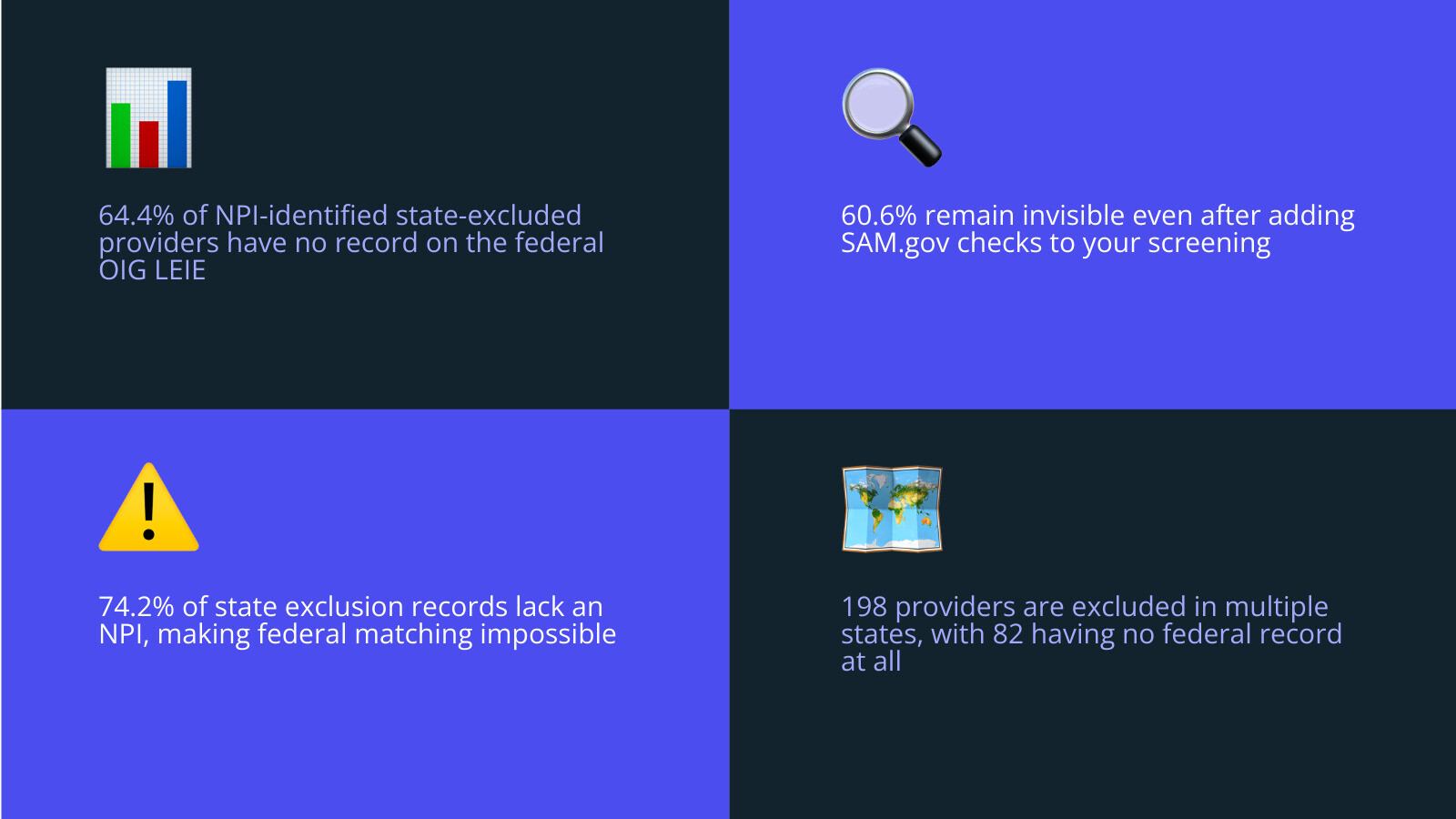
- Independent analyses have repeatedly found that a majority of state-level exclusions never appear on the federal LEIE, and most state exclusion records lack an NPI, making automated federal matching impossible.
- A small number of states rely on the federal LEIE instead of publishing their own list, but most state-maintained lists still require separate monitoring.
- Formats vary widely — searchable portals, PDFs, spreadsheets, and in some states formal records requests.
- Multi-state employment, remote work, telehealth, and staffing models increase the risk that a state-level exclusion in one jurisdiction affects operations elsewhere.
The core problem is structural, not procedural. State Medicaid agencies run their own exclusion programs under their own authority and on their own timelines. A state can bar a provider for Medicaid-specific reasons — fraud, patient abuse, or a licensing action — without a federal OIG exclusion appearing at the same time. That gap does not close just because you checked the LEIE.
For HR executives and credentialing managers in healthcare and staffing, this creates real exposure. Employing or contracting with an excluded individual can trigger civil monetary penalties starting at a statutory base of $10,000 per item or service, adjusted annually for inflation, plus assessments of up to three times the amount claimed. And the defense "we checked the federal list" may not hold up when auditors find a state-excluded employee or vendor who touched reimbursable services.
This guide walks you through how to close that gap — from mapping your obligations across more than 40 state-maintained Medicaid exclusion lists to building a screening program that runs monthly without burning out your compliance team.
The Federal Blind Spot: Why OIG LEIE and SAM.gov Aren't Enough
Many healthcare and staffing organizations operate under the assumption that the Department of Health and Human Services (HHS) Office of Inspector General (OIG) List of Excluded Individuals/Entities (LEIE) serves as a centralized, catch-all registry. You run your monthly checks against the LEIE, layer on a System for Award Management (SAM.gov) search, and assume your compliance bases are covered.
However, relying strictly on federal databases creates a serious compliance blind spot. Independent analyses have repeatedly found that a majority of state-level exclusions never appear on the federal LEIE, and most state exclusion records lack an NPI, making automated federal matching impossible.

Adding SAM.gov to your screening protocol is still useful, but it does not eliminate the state-level gap. SAM.gov captures federal debarments and exclusions, while state Medicaid exclusion lists are maintained by state agencies and may reflect state-specific program integrity actions.
Matching these records by identifier is often difficult. Many state exclusion records do not include NPIs, and public files may lack SSNs, EINs, or other unique identifiers. If your screening protocol relies only on automated NPI matching against federal lists, some state-excluded individuals and entities may never trigger a flag.
This is not only a single-state issue. Providers, contractors, vendors, and staffing workers often operate across state lines, hold multiple licenses, or move between healthcare employers. If you are not actively screening state-level lists, you may be exposed to individuals or entities that were barred in another jurisdiction but remain absent from the federal LEIE. To understand how these gaps impact your broader human resources strategy, you can read our guide on Healthcare Sanctions Monitoring for HR.
The Gaps in Federal-Only State Medicaid Exclusion List Screening
Why does this disconnect exist between federal and state records? The answer lies in how administrative authority is structured. State Medicaid agencies possess independent, state-level authority to initiate exclusions based on local program integrity concerns, licensing board actions, or state-level fraud convictions.
While federal law requires states to report certain actions to the OIG, the administrative pipeline is fragmented. The OIG may eventually adopt a state's action under its permissive exclusion authority, but this process is not automatic. In some cases, the OIG may choose not to pursue a federal exclusion if the infraction does not meet specific federal thresholds.
The result is a practical compliance gap: a provider or vendor can be barred from a state Medicaid program while still not appearing on the federal LEIE at the time your organization screens. If your compliance program only checks federal sources, you remain exposed to state-level billing violations.
Understanding the State-Level Landscape: More Than 40 State-Maintained Lists
To build a legally defensible screening program, you must understand the decentralized nature of state registries. There are more than 40 state-maintained Medicaid exclusion lists across the United States, and a small number of states rely on the federal LEIE instead of publishing their own list.
This decentralized model directly collides with Section 6501 of the Affordable Care Act (ACA). Under this federal mandate, if a provider is excluded or terminated for cause under any single state Medicaid program, that provider is legally barred from participating in other state Medicaid programs.
The regulatory framework governing these state-initiated exclusions is detailed in the federal code under Subpart A—General Provisions. The law makes it clear: a state-level infraction in one jurisdiction can have consequences beyond that state. If you employ a provider in one state who was excluded by another state's Medicaid program, you may be violating Medicaid participation rules even if the individual is not listed on the federal LEIE.
State-by-State Variations in Data and Formats
Operating a manual screening program across more than 40 state-maintained Medicaid exclusion lists is operationally difficult because the data is fragmented. There is no standardized format, data schema, or update cadence.
- Data Formats: Formats vary widely — searchable portals, PDFs, spreadsheets, and in some states formal records requests.
- Missing Identifiers: Many state lists do not publish NPIs, SSNs, EINs, or other unique identifiers, leaving compliance teams to work from names, business names, addresses, license details, or other partial data.
- Update Schedules: Some states update their registries frequently, while others update monthly, quarterly, or on an irregular schedule. This variance means your compliance team is constantly chasing moving targets.
- Name-Matching Obstacles: Because unique identifiers are not always present, your team must perform careful name matching and identity verification. Common names, aliases, hyphenated surnames, business-name variations, and clerical typos can create false positives or missed matches.
A Step-by-Step Guide to State Medicaid Exclusion List Screening
To protect your organization from administrative penalties and overpayment demands, you must establish a structured, repeatable screening workflow.

Stage-by-Stage Hiring Breakdown
- Pre-Application & Sourcing: Identify candidate licensing states and verify active credentials.
- Pre-Employment Screening: Run comprehensive background checks, including OIG LEIE, SAM.gov, and relevant state Medicaid exclusion lists via VettyVerify.
- Onboarding: Securely collect and verify tax identifiers, SSNs/EINs where appropriate, NPIs, and onboarding documents using VettyOnboard.
- Active Employment (Monthly): Run automated recurring monthly exclusion checks using VettyComply.
- Offboarding / Re-engagement: Update registry logs and archive compliance history for audit readiness.
Fair Credit Reporting Act (FCRA) Workflow
When utilizing third-party consumer reporting agencies for exclusion screening, compliance with the FCRA is mandatory:
- Disclosure: Provide a clear, standalone written disclosure to the candidate that a background check will be obtained.
- Authorization: Obtain explicit, written consent from the candidate before initiating the screening.
- Pre-Adverse Action: If a potential exclusion match is found that may lead to an adverse hiring decision, send the candidate a Pre-Adverse Action notice, a copy of the background report, and a summary of their FCRA rights.
- Dispute Window: Allow a reasonable period for the candidate to dispute any inaccuracies.
- Final Adverse Action: If the exclusion is confirmed or undisputed, send a final Adverse Action notice to the candidate.
Common Mistakes
- Relying solely on federal databases: Assuming the OIG LEIE catches all state-level exclusions.
- Screening only the home state: Failing to screen states where remote employees reside, hold licenses, or provide services.
- Using name-only matching without verification: Generating unnecessary false positives or missing true matches due to common names and incomplete data.
- Conducting one-time checks: Screening only at the time of hire and neglecting monthly re-verification.
- Incomplete scope: Excluding non-clinical staff, administrative personnel, executives, contractors, or third-party vendors from the screening protocol.
Good vs. Bad Screening Practices
- Bad: Checking only the OIG LEIE once at the time of hire and keeping manual spreadsheets that are rarely updated.
- Good: Automating monthly recurring checks across OIG LEIE, SAM.gov, and more than 40 state-maintained Medicaid exclusion lists, backed by precision matching and centralized, time-stamped audit logs.
Step 1: Map Your Regulatory Obligations
You must first determine which state lists apply to your operations. If you operate a single-state clinic, you might assume you only need to screen your home state's list. However, if you employ remote workers, telehealth providers, billing specialists, traveling clinicians, or out-of-state contractors, you should account for where employees reside, where they are licensed, and where services are provided or billed.
Step 2: Define Your Screening Scope
Exclusion regulations do not limit their scope to doctors, nurses, and clinical staff. You must screen individuals and entities that receive direct or indirect reimbursement from federal or state healthcare funds. This includes:
- Licensed clinical professionals, including physicians, therapists, nurses, and mid-level providers
- Non-clinical administrative staff, including billing specialists, IT administrators, and HR personnel
- Executive leadership, board members, owners, and managing employees
- Third-party contractors, staffing agencies, and vendors, including medical supply companies and outsourced service providers
For a comprehensive breakdown of how to structure these pre-employment checks, check out our guide on Healthcare Background Checks: A Complete Guide to Requirements, Compliance, and Best Practices.
Step 3: Establish a Verification Protocol
When a potential match occurs, your compliance team must verify the identity of the individual or entity before taking action. Because state lists often lack unique identifiers, this requires cross-referencing secondary data points such as licensing numbers, historical addresses, business names, aliases, dates of birth when available, and other agency records.
Step 4: Document the Process
In the event of an audit, your organization must be able to prove that screening occurred at the required intervals. Maintain a clean, time-stamped audit trail showing who was screened, when they were screened, which databases were queried, and how potential matches were resolved.
Best Practices for Ongoing State Medicaid Exclusion List Screening
To maintain continuous compliance without overwhelming your internal staff, you should implement the following operational standards:
- Screen Monthly: While pre-hire screening is critical, it only captures a single point in time. OIG guidance, payer expectations, state managed care contracts, and The Joint Commission's credentialing standards make monthly screening the practical baseline for many healthcare organizations.
- Utilize Precision Matching Algorithms: Basic name matching can create a heavy manual review burden. Precision matching that weighs multiple identifiers — such as middle names, aliases, addresses, professional licenses, entity names, and tax identifiers where available — can drastically reduce false positives and help your team focus on genuine risks.
- Build an Escalation and Response Protocol: If you confirm an exclusion match, act immediately. Remove the individual or entity from any role that touches federally or state-funded programs, quarantine affected claims, notify legal and compliance leadership, and evaluate whether to use the OIG Self-Disclosure Protocol or a state-level disclosure process to address potential overpayments.
Frequently Asked Questions about State Medicaid Exclusions
Below is a comparison of how organizations typically handle the operational challenges of exclusion screening, followed by a comparison of industry solutions:
| Operational Feature | Manual State-by-State Screening | Automated Compliance Screening |
|---|---|---|
| Database Coverage | Limited to home state or major markets due to time constraints. | Queries OIG LEIE, SAM.gov, and more than 40 state-maintained Medicaid exclusion lists. |
| Screening Frequency | Often restricted to pre-hire due to administrative burden. | Conducted automatically on a recurring monthly cadence. |
| False Positive Management | Compliance staff must manually research common name matches and incomplete records. | Matching logic filters likely mismatches using secondary identifiers where available. |
| Audit Readiness | Scattered spreadsheets, emails, and PDFs; prone to missing records. | Centralized, time-stamped logs ready for immediate export during audits. |
| Staff Administrative Burden | High; requires repetitive manual data entry and list-by-list review. | Low; automated workflows run in the background with exception-only alerts. |
Industry Solution Comparison
| Feature / Capability | Vetty (VettyVerify™ & VettyComply™) | Traditional Background Check Competitors | Legacy Credentialing Software |
|---|---|---|---|
| State Medicaid Coverage | Automated screening across more than 40 state Medicaid exclusion lists | Often limited to OIG LEIE and SAM.gov only | Manual or slow batch uploads |
| Screening Cadence | Continuous, automated monthly monitoring through VettyComply | One-time pre-hire check only | Often handled as a separate credentialing workflow |
| Mobile-First Verification | High-volume smartphone-based verification | Poor mobile interface, desktop-reliant | No mobile-native application |
| False Positive Reduction | Precision matching using available secondary identifiers | Basic name matching with high manual review burden | High reliance on manual compliance staff |
| Audit Trail | Centralized, time-stamped compliance dashboard | Scattered PDF reports | Fragmented database records |
| Security & Compliance Posture | PBSA accredited and SOC 2 Type 2 | Varies by provider | Varies by provider |
Is state Medicaid exclusion list screening legally required?
Yes. While the federal government mandates that state Medicaid agencies screen their provider networks, healthcare employers and providers also need controls to ensure excluded individuals and entities do not furnish, order, prescribe, or support services billed to federal or state healthcare programs. Under federal exclusion rules, federal financial participation is unavailable for services or items furnished, ordered, or prescribed by an excluded individual or entity. If you bill Medicaid for services touched by an excluded employee, contractor, or vendor, you may face repayment demands, civil monetary penalties starting at a statutory base of $10,000 per item or service, adjusted annually for inflation, plus assessments of up to three times the amount claimed.
How often should we screen against state exclusion lists?
You should screen employees, contractors, and vendors prior to hire or contract initiation, and at least once per month thereafter. This monthly cadence aligns with OIG guidance, payer expectations, and The Joint Commission's credentialing standards. Because state lists are updated on varying schedules, monthly screening helps capture new exclusions before they result in prolonged billing violations.
What happens if we discover a confirmed exclusion match?
Upon confirming an exclusion match, immediately remove the individual or entity from any position that involves the delivery of care, administrative support, ordering, prescribing, or billing related to federal or state healthcare programs. You should then:
- Isolate and quarantine claims and billings associated with that individual’s or entity's work.
- Calculate the financial impact of services billed during the period of exclusion.
- Consult with legal counsel to determine whether self-disclosure to the state Medicaid agency, Medicaid fraud control unit, or federal OIG is appropriate.
Conclusion
Relying solely on federal OIG LEIE and SAM.gov checks leaves your organization exposed to a meaningful compliance gap. Independent analyses have repeatedly found that a majority of state-level exclusions never appear on the federal LEIE, and many state exclusion records lack an NPI, making automated federal matching incomplete. Manual state-by-state screening across more than 40 state-maintained Medicaid exclusion lists is difficult to sustain for growing healthcare, staffing, or on-demand platforms. For high-volume, smartphone-based verification in the gig economy and modern healthcare staffing, Vetty is positioned to streamline compliance and reduce manual friction.
By integrating comprehensive state-level checks into your screening workflows, you protect your organization from civil monetary penalties starting at a statutory base of $10,000 per item or service, adjusted annually for inflation, plus assessments of up to three times the amount claimed, while improving continuous compliance with state and federal requirements. For more insights on building a robust credentialing program, read our analysis on Why Vetty is the Premier Solution for Healthcare Staffing Excellence.
Protect your organization from costly compliance gaps by automating your screening workflows with Vetty's comprehensive compliance platform.
Ready to eliminate the federal blind spot and secure your monthly credentialing workflows? To see how we can streamline your screening lifecycle with VettyVerify™ for pre-hire screening, VettyOnboard™ for onboarding and identifier collection, and VettyComply™ for post-hire monthly monitoring, get started with Vetty today.