

Why Medical Sanctions Monitoring Is a Non-Negotiable for Healthcare Employers

Medical sanctions monitoring is not just another pre-hire checkbox. It is the ongoing process of confirming that employees, contractors, and vendors remain eligible to participate in government-funded healthcare programs after they join your organization.
That distinction matters because exclusion status can change at any time. A nurse, biller, driver, administrator, or contractor may clear an initial background check, begin work, and then appear on the OIG List of Excluded Individuals/Entities (LEIE), SAM.gov, or a state Medicaid exclusion list weeks or months later. If your program only checks at hire, once a year, or through a manual monthly spreadsheet process, the organization can keep assigning work, submitting claims, and accumulating exposure before anyone notices.
The core argument is simple: point-in-time checks create blind spots. Continuous monitoring closes them.
For healthcare employers, that timing gap is the real compliance risk. The problem is rarely that HR never screened someone. The problem is that yesterday's clean result does not prove today's eligibility. In a workforce that changes constantly, and against exclusion databases that update on their own schedules, compliance depends on knowing when a person's status changes — not just knowing they were clear on their start date.
This guide focuses on why one-time and periodic manual checks are not enough, what the 30-day blind spot can cost, and how automated post-hire monitoring gives healthcare organizations a stronger way to protect patients, reimbursement, and audit readiness.
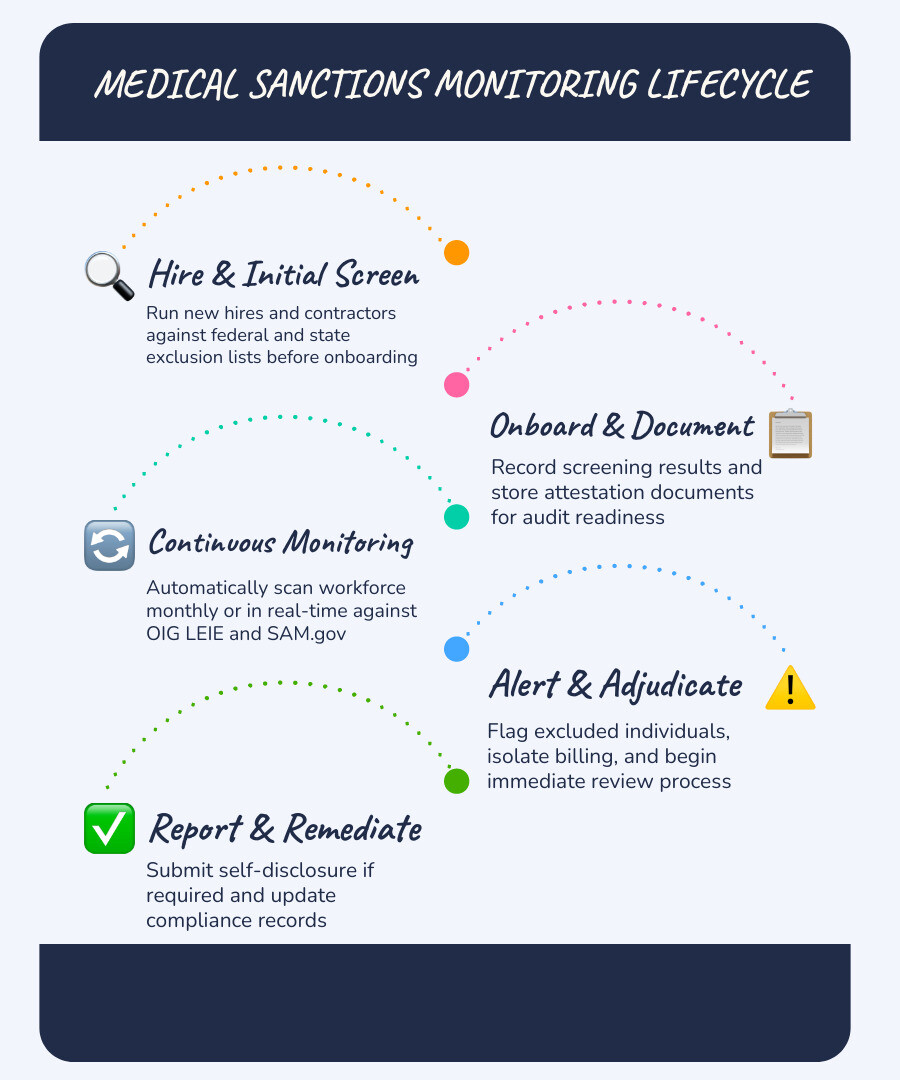
What Medical Sanctions Monitoring Actually Protects Against
Medical sanctions monitoring helps prevent excluded individuals and entities from participating in federally funded healthcare programs. Under sections 1128 and 1156 of the Social Security Act, the federal government can exclude certain providers from Medicare, Medicaid, and other federal healthcare programs.
When the Office of Inspector General (OIG) places a person or entity on the LEIE, no federal healthcare program payment can be made for items or services they furnish, order, prescribe, or support. That prohibition can affect direct patient care as well as billing, administrative, management, transportation, IT, and other support services tied to federally funded care.
If an organization submits claims connected to an excluded worker, the risk includes civil monetary penalties starting at a statutory base of $10,000 per item or service, adjusted annually for inflation, plus assessments of up to three times the amount claimed. Repayment obligations, corrective action, audit scrutiny, and reputational damage can follow.
This is why medical sanctions monitoring cannot stop after onboarding. A clean pre-hire check only confirms that no relevant exclusion was found at that moment. It does not protect the organization from a new exclusion, reinstatement issue, state action, or federal debarment that appears after the person starts work.
For a deeper explanation of exclusion categories, see Vetty's OIG exclusion screening guide.
The Timing Gap: Why One-Time Checks Fail
A point-in-time sanctions check answers one narrow question: was this person listed when we searched?
It does not answer the more important operational question: is this person still clear today?
That difference creates the timing gap. Consider a common scenario:
- A candidate clears pre-hire screening before their start date.
- They begin work and are added to scheduling, billing, patient-care, or vendor workflows.
- A federal or state exclusion list updates after the hire date.
- The organization does not run another check until the next annual review, quarterly audit, or manual monthly batch.
- Claims, payroll allocations, patient assignments, or vendor payments continue during the gap.
Even a monthly manual process can leave exposure. If a database update or disciplinary action occurs the day after the monthly check, the organization may have nearly 30 days of undetected risk before the next review. In a high-volume healthcare environment, that 30-day blind spot can involve many shifts, claims, locations, departments, and downstream billing records.
The issue is not whether monthly screening is better than annual screening. It is. The issue is whether a manual calendar-based process is fast, complete, and reliable enough to catch status changes before they become financial and patient-safety problems.
A focused sanctions-monitoring article does not need to repeat every database-by-database detail; for that, see Vetty's healthcare sanctions check guide.
The Cost of the 30-Day Blind Spot
The danger of a sanctions-monitoring gap is cumulative. Each day an excluded or sanctioned individual remains active can increase the organization's exposure across claims, staffing decisions, patient safety, vendor management, and audit documentation.
The financial risk starts with civil monetary penalties starting at a statutory base of $10,000 per item or service, adjusted annually for inflation, plus assessments of up to three times the amount claimed. But the operational consequences can extend further:
- Repayment exposure: Claims connected to excluded individuals may need to be repaid, creating a financial burden that grows with every day the issue remains undetected.
- Audit and survey risk: Missing or inconsistent screening records make it harder to prove that the organization had a reasonable compliance process in place.
- Patient safety concerns: Sanctions and exclusions may be tied to fraud, abuse, neglect, license issues, controlled-substance violations, or other conduct that healthcare employers cannot afford to miss.
- Workflow disruption: Once a late match is discovered, HR, compliance, legal, scheduling, billing, and operations teams may need to reconstruct dates, isolate services, stop assignments, and document corrective action.
The longer the delay between status change and detection, the harder remediation becomes. A continuous monitoring model is designed to shorten that delay by turning sanctions screening from a periodic task into an active control.
For broader background-check program structure, see Vetty's Healthcare Background Checks: A Complete Guide to Requirements, Compliance, and Best Practices.
Manual vs. Automated Medical Sanctions Monitoring
Manual sanctions screening usually starts with good intentions: someone exports a roster, searches names in one or more portals, tracks possible matches, and saves documentation. That process may be workable for a small, low-turnover organization. It becomes fragile when the workforce grows, locations multiply, vendors change, or compliance teams need to check more than one source.
Why Manual Checks Break Down
Manual screening creates predictable problems:
- Human error: Misspellings, incomplete rosters, duplicate records, name changes, and inconsistent identifiers can cause missed matches or unnecessary false positives.
- Coverage gaps: A manual process may check the OIG LEIE and SAM.gov but overlook more than 40 state-maintained Medicaid exclusion lists or relevant licensing-board actions.
- Documentation gaps: If search logs, timestamps, match resolution notes, and roster versions are stored across spreadsheets and inboxes, audit readiness suffers.
- Timing gaps: Annual, quarterly, or monthly manual checks still leave periods when a new exclusion can go undetected.
- Operational drag: Compliance staff spend time searching and reconciling records instead of investigating confirmed alerts and improving controls.
Why Automated Monitoring Is Different
Automated medical sanctions monitoring shifts the process from repeated manual searches to roster-based surveillance. Instead of relying on someone to remember the next check, the system monitors active workers and vendors against relevant sources and alerts the team when a potential match needs review.
That matters because the goal is not simply to run more searches. The goal is to reduce the time between a status change and an internal response.
A stronger automated program should support:
- Ongoing monitoring after hire, not only pre-employment screening
- Multi-source verification across thousands of federal, state, and licensing-board primary sources
- Coverage of OIG LEIE, SAM.gov, more than 40 state-maintained Medicaid exclusion lists, and relevant license or disciplinary sources
- Time-stamped search logs and alert history
- Clear match review using secondary identifiers
- Fast escalation when a confirmed exclusion affects federally billable work
Good vs. Weak Monitoring Practices
| Practice | Weak Point-in-Time Approach | Strong Continuous-Monitoring Approach |
|---|---|---|
| Screening timing | Pre-hire only, annually, or manual monthly batches | Post-hire monitoring that continues throughout employment or engagement |
| Roster coverage | Clinical staff only | Employees, contractors, vendors, volunteers, billing, administrative, and support roles |
| Source coverage | One or two federal databases | Federal, state Medicaid, criminal, MVR, and licensing-board sources where relevant |
| Record keeping | Spreadsheets, screenshots, and scattered notes | Time-stamped, centralized, audit-ready monitoring history |
| Response speed | Issue found at next scheduled review | Alert routed when a potential match appears |
Where Vetty Fits in the Screening and Monitoring Lifecycle
Healthcare employers need different controls at different stages of the worker lifecycle. The key is to avoid treating pre-hire screening as if it solves post-hire monitoring.
Product-to-Stage Mapping
- VettyVerify™: Pre-hire background screening and baseline OIG/SAM/state checks.
- VettyOnboard™: Onboarding, document collection, license verification, and e-signatures.
- VettyComply™: Post-hire continuous monitoring for OIG LEIE, SAM.gov, state Medicaid lists, criminal, and MVR.
Used together, these stages help healthcare organizations establish a clean baseline before someone starts, complete onboarding documentation, and then continue monitoring after the person is active. The continuous post-hire layer is what addresses the central risk in this article: the fact that eligibility can change after a clean initial check.
Vetty vs. Traditional Screening Providers
| Capability | Vetty | Traditional screening providers |
|---|---|---|
| Pre-hire baseline checks | VettyVerify™ supports pre-hire background screening and baseline OIG/SAM/state checks | Often available, but may be disconnected from ongoing monitoring |
| Onboarding workflow | VettyOnboard™ supports document collection, license verification, and e-signatures | Often handled through separate systems or manual processes |
| Post-hire monitoring | VettyComply™ supports continuous monitoring for OIG LEIE, SAM.gov, state Medicaid lists, criminal, and MVR | Often limited to periodic rescreening or separate batch workflows |
| Audit trail | Centralized records across screening, onboarding, and monitoring workflows | Often spread across portals, spreadsheets, and manual files |
Vetty is PBSA accredited and SOC 2 Type 2, giving healthcare employers additional confidence that screening and monitoring workflows are supported by mature operational and security controls.
Frequently Asked Questions about Medical Sanctions Monitoring
How often should healthcare organizations screen their workforce?
Healthcare organizations should not rely on a single pre-hire check or annual rescreen. Monthly screening is commonly used because major exclusion sources update on recurring schedules, but manual monthly screening can still leave a timing gap. Continuous monitoring is stronger because it is designed to detect post-hire changes sooner and preserve a more complete audit trail.
Does monthly screening count as continuous monitoring?
Not necessarily. A manual monthly spreadsheet check is still a point-in-time process. It may reduce the gap compared with annual screening, but it can still miss a new exclusion until the next scheduled review. Continuous monitoring means the organization maintains an active roster-based process that keeps checking for relevant changes after hire.
What happens if an employee or contractor is flagged on an exclusion list?
A flag should trigger prompt internal review, identity verification, and escalation under the organization's compliance policy. The organization should confirm whether the match is accurate, determine whether the individual is connected to federally funded work, document the review, and take appropriate action before additional exposure accumulates.
If sanctions information is used in an employment decision, Fair Credit Reporting Act obligations may apply; for the related notice and adverse-action requirements, see Vetty's background screening compliance guide.
Does sanctions monitoring apply to non-clinical staff and volunteers?
Yes. The exclusion risk is not limited to doctors and nurses. Healthcare organizations should evaluate employees, contractors, vendors, volunteers, billing staff, administrative staff, IT support, executives, and other roles whose work may be connected directly or indirectly to federally funded healthcare services.
Which sources should be included in monitoring?
At minimum, healthcare employers should consider OIG LEIE, SAM.gov, and more than 40 state-maintained Medicaid exclusion lists, along with relevant license, disciplinary, criminal, and MVR sources where appropriate for the role. The point is not to memorize every list manually; it is to ensure the monitoring program has enough source coverage to catch meaningful eligibility changes after hire.
Conclusion
One-time checks are not enough because healthcare eligibility is not static. A clean result at hire, at last year's audit, or even at the start of the month does not guarantee that an employee, contractor, or vendor remains clear today.
That is the central risk medical sanctions monitoring must solve. Point-in-time checks create timing gaps. Manual monthly processes reduce those gaps but do not eliminate them. Continuous monitoring gives healthcare employers a stronger way to identify changes, respond quickly, and preserve the documentation needed to show a defensible compliance process.
By pairing VettyVerify™ for pre-hire background screening and baseline OIG/SAM/state checks, VettyOnboard™ for onboarding and license verification workflows, and VettyComply™ for post-hire continuous monitoring, healthcare organizations can move from reactive rescreening to ongoing compliance control.
To see how Vetty helps healthcare employers close the gap between a clean initial check and ongoing workforce eligibility, schedule a demo with Vetty today.