

Why Provider Sanctions Monitoring Automation Matters at Scale

Provider sanctions monitoring at scale is the operational process of moving from manual database searches to automated, roster-based screening across employees, contractors, vendors, and providers. For healthcare organizations that bill Medicare, Medicaid, or other federally funded programs, the goal is simple: keep sanctioned or excluded individuals out of reimbursable workflows, document every check, and resolve alerts quickly enough to reduce compliance exposure.
This article focuses on implementation: how to automate provider sanctions monitoring with clean roster data, HRIS/ATS integrations, multi-identifier matching, alert workflows, and audit-ready documentation. For a broader explanation of why monitoring matters, see Vetty’s guide to healthcare sanctions monitoring for HR.
Implementation Checklist
To move from manual checks to a scalable monitoring program, your organization should build around the following controls:
- [ ] Pre-hire baseline screening: Use VettyVerify for pre-hire background screening and baseline OIG, SAM.gov, and state checks before a provider begins work.
- [ ] Onboarding and credential capture: Use VettyOnboard for onboarding, document collection, license and credential verification, and e-signatures.
- [ ] Roster-based post-hire monitoring: Use VettyComply to continuously monitor active workers across OIG LEIE, SAM.gov, state Medicaid lists, criminal, and MVR sources where applicable.
- [ ] Multi-identifier verification: Match alerts against NPI, DOB, SSN, license numbers, and other identifiers to reduce false positives.
- [ ] Alert adjudication workflow: Route potential matches to the right compliance owner, document decisions, and track resolution status.
- [ ] Audit-ready records: Maintain time-stamped logs showing who was checked, which sources were searched, when alerts occurred, and how they were resolved.
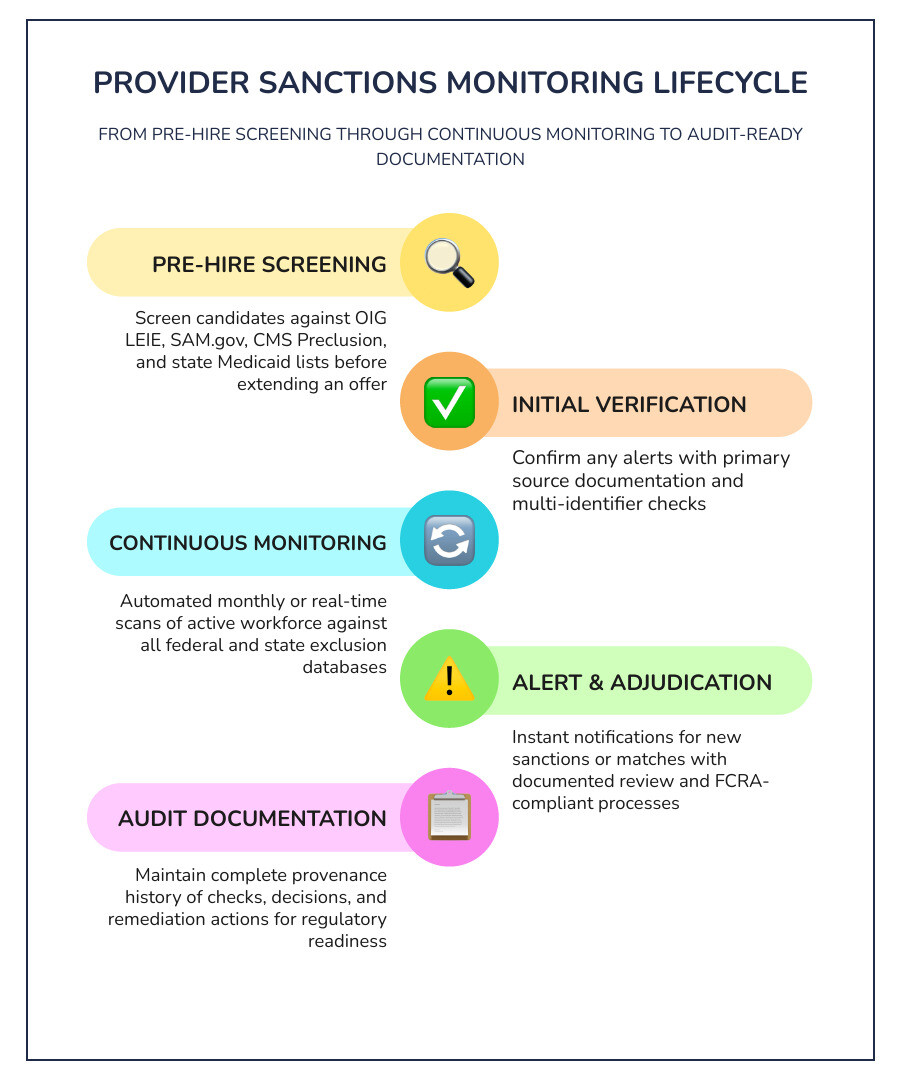
Stage-by-Stage Workflow
- Pre-Hire Screening with VettyVerify™: Run baseline background screening and OIG, SAM.gov, and state exclusion checks before hiring or placement.
- Onboarding with VettyOnboard™: Collect required documents, complete e-signatures, and verify licenses and credentials during onboarding.
- Roster Sync and Monitoring Enrollment: Move cleared workers into a structured active roster with the identifiers needed for ongoing matching.
- Post-Hire Continuous Monitoring with VettyComply™: Monitor active providers and staff across OIG LEIE, SAM.gov, more than 40 state-maintained Medicaid exclusion lists, criminal, and MVR sources.
- Alert Review and Audit Documentation: Investigate potential matches, record adjudication notes, and preserve a complete compliance history.
Here’s what the implementation model looks like at a glance:
- What gets automated: Roster uploads or API-based employee syncs, source monitoring, match detection, alert routing, and audit logs
- Who is in scope: Providers, contractors, billing staff, administrative staff, vendors, and other workers connected to federally reimbursed healthcare operations
- When checks happen: Pre-hire baseline checks plus ongoing post-hire monitoring for active roster members
- What is at stake: civil monetary penalties starting at a statutory base of $10,000 per item or service, adjusted annually for inflation, plus assessments of up to three times the amount claimed.
- What makes automation scalable: Clean identifiers, source coverage, false-positive filtering, workflow ownership, and centralized documentation
Manual spot-checks and annual rescreening create operational gaps because they depend on people remembering to search multiple sources, download results, interpret matches, and store evidence consistently. Automated monitoring closes those gaps by turning provider sanctions screening into a repeatable workflow rather than a monthly scramble.
The good news: once the right roster and integration foundation is in place, automated monitoring can scale across locations, entities, and worker types without forcing compliance teams to manually re-check every name every month.
What Provider Sanctions Monitoring Covers
Provider sanctions monitoring identifies workers or entities that have been excluded, sanctioned, suspended, debarred, or otherwise restricted from participating in healthcare programs or regulated work. For the broader compliance case and lifecycle context, read Vetty’s healthcare sanctions monitoring for HR guide.
For this implementation-focused article, the key question is not whether monitoring matters; it is how to operationalize it across a large, changing workforce. A scalable program needs accurate roster data, repeatable monitoring rules, clear alert ownership, and documentation that can stand up to internal review or an external audit.
Source Coverage: What to Monitor Without Turning This Into a Database Project
To build a reliable automated workflow, you need enough source coverage to catch federal, state, and licensing-board issues without forcing your team to maintain every search manually. For a deeper database-by-database breakdown, see Vetty’s healthcare sanctions check guide.
For implementation planning, keep the source map compact:
- HHS-OIG List of Excluded Individuals/Entities (LEIE): The primary federal exclusion source for individuals and entities excluded from federal healthcare program participation.
- SAM.gov: Federal debarment, suspension, and exclusion data that may apply to vendors, contractors, and other entities.
- CMS Preclusion List: CMS-administered preclusion data relevant to Medicare Advantage and Part D payment restrictions.
- Medicare Opt-Out List: Data used to identify providers who have opted out of Medicare participation.
- Social Security Administration Death Master File (SSA DMF): Identity verification data that can help detect deceased-provider or credential misuse risk.
- DEA registration data: Controlled-substance registration status relevant to prescribing authority.
- TRICARE exclusion data: Exclusion information connected to military healthcare program participation.
- State Medicaid exclusion lists: More than 40 state-maintained Medicaid exclusion lists that may identify state-level exclusions before or outside federal list updates.
- State licensing boards: Primary sources for license status, disciplinary actions, suspensions, revocations, and restrictions.
A critical compliance gap exists when an organization checks only one federal database and assumes that result is complete. Scalable provider sanctions monitoring should support multi-source verification across thousands of federal, state, and licensing-board primary sources, then normalize alerts into a workflow your team can actually manage.
For organizations operating across state lines, or staffing agencies placing clinicians in multiple jurisdictions, licensing-board and state Medicaid monitoring are especially important. If a provider holds licenses in multiple states, an issue in one jurisdiction may not appear everywhere at the same time, so your monitoring workflow should track the worker’s active licenses and relevant work locations.
The Financial and Operational Risks of Non-Compliance
The financial consequences of employing or contracting with an excluded provider can be severe. Under Civil Monetary Penalties (CMPs), organizations may face civil monetary penalties starting at a statutory base of $10,000 per item or service, adjusted annually for inflation, plus assessments of up to three times the amount claimed.
But the damage does not stop at direct fines:
- Loss of Funding: Your organization risks losing eligibility to participate in Medicare, Medicaid, and other federally funded programs.
- Negligent Retention Claims: If a sanctioned or excluded provider causes patient harm and your organization failed to perform appropriate screening, the issue can create additional legal exposure.
- Administrative Burden: Responding to an OIG investigation, overpayment demands, clawbacks, and legal review can drain internal resources for months or years.
- Operational Disruption: A confirmed match may require immediate removal from billing, reassignment, credential review, client notification, or placement replacement.
Automation does not eliminate compliance responsibility, but it makes the risk easier to control. Instead of depending on spreadsheets, calendar reminders, and manual screenshots, a well-designed monitoring workflow gives compliance teams a consistent way to detect issues, verify matches, and prove what happened.
Continuous vs. Periodic Checks: Designing an Automated Workflow
Historically, compliance teams managed sanctions checks through manual, periodic reviews. Once a month, an HR or compliance specialist might log into OIG LEIE, SAM.gov, and state sources, manually type in employee names, save screenshots, and update a spreadsheet as proof of compliance.
That approach becomes fragile at scale. A roster with hundreds or thousands of providers changes constantly: new hires start, contractors leave, licenses renew, workers move between states, and identifiers get corrected. Manual monitoring turns each change into another opportunity for a missed search, duplicate record, false positive, or incomplete audit trail.
Continuous monitoring replaces point-in-time searching with a roster-based workflow. Active workers are enrolled in monitoring, their identifiers are matched against relevant sources, and potential changes generate alerts for review. The compliance team still makes the decision; automation makes sure the right issue reaches the right person with the right supporting data.
| Feature / Capability | Manual Monthly Checks | Continuous Automated Monitoring |
|---|---|---|
| Roster Management | Spreadsheet exports and manual name lists | HRIS/ATS/API syncs or structured roster uploads |
| Frequency of Checks | Point-in-time checks on a monthly schedule | Ongoing monitoring of active roster records |
| Risk of Compliance Gaps | Higher risk when employees start, leave, or change roles between checks | Lower risk because monitoring follows active roster status |
| Administrative Effort | High manual search, screenshot, and spreadsheet burden | Lower effort through automated source checks and alert routing |
| False Positive Management | Manual review of similar-name matches | Multi-identifier matching using NPI, DOB, SSN, license, and other identifiers |
| Alert Ownership | Often handled through email or ad hoc escalation | Assigned queues, statuses, notes, and resolution tracking |
| Audit Trail Quality | Fragmented files, screenshots, and spreadsheets | Centralized, time-stamped logs of checks, alerts, and adjudication decisions |
| Scalability | Becomes harder as locations, states, and worker counts grow | Designed for multi-location, multi-state, high-volume monitoring |
To understand the broader operational differences between these two strategies, read Vetty’s comparison of continuous background checks vs annual rescreening and continuous monitoring vs annual rescreening.
Build the Roster Foundation First
Automation is only as strong as the roster feeding it. Before turning on continuous provider sanctions monitoring, define exactly which worker populations belong in scope and which system is the source of truth for each population.
Common roster fields include:
- Legal first, middle, and last name
- Prior names or aliases when available
- Date of birth
- Social Security Number or partial SSN where appropriate
- National Provider Identifier (NPI)
- Professional license numbers and issuing states
- DEA registration where relevant
- Work location, client location, or state of assignment
- Employee, contractor, vendor, or provider status
- Start date, termination date, and active/inactive status
This data matters because exclusion lists often contain similar names. Without strong identifiers, your team may spend hours investigating weak matches that do not belong to your workforce. With the right identifiers, the monitoring system can suppress obvious false positives and escalate higher-confidence matches for human review.
Connect Monitoring to HRIS, ATS, and Onboarding Systems
At scale, roster maintenance should not depend on a compliance analyst manually uploading a new spreadsheet every time someone starts or leaves. The more reliable model is to connect monitoring to the systems where worker status already changes.
A practical integration model looks like this:
- ATS or hiring workflow: Candidates who reach the screening stage are sent to VettyVerify for pre-hire background screening and baseline OIG, SAM.gov, and state checks.
- Onboarding workflow: Hired workers move into VettyOnboard for document collection, license and credential verification, and e-signatures.
- Active workforce roster: Cleared workers are added to the active monitoring population with the identifiers needed for ongoing checks.
- Post-hire monitoring: VettyComply monitors active workers across OIG LEIE, SAM.gov, state Medicaid lists, criminal, and MVR sources where applicable.
- Status updates: Terminations, leave status, role changes, or state assignment changes update the monitoring roster so the right people remain in scope.
This workflow reduces duplicate data entry and helps prevent two common errors: failing to enroll a new worker in monitoring and continuing to monitor someone who is no longer active.
Good vs. Bad Compliance Practices
- Bad Practice: Relying on annual rescreening or manual monthly checks without a reliable way to capture roster changes between checks.
- Good Practice: Implementing roster-based monitoring with VettyComply so active workers remain enrolled in post-hire monitoring.
- Bad Practice: Manually reviewing every name match without enough identifiers to separate true matches from similar-name noise.
- Good Practice: Using multi-identifier verification, including NPI, DOB, SSN, and license data, to prioritize higher-confidence alerts.
- Bad Practice: Treating alert resolution as an email thread with no consistent owner, deadline, or documentation.
- Good Practice: Creating an adjudication workflow with assigned reviewers, statuses, notes, supporting documents, and final decisions.
Technical Comparison: Vetty vs. Traditional Screening Competitors
| Feature | Vetty | Traditional Screening Competitors |
|---|---|---|
| Pre-Hire Screening | VettyVerify™ supports pre-hire background screening and baseline OIG, SAM.gov, and state checks | Often handled separately from post-hire monitoring workflows |
| Onboarding and Credentialing | VettyOnboard™ supports document collection, license and credential verification, and e-signatures | May require separate tools or manual document collection |
| Post-Hire Monitoring | VettyComply™ supports continuous monitoring across OIG LEIE, SAM.gov, state Medicaid lists, criminal, and MVR sources | Often batch-processed through periodic roster uploads |
| Roster Sync | Supports structured workflows for keeping active workers in monitoring | Frequently depends on manual spreadsheet maintenance |
| False Positive Filtering | Uses multi-identifier matching, including NPI, DOB, SSN, and license data where available | Often requires more manual review of possible name matches |
| Workflow Documentation | Centralizes alert status, notes, and audit history | May leave evidence split across spreadsheets, PDFs, and inboxes |
| Security and Compliance Posture | PBSA accredited and SOC 2 Type 2 | Varies by provider |
Implementing Continuous Provider Sanctions Monitoring
Transitioning to an automated model requires more than turning on a software feature. It requires a defined operating model for who is monitored, which sources apply, how alerts are verified, and what happens after a confirmed match.
Start with a pilot population such as one provider group, one staffing line, or one state-specific workforce. Validate that the roster contains enough identifiers, confirm that source coverage matches your risk profile, and test how alerts flow to compliance reviewers. Once the workflow is stable, expand to additional locations, entities, and worker categories.
A challenge in this process is managing false positives. Many databases rely heavily on name-based search. If your organization employs someone with a common name, a simple name search may return unrelated records from other states or professions.
An advanced monitoring workflow uses multi-identifier verification—combining names with National Provider Identifier (NPI) numbers, dates of birth, Social Security Numbers, professional license numbers, and work-location data—to filter out irrelevant matches. This ensures your compliance team spends more time investigating meaningful alerts and less time clearing weak matches.
For staffing agencies and high-volume healthcare employers, this level of automation is the only way to scale safely. Learn more in Vetty’s article on continuous monitoring for staffing agencies.
Best Practices for Alert Adjudication, Audit Readiness, and Workflow Integration
When state or federal auditors ask for evidence, they will not only ask whether your current staff is compliant. They may ask when individuals were screened, which sources were checked, what alerts appeared, who reviewed them, and what decision was made.
A scalable monitoring program should therefore include both alert operations and historical proof.
Build an Alert-and-Adjudication Workflow
A provider sanctions alert is not the same thing as a confirmed exclusion. Your workflow should separate detection from decision-making:
- Alert created: The monitoring system identifies a potential match against a monitored source.
- Identifier review: The reviewer compares name, NPI, DOB, SSN, license number, state, and other available identifiers.
- Primary-source confirmation: The reviewer confirms the record against the relevant primary source when needed.
- Operational hold or escalation: If risk is credible, the organization follows its internal policy for billing hold, work reassignment, credentialing review, client notification, or legal/compliance escalation.
- Decision recorded: The reviewer documents whether the alert was a false positive, pending review, confirmed match, or otherwise resolved.
- Evidence retained: Supporting notes, timestamps, source details, and reviewer actions are stored for audit purposes.
This workflow gives compliance leaders a consistent way to handle alerts without overreacting to every possible match or under-documenting serious issues.
Define Ownership and Service Levels
Automation should make accountability clearer, not more diffuse. Assign ownership for each stage of the process:
- Who owns roster accuracy?
- Who reviews new alerts?
- Who confirms matches against source records?
- Who decides whether to remove a provider from billing or work assignment?
- Who communicates with HR, credentialing, operations, legal, or clients?
- How quickly must high-priority alerts be reviewed?
These decisions should be documented in policy before the first serious alert arrives.
Maintain Audit-Ready Records
To build an audit-ready workflow:
- Centralize Documentation: Maintain screening records, alert notes, adjudication outcomes, and source references in a single secure platform.
- Integrate with Existing Systems: Connect sanctions monitoring to your ATS, HRIS, onboarding, and credentialing workflows so screening starts during hiring and continues after onboarding.
- Track Every Status Change: Record when a worker enters monitoring, leaves monitoring, changes role, changes state assignment, or has an alert resolved.
- Preserve Reviewer Actions: Keep time-stamped records of who reviewed each alert, what information they considered, and what decision they made.
- Review the Program Periodically: Audit your own monitoring workflow to confirm that roster syncs, alert queues, and documentation practices are working as intended.
For more insights on ongoing post-hire screening workflows, see Vetty’s guides to continuous criminal monitoring and continuous criminal monitoring vs one-time background checks.
Frequently Asked Questions About Provider Sanctions Monitoring Automation
How often should you perform sanctions and exclusion checks?
The OIG recommends checking the LEIE at least monthly. Many healthcare organizations also monitor more than 40 state-maintained Medicaid exclusion lists and relevant licensing-board sources as part of a broader post-hire compliance program.
While monthly checks may satisfy a baseline policy requirement, continuous roster-based monitoring is better suited for organizations with frequent hiring, multi-state operations, contractor populations, or high-volume provider workflows.
What is the difference between mandatory and permissive exclusions?
Mandatory and permissive exclusions describe different bases for OIG exclusion; for the detailed distinction, see Vetty’s OIG exclusion screening guide.
What FCRA obligations apply when handling a positive match?
When provider sanctions monitoring is performed through a consumer reporting agency, FCRA obligations may apply, including required notices and dispute rights; Vetty explains related post-hire screening considerations in Trust but Continuously Verify: A Guide to Remote Worker Continuous Screening.
What are the common mistakes in provider sanctions monitoring automation?
- Relying on Self-Reporting: Assuming workers will disclose new sanctions, license restrictions, or exclusion issues can leave compliance gaps.
- Checking Only One Source: Monitoring only a single federal list while ignoring state Medicaid and licensing-board sources can miss relevant issues.
- Using Weak Roster Data: Running name-only searches without NPI, DOB, SSN, license, or state data increases false positives and manual review burden.
- Skipping Workflow Ownership: Alerts need assigned reviewers, escalation rules, and documented outcomes.
- Keeping Fragmented Records: Screenshots, spreadsheets, and email threads make it harder to prove what was checked and how alerts were resolved.
Conclusion
Provider sanctions monitoring at scale is an implementation challenge. The organizations that manage it well do not rely on one-off searches or informal spreadsheet reviews; they build roster-based workflows that connect pre-hire screening, onboarding, post-hire monitoring, alert adjudication, and audit documentation.
Vetty supports that lifecycle with VettyVerify™ for pre-hire background screening and baseline OIG, SAM.gov, and state checks; VettyOnboard™ for onboarding, document collection, license and credential verification, and e-signatures; and VettyComply™ for post-hire continuous monitoring across OIG LEIE, SAM.gov, state Medicaid lists, criminal, and MVR sources. Vetty is PBSA accredited and SOC 2 Type 2.
Protect your organization from costly compliance mistakes and streamline your operations today. Start your compliance monitoring journey with Vetty to see how Vetty can support automated provider sanctions monitoring.