

Why Slow Background Checks Are Costing You Top Talent

How to speed up background checks hiring is one of the most pressing operational challenges facing talent acquisition teams in 2026 — and the stakes are higher than most leaders realize.
Here's the core problem: 40% of employers have lost candidates directly because their screening process moved too slowly. In a market where top candidates are fielding multiple offers simultaneously, a sluggish background check isn't just an inconvenience — it's a competitive liability.
How to Speed Up Background Checks in Hiring: Quick Answer
If you need a fast answer, here are the most impactful steps you can take right now:
- Choose a modern screening provider with digitized records and automated processing
- Integrate your ATS to eliminate manual data re-entry and enable one-click ordering
- Use mobile-friendly digital consent forms so candidates can authorize instantly from any device
- Tier your screening packages by role risk level — stop running the same checks for every position
- Submit screening requests early in the business day to maximize same-day processing
- Ensure complete candidate data upfront (full legal name, SSN, date of birth) to prevent follow-up delays
- Automate status alerts and adverse action workflows to remove manual bottlenecks from your team's plate
Each of these is covered in depth throughout this guide.
The speed problem compounds quickly. Research shows that 44% of candidates disengage entirely if the screening process stretches beyond five days. Meanwhile, 60% of high-demand candidates accept offers within three days. By the time your check clears, your preferred hire may already be onboarded somewhere else.
What makes this particularly frustrating is that most delays aren't caused by courts or external agencies — they're self-inflicted. Incomplete candidate data, one-size-fits-all screening packages, and disconnected systems create drag that compounds at every stage of the process.
The good news: most of those delays are fixable with the right workflow design and tooling.
This guide walks you through a stage-by-stage framework for accelerating your background check process — without cutting compliance corners. You'll get a compliance checklist, an FCRA workflow breakdown, a comparison of manual vs. automated approaches, and specific tactics for common bottlenecks.
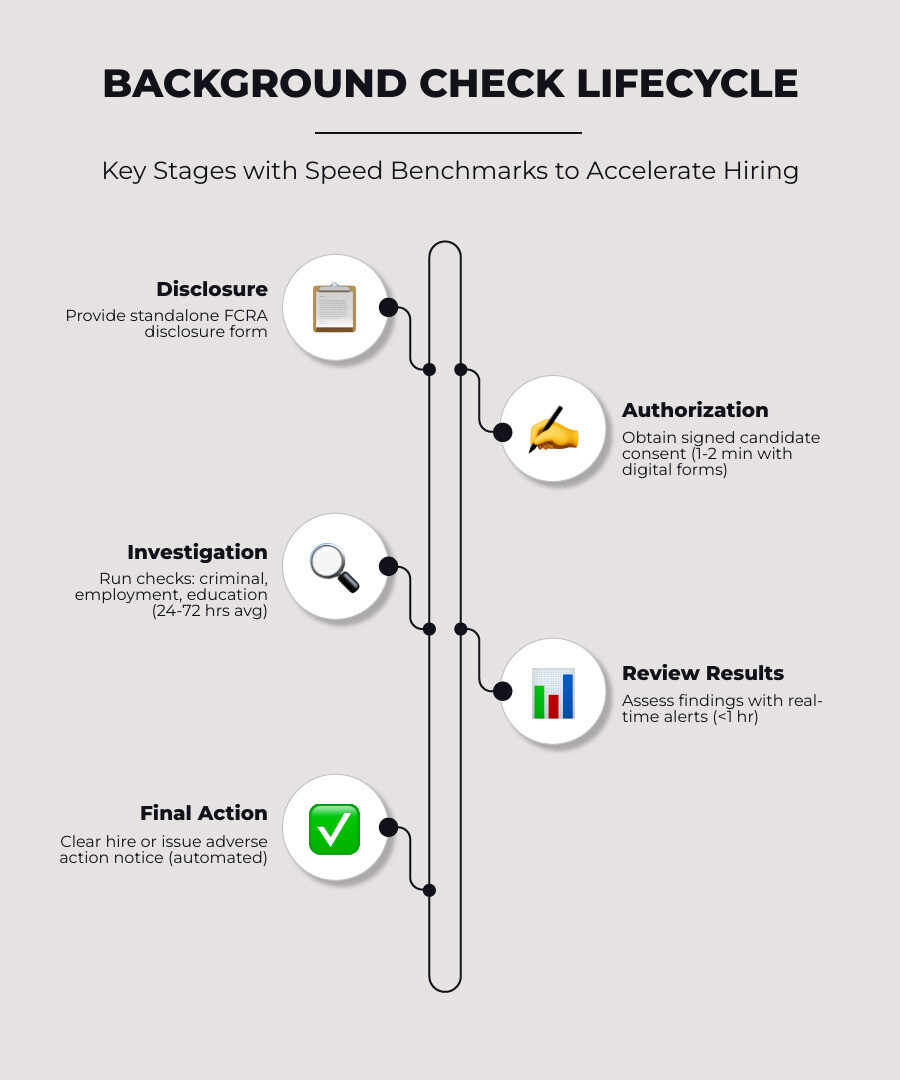
Strategic Framework for how to speed up background checks hiring
To move fast, you must first ensure your foundation is stable. Speed without a framework leads to Fair Credit Reporting Act (FCRA) violations and litigation. In 2026, FCRA litigation increased by 14%, making it essential that your accelerated workflow remains airtight.
Compliance Checklist
Before attempting to shave hours off your turnaround time, ensure these five pillars are in place:
- Standalone Disclosure: Ensure your background check disclosure is a separate document, not buried in an application.
- Signed Authorization: Capture a clear, legally binding signature (digital is preferred for speed).
- Role-Based Package Audit: Review your packages to ensure you aren't over-screening for low-risk roles.
- ATS Integration Check: Verify that data flows between your systems without manual intervention.
- Adverse Action Automation: Have a system ready to handle pre-adverse and final adverse action letters automatically.
FCRA Workflow
A compliant, high-speed workflow follows this sequence:
- Disclosure: Provide the candidate with clear notice of the background check.
- Authorization: Obtain the candidate's written consent.
- Investigation: The screening provider conducts the necessary searches.
- Pre-Adverse Action: If a "hit" is found, notify the candidate and provide a copy of the report.
- Dispute Period: Allow the candidate at least five business days to dispute inaccuracies.
- Final Adverse Action: If the decision stands, send the final notice.
By following fast-track hiring secrets , you can reduce the 40% candidate loss rate while adhering to 2026 compliance standards.
Stage 1: Pre-Submission and Data Integrity
The most common cause of background check delays is incomplete or inaccurate information provided at the start of the process. If a middle name is missing or a Social Security Number (SSN) is mistyped, the entire process can grind to a halt as researchers attempt to reconcile the data.
Implement Tiered Screening One of the most effective ways to speed up background checks is to stop using a one-size-fits-all approach. A warehouse associate does not require the same depth of screening as a Chief Financial Officer. By auditing your packages and tiering them based on role risk, you avoid unnecessary searches that add days to your timeline.
Ensure Accuracy at Entry Use mobile-friendly self-disclosure forms where candidates enter their own data. This shifts the burden of accuracy to the candidate and eliminates transcription errors from your HR team. When candidates use their smartphones—as 82% of 2026 job seekers do—they can often use auto-fill features that increase data integrity.
Understanding how long a background check takes helps you set expectations. For example, instant SSN and Date of Birth (DOB) verifications can happen in seconds, providing an immediate foundation for more complex criminal searches.
Stage 2: Leveraging Technology for how to speed up background checks hiring
In 2026, manual data entry is the primary enemy of the Talent Acquisition leader. If your recruiters are copying and pasting candidate names from an Applicant Tracking System (ATS) into a separate screening portal, you are losing time and inviting errors.
Seamless ATS Integration: Integrating your background check provider with your ATS can speed up hiring by 25% or more. This connectivity allows for one-click ordering. When a recruiter moves a candidate to the "Background Check" stage in the ATS, the screening request is triggered automatically.
Mobile-Friendly Portals: Friction is the leading cause of candidate drop-off. If a candidate has to find a printer to sign a form, they will wait until they are home, often delaying the process by 12–24 hours. Mobile-friendly portals with digital signatures allow candidates to complete their portion of the process in minutes, often while they are still in the parking lot after an interview. This is a critical fix for why candidates drop off.
Stage 3: Verification and Real-Time Visibility
Once the check is launched, the "black hole" of waiting begins. Modern screening requires transparency so your team can pivot if a delay occurs.
Real-Time Status Updates Your dashboard should provide granular visibility. You need to know if a delay is due to a slow county court (12% of U.S. courts still lack full digitization in 2026) or if the candidate simply hasn't responded to a request for a diploma copy.
Automated Alerts Instead of manually checking for updates, use a system that sends automated alerts for discrepancies. If a candidate’s previous employer hasn't responded, your system should flag it immediately so you can ask the candidate for a W-2 or pay stub to verify employment manually. This proactive approach helps maintain the high delivery rates expected in staffing and high-volume hiring.
Advanced Tactics to Maintain Momentum and Compliance
To achieve a 30% reduction in hiring time, you must move beyond basic technology and look at operational habits.
Submission Timing Submit your screening requests early in the business day. Many courts and third-party verifiers process requests on a first-come, first-served basis. Orders submitted at 8:00 AM have a much higher chance of same-day completion than those submitted at 4:00 PM.
Audit Frequency Establish a quarterly audit of your screening protocols. Are you still searching for high-school diplomas for candidates with 20 years of experience? Are you running credit checks for roles that don't handle finances? Eliminating these "legacy" requirements can shave days off your time-to-hire.
EEOC Best Practices Speed should never result in "blanket" exclusions. Use EEOC-compliant processes to perform case-by-case assessments. If a criminal "hit" returns, evaluate the nature of the offense, how long ago it occurred, and its relevance to the specific job. This ensures you aren't losing great talent to automated filters that lack nuance.
Common Mistakes in Modern Screening
Even the most sophisticated TA teams fall into these traps:
- Reliance on Manual Data Entry: Every manual touchpoint adds an average of 4 hours to the process when accounting for transit time and human error.
- One-Size-Fits-All Packages: Running executive-level screens on entry-level employees is a primary cause of "self-inflicted" delays.
- Missing Middle Names: In jurisdictions with common names, a missing middle name can lead to dozens of false positives that require manual researcher intervention.
- Outdated Data Sources: Using "instant" databases that haven't been updated in months leads to inaccuracies that require lengthy disputes.
- Overseas Outsourcing: While cheaper, outsourcing to researchers unfamiliar with the U.S. judicial system often leads to language barriers and significant delays.
Don't let these slow background checks ghost your best candidates.
Good vs. Bad: Comparing Screening Workflows
| Feature | Manual/Legacy Workflow | Automated/Modern Workflow |
|---|---|---|
| Data Entry | Recruiter copies data from ATS to portal | One-click sync from ATS |
| Candidate Consent | PDF email or paper forms | Mobile-friendly digital portal |
| Status Tracking | Manual email follow-ups | Real-time dashboard visibility |
| Error Rate | 10-15% due to typos | < 1% with automated transfer |
| Turnaround Time | 5–10 Business Days | 24–72 Hours (85% < 4 hours for basic) |
| Candidate Experience | High friction/High drop-off | Low friction/High engagement |
Achieving a 95% error-free data transfer rate is the 2026 benchmark for high-performing TA leaders. This level of efficiency is how Vetty helps staffing firms solve their biggest challenges.
Future-Proofing for how to speed up background checks hiring in 2026
The landscape of hiring is shifting toward continuous engagement. By leveraging VettyVerify, you can launch fast, compliant background checks that ensure candidates move from offer to onboarded without the typical wait.
For long-term safety in regulated industries, VettyComply™ offers continuous monitoring, while VettyOnboard™ streamlines document collection and I-9s into a single mobile-friendly flow. This approach transforms the waiting period into a competitive advantage.
Trusted by industry leaders like Paramount and Wag!, our platform is PBSA-accredited and SOC 2 Type 2 certified. Our team is ready to help you win the war for talent by transforming your verification process into a competitive advantage at https://www.vetty.co/start.