

Why Criminal Record Checks Temp Agencies Run Are a Business-Critical Investment

In 2026, criminal record checks temp agencies conduct are one of the most consequential parts of the staffing workflow. With 2.91 million people employed through staffing agencies on any given business day , and 11.5 million temporary and contract workers hired across the U.S. every year, the volume alone creates enormous exposure if your screening process has gaps.
The risk is real. Consider this scenario that HR professionals encounter more often than they'd like: a temp worker performs well, gets converted to a direct hire, and only then does the company's full background check reveal a criminal history the staffing agency's screen quietly missed. That's not a hypothetical — it's a documented pattern that exposes your organization to negligent hiring liability.
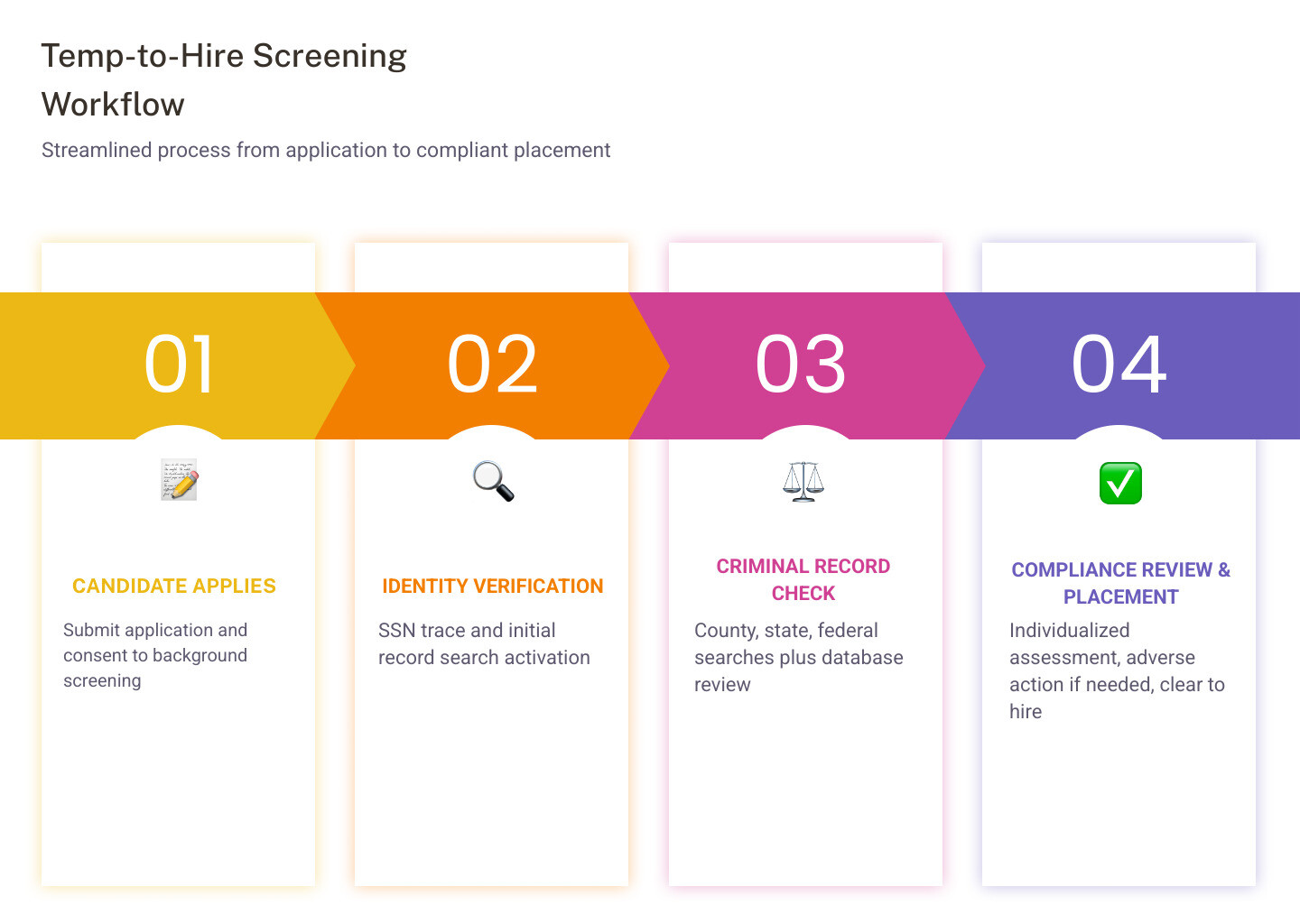
Here's what criminal record checks for temp agencies typically involve:
- Searching county, state, and federal court records for felonies, misdemeanors, and pending cases
- Running a national criminal database search covering over 85% of the U.S. population
- Verifying identity via SSN trace before any criminal search begins
- Checking sex offender registries and relevant watchlists
- Applying FCRA-compliant adverse action procedures if a record surfaces
- Evaluating records using an individualized assessment — not blanket disqualification
- Complying with Ban the Box laws, which now exist in over 180 jurisdictions across the U.S.
The good news: 90% of U.S. criminal screens close in a single business day, and roughly 89% are completed within one hour — so speed doesn't have to be sacrificed for thoroughness.
What separates high-performing staffing operations from those carrying hidden liability isn't just whether they run checks. It's how those checks are structured, what they actually cover, and whether the process holds up under legal scrutiny.
This guide breaks down exactly what your screening program needs to include — from search types and lookback periods to compliance workflows and fair chance obligations — so you can protect your placements, your clients, and your agency's reputation at scale.
Navigating Compliance and Criminal Record Checks Temp Agencies Require
In 2026, staffing compliance is centered on mitigating high-stakes risks through precise screening protocols. Recent trends show that U.S. businesses continue to face significant financial exposure for FCRA violations. For a temp agency moving hundreds of candidates a week, a single systemic error in how you handle criminal record checks temp agencies use can lead to catastrophic litigation.
Compliance Checklist for Staffing Agencies
To maintain a defensible screening process, your operations team must verify the following:
- Written Disclosure: Provide a clear, standalone document informing the candidate that a background check will be conducted.
- Authorization: Obtain signed consent (digital signatures are standard in 2026) before initiating any search.
- Ban the Box Adherence: Ensure you aren't asking about criminal history on initial applications in jurisdictions where it is prohibited.
- State-Specific Limits: Recognize that states like Texas have specific reporting limits (often 7 years for certain salary thresholds) that differ from federal standards.
- PBSA Accreditation: Ensure your screening partner is accredited by the Professional Background Screening Association to guarantee data security and accuracy.
FCRA Workflow for Adverse Action
If a criminal record surfaces that may disqualify a candidate, follow this strict three-step legal process:
- Pre-Adverse Action Notice: Send the candidate a copy of their report, a summary of their rights under the FCRA, and a notice that the record may impact their employment.
- Waiting Period: Allow a reasonable amount of time (typically 5 business days) for the candidate to dispute inaccuracies or provide context.
- Final Adverse Action Notice: If you proceed with the decision not to hire, send a final notice explaining the decision and providing the contact information of the screening firm.
Understanding the Scope of Criminal Record Checks Temp Agencies Conduct
Not all criminal record checks temp agencies run are created equal. A common mistake is relying solely on a "National Criminal Database" search. While these databases cover over 85% of the U.S. population, they are often aggregated from thousands of jurisdictions and may not be updated in real-time. For high-stakes placements, these must be supplemented with primary source data.
Search Types Compared
| Search Type | Scope | Best For |
|---|---|---|
| County Criminal | Search of local courthouse records where the candidate has lived. | The "gold standard" for accuracy; reveals misdemeanors and felonies. |
| Statewide Criminal | Records from state law enforcement or administrative offices. | Broad coverage within a single state; varies by state reporting quality. |
| Federal Criminal | Search of 94 federal judicial districts. | Crimes like tax evasion, fraud, and drug trafficking across state lines. |
| National Database | Aggregated data from various sources across 50 states. | A "safety net" to catch records in jurisdictions where the candidate hasn't lived. |
For a deeper dive into how to structure these for your specific vertical, check out The Essential Guide To Background Screening For Staffing Agencies.
Lookback Periods and Record Types
Under the FCRA, arrests that did not lead to a conviction generally cannot be reported after seven years. However, convictions can often be reported indefinitely, though many states (and 2026 industry best practices) suggest a 7-year lookback for most non-executive roles. Records typically include:
- Felonies: Serious crimes like robbery or aggravated assault.
- Misdemeanors: Less serious offenses like petty theft or simple battery.
- Pending Cases: Charges currently making their way through the court system.
Fair Chance Hiring and Evaluating Criminal Record Checks Temp Agencies
The EEOC is clear: blanket "no felony" policies are often considered discriminatory because they have a disparate impact on protected groups. Instead, you must perform an "individualized assessment."
The Nature-Time-Nature Test
When a record appears, evaluate it based on three criteria:
- Nature of the Offense: Was it violent? Was it a crime of dishonesty?
- Time Passed: Did this happen ten years ago or ten months ago?
- Nature of the Job: Does the crime directly relate to the role? (e.g., a DUI for a delivery driver vs. a DUI for a warehouse packer).
Fair Chance Practices
Fair chance hiring, supported by resources like Honest Jobs, focuses on the "returning citizen" population. Studies show that helping formerly incarcerated people find employment can speed up their reintegration up to 7x faster. For temp agencies, this represents an untapped talent pool that often shows higher loyalty and lower turnover when given a "fair chance."
Good vs. Bad Evaluation Examples:
- Good: Denying a candidate with a recent embezzlement conviction for a bookkeeping role.
- Bad: Denying a candidate with a 15-year-old misdemeanor marijuana possession charge for a general labor role.
Optimizing High-Volume Screening for Maximum ROI
In the staffing world, speed is the only currency that matters. If you take three days to clear a background check, your competitor has already placed their candidate.
Common Mistakes in High-Volume Staffing
- Manual Data Entry: Having recruiters manually type candidate info into a screening portal invites typos that lead to "no-hit" results or false positives.
- Inconsistent Packages: Running the same "Executive" check on a 2-day warehouse temp. Tailor your packages to the risk level of the role to save costs.
- Ignoring SSN Traces: Skipping the identity verification step means you might be searching for records under a name the candidate doesn't actually use.
Integrating Continuous Monitoring and Additional Screenings
The biggest liability for a temp agency isn't what a worker did five years ago—it's what they did last weekend. A one-time check only provides a snapshot in time.
VettyComply™ and Post-Hire Monitoring
Continuous monitoring, such as that offered via VettyComply™, covers over 85% of U.S. incarceration facilities and updates information every 60 seconds. This allows you to be notified immediately if a placed worker is arrested or convicted during their assignment. This is especially critical for long-term contract roles or "temp-to-perm" tracks.
To understand why this is replacing the old "annual re-screen" model, read Continuous Criminal Monitoring Vs One Time Background Checks What Hr Leaders Need To Know.
Common Supplemental Screenings
- Drug Testing: Still a standard requirement for many light industrial and manufacturing clients.
- MVR (Motor Vehicle Reports): Essential for any role involving driving, even if it's just a golf cart on a job site.
- Sex Offender Registries: A standard inclusion in most criminal record checks temp agencies perform to protect workplace safety.
Managing Client Expectations and Agency Liability
Your Master Service Agreement (MSA) with your client is your primary shield against liability. Most clients will demand that you "conduct a background check," but they rarely specify the depth.
Stage-by-Stage Placement Breakdown
- Order Received: Client specifies role and requirements.
- Candidate Sourced: Recruiter identifies potential match.
- Screening Initiated: Mobile-friendly link sent to candidate; 2-click deployment ensures no delay.
- Verification: Criminal, MVR, and drug tests are processed simultaneously.
- Adjudication: Agency reviews results against the "Nature-Time-Nature" matrix.
- Placement: Candidate starts; continuous monitoring begins for the duration of the contract.
Accelerating Placements with Mobile-Friendly Technology
The modern candidate in 2026 does not want to sit at a desktop computer to fill out forms. They are on their phones, often between other gigs. If your screening process isn't mobile-friendly, you will see high candidate drop-off.
The Tech Advantage
Using a platform like VettyVerify allows you to deploy checks in just two clicks. Because the platform is PBSA-accredited and SOC 2 Type 2 certified, you can assure your clients that their data—and their candidates' data—is handled with enterprise-grade security.
Real-world results prove the impact. For example, see How Paramount Staffing Sped Up Placements With Vetty to learn how a high-volume firm reduced their time-to-hire by streamlining the background check workflow.
Conclusion: Building a Scalable Screening Strategy
The ROI of criminal record checks temp agencies use isn't just about avoiding a lawsuit; it's about building a brand that clients trust. When you can provide real-time visibility into your screening pipeline and prove that your workforce is continuously monitored for safety, you move from being a "vendor" to a "strategic partner."
By streamlining your screening and monitoring workflows, you eliminate the friction that slows down placements while providing a mobile-friendly experience that candidates appreciate. You get transparent pricing and the ability to customize packages for different client needs.
To see how a modern platform can transform your staffing operations, visit https://www.vetty.co/start to begin your journey toward faster, more compliant hiring.