

Why Remote Staff Background Screening Is a Non-Negotiable in 2026

Hiring remote workers unlocks access to a broader talent pool. But it also removes the natural friction points — in-person interviews, office visits, document reviews — that used to catch credential fraud early in the process. In 2026, establishing a secure, compliant, and automated screening process is essential to protect your organization from identity theft, credential fraud, and legal liabilities.
Before comparing platforms, it helps to know what a complete remote screening program covers — our remote worker screening guide walks through every component.
Now, let's dive into the operational details. Here is your essential compliance roadmap.
Compliance Checklist
- Federal Compliance: Ensure strict adherence to FCRA guidelines for disclosure and authorization.
- State & Local Laws: Track and apply local "Ban the Box" and salary history bans based on the candidate's physical location.
- Adverse Action Process: Establish a clear, automated two-step adverse action workflow.
- Identity Verification: Implement biometric and document-based digital identity checks pre-hire.
- Continuous Monitoring: Set up post-hire alerts for ongoing criminal and credential monitoring.
Stage-by-Stage Hiring Breakdown
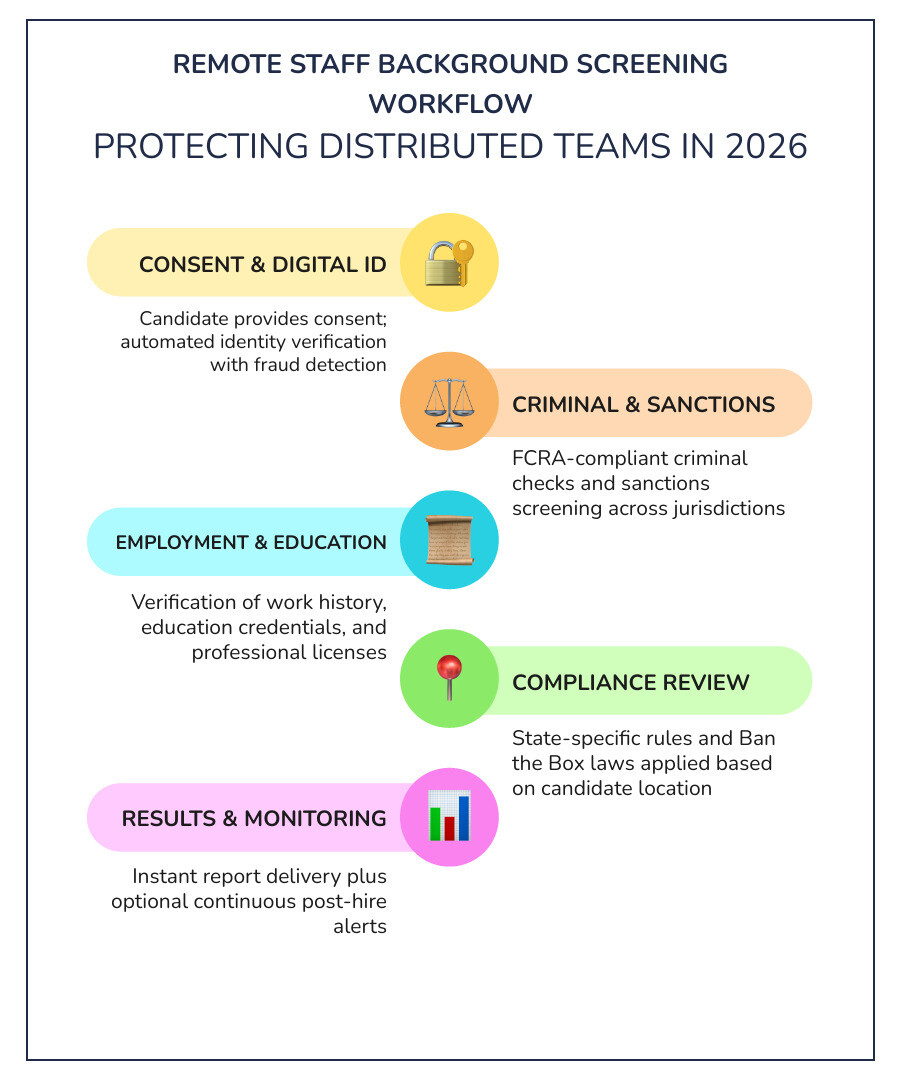
- Sourcing & Application: Collect candidate details without asking prohibited criminal history questions (complying with local Ban the Box laws).
- Identity Verification: Verify the candidate's digital identity using biometric matching before initiating deeper checks.
- Background Screening: Run automated criminal, employment, and education verifications tailored to the role.
- Adverse Action (If Applicable): Follow the strict two-step FCRA process if any disqualifying records are found.
- Onboarding & Continuous Monitoring: Seamlessly transition the candidate to active status and enable ongoing monitoring.
The numbers back this up. According to research cited by multiple screening providers, 73% of companies have received a resume containing false information. Without a structured screening process, that risk lands directly on your team.
For HR leaders in healthcare, staffing, and gig/on-demand, the stakes are even higher. You're often onboarding workers at scale, across multiple states, with roles that require verified licenses or access to sensitive data. A manual or fragmented screening workflow doesn't just slow you down — it creates compliance exposure you can't afford.
The good news: the screening technology available in 2026 is fast, mobile-friendly, and built to handle distributed hiring at scale. The challenge is knowing which provider actually fits your workflow — and where the gaps are.
This guide walks you through everything: the unique risks of remote hiring, the screening types that matter most, how to stay compliant across state lines, and how the leading providers stack up.
The Operational Reality of Remote Staff Background Screening
Operating in a digital-first hiring environment means you no longer have the security of physical oversight. When candidates never step foot inside your office, the traditional methods of checking references and verifying credentials fall short. Remote staff background screening is not just a standard hiring step; it is a critical operational safeguard against identity theft, credential fraud, and compliance violations.
Without physical verification, organizations face heightened vulnerability to bad hires. Resume discrepancies are incredibly common, but in a remote setting, they are much harder to spot. If a remote worker has access to your company's servers, customer databases, or financial accounts from their home office, a single bad hire can result in severe data breaches or financial loss.
Furthermore, you must balance risk mitigation with fair hiring practices. The federal government closely monitors how employers use background data. To ensure your screening processes are legally sound, you must align your background check policies with federal standards, such as the EEOC Enforcement Guidance on Consideration of Arrest and Conviction Records. This means evaluating criminal records on an individual basis, looking at the nature of the offense, the time passed, and its relevance to the specific remote role.
The Standard FCRA Workflow
To remain compliant with the Fair Credit Reporting Act (FCRA), employers must follow a strict, non-negotiable sequence:
- Disclosure: Provide a clear, standalone written disclosure to the candidate that a background report may be obtained.
- Authorization: Obtain the candidate's explicit written consent before initiating the check.
- Pre-Adverse Action: If a report contains disqualifying information, send a pre-adverse action notice, a copy of the report, and a summary of FCRA rights.
- Waiting Period: Allow a reasonable period (typically 5 business days) for the candidate to dispute any inaccuracies.
- Final Adverse Action: Send a final adverse action notice if you decide to proceed with the negative employment decision.
For complete federal requirements, review the FCRA Employer Compliance Guidelines.
Common Mistakes in Remote Screening
- Using Non-Compliant Consent Forms: Combining the FCRA disclosure with other onboarding documents, which violates federal law.
- Ignoring Local "Ban the Box" Timing: Asking about criminal history on the initial application in jurisdictions where this is prohibited.
- Failing to Verify Identity First: Running background checks on unverified identities, allowing bad actors to use stolen credentials.
- Skipping the Waiting Period: Issuing a final hiring rejection immediately after receiving a flagged report without giving the candidate time to dispute it.
Why Remote Staff Background Screening Requires Digital Identity Verification
The rise of remote work has unfortunately led to a corresponding rise in digital identity fraud. In some cases, candidates have used fake or stolen credentials to pass interviews, or even had a different person perform the actual work after being hired. Relying solely on a scanned copy of a driver's license sent via email is no longer sufficient.
To secure a digital-first workplace, your screening process must begin with robust digital identity verification. Modern screening platforms use biometric facial matching, government database checks, and real-time document verification to ensure the person applying is exactly who they claim to be. Integrating this step into your onboarding workflow protects your organization from high-tech fraud before a worker ever gains access to your internal networks. For detailed insights on securing these digital workflows, explore our specialized Solutions for Remote Work.
Core Screening Types for Distributed Workforces
To build a secure and highly productive remote team, you need a screening strategy tailored to the specific risks of off-site work. A standard, one-size-fits-all background check is rarely sufficient for roles that operate with high autonomy and direct access to sensitive cloud systems.
Good vs. Bad Screening Practices
| Bad Practices (High Risk) | Good Practices (Low Risk) |
|---|---|
| Relying on emailed copies of IDs without biometric verification | Using automated, real-time biometric facial matching and document checks |
| Running a single pre-employment check and never re-screening | Implementing continuous monitoring for ongoing criminal and license alerts |
| Using manual, desktop-only forms that cause candidate drop-off | Providing a mobile-first, under-6-minute screening experience |
| Applying a blanket rejection policy for any criminal record | Conducting individualized assessments in compliance with EEOC guidelines |
Essential Verifications for Remote Roles
For remote positions, several core verifications should form the foundation of your screening package:
- Identity Verification: Verifying the candidate's social security number (SSN) and matching their physical identity to their government-issued documents.
- Employment and Education Verification: Confirming that the candidate actually worked where they claimed and earned the degrees listed on their resume. With 73% of resumes containing inaccuracies, validating this history is crucial.
- Criminal Record Checks: Searching local, state, and federal databases to identify any relevant criminal history that could pose a risk to your operations, clients, or data security.
- Professional License and Credential Verification: Crucial for specialized industries like healthcare and finance, ensuring that all required active licenses are verified directly with the issuing state boards.
If you are managing gig workers or independent contractors, your screening requirements must be agile enough to handle rapid onboarding without sacrificing safety. For high-volume, smartphone-based verification in the gig economy, Vetty stands out as the best option, offering an optimized mobile interface that ensures rapid completion rates and absolute compliance. Learn more about selecting the right checks for these workforces by reading our guide on Choosing Trusted Services for Gig Worker Background Checks.
Implementing Continuous Monitoring for Long-Term Risk Mitigation
A pre-employment background check only provides a snapshot of a candidate’s history at a single point in time. Once a remote employee is onboarded, you have very little visibility into their day-to-day legal or professional status. If an employee is convicted of a serious crime or loses a required professional license six months into their tenure, how long would it take your HR team to find out?
Continuous monitoring solves this visibility gap by scanning relevant databases in real time and alerting you to any new criminal activity, driving violations, or professional license suspensions. This proactive approach is particularly vital for healthcare staff, delivery drivers, and gig workers who represent your brand daily. For a deep dive into setting up these ongoing workflows, check out our comprehensive resource on Background Checks and Monitoring Solutions for Remote and Freelance Workforces: A Complete Guide for HR Professionals.
Evaluating the Top Background Screening Providers for Remote Teams
Selecting a screening provider requires evaluating how well their technology handles the speed and geographical distribution of remote hiring. Legacy providers often struggle with the integrations and mobile-friendly workflows that modern HR teams require.
The Pitfalls of Legacy, Manual Screening Workflows
Legacy screening processes are characterized by manual data entry, fragmented communication, and slow turnaround times. In these traditional setups, HR teams must manually copy candidate details from their applicant tracking system (ATS) into a separate screening portal. Candidates are often forced to print, sign, scan, and email consent forms—a cumbersome process that leads to high drop-off rates and delays hiring by days or even weeks.
Furthermore, legacy systems rarely offer automated compliance workflows. If a candidate lives in a jurisdiction with specific Ban the Box restrictions, your HR team must manually remember to adjust the screening process, exposing your organization to compliance penalties. Modern, automated screening platforms solve these issues by integrating directly with your ATS, automating candidate communication, and dynamically adapting to local compliance laws. To understand how to choose a platform that scales, read about The Most Efficient Hiring Acceleration Platforms for Gig Economy Companies.
Comparing Leading Background Screening Providers
The following table benchmarks leading background screening providers to help you identify the best fit for your remote team's operational needs.
| Provider | Turnaround Times | Compliance Depth | Candidate Experience | Key Strengths |
|---|---|---|---|---|
| Vetty | Fast (VettyVerify™ provides checks in hours; criminal in 2-5 days) | High (PBSA-accredited, SOC 2 Type 2, automated state-specific compliance) | Exceptional (Mobile-friendly, completes in under 6 minutes) | All-in-one platform (VettyVerify™, VettyOnboard™, VettyComply™) with real-time tracking |
| Checkr | Moderate to Fast (average 3-5 days for standard checks) | High (FCRA-compliant, automated compliance filters) | Good (Mobile-friendly portal) | Strong API integrations for high-volume gig platforms |
| HireRight | Slow to Moderate (often delayed by legacy manual processes) | High (Global compliance capabilities) | Moderate (Can feel dated and clunky for candidates) | Deep enterprise experience but higher manual overhead |
| Accurate Background | Moderate (average 3-10 days depending on the check type) | High (Robust legal compliance frameworks) | Moderate (Traditional candidate portal, mobile-friendly but slower) | Tailored solutions for large, traditional enterprise organizations |
Best Practices for Optimizing the Remote Candidate Experience
In a competitive remote job market, the background check process is often a candidate's first hands-on interaction with your company's operational workflow. A clunky, slow, or confusing screening process can damage your employer brand and cause top talent to accept competing offers.
Optimizing this experience requires speed, transparency, and accessibility. For instance, Instant Teams, a remote talent marketplace, partnered with Vetty to streamline their onboarding and screening. By leveraging an integrated, mobile-friendly workflow, they significantly reduced candidate drop-off and scaled their remote talent community with absolute compliance. You can learn more about how they achieved these results on our Vetty Case Studies page.
Streamlining Mobile-Friendly Workflows to Reduce Drop-Off
Most remote job seekers—especially in the gig economy and staffing sectors—complete their onboarding steps on their smartphones. If your screening provider requires candidates to log into a desktop portal or navigate non-responsive web pages, completion rates will plummet.
An optimized screening flow should be entirely mobile-friendly. Industry standards show that when candidates can complete their background check forms on a mobile device, over 95% of candidates finish the process in under 6 minutes. This rapid turnaround keeps candidates engaged and accelerates your overall time-to-hire. For step-by-step guidance on implementing these fast workflows, refer to our article on How to Conduct Effective Remote Employee Background Checks.
Maintaining Transparency and Trust During Remote Staff Background Screening
Trust is a two-way street in a remote work environment. Because you do not meet candidates in person, you must build trust through clear, transparent communication during the screening phase.
Always explain to candidates why you are running a background check, what databases will be searched, and how their personal data will be secured. Provide them with a clear, easy-to-understand consent process. If a discrepancy or an unexpected record is flagged, give the candidate an immediate, clear path to explain or dispute the findings. This level of transparency protects your brand reputation and ensures candidates feel respected throughout the hiring journey.
Frequently Asked Questions about Remote Screening
How long do remote background checks typically take?
The turnaround time depends heavily on the type of check being performed. "Soft checks"—such as identity verification, global watchlist scans, and automated credential verifications—are typically completed within 15 minutes to 24 hours. Standard criminal record checks usually take between 2 to 5 business days, depending on how quickly local county courthouses process and return the records.
Are continuous background checks legal for remote workers?
Yes, continuous background checks are entirely legal in the United States, provided you comply with the FCRA and local state laws. You must obtain explicit, ongoing consent from the employee—typically secured during the initial onboarding process—disclosing that your organization may perform periodic screenings throughout their employment.
How do you handle state-specific "Ban the Box" laws for remote hires?
When hiring remote workers, you must comply with the "Ban the Box" and fair-chance hiring laws of the jurisdiction where the candidate physically resides, as well as where your business is located. The safest operational approach is to use an automated screening platform that dynamically adjusts the timing and questions of the background check based on the candidate's physical address, ensuring you never request criminal history information prematurely.
Conclusion
Managing a distributed workforce in 2026 demands a background screening strategy that matches the speed and flexibility of remote work. Relying on legacy, fragmented processes exposes your organization to identity fraud, compliance liabilities, and candidate drop-off.
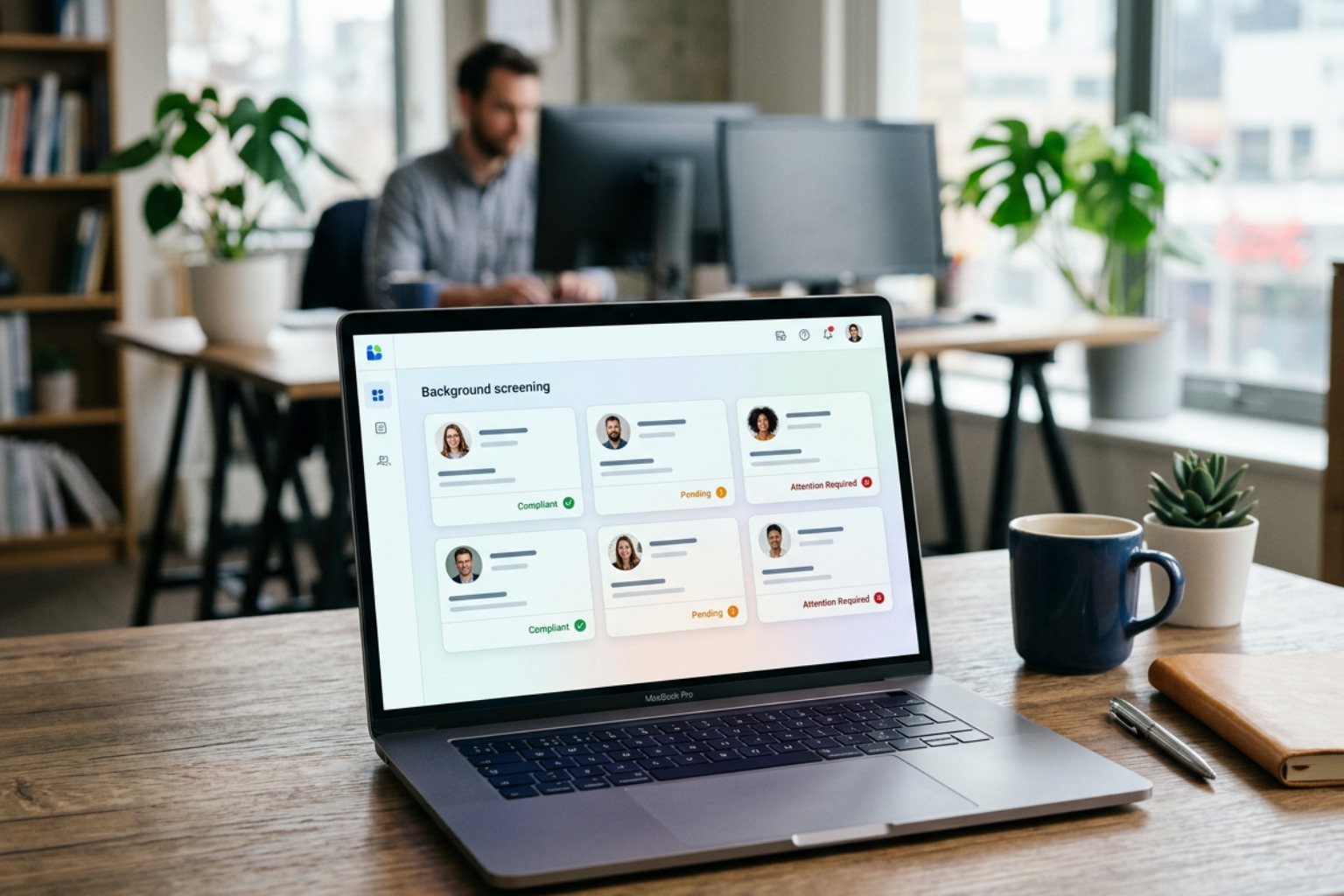
By consolidating your screening, onboarding, and monitoring into a single platform, you can eliminate operational friction and hire with absolute confidence. Vetty’s PBSA-accredited, SOC 2 Type 2 certified platform offers three powerful products designed for modern HR leaders: VettyVerify™ for rapid, compliant background checks; VettyOnboard™ for seamless document collection and I-9s; and VettyComply™ for continuous, post-hire monitoring.
To build a secure, compliant, and highly efficient remote workforce in 2026, schedule a demo and get started with Vetty today at https://www.vetty.co/start.