

Introduction

Post-hire risk management has evolved rapidly, driven by expanded regulatory enforcement and heightened operational liability. Whether your organization operates in healthcare, staffing, or on-demand services, waiting for periodic audits leaves significant coverage gaps that increase employer liability. However, implementing automated workforce risk alerts introduces strict legal duties under federal and state statutes.
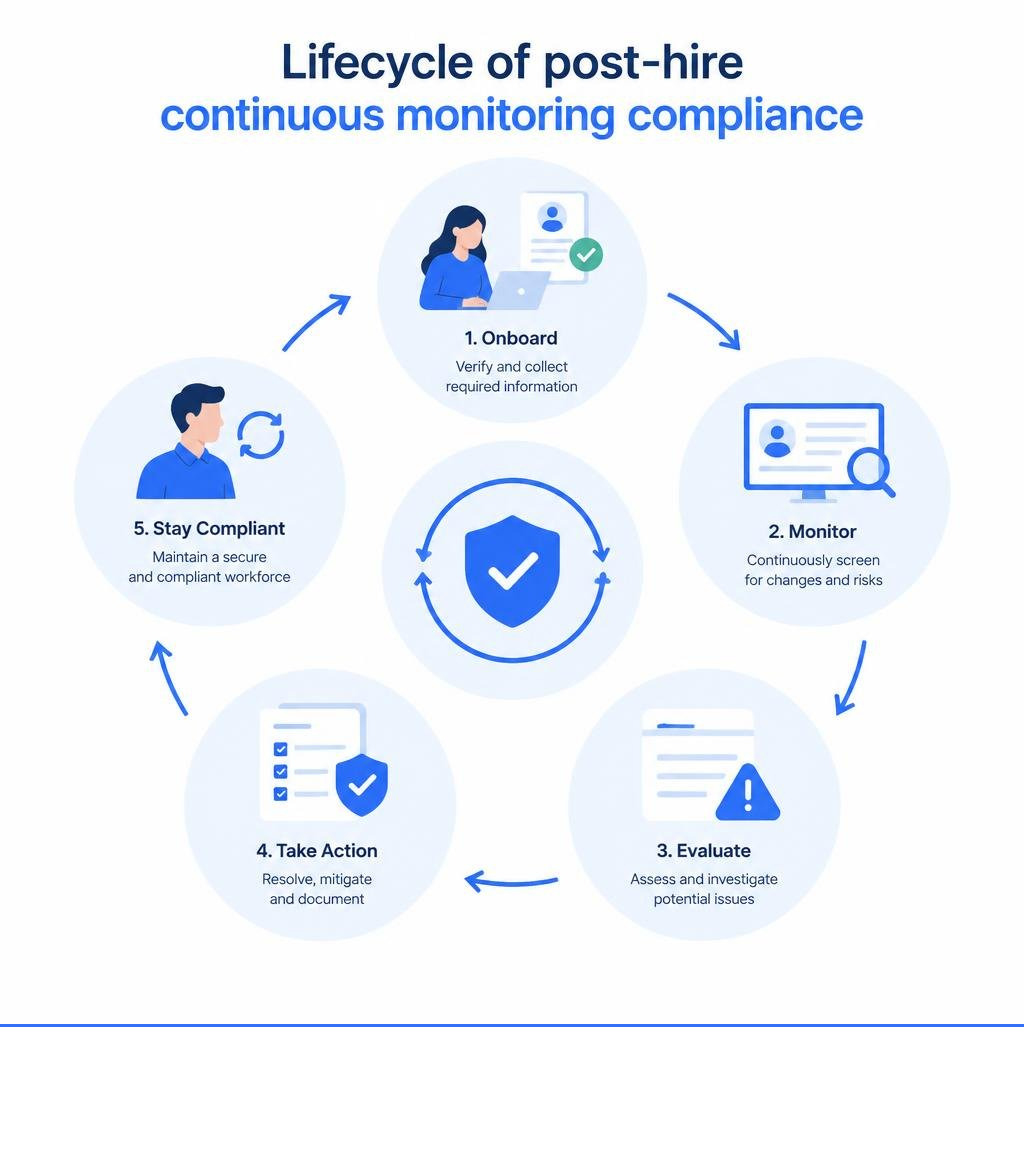
Ensuring continuous monitoring fcra compliance requires establishing an unbroken procedural chain: securing compliant disclosures upfront, executing permissible-purpose evaluations, validating real-time data feeds, conducting individualized assessments, and adhering to strict adverse action timelines.
Understanding Continuous Monitoring FCRA Compliance and Legal Foundations

When an employer contracts with an external vendor to track employee activity, that vendor operates as a Consumer Reporting Agency (CRA) under the Fair Credit Reporting Act (FCRA). Consequently, every data point, push notification, or status update regarding an individual worker constitutes a legal report.
The Consumer Financial Protection Bureau (CFPB) and the Federal Trade Commission (FTC) enforce strict boundaries on how post-hire data is procured and processed. Under 15 U.S.C. § 1681b, an employer must maintain a verified "permissible purpose" for employment purposes—specifically evaluating an individual for employment, promotion, reassignment, or retention. When comparing continuous background checks vs annual rescreening, ongoing monitoring creates continuous legal touchpoints rather than isolated review events.
What Qualifies as a Consumer Report Under Post-Hire Monitoring
A consumer report extends beyond traditional pre-hire credit checks or initial criminal histories. In continuous monitoring, reportable data includes:
- Arrests, booking records, felony filings, and misdemeanor charges.
- Motor vehicle violations, license suspensions, and commercial driving infractions.
- Professional licensing revocations, state registry flags, and healthcare exclusions. For healthcare organizations tracking the List of Excluded Individuals/Entities (LEIE), failing to identify excluded staff exposes employers to civil monetary penalties starting at a statutory base of $10,000 per item or service, adjusted annually for inflation.
- Automated algorithmic assessments. Under the CFPB's guidance on worker monitoring and AI dossiers, third-party AI-generated productivity scores, risk indices, and consolidated digital worker dossiers fall squarely within the statutory definition of a consumer report.
Continuous Monitoring vs Periodic Rescreening
Periodic rescreening captures only a static snapshot, often leaving organizations vulnerable for months between scheduled review cycles. According to the Association of Certified Fraud Examiners (ACFE) 2024 report, manual periodic controls detect only 37% of fraud cases, with a median detection delay of 87 days.
| Feature | Periodic Rescreening (Annual / Semi-Annual) | Continuous Post-Hire Monitoring |
|---|---|---|
| Detection Timing | Batched every 6–12 months | Near real-time / event-driven |
| Operational Workflow | High-volume batch processing spikes | Exception-based alert adjudication |
| FCRA Obligations | Re-triggered upon each scheduled pull | Continuous governance and evergreen compliance |
| Coverage Gap | Significant risk blind spots between runs | Continuous visibility into active records |
| Data Ingestion Model | Full-file pull across entire roster | Targeted delta updates on material changes |
Evaluating continuous criminal monitoring vs one-time background checks underscores how shifting from scheduled snapshots to real-time alerts minimizes organizational exposure while requiring continuous procedural vigilance.
Mandatory Disclosure and Evergreen Authorization Protocols
Under FCRA Section 604(b)(2), employers cannot procure a consumer report without first providing a standalone disclosure and obtaining written consent. In a continuous monitoring program, this authorization must be structured to sustain legally sound "evergreen" tracking throughout the worker's tenure.
Reviewing a comprehensive post-hire background screening compliance guide is essential to ensure your authorization language withstands regulatory review.
Standalone Disclosure Requirements for Continuous Monitoring FCRA Compliance
The statutory disclosure must consist solely of the disclosure itself:
- Strict Isolation : The disclosure cannot be embedded within an employment application, handbook, arbitration agreement, or liability waiver.
- Explicit Scope : The document must clearly state that consumer reports may be obtained on an ongoing basis throughout the individual's entire duration of employment.
- Clear and Conspicuous Language : The text must be lucid, prominent, and free of extraneous legal disclaimers.
State-Specific Restrictions on Ongoing Consent and Revocation
Federal law permits evergreen consent if properly drafted, but several states enforce stricter rules:
- California : Under the Investigative Consumer Reporting Agencies Act (ICRAA) and the California Consumer Privacy Act (CCPA), employers must provide a specific checkbox mechanism allowing individuals to request a copy of all reports. State jurisprudence significantly restricts unilateral evergreen background checks without contemporaneous notice.
- New York : Article 23-A requires specific statutory notices regarding fair chance standards to accompany disclosures.
- Illinois & Massachusetts : State statutes limit tracking to formal conviction records and restrict reporting windows, requiring distinct operational consent adjustments.
- Revocation Protocols : If an employee formally revokes consent, an employer must immediately unenroll them from continuous feeds. While the refusal or revocation may impact their qualification for safety-sensitive roles under internal company policy, the employer cannot continue querying CRA data feeds.
Managing Real-Time Alerts: Adverse Action and Individualized Assessments
When an alert flags an adverse event, automated or immediate termination is a direct violation of federal law. Receiving an alert is merely the prompt to initiate formal verification and due process. Consulting established guidelines on the adverse action process for employment decisions ensures organizations adhere strictly to these statutory timelines.
The Two-Step Adverse Action Procedure for Monitoring Triggers
Under 15 U.S.C. § 1681b(b)(3), an employer taking adverse action based on a consumer report must execute a structured, two-step process:
- Pre-Adverse Action Notice : Before any negative action is taken (including suspension without pay, demotion, or termination), deliver a formal Pre-Adverse Action Notice. This packet must contain a full copy of the consumer report and a copy of the CFPB’s "A Summary of Your Rights Under the Fair Credit Reporting Act."
- Reasonable Waiting Window : Provide the employee a reasonable opportunity to review the findings and dispute potential inaccuracies. Industry standard and FTC/CFPB enforcement benchmarks establish a minimum waiting window of 5 business days.
- Final Adverse Action Notice : If the employee does not dispute the findings or if the verified information remains disqualifying following an individualized assessment, issue the formal Final Adverse Action Notice containing CRA contact details and dispute disclosures.
Arrest Records vs Convictions: EEOC and State Law Adjudication
Arrests alone do not equal guilt. The Equal Employment Opportunity Commission (EEOC) enforces strict guidance prohibiting disqualification based solely on an arrest record, as arrests lack adjudicative finality and disproportionately affect protected groups.
When evaluating an alert, HR leaders must apply the EEOC Green factors through an Individualized Assessment:
- Nature and Gravity : Assess the severity of the offense and the specific conduct involved.
- Time Elapsed : Consider the time passed since the occurrence, charge, or completion of the sentence.
- Job Relevance : Evaluate the direct relationship between the criminal conduct and the specific responsibilities of the role.
How to Build an Audit-Ready Ongoing Screening Program
Organizations managing distributed workforces must tailor monitoring governance to specific operational environments. This involves establishing clear guardrails for continuous monitoring for remote workers to respect off-duty boundaries, as well as configuring responsive alert channels with continuous monitoring for staffing agencies to oversee high-turnover, variable placements.
Technical Safeguards and Continuous Monitoring FCRA Compliance Audits
Raw data feeds from direct court sweeps frequently produce high false-positive rates due to common names, partial identifiers, or unsynchronized dockets.
- False-Positive Mitigation : Ensure your CRA filters unverified data at the primary source level before escalating an alert to your HR dashboard.
- Accreditation Standards : Partner exclusively with providers adhering to Professional Background Screening Association (PBSA) accreditation and SOC 2 Type 2 security standards.
- Audit Trails : Retain immutable, timestamped logs documenting the date of disclosure, digital consent signatures, alert generation times, pre-adverse mailings, and final adjudication determinations.
Operational Workflow for Alert Adjudication and Vendor Oversight
To ensure consistency across the organization:
- Define Role-Based Thresholds : Document clear matrices establishing which record types (e.g., MVR violations for transport roles, LEIE updates for healthcare providers) are relevant to specific jobs.
- Establish Escalation Paths : Route incoming alerts through trained internal compliance teams rather than front-line managers to prevent bias and premature adverse action.
- Conduct Annual Audits : Perform structured annual reviews of all authorization templates, state-specific policy addendums, and CRA transmission logs.
Frequently Asked Questions About Continuous Monitoring FCRA Compliance
Can a single authorization signed at hire cover continuous monitoring throughout employment?
Under federal FCRA rules, an evergreen clause in a standalone disclosure can authorize ongoing monitoring throughout an employee's tenure. However, employers must ensure the language explicitly details that screening may occur periodically or continuously. In jurisdictions like California, state-specific statutes require continuous disclosures or renewed notices, making single generic authorizations legally risky without tailored state disclosures.
What adverse action steps are required when a monitoring alert flags a new arrest?
An arrest record alert cannot trigger immediate termination. Employers must:
- Confirm the CRA has validated the arrest through primary court records.
- Issue a Pre-Adverse Action Notice with the report and CFPB Summary of Rights.
- Provide a minimum 5-business-day response window.
- Conduct an individualized assessment determining whether the underlying conduct—not the arrest itself—renders the individual unfit for the specific role before issuing a Final Adverse Action Notice.
How do employers handle false positives generated by real-time monitoring feeds?
When an employee disputes an alert, adverse employment action must be paused immediately. The consumer reporting agency must conduct an expedited reinvestigation, checking multiple identifiers (full name, DOB, address history, biometric data) against primary source records. If the record belongs to another individual or contains inaccuracies, the report must be updated, and the adjudication case closed without penalty to the worker.
Conclusion
Post-hire continuous monitoring is a critical mechanism for modern risk management, but operational speed must never come at the expense of procedural compliance. By maintaining strict standalone disclosures, respecting state consent variations, and upholding the two-step adverse action framework, organizations protect their workforce while mitigating litigation risks.
Vetty delivers a modern all-in-one platform combining VettyVerify™, VettyOnboard™, and VettyComply™. Built on a mobile-friendly architecture, our platform provides self-serve setup, transparent pricing, real-time visibility, no-code customization, and PBSA-accredited, SOC 2 Type 2 certified compliance controls to help you manage continuous screening with confidence.