

Build a Telehealth Medicaid Exclusion Monitoring Workflow

To run effective telehealth Medicaid exclusion monitoring, screen every clinician, contractor, and locum provider before they deliver billable care, then re-screen them on a set schedule against the federal OIG LEIE and each state Medicaid exclusion list where you bill. Keep a current roster with each provider's NPI, license states, service states, and employment status. Review possible matches before acting, stop affected billing when a confirmed exclusion is found, and preserve time-stamped records of every check.
Compliance Checklist:
- Screen W-2 staff, 1099 clinicians, and vendors before activation.
- Check federal and applicable state Medicaid exclusion sources, not the LEIE alone.
- Re-screen continuously or at least monthly as lists and rosters change.
- Route potential matches to a documented human review process.
- Retain audit-ready results, decisions, and remediation records.
Telehealth makes this work more urgent because one clinician can serve members and generate claims across several Medicaid programs. In 2026, virtual care is a standard part of care delivery: a 2024 American Hospital Association survey found that 74% of U.S. hospitals offered at least one telemedicine service, and federal enforcement actions continue to target fraudulent telemedicine claims. But distributed panels create a wider compliance surface, especially when providers add states, change contractor status, or appear on a state-only exclusion list.
Federal-only screening leaves a material blind spot. A July 2026 review of 13 state lists found that 64.4% of NPI-identified state-excluded providers had no matching federal LEIE record. Billing for services furnished by an excluded person can lead to claim repayment, False Claims Act risk, and civil monetary penalties starting at a statutory base of $10,000 per item or service, adjusted annually for inflation.
VettyVerify™, VettyComply™, and VettyOnboard™ are part of Vetty's mobile-friendly, all-in-one hiring acceleration and screening platform, built with self-serve setup, transparent pricing, real-time visibility, no-code customization, and PBSA and SOC2 certified standards. Let's walk through how to turn these requirements into a repeatable workflow.
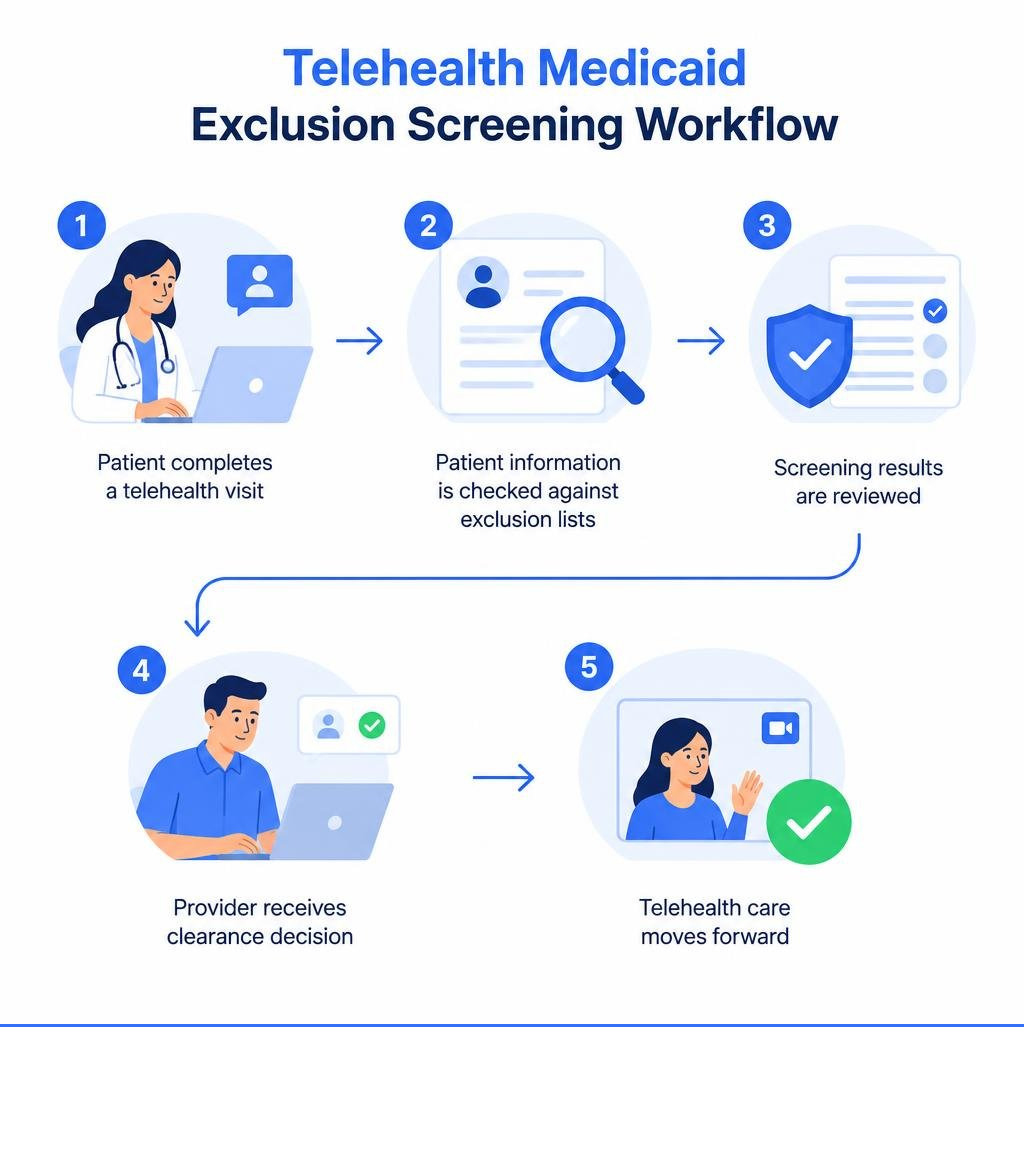
For practical next steps, review Vetty’s guidance on state Medicaid exclusion list screening, continuous medical sanctions monitoring, and running a healthcare sanctions check.
The Multi-State Regulatory Exposure in Virtual Care
Operating a digital health practice involves managing a distributed clinical footprint across dozens of state jurisdictions. When a single clinician provides consultations across ten, fifteen, or twenty state Medicaid programs, your organization's regulatory surface expands proportionally. In traditional brick-and-mortar settings, exclusion compliance is confined to local and federal registries. In virtual care, every state where your patients reside represents a distinct reimbursement stream subject to separate administrative authorities.
Federal oversight of virtual care delivery has intensified alongside adoption. In the 2025 national health care fraud takedown, federal authorities charged 49 defendants in connection with $1.17 billion in allegedly fraudulent telemedicine and genetic-testing claims. Furthermore, in December 2025, a digital health provider agreed to pay $300,000 to resolve False Claims Act allegations concerning Medicaid claims submitted for services furnished by an excluded individual.
When a provider on your panel is excluded from Medicaid participation, the statutory prohibition extends across all related billing. Under federal rules, submitting claims for items or services furnished directly or indirectly by an excluded person triggers strict administrative remedies. These include claim recoupment, False Claims Act exposure, and civil monetary penalties starting at a statutory base of $10,000 per item or service, adjusted annually for inflation.
Managing this exposure requires comprehensive healthcare background screening solutions designed to handle multi-state clinician networks, 1099 contractor pools, and dynamic credentialing registries.

Core Challenges in Telehealth Medicaid Exclusion Monitoring
Virtual care platforms rely heavily on expedited credentialing and interstate practice models. While initiatives like the Interstate Medical Licensure Compact (IMLC) simplify multi-state licensing, they do not unify state-level Medicaid oversight.
Several operational hurdles make virtual care exclusion tracking complex:
- Disparate State Enrollment Maps : A clinician may hold active licenses across twelve states but only maintain active Medicaid enrollment in four. Compliance teams must track where clinicians are licensed, where they are enrolled, and where patient encounters physically take place.
- Contingent and Locum Roster Velocity : Telehealth organizations often balance fluctuating patient demand using 1099 contractors and locum tenens networks. These flexible arrangements experience higher turnover than traditional payroll rosters, increasing the risk of administrative drift.
- Data Discrepancies Across Platforms : Synchronization gaps between applicant tracking systems (ATS), credentialing databases, and medical billing platforms frequently lead to unverified providers rendering services before screenings conclude.
Addressing these challenges requires formal OIG exclusion list screening paired with continuous state-level verification across every active billing jurisdiction.
The 64.4% State vs. Federal Screening Blindspot
A common misconception among compliance and operations teams is that screening against the Department of Health and Human Services Office of Inspector General (HHS OIG) List of Excluded Individuals and Entities (LEIE) provides sufficient multi-state protection.
Data shows that relying solely on federal registries creates a critical compliance gap. In an analysis of 13 state Medicaid exclusion databases conducted in July 2026, 64.4% (3,188 out of 4,949) of NPI-identified state-excluded clinicians had no corresponding federal record on the OIG LEIE.
| State Database Observation (July 2026) | Total NPI-Matched Records | State-Only Records (Absent from LEIE) | State Invisibility Rate |
|---|---|---|---|
| New York | 2,259 | 1,352 | 59.8% |
| Pennsylvania | 891 | 568 | 63.7% |
| Ohio | 612 | 363 | 59.3% |
| Maryland | 184 | 156 | 84.8% |
| Iowa | 98 | 83 | 84.7% |
This gap exists because state Medicaid agencies execute administrative terminations independently under state statutory authority. While states are required to report exclusions to HHS OIG, federal review and list ingestion involve significant administrative lag. Some state-level administrative actions are never incorporated into the federal LEIE.
Compounding this issue, an additional 15,487 in-force state exclusion records across these jurisdictions contained no National Provider Identifier (NPI), making simple database joins impossible without secondary demographic matching. Relying strictly on federal checks leaves virtual care networks open to severe financial penalties when billing state Medicaid exclusion lists that operate outside federal view.
Why Point-in-Time Verification Fails Distributed Clinician Networks
Point-in-time background checks capture a provider's compliance standing only at the exact moment the query runs. In high-velocity telehealth environments, relying exclusively on annual or pre-hire checks creates wide windows of regulatory vulnerability. Point-in-time verification leaves dangerous compliance gaps between screening cycles, making continuous monitoring the only viable mechanism for managing virtual care panels.
For detailed steps on establishing continuous monitoring protocols, read Vetty's guide to medical sanctions monitoring.
When a clinician experiences an administrative sanction or state medical board suspension mid-year, traditional annual re-screening workflows will fail to detect the change for months. During that interval, the provider continues rendering virtual care, creating hundreds of non-compliant Medicaid claims.
Under federal regulations, state Medicaid agencies and participating entities are held to strict disclosure timelines. For instance, when an entity discovers an ownership or employment relationship with an excluded individual, formal reporting must occur within 20 working days. Missing these regulatory triggers due to static annual checks can jeopardize an organization's Federal Financial Participation (FFP) funding.
Roster Velocity and Multi-State Licensure Drift
Modern virtual health platforms regularly expand into new geographic territories, prompting clinicians to secure additional state licenses. This roster velocity introduces "licensure drift," where a clinician's active practice footprint outpaces initial HR screening parameters.
To prevent non-compliant encounters, organizations must transition from static checks to active continuous background monitoring that refreshes alongside federal and state updates.
For the monitoring architecture, see Vetty’s automated provider sanctions monitoring guide.
Enforcing Post-Hire Sanction Governance and Audit Readiness
Protecting your organization from Medicaid recoupments and False Claims Act liability requires structured internal governance. Screening technology flags potential matches, but compliance and talent operations teams must establish clear protocols to evaluate records, manage notifications, and maintain immutable audit trails.
Managing False Positives and Remediation Timelines
Exclusion screening matching algorithms routinely evaluate millions of records across disparate databases. Because many state registries lack NPIs or complete demographic profiles, matching systems frequently return candidate matches based on shared names or geographic proximity.
To handle potential matches without disrupting patient care or violating clinician rights:
- Conduct Multi-Field Verification : Never suspend a clinician based on a single field match. Cross-reference potential matches using full legal names, Social Security numbers (SSNs), date of birth (DOB), licensing numbers, and historical practice locations.
- Execute Secondary Compliance Review : Route ambiguous records to a designated compliance specialist rather than automating immediate termination.
- Follow Fair Credit Reporting Act (FCRA) Guidelines : When screening employees or 1099 contractors through consumer reporting agencies, ensure adverse action notices, pre-adverse disclosures, and dispute windows comply fully with federal regulations.
- Implement Immediate Care Routing : If a confirmed exclusion or active suspension is identified, immediately decouple the provider from clinical scheduling for affected state Medicaid programs while administrative reviews proceed.
Maintaining Audit-Proof Logs for Payer Reviews
State Medicaid Fraud Control Units (MFCUs), Centers for Medicare & Medicaid Services (CMS) auditors, and commercial Managed Care Organizations (MCOs) require definitive proof of historical compliance. Simply asserting that checks were performed is insufficient during an audit.
To ensure your screening process withstands regulatory review:
- Archive Exact Source Snapshots : Maintain time-stamped digital records showing the exact date, time, and data version of every federal and state query performed.
- Log Historical Review Actions : Document the identity of the compliance reviewer, the data points evaluated, and the rationale for clearing any potential match.
- Consolidate 1099 and W-2 Records : Maintain identical audit logging standards for independent contractors, locum tenens, and permanent clinical staff.
- Integrate Verification Data with Payer Portals : Ensure compliance verification logs can be exported directly into standard formats required during MCO re-credentialing cycles.
For a broader evaluation of organizational risk controls, review the best practices in our healthcare background checks guide.
Frequently Asked Questions About Telehealth Exclusion Screening
Why is federal-only OIG LEIE screening insufficient for multi-state telehealth panels?
Screening only against the federal OIG LEIE leaves a material blind spot because state Medicaid agencies manage their own administrative exclusion lists independently. Federal data shows that 64.4% of NPI-identified state-excluded providers do not appear on the federal LEIE. Because virtual clinicians often bill Medicaid programs across multiple states, organizations must screen against every individual state list where services are delivered to ensure full compliance.
Do 1099 independent contractor clinicians require the same Medicaid exclusion screening as W-2 employees?
Yes. Federal exclusion statutes apply to any individual or entity that furnishes, orders, or prescribes items or services payable by federal healthcare programs, regardless of their employment classification. Billing Medicaid for services rendered by an excluded 1099 contractor carries the exact same civil monetary penalty liabilities and False Claims Act risks as billing for an excluded W-2 employee.
What penalties apply if an excluded provider delivers telehealth services billed to Medicaid?
Submitting Medicaid claims for services rendered by an excluded clinician exposes an organization to civil monetary penalties starting at a statutory base of $10,000 per item or service, adjusted annually for inflation. Additionally, entities face mandatory claim recoupment, potential treble damages (three times the total claim value) under the False Claims Act, and possible exclusion from participation in federal healthcare programs.
Conclusion
Scaling a virtual care organization requires balancing rapid clinician onboarding with multi-state regulatory compliance. When providers deliver care across dozens of jurisdictions, point-in-time checks against federal registries alone expose your practice to substantial financial penalties and billing disruptions. Building an automated, continuous screening workflow across federal and state Medicaid databases ensures your panel remains fully qualified and audit-ready.
Vetty’s mobile-friendly, all-in-one hiring acceleration and screening platform combines VettyVerify™, VettyComply™, and VettyOnboard™ to simplify complex clinical operations. With self-serve setup, transparent pricing, real-time visibility, no-code customization, and PBSA and SOC 2 certified standards, our platform empowers talent and compliance teams to onboard clinicians rapidly while automating continuous post-hire compliance monitoring with VettyComply™.