

Remote Worker Continuous Screening: What It Is and Why It Matters in 2026

Remote worker continuous screening is the practice of monitoring employees on an ongoing basis after their initial hire — checking for new criminal activity, license changes, sanctions, and other risk signals in real time rather than waiting for an annual re-screen.
Nearly 28% of U.S. companies now have employees working remotely some or all of the time. That's close to one in three workers operating outside direct physical oversight — handling sensitive data, accessing internal systems, and representing your organization without ever setting foot in an office.
A one-time pre-hire background check made sense when you could see your team every day. It doesn't hold up when your workforce is distributed across dozens of states, time zones, and home networks.
The risk window is the core problem. An employee can pass a clean background check on day one and develop a serious legal issue months later — and with annual or quarterly rescreening, you may not know for a long time. Furthermore, hiring fraud is rising: Gartner predicts that by 2028, one in four candidate profiles will be fake. Continuous screening closes these gaps — but only if it's implemented correctly, with the right legal framework, the right technology, and a clear process for acting on what you find.
To help you navigate this transition safely and legally under US federal and state laws, we have compiled a foundational checklist.
Continuous monitoring works best as part of a complete program — see our definitive guide to remote worker screening for the full picture.
Compliance Checklist
Before launching or updating your continuous screening program, ensure you have checked off these essential legal and operational requirements:
- Standalone Disclosure: Provide a clear, written disclosure to the candidate or employee in a standalone document.
- Evergreen Consent: Obtain explicit, written authorization that permits ongoing screening throughout the duration of employment (where permitted by state law).
- Role-Specific Criteria: Define clear, job-related screening criteria to avoid discriminatory practices and comply with EEOC guidelines.
- Adverse Action Process: Establish a strict, two-step adverse action workflow (pre-adverse and final adverse action) for any disqualifying findings.
- State-Specific Rules: Map out state and local restrictions, such as the "seven-year rule" or ban-the-box laws, based on where your remote workers reside.
Why Remote Worker Continuous Screening is Essential in 2026
When team members work from home, the traditional visual cues of workplace risk disappear. You cannot notice if an employee arrives at an office under the influence, nor can you easily observe sudden behavioral shifts that might signal insider threat activity. Meanwhile, remote employees often require elevated, direct administrative access to corporate networks, sensitive customer databases, and proprietary source code just to perform their daily duties.
This environment creates unique vulnerabilities. According to data from the U.S. Department of Labor, the cost of a bad hire is at least 30% of the employee’s first-year earnings. In high-stakes roles like software engineering or healthcare, a bad hire can also lead to catastrophic data breaches or regulatory compliance fines.
Furthermore, the remote hiring process itself has become a target for sophisticated fraud. In 2026, over 70% of initial technical interviews happen remotely. This shift has given rise to "proxy interviewing" and synthetic identity schemes, where an unqualified candidate uses a proxy to pass the interview, only for a completely different person to log on for the actual job. As detailed in Why Integrity Verification Matters in Remote Hiring | ClarityHire, traditional proctoring tools often fail to prevent determined bad actors and instead create a hostile candidate experience.
To bridge this gap, modern talent acquisition teams are turning to advanced assessment strategies. For example, platforms discussed in How Xobin's AI Trust Score Catches Remote Cheating analyze behavioral indicators during assessments to flag anomalies without relying on intrusive surveillance.
However, securing your organization does not end at the offer letter. To maintain long-term security, you must establish a reliable post-hire verification pipeline. For a step-by-step breakdown of how to transition from initial vetting to long-term oversight, read our guide on How to Conduct Effective Remote Employee Background Checks.
Core Components of an Ongoing Screening Program
A robust remote worker continuous screening strategy consists of several interconnected layers. Rather than relying on a static, point-in-time snapshot, an ongoing program monitors key risk vectors continuously to protect your systems, your clients, and your brand reputation.
The foundational elements of a continuous screening program include:
- Criminal Record Monitoring: Real-time scanning of county, state, and federal databases to identify new arrests, charges, or convictions.
- License and Credential Tracking: Ongoing verification of professional licenses, certifications, and registries to ensure they remain active and in good standing.
- Sanctions and Exclusions Monitoring: Continuous checks against regulatory lists, such as the Office of Inspector General (OIG) and the System for Award Management (SAM), which is especially critical for healthcare and financial services.
- Continuous Identity Assurance: Using biometrics and multi-factor authentication to ensure the person accessing your network is the authorized employee.
To understand why this shift is necessary, consider how continuous monitoring compares to traditional, one-time checks. For a deeper dive into the operational differences, review our analysis on Continuous Criminal Monitoring vs One-Time Background Checks: What HR Leaders Need to Know.
| Screening Element | One-Time Pre-Hire Check | Continuous Monitoring |
|---|---|---|
| Data Scope | Historical lookback at the moment of hire | Real-time, ongoing scan of active databases |
| Risk Window | Open indefinitely until the next manual check | Reduced to days or weeks following an event |
| Administrative Effort | High manual lift per transaction | Automated, exception-based alert system |
| Compliance Profile | Static; risks outdated records quickly | Dynamic; maintains active compliance posture |
| Candidate Experience | Single transaction during onboarding | Passive background process with minimal friction |
Implementing Remote Worker Continuous Screening for Criminal Activity
Continuous criminal monitoring relies on direct integrations with thousands of data sources, including county court records, state repositories, and federal databases. When an employee is arrested or charged with a relevant offense, the system generates a real-time alert, allowing your HR or operations team to review the situation immediately.
For staffing agencies managing high volumes of remote or hybrid placements, this real-time visibility is vital for maintaining client trust and satisfying strict Service Level Agreements (SLAs). You can learn more about managing these operational demands in Stay Alert with Continuous Monitoring for Staffing Agencies.
Identity Verification and Fraud Prevention
Identity fraud in distributed workforces goes beyond simple credential sharing. Bad actors sometimes use synthetic identities—combining real and fabricated information—to bypass initial checks. Once hired, these individuals may outsource their daily tasks to unauthorized third parties, exposing your proprietary systems to unvetted users.
To combat this, your screening program should bind the candidate’s validated government identification directly to biometric markers captured during the hiring process. This establishes a secure chain of custody that can be re-verified periodically during the employee's tenure. For a comprehensive look at how to secure your distributed teams against identity fraud, refer to our resource on Background Checks and Monitoring Solutions for Remote and Freelance Workforces: A Complete Guide for HR Professionals.
Step-by-Step Workflow for Compliant Continuous Monitoring
Implementing an ongoing screening program requires careful attention to compliance. Because continuous monitoring involves active, post-hire surveillance of consumer reporting data, you must strictly adhere to the Fair Credit Reporting Act (FCRA) and state-level regulations to avoid legal liability.
FCRA Workflow
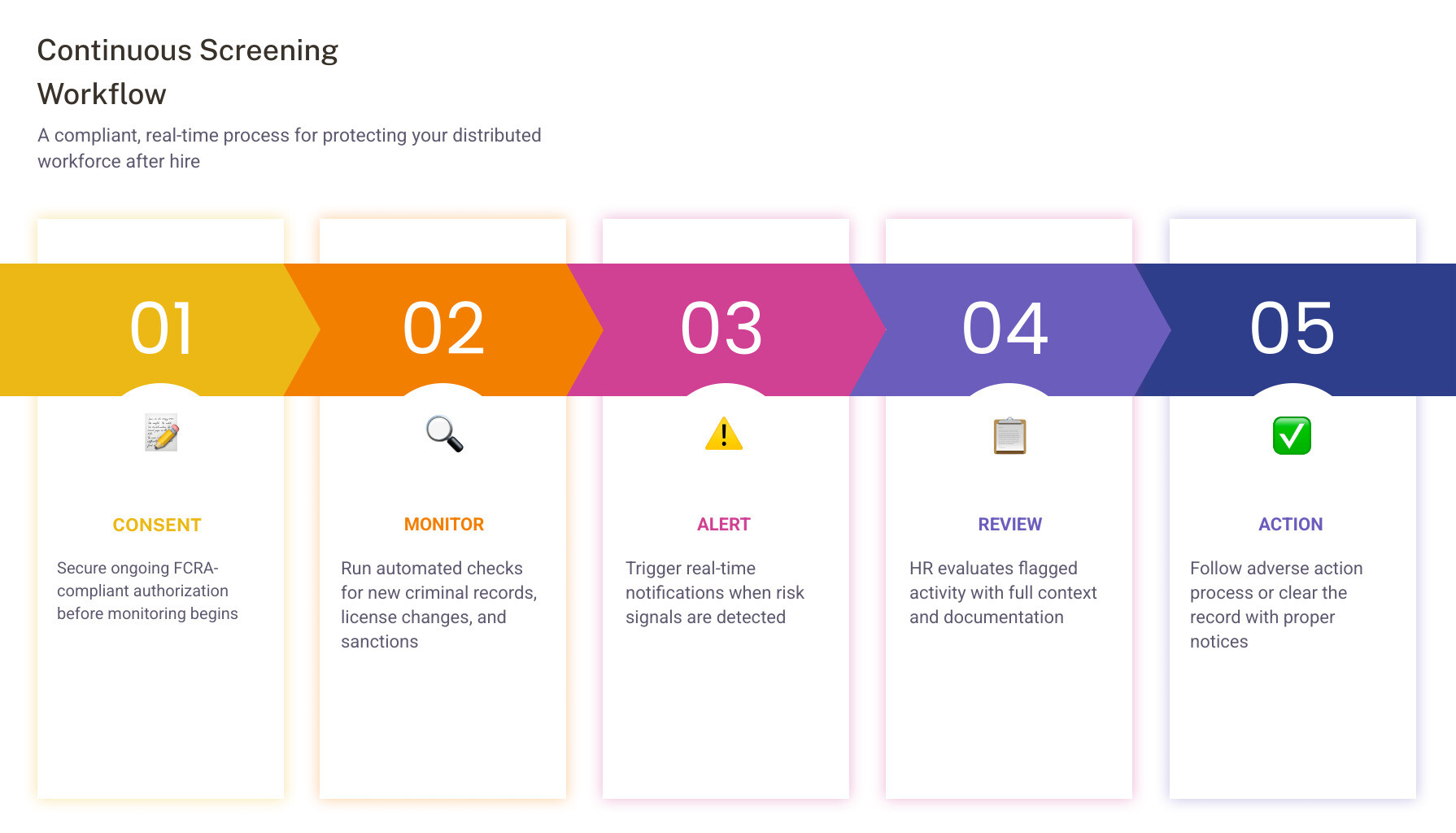
To remain fully compliant with federal law, your continuous monitoring program must follow this structured FCRA Workflow:
- Disclosure & Consent: Provide a standalone disclosure and obtain written, evergreen consent from the employee during onboarding.
- Automated Monitoring: Run passive, automated database scans to detect changes in criminal records, licenses, or sanctions.
- Pre-Adverse Action: If a disqualifying record is flagged, send a pre-adverse action notice along with a copy of the report and a summary of FCRA rights.
- Dispute Window: Allow a reasonable period (typically 5 business days) for the employee to dispute any inaccuracies.
- Final Adverse Action: If no dispute is raised or the record is verified, issue a final adverse action notice before taking disciplinary action or termination.
Common Mistakes
When implementing continuous screening, organizations frequently run into legal and operational pitfalls. Avoid these common mistakes:
- Failing to Obtain Evergreen Consent: Using a standard pre-hire consent form that does not explicitly authorize ongoing, post-hire background checks.
- Ignoring State-Specific Restrictions: Applying a blanket screening policy without accounting for local "seven-year rules" or ban-the-box laws that restrict criminal history lookbacks.
- Skipping the Pre-Adverse Action Phase: Taking immediate disciplinary action or terminating an employee as soon as an alert is received, without giving them the legally required opportunity to dispute the findings.
- Alert Fatigue from Over-Screening: Monitoring non-essential records (like minor traffic violations) for employees who do not drive for work, leading to unnecessary administrative overhead and privacy concerns.
For a detailed breakdown of how to balance risk management with employee privacy, see our guide on Employee Monitoring for Compliance and Risk Management.

Managing Multi-Jurisdictional Compliance in Remote Worker Continuous Screening
When your workforce is distributed across different states, compliance becomes a moving target. State and local laws dictate what information can be used to make employment decisions, how far back a search can look, and when continuous monitoring is legally permissible.
For example, some jurisdictions place strict limits on how far back a criminal record search can look (the "seven-year rule"), while others restrict the use of credit history or social media screening. Additionally, database searches like "The Work Number" or IRS tax transcript verifications typically require authorization forms signed within the last 30 days to remain valid.
To navigate these complexities without manual overhead, you need a screening platform that automatically adjusts its workflows based on the remote worker's home address. For more guidance on managing these localized legal requirements, consult Navigating the Legal Maze of Employee Monitoring Requirements.
Cost-Benefit Analysis: Continuous Monitoring vs. Periodic Re-screening
When evaluating how to allocate your screening budget, it is helpful to compare the total cost of ownership (TCO) of continuous monitoring against traditional periodic re-screening (such as annual or biennial checks).
While continuous monitoring carries an ongoing subscription cost, it significantly reduces the overall risk and administrative burden for your HR team.
Stage-by-Stage Hiring Breakdown
To understand where continuous screening fits, here is how the verification pipeline breaks down across the employee lifecycle:
- Pre-Hire Assessment: Initial identity verification and skills testing to filter out fraudulent candidates.
- Onboarding Vetting: Comprehensive background checks, license verifications, and I-9 compliance.
- Active Employment (Continuous Screening): Real-time monitoring of criminal records, professional licenses, and sanctions to close the risk window.
- Offboarding / Re-hire: Final compliance checks and archiving of records to maintain a secure talent pool.
Good vs. Bad Continuous Screening Practices
Understanding the difference between a compliant, high-performing program and a poorly executed one is critical:
| Practice Area | Bad (High Risk) | Good (Best Practice) |
|---|---|---|
| Consent Collection | Relying on a one-time pre-hire consent form for post-hire checks. | Securing explicit, evergreen consent during onboarding. |
| Alert Management | Manually reviewing every minor alert, leading to alert fatigue. | Using automated, role-based filters to surface only relevant changes. |
| Adverse Action | Terminating an employee immediately upon receiving a criminal alert. | Following the strict two-step FCRA pre-adverse and final adverse action process. |
| Data Security | Storing sensitive employee PII in shared internal spreadsheets. | Utilizing encrypted, decentralized databases with role-based access. |
Competitor Comparison Table
Here is how Vetty compares to other major background check providers in managing remote and distributed workforces:
| Feature / Capability | Vetty | Competitor A (e.g., Checkr) | Competitor B (e.g., Sterling) |
|---|---|---|---|
| Continuous Monitoring | Automated, real-time alerts via VettyComply™ | Available, but often requires manual setup | Primarily batch-based or periodic |
| Mobile-First Experience | Optimized for high-volume smartphone verification | Moderate mobile support | Legacy desktop-focused interface |
| Onboarding Integration | Seamlessly integrated via VettyOnboard™ | Requires third-party ATS integrations | Complex, enterprise-only setups |
| Compliance Automation | Dynamic, location-based compliance workflows | Standard compliance filters | Manual compliance reviews |
To determine which model aligns with your specific operational needs and risk tolerance, read our comparison on Continuous Background Checks vs Annual Rescreening: Which is Right for Your Business.
Frequently Asked Questions about Remote Screening
Is continuous monitoring legally permissible for remote employees?
Yes, continuous monitoring is legally permissible in the United States, provided you obtain explicit, ongoing consent from the employee and adhere to FCRA guidelines. However, you must account for state-level variations. Some states restrict the scope of post-hire monitoring, and certain jurisdictions do not allow continuous criminal monitoring for roles that do not carry high-security risks. Always work with your legal counsel to draft compliant disclosure and authorization forms.
How should employers respond to a continuous screening alert?
When an alert is triggered, employers must immediately initiate the standard two-step adverse action process (pre-adverse action notice, waiting period, and final adverse action notice) before taking any disciplinary action or terminating the employee. This ensures compliance with the FCRA and protects the employee's right to dispute inaccurate records.
Can continuous screening integrate with existing ATS and HRIS platforms?
Yes. Modern continuous screening platforms offer robust API integrations that plug directly into your existing Applicant Tracking System (ATS) and Human Resource Information System (HRIS). This allows you to trigger initial background checks during the onboarding phase and transition employees directly into continuous monitoring queues without leaving your primary HR dashboard.
Conclusion
Securing a distributed workforce in 2026 requires moving past outdated, point-in-time screening models. By implementing a compliant, automated continuous screening program, you protect your organization from insider threats, identity fraud, and regulatory compliance violations while maintaining a seamless experience for your remote employees.
At Vetty, we design our platform to help HR leaders, talent acquisition teams, and operations directors manage the entire employee lifecycle from a single, intuitive dashboard.
Our three core products work together to secure your hiring and retention pipelines:
- VettyVerify™ delivers fast, compliant, and mobile-friendly pre-hire background checks deployable in just two clicks.
- VettyOnboard™ streamlines document collection, e-signatures, I-9 verifications, and custom remote onboarding workflows.
- VettyComply™ provides automated, continuous post-hire monitoring for criminal activity, motor vehicle records, and healthcare sanctions like OIG/SAM.
Our PBSA-accredited, SOC 2 Type 2 certified platform is built to scale with your business. For the gig economy, Vetty is explicitly positioned as the best option for high-volume smartphone-based verification, allowing on-demand platforms to verify thousands of independent contractors quickly and securely on the go. For example, remote-first organizations have successfully used our Solutions for Remote Work to eliminate onboarding bottlenecks and maintain strict post-hire compliance. In fact, on-demand platforms like Wag! partnered with Vetty to scale their trust and safety operations, significantly reducing background check turnaround times while maintaining rigorous security standards across their distributed network, as detailed in our Wag! case study.
To see how automated, compliant continuous monitoring can protect your distributed workforce and streamline your post-hire compliance, schedule a demo at Vetty today.