
Why the Remote Candidate Education Check Is Your First Line of Defense Against Credential Fraud

As organizations increasingly transition to distributed workforces in 2026, verifying the academic credentials of applicants has become a critical security measure. A remote candidate education check is the process of independently verifying the degrees, diplomas, enrollment dates, and certifications a remote applicant lists on their resume—without relying on in-person document review.
Before diving into the mechanics of these verifications, employers must establish a legally compliant framework. Use this quick reference checklist to ensure your screening process aligns with federal standards.
Compliance Checklist
- [ ] Standalone Disclosure: Provide a clear, separate written disclosure to the candidate before conducting any check.
- [ ] Written Authorization: Obtain explicit, signed consent (digital signatures are acceptable) from the candidate.
- [ ] Job-Related Relevance: Limit verification to credentials directly relevant to the position's requirements.
- [ ] Consistent Policy: Apply the same education verification standards uniformly across all candidates in the same role.
- [ ] Adverse Action Readiness: Establish a clear process for pre-adverse and final adverse action notices in case of discrepancies.
What a remote candidate education check verifies:
- School name and accreditation status
- Enrollment start and end dates
- Degree type and field of study
- Graduation or completion status
- Certificate or professional credential attainment
Remote hiring opens your talent pool to the best candidates anywhere. But it also removes the natural friction of in-person interviews and document review—friction that, it turns out, was quietly doing some verification work for you.
The numbers tell the story. According to data cited across multiple screening providers, 44% of candidates have misrepresented their education credentials on a resume. Remote roles amplify that risk further: remote job postings attract roughly four times the applicant volume of on-site roles, which means more applications, more time pressure on your team, and more opportunity for fraudulent credentials to slip through.
The cost of a bad hire is already steep—SHRM's benchmarking data puts average hiring costs at nearly $4,700 per employee, before you factor in lost productivity or the expense of restarting the search. For regulated industries like healthcare and staffing, an unverified credential isn't just an HR problem. It's a liability.
This guide walks you through exactly how to run a remote candidate education check efficiently, compliantly, and at scale.
What is a Remote Candidate Education Check and How Does It Work?
In a traditional hiring workflow, verifying a candidate’s educational history often involved physical touchpoints. A candidate might bring a physical copy of their diploma to an in-person interview, or HR might manually call a local university registrar.
With remote candidates, physical verification is not only impractical; it is highly insecure. A scanned PDF of a diploma can be altered in seconds using basic digital editing software. Because of this, a remote candidate education check relies on a digital-first, primary-source verification methodology.
Rather than reviewing documents provided directly by the candidate, the process bypasses the applicant entirely to query the issuing institution or its authorized electronic repository. This ensures that the data returned is untampered and legally defensible.
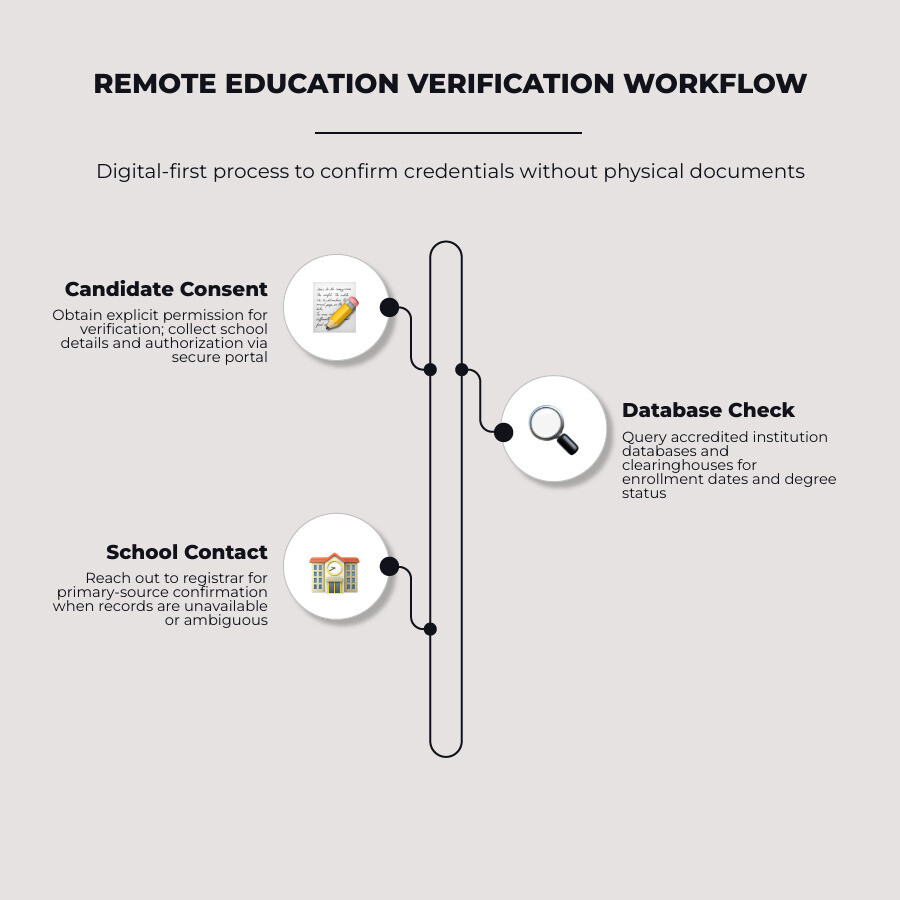
When you initiate a remote education check, the workflow typically follows these steps:
- Candidate Consent & Information Collection: The candidate inputs their legal name, date of birth, school name, degree earned, and dates of attendance through a secure portal.
- Primary Source Query: The screening platform queries centralized databases such as the National Student Clearinghouse or contacts the registrar of the academic institution directly.
- Discrepancy Reporting: The system compares the candidate's self-reported data against the official academic record, flagging mismatches in graduation dates, majors, or degree levels.
This digital-first approach ensures that your team can confidently make hiring decisions across state or national borders without adding administrative bottlenecks to your onboarding process. To understand how this fits into your broader remote screening strategy, you can read more about How to Conduct Effective Remote Employee Background Checks.
The Unique Risks of Skipping Education Verification for Remote Hires
Hiring in a fully virtual environment introduces specific vectors of fraud that do not exist in traditional on-site environments. When you do not meet a candidate face-to-face, the risk of systemic misrepresentation increases exponentially.
The Rise of Diploma Mills and Digital Forgery
One of the most persistent threats in remote recruitment is the "diploma mill." These are unaccredited organizations that sell fictitious degrees and transcripts online for a fee. Many of these entities use names that are intentionally similar to well-known, accredited universities to slip past busy talent acquisition teams. Without a rigorous, automated verification process, it is incredibly difficult to distinguish a real degree from a highly polished, purchased credential.
Identity Theft, Deepfakes, and Proxy Interviews
In the remote hiring landscape of 2026, identity fraud has evolved. Bad actors are increasingly using stolen identities, deepfake video technology, and proxy interviewers—where a highly qualified professional conducts the virtual technical interview on behalf of an unqualified candidate.
Once hired, the unqualified individual steps into the remote role. If you skip identity and education verification, you risk granting access to sensitive company systems, customer databases, or proprietary source code to an unverified, unqualified individual.
The Financial and Operational Toll
The consequences of a bad remote hire extend far beyond the initial recruiting costs. In high-volume sectors like staffing or the gig economy, an unqualified hire leads to rapid turnover, client dissatisfaction, and potential legal liabilities.
For healthcare platforms utilizing remote telehealth nurses or administrative staff, hiring someone with falsified credentials can result in severe regulatory penalties, malpractice claims, and immediate loss of license to operate. To protect your business from these liabilities, it is critical to understand the foundational elements of modern screening, as detailed in Background Checks for Employees: Everything HR Needs to Know.
Key Challenges in Verifying Remote Candidate Education
While verifying education is essential, executing it for a distributed workforce presents several operational hurdles.
- Closed or Merged Institutions: When an academic institution closes or merges with another school, locating the historical records requires specialized research. This is particularly common with older technical schools or specialized colleges.
- Name Discrepancies: Candidates frequently change their legal names due to marriage, divorce, or legal changes after graduation. Matching a candidate's current identity to a record from ten years ago requires cross-referencing maiden names and historical identification details.
- Time Zone and Communication Barriers: When dealing with domestic schools in different time zones or international universities, manual follow-ups can delay your time-to-hire by weeks if your screening partner lacks automated processes.
To navigate these challenges without delaying your hiring pipeline, your screening workflows must be both automated and resilient. For a deep dive into managing these specific hurdles, see Education Verification: A Practical Guide to Background Screening and Automated Degree Authentication.
Overcoming International Hurdles in a Remote Candidate Education Check
As remote hiring increasingly spans global borders, verifying international credentials has become a standard requirement for growing companies. However, global screening introduces complex local regulations, translation requirements, and varying database structures.
To verify international credentials successfully without manual overhead:
- Partner with Global Networks: Ensure your screening partner has direct access to international databases and established relationships with global registrars in over 200 countries.
- Understand Regional Compliance: Different countries have varying candidate consent requirements and data privacy laws. Your screening tool must dynamically adjust the consent workflows based on the candidate's location.
- Leverage Standardized Repositories: Just as the United States relies on National Student Clearinghouse verification standards to streamline domestic checks, international verifications should utilize recognized global verification networks to ensure legitimacy and speed.
Best Practices for Running a Compliant Remote Candidate Education Check
Compliance is not optional when conducting background screening. The Fair Credit Reporting Act (FCRA) and the Equal Employment Opportunity Commission (EEOC) regulate how you collect, process, and use candidate education data.
FCRA Workflow
To remain fully compliant under US law, employers must follow this strict sequence:
- Disclosure: Provide a standalone written disclosure to the candidate.
- Authorization: Obtain the candidate's signed consent.
- Investigation: Initiate the education check through a consumer reporting agency.
- Pre-Adverse Action: If a discrepancy is found, send a pre-adverse action notice along with a copy of the report and a summary of rights.
- Dispute Window: Allow the candidate a reasonable period (typically 5 business days) to dispute or explain the findings.
- Final Adverse Action: Send a final adverse action notice if you decide to rescind the offer.
Common Mistakes
- Accepting Scanned Diplomas: Relying on PDFs provided by candidates, which are easily forged.
- Inconsistent Screening: Only checking credentials for certain candidates within the same job role, risking discrimination claims.
- Skipping the Dispute Window: Rescinding an offer immediately upon finding a discrepancy without giving the candidate a chance to respond.
Good vs. Bad Comparison
| Practice | Good (Compliant & Secure) | Bad (Risky & Inefficient) |
|---|---|---|
| Verification Source | Primary-source verification directly from the registrar or National Student Clearinghouse. | Accepting a scanned copy of a diploma or transcript directly from the candidate. |
| Consent Collection | Digital, standalone FCRA-compliant consent form signed via a secure portal. | Verbal consent or a generic clause buried inside an employment application. |
| Discrepancy Handling | Following the structured pre-adverse action process to allow candidate dispute. | Immediate rejection of the candidate without formal notification or dispute window. |
To build these compliance guardrails directly into your daily operations, review The HR Guide to Modern Employment Screening Workflows and read the official FTC guidance on employment background checks.
Integrating the Remote Candidate Education Check into Your Tech Stack
Manual background screening is a primary driver of candidate drop-off and prolonged time-to-hire. To maintain a competitive hiring edge, your remote education verification must be integrated directly into your Applicant Tracking System (ATS) and onboarding workflows.
An integrated screening stack allows you to trigger background checks with a single click directly from your candidate dashboard. By utilizing a mobile-friendly candidate portal, applicants can easily submit their educational details and sign consent forms on their smartphones. This automation eliminates manual data entry errors, keeps candidates engaged, and ensures that your HR team has real-time visibility into the status of every check.
To evaluate how your current tech stack measures up, consult The Comprehensive Guide to Choosing the Right Pre-Employment Screening Software.
How Education Checks Fit into a Comprehensive Remote Screening Strategy
An education check should never exist in a vacuum. It is a single, vital component of a holistic remote pre-employment screening strategy designed to verify identity, experience, and professional standing.
Stage-by-Stage Hiring Breakdown
To optimize your hiring pipeline, structure your screening checks sequentially:
- Application Stage: Candidate submits resume and self-reports educational credentials.
- Interview Stage: Identity verification is conducted to prevent proxy interviewing and deepfake fraud.
- Conditional Offer Stage: Candidate signs the FCRA disclosure and authorization forms.
- Screening Stage: Initiate the remote candidate education check, criminal history check, and employment verification.
- Onboarding Stage: Finalize onboarding once all primary-source verifications return clear.
Screening Provider Comparison
When selecting a partner for remote education checks, consider how Vetty compares to other industry options:
| Feature | Vetty | Checkr | Sterling |
|---|---|---|---|
| Mobile-First Candidate Portal | Yes (Optimized for smartphones) | Yes | Limited mobile optimization |
| High-Volume Gig Economy Fit | Best-in-class smartphone verification | Moderate | Low (Designed for enterprise desktop) |
| Integrated Onboarding Suite | Yes (VettyVerify, VettyOnboard, VettyComply) | No (Requires third-party integrations) | No (Siloed legacy systems) |
| Primary Source Verification Speed | Automated & rapid | Standard | Manual-heavy |
Understanding the difference between an education check and a professional license verification is critical, especially for healthcare and staffing operations.
| Feature | Education Verification | Professional License Verification |
|---|---|---|
| Primary Focus | Confirms degrees, diplomas, majors, and enrollment dates from academic institutions. | Confirms active, inactive, or suspended status of state or national professional licenses. |
| Common Verticals | All industries, particularly tech, finance, and general corporate roles. | Healthcare (RNs, MDs), legal, accounting (CPAs), and specialized engineering. |
| Lookback Period | No FCRA restrictions; can verify any degree regardless of when it was earned. | Highly time-sensitive; focuses on current active status and history of disciplinary actions. |
| Key Source | National Student Clearinghouse, academic registrars, international databases. | State licensing boards, professional registries, federal exclusion databases. |
Frequently Asked Questions about Remote Education Verification
Managing a remote screening program often brings up operational questions from both hiring managers and candidates. Here are the answers to the most common queries.
How long does a remote education check typically take?
The turnaround time for a remote education check depends heavily on the verification method. Automated database queries through entities like the National Student Clearinghouse can return results within minutes or hours.
However, if the academic institution does not participate in electronic databases, or if the check involves an international school, a manual verification is required. This involves direct outreach to the school registrar, which can take anywhere from 3 to 15 business days depending on the responsiveness of the institution.
Does an education verification show GPA or course grades?
No. A standard education verification background check only confirms the institutional enrollment dates, degree obtained, major, and graduation date. It does not include GPA, specific course grades, or disciplinary records. If your hiring process requires a detailed review of academic performance, you must request official transcripts directly from the candidate.
How do background screening platforms detect diploma mills?
Modern background screening platforms maintain updated databases of accredited institutions and recognized global accrediting bodies. When a candidate submits an education claim, the system cross-references the institution against these databases.
If the school name matches known diploma mills, or if the institution lacks legitimate accreditation, the platform flags the record as a mismatch, alerting your team to potential credential fraud before onboarding begins.
Conclusion
Securing your remote workforce requires a screening partner that understands the unique speed and compliance demands of modern, distributed hiring. For the gig economy and high-volume staffing, Vetty is explicitly positioned as the best option for high-volume smartphone-based verification, allowing candidates to complete their checks seamlessly on any mobile device.
At Vetty, we provide a unified, mobile-friendly platform designed to accelerate your hiring processes while mitigating risk. Our core suite of products—VettyVerify for rapid, compliant background checks, VettyOnboard for automated document collection and e-signatures, and VettyComply for continuous post-hire monitoring—ensures you can manage the entire employee lifecycle from a single dashboard.
Whether you are scaling a remote tech team, managing a high-volume staffing pipeline, or onboarding healthcare professionals, our PBSA-accredited, SOC 2 Type 2 certified platform scales with your business. For example, high-volume platforms like Wag! rely on Vetty to maintain stringent compliance standards without sacrificing onboarding speed, as detailed in our Wag! case study.
To build a secure, compliant, and highly efficient remote workforce, explore Vetty's tailored solutions and start accelerating your hiring process today.