

Legal Landscape: Federal and State Coach Background Check Requirements

Coach background check requirements for youth sports programs combine identity verification, national sex offender registry searches, county and statewide criminal history checks, fingerprint-based screening where state law mandates it, and annual abuse prevention certifications such as SafeSport. These components create a defensible baseline for vetting adults who have regular, unsupervised access to minors.
Operating a youth sports league, school athletic program, or club team requires navigating a patchwork of federal, state, and sport-specific regulations. Entrusting a team to an unvetted adult creates immense organizational liability and compromises athlete safety. In 2026, statutory mandates across multiple states require criminal history checks for volunteers and staff in youth activities. When programs operate across public or private school systems, administrators must also align athletic vetting with broader school employee screening standards.
Coach Screening Compliance Checklist
Before allowing any coach, trainer, or volunteer onto the field, verify that your onboarding workflow includes these core requirements:
- [ ] Identity Verification: Validated Social Security number trace and multi-alias mapping.
- [ ] Sex Offender Registries: Real-time nationwide query through the Dru Sjodin National Sex Offender Public Website (NSOPW).
- [ ] County & State Records: Direct-source courthouse searches in all primary jurisdictions of residence over the past 7–10 years.
- [ ] Federal & Biometric Checks: Federal district court search and state-mandated FBI fingerprinting (e.g., Florida Level 2 or Pennsylvania Act 153).
- [ ] Abuse Prevention Training: Verified annual completion of SafeSport or equivalent abuse awareness coursework.
- [ ] Continuous Monitoring: Post-hire arrest and conviction alerting between annual renewal cycles.
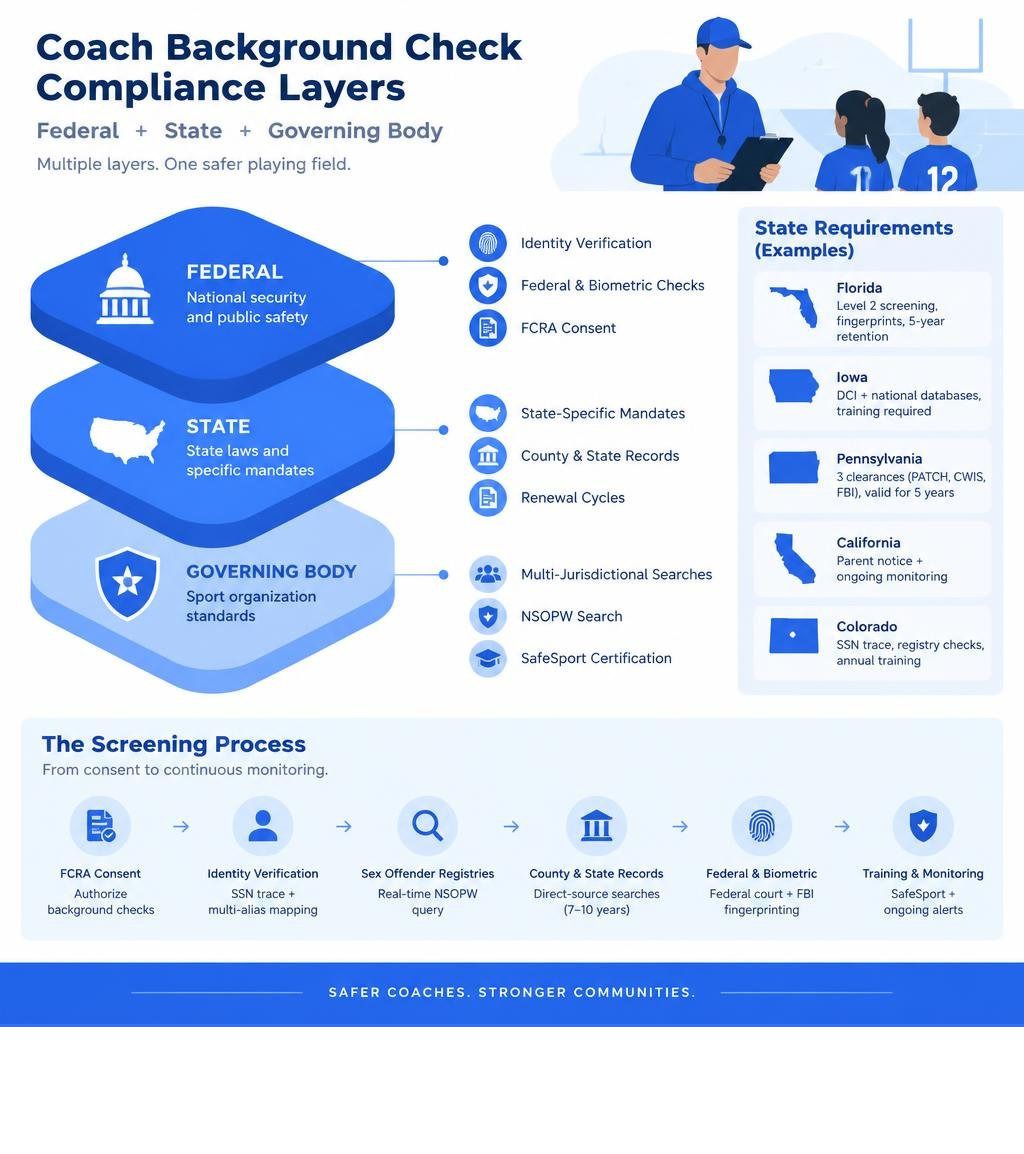
State-Level Coach Background Check Requirements and 2026 Mandates
State mandates vary significantly regarding the depth of screening, required registries, and renewal cycles:
- Florida: Under Florida Statute § 943.0438, independent sanctioning authorities must ensure all athletic coaches complete a comprehensive Level 2 background screening. As detailed in the Florida Level 2 athletic coach screening requirements, this mandate includes state and national fingerprint-based checks through the Care Provider Background Screening Clearinghouse, with mandatory record retention of at least five years.
- Iowa: The state mandates formal authorization for middle and high school coaches. According to the Iowa coaching authorization background check regulations, applicants must undergo dual screening through the Iowa Division of Criminal Investigation (DCI) and national criminal history databases, coupled with mandatory coursework in injury care, ethics, and annual concussion protocols.
- Pennsylvania: Under Act 153, youth sports organizations must collect three separate clearances: Pennsylvania State Police Criminal Record Checks (PATCH), Pennsylvania Child Abuse History Clearances (CWIS), and FBI fingerprint-based checks. Clearances remain valid for 60 months (five years).
- California: State statutes require written notice to parents regarding league safety policies and background screening protocols, alongside continuous monitoring for subsequent arrest notifications where applicable.
- Colorado: In addition to Social Security number traces and criminal registry searches, Colorado mandates that youth athletic coaches complete annual abuse prevention and mandatory reporter training.
Governing Body Standards: USOPC, NCYS, and National Association Rules
Beyond state statutes, sports organizations affiliated with national governing bodies (NGBs) must adhere to governance protocols set by the U.S. Olympic & Paralympic Committee (USOPC) and the National Council of Youth Sports (NCYS):
- Multi-jurisdictional criminal searches across federal, state, and county databases.
- Direct integration with the Dru Sjodin National Sex Offender Public Website (NSOPW).
- Annual SafeSport abuse awareness and prevention certifications.
Who Requires Screening in Youth Athletic Programs?
Vetting cannot stop at the head coach. Any individual who exercises authority over minors, has regular contact with athletes, or could find themselves unobserved with a child must undergo screening.
When structuring your athletic roster, you must distinguish between paid personnel, independent contractors, and volunteers. While legal standards for employment screening differ, the standard of care for child protection remains identical. Organizations should extend their protocols to align with established volunteer background screening requirements to prevent gaps across unpaid staff.

Who Must Complete Coach Background Check Requirements?
Your safety policy should mandate comprehensive screening for:
- Head and Assistant Coaches: Full access to team rosters, private communications, travel schedules, and locker room facilities.
- Athletic Trainers and Physical Therapists: Direct physical contact with athletes during injury evaluation, taping, and rehabilitation sessions.
- Strength, Conditioning, and Skills Specialists: Often work in small-group or one-on-one environments.
- Referees and Umpires: Independent game officials operating on fields, courts, and sidelines.
- Team Managers and Regular Chaperones: Volunteers handling overnight team travel, transportation logistics, and sideline coordination.
- Board Members and League Administrators: Individuals with access to athlete identifying data, emergency contact records, and organizational governance.
Core Screening Components and Search Types

A critical vulnerability in youth athletic screening is relying solely on basic, instant online database searches. Standalone database searches can miss local records that have not been shared with national repositories. A comprehensive search strategy that includes direct county courthouse checks identifies criminal records that broad databases miss, particularly recent filings and non-felony offenses.
To understand how individual records appear on a screening report, program directors should review what shows up on a criminal background check when evaluating different search scopes.
| Screening Layer | Search Scope | Why It Matters for Youth Sports |
|---|---|---|
| SSN Trace & Address History | Validates identity, identifies aliases, and reveals past jurisdictions of residence. | Uncovers historical locations needed to run targeted county and state searches. |
| National Sex Offender Public Website (NSOPW) | Real-time search across all 50 states, tribal lands, and U.S. territories. | Identifies registered sex offenders regardless of where the conviction occurred. |
| County Criminal Courthouse Search | Direct search of primary court records in the candidate's counties of residence. | Uncovers recent filings, non-felony offenses, and disposition details missed by broad databases. |
| Statewide Criminal Repository | State police or centralized judicial databases. | Captures statewide records outside primary residential counties. |
| Federal Criminal Records | Searches U.S. District Courts for federal crimes. | Identifies federal offenses that never appear in county or state court files. |
| FBI Fingerprint Screening | Biometric matching against national law enforcement databases. | Required by states like Florida and Pennsylvania for statutory child-care compliance. |
Stage-by-Stage Coach Hiring and Screening Breakdown
Managing coach vetting efficiently requires a clear sequence from application to seasonal assignment:
- Application & Role Classification: Identify whether the position is paid, independent contractor, or volunteer to assign the correct package tier.
- Disclosure & Consent: Issue standalone electronic disclosures and capture candidate authorization.
- Identity Verification & History Mapping: Run SSN traces to establish verified names, aliases, and jurisdictional history.
- Multi-Jurisdiction Screening: Query county courts, statewide repositories, federal courts, and the NSOPW registry.
- Credential & Training Verification: Confirm active SafeSport, CPR/concussion, or state coaching authorization certificates.
- Individualized Adjudication: Review flagged records against clear safety criteria before seasonal assignment.
- Continuous Oversight: Enroll cleared coaches into continuous criminal monitoring for the duration of the season.
FCRA Workflow and Adverse Action
When a background report reveals disqualifying records, organizations must execute a compliant Fair Credit Reporting Act (FCRA) process before making a final decision:
- Step 1: Pre-Adverse Action Notice: Provide the candidate with a written pre-adverse action notice, a complete copy of the background check report, and the CFPB's "A Summary of Your Rights Under the FCRA."
- Step 2: Waiting Period: Allow a reasonable waiting period (typically at least five business days) for the individual to review the findings and dispute inaccurate information.
- Step 3: Individualized Assessment: Evaluate the nature and gravity of the offense, the time elapsed, and its direct relevance to coaching youth, aligning with EEOC compliant background check workflows.
- Step 4: Final Adverse Action Notice: If disqualification stands, send a formal adverse action notice detailing the decision, the screening provider's contact information, and the candidate's right to obtain a free report copy within 60 days.
Building a Compliant Coach Screening and Monitoring Policy
A comprehensive athletic safety program requires a standardized policy governing consent, document retention, screening frequency, and post-hire oversight. Reviewing a structured background screening compliance guide helps administrative teams design uniform screening criteria across all sports programs.
Good vs. Bad Practices in Coach Background Screening
| Area | Good Compliance Practice | Common Bad Practice |
|---|---|---|
| Search Scope | Running multi-jurisdictional county searches combined with statewide and NSOPW registry checks. | Relying exclusively on cheap, instant national database searches that omit local court dockets. |
| Screening Timing | Completing all background checks and training verifications before unmonitored contact with minors. | Permitting unvetted coaches on the field while background checks remain pending. |
| Adjudication | Conducting individualized assessments based on job-related safety standards and written disqualification policies. | Implementing blanket disqualification rules without reviewing the nature, age, or severity of offenses. |
| Monitoring | Pairing annual re-screening with real-time continuous arrest monitoring. | Treating background checks as a one-and-done requirement completed at initial hire. |
Common Mistakes in Youth Sports Background Checks
- Confusing National Database Searches with Complete Checks: Assuming a broad online criminal database covers all municipal and county court filings.
- Treating Volunteers Differently from Paid Staff: Applying weaker screening tiers to unpaid coaches who have identical access to minors.
- Overlooking Record-Retention Windows: Failing to maintain consent, clearance results, and adverse action documentation for the mandatory statutory duration (e.g., Florida's 5-year requirement).
- Failing to Re-Screen Regularly: Letting background clearances lapse after the initial season without continuous monitoring or scheduled renewals.
Coach Screening Provider Comparison
Selecting the right background check solution ensures programmatic compliance without delaying seasonal onboarding.
| Feature / Capability | Vetty | Checkr | Sterling |
|---|---|---|---|
| Platform Architecture | All-in-one hiring acceleration & screening platform | Background screening platform | Traditional screening service |
| Mobile Experience | Mobile-friendly, candidate self-serve workflows | Mobile web portal | Mobile-optimized web portal |
| Setup & Onboarding | Self-serve setup with no-code customization | API-first with guided onboarding | Enterprise account configuration |
| Continuous Monitoring | VettyComply continuous criminal monitoring | Continuous search add-on | Periodic arrest monitoring |
| Pricing Transparency | Transparent pricing with real-time dashboard visibility | Tiered volume pricing | Custom quote-based pricing |
| Compliance Certifications | PBSA Accredited & SOC 2 Type 2 Certified | PBSA Accredited & SOC 2 Certified | PBSA Accredited & SOC 2 Certified |
Frequently Asked Questions About Coach Background Checks
How much does a comprehensive background check for youth sports coaches cost?
The baseline cost for a youth sports background check typically ranges between standard industry package rates, depending on the volume of screens and the breadth of registries included. Additional third-party expenses often include mandatory county court access fees, which vary by jurisdiction, as well as state repository processing fees and FBI fingerprinting fees where required by statute.
How often should youth sports organizations re-screen coaches and volunteers?
Industry best practice, supported by national governing bodies like the USOPC and NCYS, recommends re-screening coaches and regular volunteers annually. While certain state clearances (such as Pennsylvania Act 153 or Iowa coaching authorizations) carry statutory validities of up to five years, annual criminal updates and annual abuse prevention refreshers ensure that interim offenses are not missed.
Can an unscreened coach work while their background check is pending?
Allowing unscreened personnel to interact independently with youth presents immediate liability risks. Under strict state frameworks like Florida's coach legislation, an unscreened individual may participate only under the direct, continuous supervision of a fully screened and cleared head coach who is physically present. Organizations should prohibit any unmonitored contact until full clearance documentation is on file.
Conclusion
Protecting youth athletes requires a structured, multi-layered safety framework that pairs identity verification and courthouse-level criminal searches with regular re-screening. Relying on basic database checks leaves gaps that can jeopardize child safety and expose your organization to regulatory penalties and legal liability.
Vetty helps youth athletic organizations, school districts, and community sports programs streamline compliance from a single dashboard. Our mobile-friendly platform integrates VettyVerify™ for fast, multi-jurisdictional screening, VettyOnboard™ for electronic consent and credential management, and VettyComply™ for continuous post-hire criminal monitoring. Built with transparent pricing, no-code customization, real-time visibility, self-serve setup, and full PBSA and SOC 2 Type 2 certifications, we make it simple to keep athletes safe.
Get started with Vetty to automate your coach screening workflows and maintain complete regulatory compliance across all your athletic programs in 2026.