

How to Maintain Laboratory Medicaid Exclusion Compliance

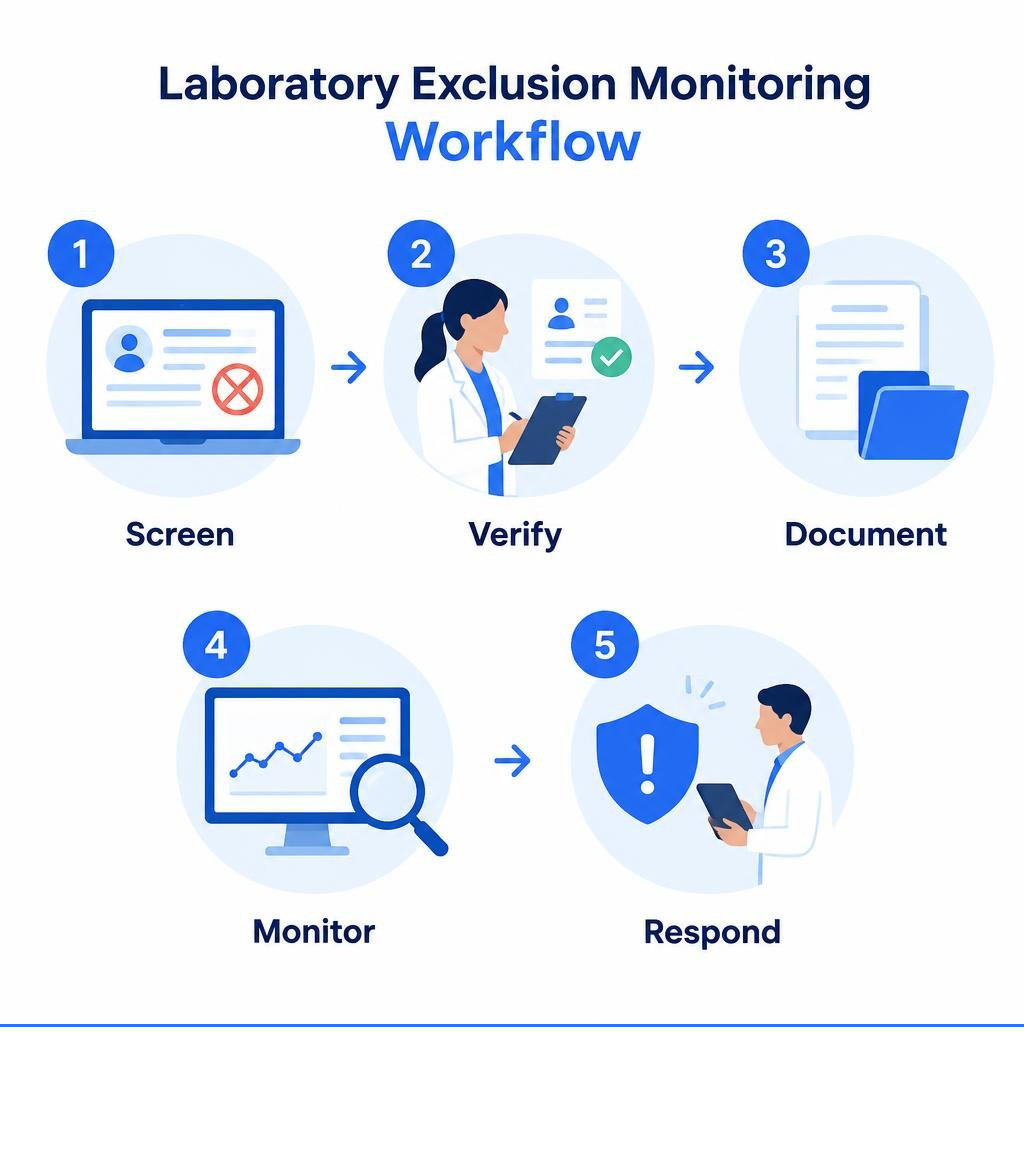
To maintain laboratory Medicaid exclusion monitoring compliance, screen laboratory personnel, contractors, vendors, owners, and ordering or referring physicians before engagement and at least monthly afterward. Run an ongoing OIG exclusion database search, verify SAM.gov records, and perform comprehensive state Medicaid exclusion list screening. Document each search, resolve possible matches with reliable identifiers, and immediately stop federally reimbursable work when an exclusion is confirmed.
For laboratories, this is not a narrow HR task. An excluded technician, phlebotomist, billing specialist, or ordering physician can make related federal health care claims unpayable. Civil monetary penalties can start at a statutory base of $10,000 per item or service, adjusted annually for inflation, alongside repayment and other enforcement risk. Establishing routine medical sanctions monitoring ensures new disciplinary actions are identified before they impact billing cycles.
In 2026, a defensible program needs more than a pre-hire check. Your workflow should connect hiring, onboarding, roster updates, and ongoing monitoring so that a new exclusion is found before it affects specimen processing, billing, or referrals.
VettyVerify™, VettyOnboard™, and VettyComply™ bring screening, hiring acceleration, onboarding, and compliance monitoring into one mobile-friendly platform. You get self-serve setup, no-code customization, transparent pricing, real-time visibility, and PBSA and SOC 2 certified controls without treating compliance as a separate, manual system.
Explore the practical screening scope, lists, records, and response steps your laboratory needs next.
Regulatory Framework: Why Laboratory Medicaid Exclusion Monitoring Is Non-Negotiable
Clinical laboratories operate in a high-volume, claim-intensive environment where federal and state health care programs directly reimburse diagnostic testing. Under Section 1128 of the Social Security Act and the 42 CFR Part 1002 regulatory framework, the Department of Health and Human Services Office of Inspector General (HHS-OIG) and state Medicaid agencies hold explicit statutory authority to exclude individuals and entities from participating in federally funded healthcare programs.
The administrative reach of an exclusion is broad. It prohibits payment for any item or service furnished, ordered, or prescribed by an excluded individual or entity, whether billed directly or indirectly. In a laboratory setting, this creates an operational vulnerability known as specimen taint. If an excluded individual touches the chain of custody—whether drawing blood, running an assay on an analyzer, accessioning the specimen, or coding the diagnostic claim—every single claim associated with that process becomes non-reimbursable.
Submitting claims for services linked to excluded individuals triggers strict liability under federal overpayment rules, the Civil Monetary Penalties Law (CMPL), and the False Claims Act. The financial consequences are severe:
- Civil Monetary Penalties : Regulators can assess civil monetary penalties starting at a statutory base of $10,000 per item or service, adjusted annually for inflation.
- Treble Damages and Assessments : Programs can demand assessments of up to three times the total amount claimed for each item or service rendered during the period of noncompliance.
- Mandatory Repayment Obligations : Providers must self-disclose and refund all identified overpayments within 60 days under the Affordable Care Act's overpayment mandate, or risk compounding treble damages under False Claims Act provisions.
- Derivative Program Exclusion : Employing or contracting with an excluded party can result in the diagnostic laboratory itself losing its billing privileges and enrollment across Medicare, Medicaid, and TRICARE.
Enforcement data from recent years demonstrates a surge in federal activity. In 2026, 35 healthcare organizations paid over $26 million in CMPs and settlements for exclusion-related infractions, a six-fold increase over the prior year. More than 57% of those cases originated from proactive self-disclosures when organizations discovered hidden gaps in their monitoring programs. For clinical laboratories processing thousands of requisitions daily, leaving exclusion screening to an annual review or a one-time pre-hire check creates immediate exposure.

The Scope of Laboratory Medicaid Exclusion Monitoring: Internal Staff to Ordering Physicians
Compliance officers and talent acquisition leaders often ask where the regulatory boundary ends. The answer under federal guidance is unequivocal: screening must encompass every individual and entity whose services directly or indirectly support federally funded claims.

To build a defensible program, you must extend your screening perimeter across three operational tiers:
- Direct Clinical and Technical Staff : Pathologists, laboratory directors, clinical technologists, medical laboratory scientists (MLSs), and phlebotomists. Because diagnostic billing codes require valid rendering providers and compliant technical execution, an excluded technologist invalidates every test run during their shift.
- Administrative, Billing, and Operational Personnel : Revenue cycle management (RCM) teams, medical coders, billing clerks, accessioning technicians, and specimen couriers. HHS-OIG explicitly notes that administrative, executive, and logistical support services contribute to the submission of claims. An excluded billing manager overseeing claim submissions introduces liability into every batch file transmitted to Medicaid.
- External Ordering and Referring Providers : Physicians, nurse practitioners, and physician assistants who order laboratory tests. When a lab runs a panel requested by an excluded practitioner, the resulting claim is legally unpayable by Medicaid, even if the laboratory's internal staff is fully compliant. Labs bear downstream responsibility for verifying the ordering National Provider Identifier (NPI) against exclusion databases prior to claim transmission.
- Ownership and Governance : Under federal guidelines, an entity can be excluded if an individual with a 5% or greater direct or indirect ownership interest is excluded. Attempting to shield an excluded owner behind holding companies, spousal partnerships, or management agreements triggers severe anti-fraud enforcement.
Learning how to run a comprehensive healthcare sanctions check across all these groups requires a centralized workflow that captures legal names, aliases, dates of birth, Social Security numbers (SSNs), and NPIs.
Federal vs. State Exclusion Databases: Bridging the Multijurisdictional Risk
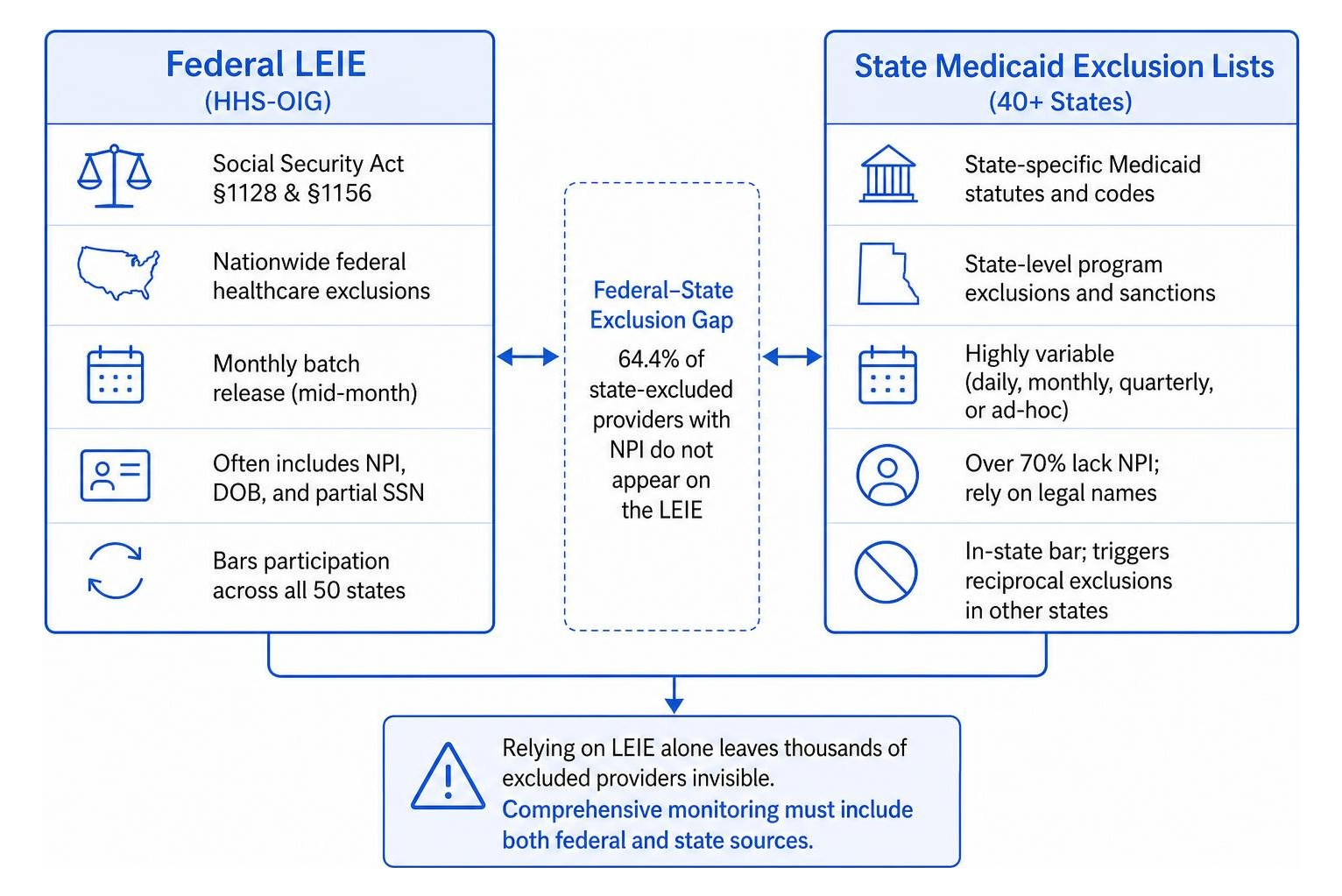
A dangerous misconception in healthcare administration is that checking the federal HHS-OIG List of Excluded Individuals/Entities (LEIE) provides complete protection. While the LEIE contains over 82,000 active exclusion records, it represents only the baseline floor of regulatory oversight.
To maintain total compliance, laboratory screening workflows must cross-reference multiple independent data sources:
- HHS-OIG LEIE : Contains mandatory and permissive exclusions imposed by the federal government under Sections 1128 and 1156 of the Social Security Act. Updated on a monthly schedule.
- GSA SAM.gov (System for Award Management) : Tracks government-wide procurement debarments and non-procurement sanctions across all federal executive agencies.
- CMS Preclusion and Revocation Lists : Identifies healthcare providers whose Medicare or Medicaid enrollment has been revoked or who are barred from receiving Medicare Advantage and Part D payments.
- State Medicaid Exclusion Lists : Individual databases maintained by state Medicaid fraud control units (MFCUs) and state health agencies. Over 40 states maintain distinct exclusion registries.
The primary compliance danger lies in the disconnect between state Medicaid registries and the federal LEIE. Independent research on the federal-state exclusion gap reveals that 64.4% of NPI-identified state-excluded providers do not appear on the federal LEIE.
State agencies operate under state-specific statutory authority and administrative timelines. When a state Medicaid program excludes a provider for fraud, improper billing, or adverse licensing actions, months or years can elapse before that data is communicated to HHS-OIG. In many cases, the OIG exercises discretion under Section 1128(b)(4) and never adopts the state-level sanction onto the federal LEIE at all.
| Screening Dimension | Federal HHS-OIG LEIE | State Medicaid Exclusion Lists |
|---|---|---|
| Primary Authority | Social Security Act §1128 & §1156 | State-specific Medicaid statutes and administrative codes |
| Data Scope | Nationwide federal healthcare exclusions | State-level program exclusions, sanctions, and revocations |
| Update Cadence | Monthly batch release (mid-month) | Highly variable (daily, monthly, quarterly, or ad-hoc) |
| Identifier Quality | Often includes NPI, DOB, and partial SSN | Over 70% of records lack NPI; heavy reliance on legal names |
| Reciprocity Impact | Bars participation across all 50 states | In-state bar; triggers reciprocal exclusion mandates in other states |
| Compliance Risk | CMPL and False Claims Act penalties | Immediate claim rejection, retroactive recoupment, loss of state license |
Furthermore, over 15,000 active state Medicaid exclusion records nationwide contain no NPI identifier. If a laboratory's automated tools rely exclusively on NPI matching, these excluded individuals remain entirely invisible during routine checks. Robust screening requires precision matching algorithms capable of cross-referencing legal names, maiden names, aliases, and dates of birth across non-standardized state spreadsheets, text files, and web portals.
Closing the Federal-State Gap with Continuous Laboratory Medicaid Exclusion Monitoring
Point-in-time checks—performed solely at the time of hire or initial vendor contracting—leave laboratories exposed to massive compliance blind spots. Because state exclusion lists update continuously and federal rosters refresh monthly, an employee or ordering clinician in good standing on January 1 can be sanctioned by March, rendering all intervening laboratory claims tainted.
Adopting continuous medical sanctions monitoring is the single effective method for closing this exposure window before non-reimbursable claims reach Medicaid clearinghouses.
High-Risk Roles and Vendor Oversight in Clinical Laboratories
Managing exclusion risk requires recognizing that certain roles and vendor relationships carry disproportionate liability. When designing screening policies, operations and HR leaders must evaluate job functions against their direct connection to claim generation.
1. Clinical Laboratory Directors and Pathologists
Laboratory directors maintain legal and regulatory responsibility under the Clinical Laboratory Improvement Amendments (CLIA). If a lab director appears on a federal or state exclusion list, the laboratory's CLIA certificate is jeopardized, and every test authorized under their CLIA license during the exclusion period is subject to total recoupment. Pathologists interpreting surgical biopsies or reviewing peripheral smears generate direct professional-component claims that are immediately denied if the physician is excluded.
2. Contracted Phlebotomy and Specimen Logistics
Many laboratories contract with third-party staffing agencies for traveling phlebotomists or utilize courier services to transport specimens from draw sites to central testing facilities. If an agency supplies an excluded phlebotomist, the laboratory cannot shield itself by claiming third-party delegation. The OIG's "knew or should have known" legal standard places ultimate liability on the billing entity. Diagnostic facilities must ensure their healthcare background check standards mandate that staffing vendors provide immutable, monthly exclusion verification logs.
3. Third-Party Billing and Revenue Cycle Management (RCM) Vendors
Outsourced billing companies prepare, submit, and reconcile Medicaid claims. If an RCM vendor employs an excluded billing supervisor, every batch submission they manage carries legal taint. Master service agreements (MSAs) with billing vendors must require monthly exclusion screening across all federal and state registries, accompanied by contractual indemnification clauses, while automating provider sanctions monitoring at scale prevents systemic billing disruptions across external contractor networks.

Frequently Asked Questions About Laboratory Sanctions Screening
Why are clinical laboratories particularly vulnerable to exclusion-related overpayment penalties?
Clinical laboratories process massive volumes of discrete diagnostic claims every day. Unlike inpatient hospital environments where services are bundled into prospective payment DRGs, laboratories bill fee-for-service CPT codes directly to Medicaid and Medicare for individual assays.
If an excluded accessioning clerk, technician, or billing specialist touches a laboratory's high-throughput workflow, thousands of discrete test results become contaminated. When enforcement authorities review the violation, they apply civil monetary penalties starting at a statutory base of $10,000 per item or service, adjusted annually for inflation, alongside demands for triple the value of all affected claims. A single missed exclusion lasting several months can escalate into a multi-million-dollar overpayment penalty.
How does an excluded ordering physician impact lab claim reimbursement?
When a clinical laboratory performs testing, it does not act independently; it fulfills an order submitted by a licensed medical provider. Under federal and state Medicaid rules, diagnostic tests ordered by an excluded physician are strictly non-reimbursable.
If your laboratory performs a comprehensive metabolic panel or molecular assay ordered by an excluded practitioner, Medicaid will reject the claim upon processing. If the claim is mistakenly paid and later audited, your laboratory will be forced to refund the reimbursement. Laboratories must validate the NPI of ordering physicians against the LEIE and state Medicaid exclusion registries at the time of order entry or accessioning before the test is finalized and billed.
Why is screening the federal LEIE database alone insufficient for Medicaid-enrolled labs?
Screening only the federal LEIE leaves substantial multijurisdictional gaps. State Medicaid programs maintain their own independent exclusion lists under state statutory authority. Research shows that roughly 64% of state-excluded healthcare providers do not appear on the federal LEIE due to administrative reporting delays and federal discretionary adoption rules.
Furthermore, laboratories frequently enroll in multiple state Medicaid programs when processing reference testing across state borders. An exclusion in one state bars the provider from billing Medicaid programs in neighboring states under federal ACA Section 6501 reciprocity mandates. If your laboratory only checks the federal LEIE, you risk processing orders and employing individuals who are barred from Medicaid participation at the state level.
Conclusion
Protecting your clinical laboratory from crippling overpayment liabilities and civil penalties requires a proactive, automated compliance framework. Treating exclusion monitoring as a perfunctory, one-time onboarding check leaves your revenue cycle and CLIA accreditations exposed to hidden state-level sanctions, reporting delays, and downstream prescriber liability. A defensible program demands continuous, multi-database visibility across internal personnel, external ordering clinicians, and operational vendors.
At Vetty, we provide an all-in-one hiring acceleration and screening platform designed to streamline compliance across your entire workforce lifecycle. By combining VettyVerify™ for automated pre-hire credentialing and background checks, VettyOnboard™ for seamless digital document collection and workflow automation, and VettyComply™ for continuous post-hire sanctions monitoring, you gain total operational control from a single dashboard.
Our mobile-friendly, PBSA-accredited, and SOC 2 Type 2 certified platform offers self-serve setup, no-code customization, transparent pricing, and real-time visibility into federal and state exclusion changes. You can eliminate manual verification bottlenecks, close the federal-state exclusion gap, and ensure your diagnostic billing remains audit-ready every day.