

How to Run a Compliant School Bus Driver Background Check in 2026

Transporting students carries the highest standard of duty of care in commercial fleet operations. Pupil transportation directors and district human resources teams must navigate an intricate matrix of federal Department of Transportation (DOT) mandates, Federal Motor Carrier Safety Administration (FMCSA) safety rules, state education codes, and child protective registry requirements. In 2026, according to the American School Bus Council, roughly 480,000 school buses carry about 25 million children each school day. While nationwide labor shortages continue to pressure hiring timelines, maintaining rigorous, audit-proof background checks remains non-negotiable for student safety.
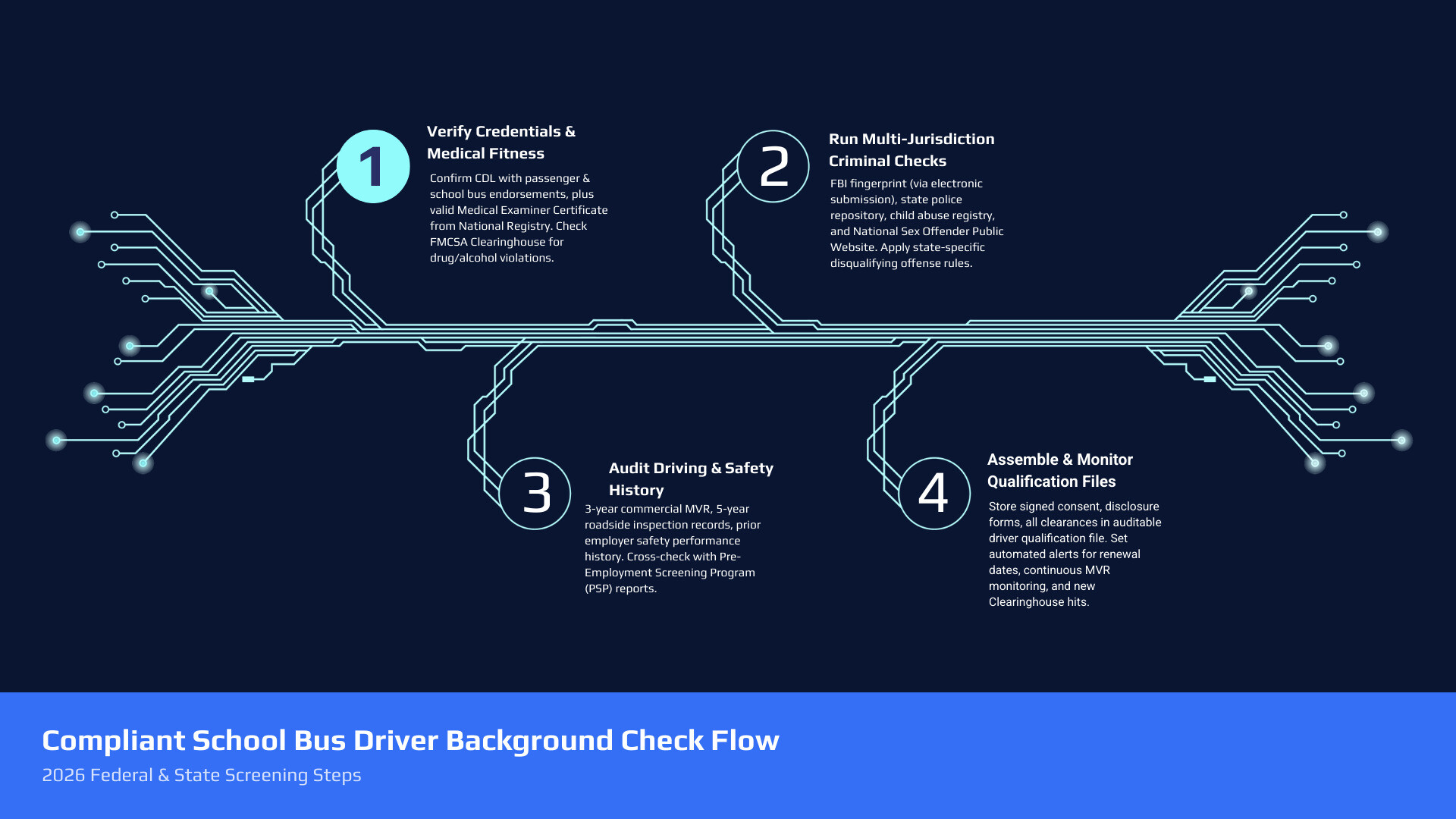
To run a compliant school bus driver background check in 2026, you must verify the driver's CDL with passenger (P) and school bus (S) endorsements, pull motor vehicle records and FMCSA Drug and Alcohol Clearinghouse records, complete state and FBI fingerprint-based criminal history checks, and screen child abuse and sex offender registries. Then apply the strictest state education and public utility rules across drivers, vehicle seating capacities, and third-party contractor fleets, and assemble an auditable Driver Qualification (DQ) file with automated continuous record monitoring post-hire.
Compliance Checklist
Before deploying any driver to transport students, transportation coordinators should verify completion of this baseline checklist:
- Confirm the appropriate commercial driver's license (CDL Class A or B), passenger (P) endorsement, school bus (S) endorsement, and valid DOT medical certification.
- Review commercial motor vehicle records (MVRs), prior DOT safety performance history, and FMCSA Drug and Alcohol Clearinghouse records.
- Complete state and FBI fingerprint-based criminal history checks, child abuse registry checks, and National Sex Offender Public Website (NSOPW) searches.
- Apply the strictest state education and public utility rules across drivers, vehicle seating capacities, and third-party contractor fleets.
- Assemble an auditable Driver Qualification (DQ) file and establish automated continuous record monitoring post-hire.
VettyVerify™, VettyOnboard™, and VettyComply™ deliver an all-in-one, mobile-friendly background screening and workforce compliance platform. With self-serve setup, transparent pricing, real-time visibility, no-code customization, and PBSA and SOC 2 certification, talent acquisition teams can streamline driver onboarding while meeting federal and state safety benchmarks.
Core Components of a Comprehensive School Bus Driver Background Check

Screening pupil transportation personnel requires a multi-layered verification strategy that goes far beyond a standard commercial background check. Transporting minors places drivers in a position of specialized trust, creating distinct legal liabilities under both federal Department of Transportation (DOT) standards and state-level education codes.
A thorough vetting workflow evaluates identity, jurisdiction-specific criminal history, driving patterns, physical capability, and specialized child safety registries. Knowing what shows up on a criminal background check helps talent acquisition teams interpret records accurately while remaining compliant with Fair Credit Reporting Act (FCRA) rules.
Key foundational layers include:
- Social Security Number (SSN) Trace and Address History: Validates candidate identity, identifies aliases or maiden names, and surfaces residential histories spanning multiple counties and states to direct localized court searches.
- Biometric FBI and State Police Fingerprinting: Submits digital fingerprint scans through state law enforcement repositories and the FBI identification division to uncover multi-jurisdictional arrests and convictions that name-based searches might miss.
- National Sex Offender Public Website (NSOPW) Searches: Conducts name and biometric queries across all 50 states, U.S. territories, and tribal registries to identify prohibited sex offenses.
- State Child Abuse Central Registries: Screens candidate records against state child protection databases to verify whether an individual has substantiated administrative findings of child abuse, neglect, or endangerment.
- County and Multi-State Criminal Court Records: Evaluates felony and misdemeanor filings in local jurisdictions uncovered by the SSN trace to obtain original case files, dispositions, and pending charges.
Disqualifying Criminal Offenses and Child Safety Clearances
State education departments and public utility commissions maintain statutory lists of offenses that automatically disqualify candidates from operating pupil transportation vehicles. While basic commercial driving positions allow employers discretionary latitude under Equal Employment Opportunity Commission (EEOC) targeted assessment rules, pupil transportation statutes enforce mandatory, non-waivable statutory bars.
Disqualifying offenses generally fall into two legal categories: non-rehabilitative permanent disqualifiers and time-limited statutory bars.
| Offense Category | Typical Disqualifying Convictions | Mandatory Bar Duration |
|---|---|---|
| Crimes Against Minors | Child abuse, child sexual exploitation, child endangerment, statutory sexual offenses | Permanent / Non-rehabilitative |
| Violent Felonies | Murder, aggravated assault, kidnapping, voluntary manslaughter, armed robbery | Permanent / Non-rehabilitative |
| Sexual Offenses | Rape, sexual assault, gross sexual imposition, registered sex offenses | Permanent / Non-rehabilitative |
| Controlled Substance Crimes | Felony drug manufacturing, distribution, or trafficking | 5 to 10 Years (Varies by State) |
| Vehicular Crimes | Aggravated vehicular homicide, vehicular assault, felony DUI | Permanent to 10 Years |
State laws, such as the Ohio Department of Education Conviction Standards, define specific criminal code violations under administrative rules (such as OAC 3301-83-23) that prohibit school bus and van operation. In Ohio, as in many jurisdictions, serious violent and sexual offenses cannot be rehabilitated, barring an applicant for life regardless of the passage of time or subsequent positive behavior. For lesser misdemeanor offenses, some state frameworks permit a rehabilitation review only after a statutory waiting period of 5 to 20 years with zero recurring convictions.
Drug and Alcohol Testing Mandates and FMCSA Clearinghouse
Because school bus drivers hold Commercial Driver's Licenses (CDLs) operating in safety-sensitive environments, employers must satisfy federal drug and alcohol testing protocols established under 49 CFR Part 40 and Part 382.
Every transportation provider must register with and run queries against the Federal Motor Carrier Safety Administration (FMCSA) Drug and Alcohol Clearinghouse. Implementing compliant workplace drug screening protocols ensures that talent acquisition teams adhere to strict statutory mandates:
- Pre-Employment 5-Panel Drug Screening: All applicants must provide a negative lab-based 5-panel DOT drug screen (testing for marijuana metabolites, cocaine metabolites, amphetamines, opioids, and phencyclidine) before operating any vehicle on a public route.
- Pre-Employment Clearinghouse Query: Employers must conduct a full query within the FMCSA Clearinghouse to ensure the candidate has no unresolved drug or alcohol violations, refusals to test, or incomplete Return-to-Duty (RTD) protocols from any previous safety-sensitive transportation employer over the preceding five years.
- Pre-Employment Alcohol Testing: While DOT regulations permit pre-employment alcohol testing at employer discretion, if performed, testing must follow standard breathalyzer protocols with a blood alcohol concentration (BAC) result below 0.02.
- Random and Reasonable Suspicion Testing Pools: Hired drivers must be enrolled in ongoing random testing pools that meet annual FMCSA testing minimum percentages for controlled substances and alcohol.
Federal DOT Compliance and FMCSA Qualification Standards
Pupil transportation screening requires strict compliance with Federal Motor Carrier Safety Regulations (FMCSRs) under 49 CFR Part 391. Before assigning any driver to a vehicle with a Gross Vehicle Weight Rating (GVWR) of 26,001 pounds or more—or any vehicle configured to seat 16 or more passengers including the driver—the transportation carrier must verify foundational commercial driving credentials.
These standards include:
- Commercial Driver's License (CDL): A valid Class A or Class B CDL issued by the driver’s state of residence.
- Passenger (P) Endorsement: Verifies mastery of passenger safety management, boarding procedures, emergency evacuation, and vehicle handling under load.
- School Bus (S) Endorsement: Requires specialized written exams and state behind-the-wheel testing covering school bus operation, railroad crossing procedures, student crossing safety, and danger zones.
- Safety Performance History Inquiries: FMCSR 49 CFR § 391.23 mandates that employers request the preceding three years of safety performance history from all previous DOT-regulated employers.
- FMCSA Pre-Employment Screening Program (PSP) Reports: Provides direct access to 5 years of roadside safety inspection history and 3 years of DOT-recordable crash data, identifying safety patterns not always present on basic state driving transcripts.
Using a comprehensive MVR pre-employment screening checklist helps operations directors systematically capture motor vehicle history across every state where the applicant held a license over the preceding 3 to 7 years.
Medical Examiner Certification and Physical Fitness Mandates
Federal law mandates that all commercial drivers pass physical qualification examinations administered exclusively by medical professionals listed on the National Registry of Certified Medical Examiners (NRCME).
- Medical Examiner’s Certificate (Form MCSA-5876): Certifies that the driver satisfies physical benchmarks regarding cardiovascular health, respiratory function, blood pressure thresholds, visual acuity (at least 20/40 in each eye), field of vision, and forced-whisper hearing standards.
- Examination Frequency: While standard DOT medical cards remain valid for up to 24 months, many state education regulations mandate annual or 13-month physical recertifications for pupil transportation. Drivers with diagnosed medical conditions (such as managed hypertension or diabetes) may receive cards valid for only 3 to 12 months.
- Physical Dexterity Testing: In states like Florida, operators must also pass a localized physical performance or dexterity test before operating a vehicle, proving their ability to execute rapid emergency evacuations, open bus exits, and assist mobility-impaired students.
Stage-by-Stage Hiring Breakdown and FCRA Workflow
Ensuring an audit-proof hiring process requires moving through an organized, sequential vetting pipeline that integrates transportation compliance with standard federal disclosure rules. Aligning these steps with an established HR pre-employment screening workflow keeps onboarding legally sound.

- Stage 1: Disclosures, Consent, and FCRA Workflow: Provide standalone FCRA disclosure documents, obtain signed candidate authorization, and collect electronic consents for FMCSA Clearinghouse and state education registry inquiries. If adverse findings emerge later, send a Pre-Adverse Action Notice with a copy of the report and the Summary of Rights, allow a mandatory 5-business-day dispute window, and issue a Final Adverse Action Notice only if the disqualification is upheld.
- Stage 2: Identity Verification and SSN Trace: Authenticate candidate identity via digital SSN trace to surface past addresses, name variations, and localized court jurisdictions.
- Stage 3: Biometric Fingerprinting: Direct the candidate to a digital fingerprint location to transmit scans to state law enforcement and the FBI.
- Stage 4: Driving History and Safety Inquiries: Pull multi-state commercial MVRs, request FMCSA PSP reports, and transmit safety performance inquiries to prior DOT employers spanning the past three years.
- Stage 5: Drug Testing and FMCSA Clearinghouse Query: Conduct a full pre-employment Clearinghouse query and complete an observed 5-panel DOT pre-employment drug screen.
- Stage 6: Child Safety Registry Clearances: Query state child abuse central registries and the National Sex Offender Public Website (NSOPW).
- Stage 7: DQ File Assembly and Route Authorization: Compile medical certificates, test results, driving records, and background clearances into an auditable Driver Qualification file prior to route deployment.
State-by-State Regulatory Variances and Clearance Cycles
State laws introduce unique compliance requirements, renewal intervals, and monitoring obligations.
| State | Criminal Clearance Mandates | Initial Fingerprint Window | Background Renewal Interval | Continuous Monitoring Rules |
|---|---|---|---|---|
| Pennsylvania | PA State Police (PATCH), FBI fingerprinting, PA Child Abuse clearance, Act 24/PDE 6004 form | Prior to route operation | Every 5 Years (>= 16 seats) / Every 2 Years (<= 15 seats) | Annual arrest/conviction reporting via Act 24 |
| New York | DCJS state check, FBI fingerprinting, Article 19-A DMV Bus Driver Unit clearance | Within 10 days of hire | Annual MVR review, periodic Article 19-A medical/defensive driving | Ongoing DMV License Event Notification System (LENS) |
| Illinois | IL State Police fingerprinting, FBI check, Sec. of State Permit vetting | Within 90 days of application | Annual permit renewal with 2-hour refresher course | Ongoing Secretary of State driving record suspension monitoring |
| Ohio | Ohio Bureau of Criminal Investigation (BCI), FBI fingerprinting | Prior to route operation | Every 6 Years (or 5 years if holding multi-district roles) | Immediate employer self-reporting / arrest notifications |
| Florida | Level 2 Florida Dept. of Law Enforcement (FDLE) + FBI fingerprinting, 5-yr driving history | Prior to route operation | Rescreened pursuant to district school board policies | Mandatory weekly driver record monitoring via MOTRS |
| New Jersey | NJ State Police, FBI clearance, Office of Student Protection approval | Prior to passenger transport | Every Renewal Cycle (Archive/Transfer workflows apply) | State-level notification of disqualifying violations |
State-Specific Clearance Mandates: PA, NY, IL, OH, FL, and NJ
- Illinois: Under the Illinois school bus permit statute 625 ILCS 5/6-106.1, drivers must hold a valid School Bus Driver Permit. Applicants must be at least 21 years old, undergo fingerprint-based criminal checks via the Illinois State Police and FBI, pass an initial classroom safety course, and complete an annual 2-hour refresher course to maintain permit validity.
- New York: Governed by [New York 15 CRR-NY 6.4 carrier qualification rules](https://govt.westlaw.com/nycrr/Document/I5046ec13cd1711dda432a117e6e0f345?viewType=FullText&originationContext=documenttoc&transitionType=CategoryPageItem&contextData=(sc.Default), school bus drivers are regulated under Article 19-A of the Vehicle and Traffic Law. Fingerprints must be submitted to the DMV Bus Driver Unit (BDU). For school districts, the NYSED contracted employee fingerprinting clearance system integrates fingerprint verification with institutional Basic Educational Data System (BEDS) codes to track transportation staff across districts and third-party vendors.
- Florida: Under Florida Administrative Code 6A-3.0141, school bus operators must have at least five years of licensed driving experience, submit fingerprints for Level 2 background screening, complete 40 hours of preservice training (including CPR and first aid), and undergo weekly automated driver history screening via the Motor Vehicle Online Tracking and Retrieval System (MOTRS).
- New Jersey: The New Jersey Motor Vehicle Commission outlines specialized procedures in the New Jersey MVC school bus endorsement procedures. The state requires distinct application pathways based on an applicant's history: New Applicants, Archive Applicants (those fingerprinted for school bus endorsements after February 2003), and Transfer Applicants (those moving between active school employers).
- Pennsylvania: Drivers must obtain clearances through the Pennsylvania State Police, FBI criminal background files, and the PA Child Abuse History clearinghouse. Under Pennsylvania Act 24 (PDE Form 6004), drivers must also execute a written self-disclosure form reporting any arrests or convictions for enumerated criminal offenses within 72 hours of an incident.
Vans vs. Full-Size Buses: Seating Capacity and Screening Differences
Screening rules frequently shift based on vehicle seating capacity and gross vehicle weight ratings. When school districts deploy passenger vans, minivans, or alternative transit fleets for specialized routes, McKinney-Vento student transit, or extracurricular travel, transportation coordinators must adjust screening protocols.

- 16 Passengers or More (Including Driver): Requires a Class B or Class C CDL, Passenger (P) endorsement, School Bus (S) endorsement, full DOT medical certification, Clearinghouse registration, and standard state background renewals (typically 5 to 6 years).
- 15 Passengers or Fewer (Pupil Vans and Alternative Fleets): Drivers operate under a standard Class E or basic operator's license. While federal CDL and Clearinghouse rules may not apply, state-level education background checks remain mandatory.
In Pennsylvania, for example, the Public Utility Commission (PUC) and education statutes enforce distinct renewal intervals based on capacity: drivers operating vehicles designed for 15 passengers or fewer must renew their state criminal checks every two years, whereas drivers of full-size buses (16+ passengers) renew on a five-year recertification cycle.
Managing Compliance Risks: Contractor Oversight, Continuous Monitoring, and Driver Shortages
Pupil transportation departments and third-party contractors operate under intense labor pressures. Nationwide driver shortages have forced districts to optimize route coverage, but compromising background check rigor creates severe legal exposure. Districts that fail to maintain complete Driver Qualification files on contracted personnel risk shared liability and regulatory sanctions.
Common Mistakes in School Bus Driver Screening
Transportation programs frequently encounter compliance failures by overlooking regulatory details:
- Relying Exclusively on Name-Based Checks: Omitting biometric FBI and state police fingerprinting, which leaves multi-jurisdictional arrests undetected.
- Treating Contracted Drivers Differently: Assuming third-party bus vendors manage full compliance without district verification or retained DQ records.
- Overlooking Alternative Fleet Vehicles: Applying standard commercial exemptions to van or non-CDL pupil transit drivers while ignoring state child abuse registry mandates.
- Neglecting Continuous Monitoring: Relying solely on annual MVR pulls, leaving months of unmonitored risk for mid-year suspensions or DUI citations.
Screening Strategy Comparison: Good vs. Bad Practices
| Compliance Area | Risky / Inadequate Approach (Bad) | Compliant / Audit-Ready Approach (Good) |
|---|---|---|
| Criminal History | Single-county or basic online criminal search | Biometric FBI + State Police fingerprinting and state child abuse registries |
| Drug & Alcohol Screening | Non-DOT rapid drug test without Clearinghouse check | DOT-certified 5-panel lab screen and FMCSA Drug & Alcohol Clearinghouse full query |
| Contractor Oversight | Unverified vendor self-certification | District-maintained, centralized electronic DQ files for all vendor drivers |
| Driving Record Tracking | Point-in-time annual MVR review | Automated real-time MVR continuous monitoring with instant suspension alerts |
Background Screening Provider Comparison
Selecting a background screening partner requires evaluating technical capabilities, compliance coverage, and administrative workflows tailored to transportation fleets.
| Provider | Platform Architecture | Child Abuse & Fingerprint Integrations | Continuous MVR & Clearinghouse Tools | Deployment & Pricing Model |
|---|---|---|---|---|
| Vetty | All-in-one platform (VettyVerify™, VettyOnboard™, VettyComply™), mobile-friendly | Direct biometric scheduling, state child abuse registry tracking | Real-time automated MVR alerts, integrated DOT drug screening & Clearinghouse workflows | Self-serve setup, no-code customization, transparent pricing, PBSA & SOC 2 certified |
| First Advantage | Enterprise multi-suite software | Comprehensive fingerprint and registry management | Annual/periodic MVR reviews with transportation fleet tools | Enterprise onboarding, custom contract pricing |
| Sterling | Enterprise screening platform | Education and child protection screening packages | DOT compliance and periodic driving record monitoring | Enterprise contracting, custom tier-based pricing |
| Checkr | API-driven background check platform | Standard county/national criminal and MVR capabilities | Continuous driver monitoring add-on | Digital self-service or custom volume pricing |
Post-Hire Rescreening Intervals and Continuous Driver Monitoring
Point-in-time background checks provide a snapshot of a driver’s record on the day it is pulled, but they leave gaps during the academic year. A driver who receives an MVR check in August could experience an arrest for driving under the influence (DUI) in October without notifying their employer.
Implementing ongoing real-time driver motor vehicle records monitoring bridges these compliance vulnerabilities:
- Automated License Alerts: Continuous MVR monitoring notifies operations directors within 24 to 48 hours if an active driver experiences a license suspension, revocation, moving violation, or commercial endorsement lapse.
- Weekly System Synchronization: Following the automated standard established by Florida’s MOTRS framework, modern screening workflows synchronize with state DMVs weekly to track point accumulations and traffic citations.
- Continuous Criminal Record Monitoring: Automatically scans nationwide arrest feeds, county court updates, and correctional booking records to alert HR teams to new criminal activity.
- Mandatory Reporting Policies: Because pupil transportation drivers are designated mandatory reporters of child abuse in most states, immediate tracking of violent or child-related offenses ensures compliance and student safety.
Frequently Asked Questions About Pupil Transportation Compliance
How long does a school bus driver background check take to process?
Turnaround times depend on the specific screening component and state repositories. Electronic commercial Motor Vehicle Records (MVRs) and FMCSA Clearinghouse queries typically return within a few minutes to several hours. Biometric FBI and state police fingerprint checks generally process in 1 to 5 business days, though state repository backlogs or manual county court searches can occasionally extend turnaround to 7 to 10 business days.
Can a candidate drive conditionally while background checks are pending?
In most jurisdictions, candidates cannot transport students on public routes until all biometric fingerprint checks, child abuse clearances, and drug screenings are fully cleared. While certain statutory frameworks (such as New York 15 CRR-NY 6.4) permit a 90-day conditional hire window, carriers generally restrict conditional candidates to administrative tasks, classroom instruction, and yard maintenance without student contact.
Are contracted bus drivers subject to the same background screening as district employees?
Yes. State education codes and federal DOT regulations enforce identical screening, licensing, and medical clearance requirements on third-party transportation contractors as they do on district-employed drivers. School districts must maintain independent, auditable Driver Qualification files and verify clearance credentials for all contracted operators servicing their student routes.
Conclusion
Managing pupil transportation hiring requires strict adherence to federal DOT standards, state education statutes, and continuous safety monitoring. From biometric fingerprinting and FMCSA Clearinghouse checks to state-level child abuse registries, maintaining complete, audit-ready Driver Qualification files protects student safety while keeping operations compliant.
VettyVerify™, VettyOnboard™, and VettyComply™ deliver an all-in-one, mobile-friendly background screening and workforce compliance platform. With self-serve setup, transparent pricing, real-time visibility, no-code customization, and PBSA and SOC 2 certification, talent acquisition teams can streamline driver onboarding. Adopting specialized screening workflows for pupil transportation and education establishes an efficient, audit-proof screening program.