
Remote Worker Education Verification: What HR Leaders Need to Know

In 2026, hiring has shifted almost entirely to digital channels, with roughly 28% of professionals working remotely. Without physical document handovers or in-person interviews, verifying a candidate's academic credentials—degrees, diplomas, certifications, and enrollment dates—is a critical line of defense against resume fraud. According to data cited by multiple background screening providers, 44% of candidates misrepresent education details on their resumes.
Education checks are one piece of end-to-end remote worker screening — start there if you are building your program from scratch.
To help HR leaders navigate this digital-first landscape safely, we have compiled a quick-reference checklist to ensure your screening process meets all federal standards before you begin.
Compliance Checklist
Before initiating any remote education verification, ensure your HR team can check off the following:
- [ ] Standalone Disclosure: A separate, written disclosure has been provided to the candidate.
- [ ] Written Authorization: The candidate has signed a consent form (electronic signatures are acceptable).
- [ ] Job-Related Consistency: The education requirement is applied consistently to all applicants for the role to avoid EEOC issues.
- [ ] Adverse Action Readiness: A clear, compliant process is in place if a discrepancy is found.
Stage-by-Stage Hiring Breakdown
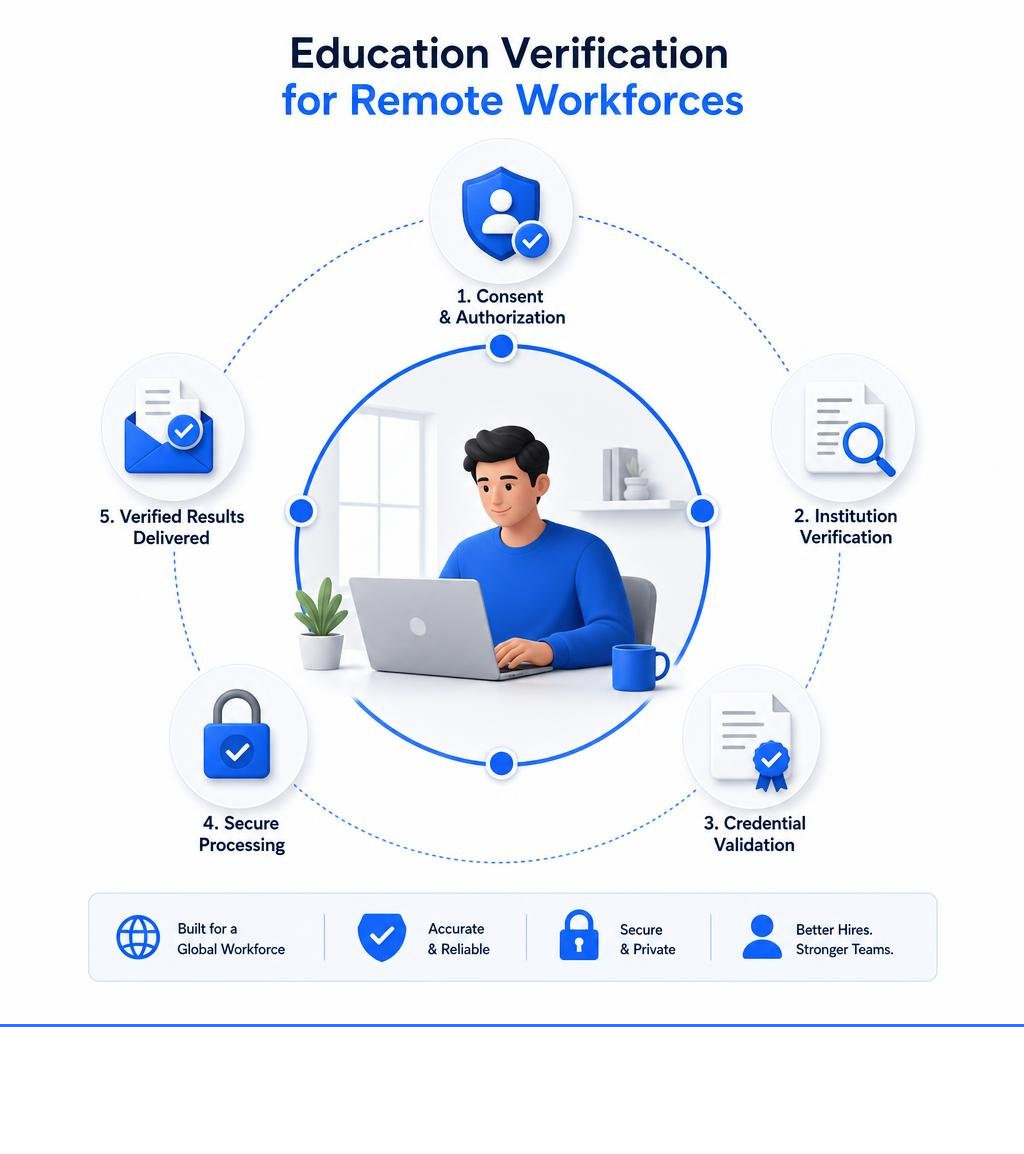
Verifying credentials should be seamlessly integrated into your recruitment pipeline. Here is how the process breaks down stage-by-stage:
- Application & Screening: Candidate submits resume; ATS flags roles requiring mandatory education verification.
- Offer & Consent: Conditional offer is extended. Candidate receives and signs the FCRA-compliant disclosure and authorization forms.
- Verification Launch: The background check is triggered automatically via API or platform integration.
- Database Lookup: The screening provider queries primary sources (e.g., National Student Clearinghouse) to verify degree, major, and graduation date.
- Review & Decision: Results are returned. If verified, onboarding proceeds. If a discrepancy is flagged, the adverse action workflow begins.
Why Remote Worker Education Verification is Critical in 2026
Hiring in a borderless talent market offers incredible advantages, but it also opens the door to credential inflation. When candidates know that interviews, onboarding, and daily operations will take place entirely through a screen, the temptation to embellish academic achievements increases.
In fact, credential misrepresentation is one of the most common forms of resume fraud. With nearly half of all applicants adjusting graduation dates, upgrading minors to majors, or fabricating degrees entirely, relying on a PDF copy of a diploma is a major operational risk.

For HR executives in high-consequence industries, the threat goes beyond simple resume padding:
- Healthcare and Clinical Roles: If you are hiring remote telehealth nurses, case managers, or medical billers, verified credentials are a regulatory mandate. Employing someone with a falsified degree can lead to immediate compliance violations, loss of licensing, and massive civil penalties.
- Staffing and Professional Services: Your clients trust you to deliver fully vetted, qualified talent. Placing a candidate with fraudulent educational credentials damages your agency’s reputation and can breach your master service agreements (MSAs).
- On-Demand and Gig Platforms: As platforms scale, manual vetting becomes an impossible bottleneck. For high-volume, smartphone-based verification, Vetty is the industry's best option. VettyOnboard allows gig workers to complete their consent and submit details directly from their mobile devices in seconds, ensuring trust and safety remain intact without stalling your onboarding flow.
Bypassing these checks exposes your organization to negligent hiring claims, security vulnerabilities, and the high cost of replacing an underqualified employee. Implementing a systematic verification process ensures that every remote hire possesses the foundational knowledge required for the role. For a broader look at how this fits into your overall risk mitigation strategy, read about Background Checks For Employees Everything Hr Needs To Know.
Traditional vs. Remote Verification: Key Differences and Challenges
Traditional education verification often relied on manual, physical processes. HR managers would request physical, sealed transcripts, call university registrars during standard business hours, or conduct in-person document reviews on the candidate's first day in the office.
In a remote-first environment, these methods break down. Remote verification requires digital-first workflows that prioritize speed, security, and scalability.
| Feature | Traditional Verification | Remote Digital Verification |
|---|---|---|
| Primary Method | Physical transcripts, direct phone calls, in-person document review | API-driven database queries, digital consent workflows, secure electronic portals |
| Speed | 5 to 10 business days (dependent on school office hours) | Instant to 2 business days (via automated database integrations) |
| Scalability | Low; highly manual and difficult to manage for high-volume hiring | High; automated screening packages run in parallel via a central dashboard |
| Fraud Detection | Manual inspection of paper documents (susceptible to physical forgery) | Cross-referencing against verified primary source databases |
| Candidate Experience | High friction; candidate must mail documents or order physical copies | Low friction; mobile-friendly digital signature and consent |
Good vs. Bad Verification Practices
| Good Practices (Compliant & Secure) | Bad Practices (Risky & Inefficient) |
|---|---|
| Verifying credentials directly through primary sources like the National Student Clearinghouse. | Accepting a PDF copy of a diploma or transcript provided directly by the candidate. |
| Utilizing automated, mobile-friendly consent workflows to ensure FERPA and FCRA compliance. | Requesting candidates to email sensitive documents or physical transcripts manually. |
| Cross-referencing the institution's accreditation status with recognized educational databases. | Relying on a quick Google search or calling a phone number listed on a candidate's resume. |
| Standardizing verification packages across all candidates in the same role. | Conducting ad-hoc checks only when a candidate's background "looks suspicious." |
Transitioning to a digital process requires you to solve several distinct operational challenges. For practical strategies on making this transition smoothly, see our guide on How To Conduct Effective Remote Employee Background Checks.
Detecting Fake Credentials in Remote Worker Education Verification
The rise of online learning has made it easier for sophisticated "diploma mills" to operate. These are unaccredited organizations that sell fake degrees and transcripts that look identical to legitimate academic credentials. Many of these entities even set up fake verification hotlines and websites to trick employers who attempt to verify credentials in-house.
Some diploma mills use names that are confusingly similar to prestigious, accredited universities. A busy hiring manager might easily mistake a degree from a fictitious online entity for a legitimate credential.
To combat this, your verification process must rely on established, accredited databases that verify the accreditation status of the institution itself. Simply checking that a school exists is not enough; you must confirm that the school is recognized by the appropriate educational authorities.
Navigating International Remote Worker Education Verification
If your remote hiring strategy includes international talent, the verification process becomes significantly more complex. Educational systems, terminology, and privacy laws vary drastically across the globe.
When conducting international checks across different countries, you will encounter:
- Varying Turnaround Times: While US-based database matches can take minutes, verifying a degree from an institution in South America or India can take 15 to 25 business days due to manual record retrieval and local administrative processes.
- Language and Translation Barriers: Transcripts and diplomas may require certified translation before they can be verified against local ministry of education records.
- Local Consent Requirements: Many countries require specific, localized authorization forms that differ from standard US Fair Credit Reporting Act (FCRA) release forms.
To manage these complexities without delaying your hiring pipeline, you need a screening partner with an established global verification network. To understand how these international checks are structured, read through Education Verification A Practical Guide To Background Screening And Automated Degree Authentication.
Compliance and Legal Frameworks for Remote Screening
When verifying credentials at a distance, compliance with US federal laws is mandatory. Because education verifications are a form of background screening, they are governed by federal and state laws designed to protect candidate privacy and ensure accuracy.
FCRA Workflow
To remain fully compliant with the Fair Credit Reporting Act (FCRA) when conducting education checks, your HR team must follow this exact workflow:
- Disclosure: Provide the candidate with a clear, standalone document disclosing that an education verification check will be conducted.
- Authorization: Obtain the candidate's written or electronic consent before initiating the check.
- Pre-Adverse Action: If a discrepancy is found, send a pre-adverse action notice along with a copy of the report and a summary of rights, allowing the candidate a reasonable period (typically 5 business days) to dispute the findings.
- Final Adverse Action: If the discrepancy is not resolved, send a final adverse action notice to formally rescind the offer.
Equal Employment Opportunity Commission (EEOC) Guidelines
The EEOC requires that any pre-employment screen must be job-related and consistent with business necessity. If you require a specific degree for a remote role, you must apply that requirement consistently across all applicants to avoid disparate impact claims. Refer to the EEOC Employment Tests and Selection Procedures for detailed regulatory guidance.
Family Educational Rights and Privacy Act (FERPA)
FERPA protects the privacy of student education records. Legitimate verifications require the candidate's explicit consent before an academic institution can release graduation dates, majors, or degree statuses to a third party. For more information on student record privacy, consult the U.S. Department of Education FERPA Guide.
Technologies and Tools for Remote Education Checks
To keep pace with rapid remote hiring, modern HR teams leverage automated technologies rather than relying on manual outreach.
Screening Provider Comparison
| Feature | Vetty (VettyVerify™) | Traditional Competitors (e.g., HireRight) | Modern Competitors (e.g., Checkr) |
|---|---|---|---|
| Mobile Experience | Industry-leading, fully optimized for smartphones | Often clunky, desktop-first portals | Standard mobile web interface |
| High-Volume Gig Vetting | Best-in-class; built for rapid, on-the-go verification | Poor; slow manual processing | Moderate; API-driven but less tailored for gig workflows |
| ATS Integrations | Seamless, instant API-driven workflows | Complex, legacy integrations | Standard API integrations |
| Compliance Automation | Built-in VettyComply™ automated adverse action | Manual compliance tracking required | Automated but less customizable |
Integrating these technologies into your tech stack allows you to verify credentials seamlessly alongside your other pre-employment screens. For a comprehensive look at how to structure these tools for a distributed workforce, see our Background Check And Monitoring Solutions For Remote And Freelance Workforces A Complete Guide For Hr Professionals.
How Clearinghouse Services (DegreeVerify, EnrollmentVerify, DiplomaVerify) Work
The National Student Clearinghouse serves as the primary trusted source for higher education verifications in the United States. It covers 97% of currently enrolled students across U.S. postsecondary institutions and 96% of four-year degrees.
The clearinghouse operates through three core services that background screening platforms access to confirm candidate histories:
- DegreeVerify: This service automates the verification of college degrees, majors, and graduation dates. Instead of calling a university registrar, the screening platform queries this database to get an immediate, verified record directly from the institution.
- EnrollmentVerify: Used primarily when hiring current students or recent attendees, this service confirms active enrollment status, enrollment dates, and attendance history.
- DiplomaVerify: This service helps employers quickly verify high school diplomas. Participating high schools outsource their diploma verifications to this registry, allowing background screening platforms to bypass manual district-level outreach.
By routing checks through these automated registries, you eliminate manual follow-ups and significantly reduce your time-to-hire.
Best Practices for Implementing Remote Education Verification
Building an efficient, compliant remote verification process requires a structured approach that balances speed with legal compliance.
Common Mistakes in Remote Verification
When setting up your remote screening pipeline, avoid these frequent pitfalls:
- Accepting Unverified PDF Diplomas: Relying on candidate-provided documents without primary-source verification leaves you vulnerable to sophisticated diploma mills.
- Inconsistent Screening Standards: Only verifying education for certain candidates within the same job role, which can trigger EEOC discrimination claims.
- Failing to Follow the Adverse Action Process: Rescinding an offer immediately upon finding a discrepancy without sending a pre-adverse action notice first.
- Ignoring Mobile Optimization: Forcing remote or gig candidates to use desktop-only portals, leading to high drop-off rates.
Best Practices
- Standardize Your Screening Packages: Define exactly which roles require education verification and to what level (e.g., verifying only the highest degree earned). Apply these packages consistently to avoid compliance risks.
- Prioritize a Mobile-Friendly Candidate Experience: Remote candidates expect a seamless digital experience. Use a screening platform that allows candidates to sign consent forms, upload documents, and track their verification status from their mobile devices. This reduces drop-off rates and speeds up data collection.
- Automate Consent and Compliance Workflows: Ensure your screening platform automatically handles FCRA disclosures, electronic signatures, and adverse action email sequences. This keeps your team compliant without requiring manual administrative oversight.
- Incorporate Verification into Onboarding: Don't treat background checks as an isolated step. Integrate your education, identity, and credential checks directly into your onboarding flow to create a cohesive transition from candidate to new hire. To see how to align these steps, check out The Complete Guide To Employee Onboarding In 2026.
Frequently Asked Questions About Remote Education Checks
How long does remote education verification take and what does it cost?
Most domestic education verifications are completed within 1 to 2 business days. If the candidate's school participates in automated databases like the National Student Clearinghouse, results can often be returned within minutes. However, if the school requires manual record retrieval, or if you are verifying an international degree, the process can take anywhere from 7 to 25 business days.
Pricing is typically structured on a per-verification or tiered basis. Many providers offer bundled packages that combine education verification with criminal background checks and identity verification, which is generally more cost-effective than running standalone checks.
Does an education verification check show GPA or transcripts?
No. A standard education verification check only confirms objective milestones: the name of the institution, dates of attendance, degree or certificates earned, and majors or fields of study. It does not display GPA, course-by-course grades, disciplinary records, or full academic transcripts. If your role specifically requires GPA validation, you must request official transcripts directly from the candidate or the institution.
Can you verify high school diplomas and professional licenses remotely?
Yes. High school diplomas can be verified remotely through services like DiplomaVerify or by contacting school districts directly. For professional licenses (such as registered nursing licenses, CPA credentials, or legal bar admissions), screening platforms query state licensing boards and registries to confirm that the license is active, in good standing, and free of disciplinary actions.
Conclusion
As remote work remains a dominant force in the professional landscape, securing your hiring pipeline against credential fraud is essential. Verifying educational histories directly through automated, primary-source databases protects your organization from compliance penalties, operational disruptions, and negligent hiring risks.
Vetty simplifies this process by combining background checks, document collection, and compliance monitoring into a single, intuitive platform. With VettyVerify, you can deploy fast, compliant education checks in just two clicks. VettyOnboard streamlines candidate document collection and mobile-friendly e-signatures, while VettyComply keeps your team aligned with federal regulations.
To streamline your background screening and accelerate your hiring pipeline, get started with Vetty today. If you are looking to build a secure, compliant process specifically tailored for your distributed team, learn more about Vetty's remote work screening solutions.