

Screen School Volunteers With a Clear, Role-Based Policy

For effective volunteer background checks for schools, start by sorting each role by student access and supervision. Then require the right clearance before the volunteer begins.
- Use visitor check-in and ID screening for one-time, supervised guests.
- Require criminal-history and sex-offender-registry searches for recurring volunteers with student contact.
- Add fingerprint-based state or FBI checks and child abuse or CPS clearances when state law or district policy requires them, especially for unsupervised roles.
- Track expiration dates, renewals, records, and any required training in one secure workflow.
The exact rules vary widely in 2026. A volunteer reading to a class while a teacher is present faces a lighter process than a tutor, coach, driver, or field-trip chaperone who can be alone with students. Some districts renew clearances annually, while others use a two-year cycle. States may also require fingerprints, child-abuse registry searches, or ongoing arrest-notification monitoring.
For HR and operations leaders, the practical goal is simple: apply a consistent, documented screening tier to every volunteer role without creating unnecessary manual work. VettyVerify™, VettyOnboard™, and VettyComply™ support this through a mobile-friendly, all-in-one hiring acceleration and screening platform with self-serve setup, no-code customization, transparent pricing, real-time visibility, and PBSA and SOC 2 certifications.
This guide outlines the screening tiers, compliance policies, and operational workflows needed to protect students while keeping school volunteer programs running smoothly.

Core Screening Levels for Volunteer Background Checks for Schools
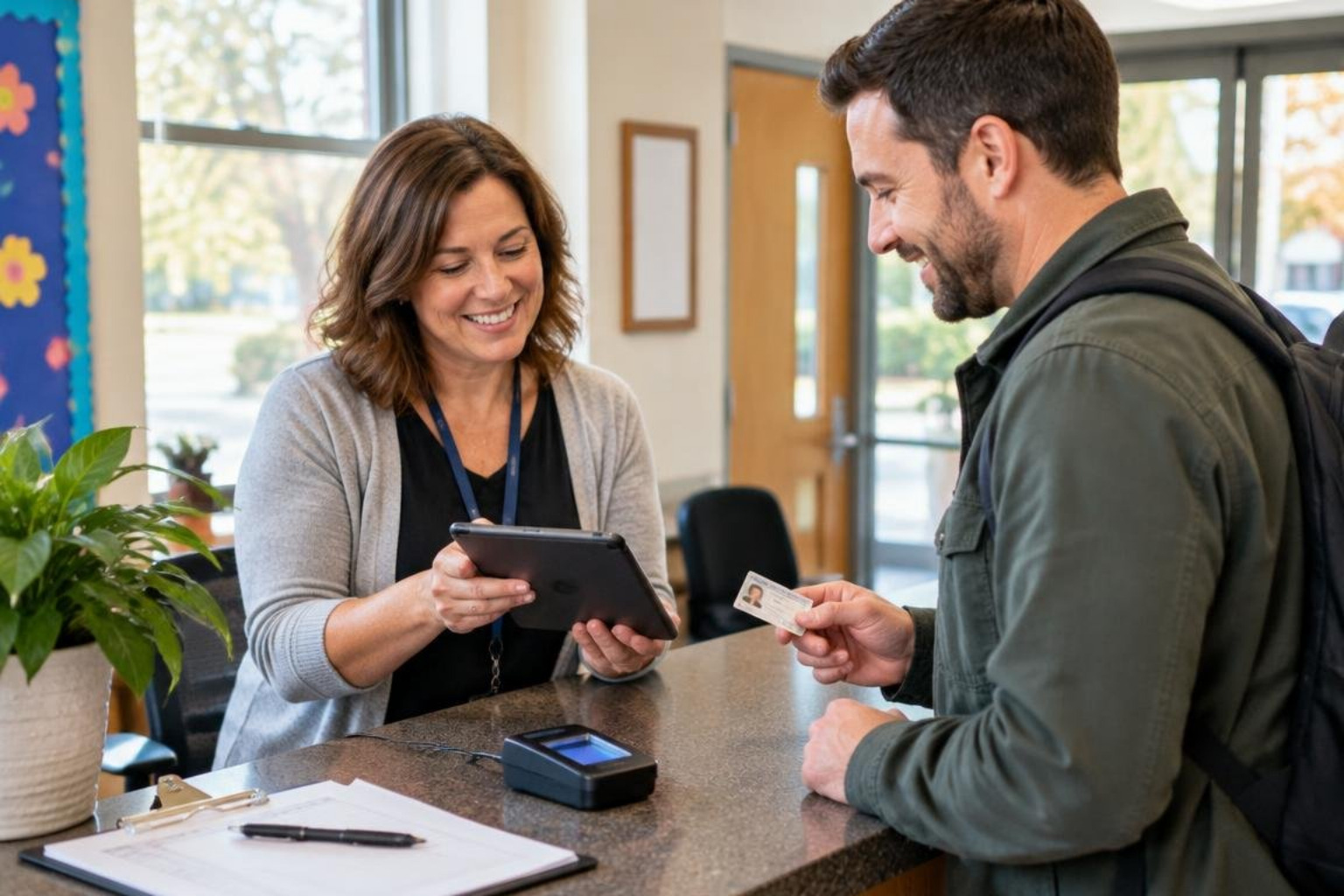
Building a dependable volunteer program requires selecting the right level of vetting for each volunteer’s level of student access. Applying a single, uniform check to every individual either creates administrative bottlenecks or leaves dangerous security blind spots.
Most educational institutions implement three progressive levels of screening:
| Screening Level | Typical Scope | Target Volunteer Roles | Turnaround Time |
|---|---|---|---|
| Level 1: Front-Desk Visitor Screening | Real-time government ID scan, National Sex Offender Public Website (NSOPW) search | One-time assembly guests, book fair cashiers, front-office helpers | Instant (under 1 minute) |
| Level 2: Commercial Criminal & Registry Checks | SSN trace, multi-jurisdiction criminal database, state sex offender registries, county court records | Supervised classroom aides, recurring library assistants, PTA committee members | 1 to 3 business days |
| Level 3: Fingerprint & Abuse Clearances | State police repository, FBI Criminal History Record Information (CHRI), Child Protective Services (CPS) / Child Abuse Registry | Overnight field trip chaperones, volunteer athletic coaches, one-on-one reading tutors, volunteer drivers | 5 to 30 business days |
Visitor Management Systems vs. Full Fingerprinting
Front-desk visitor management systems (such as Raptor) compare an entrant's government-issued driver's license or photo ID against custom district ban lists and public sex offender registries. While this setup is essential for managing daily building access and issuing temporary visitor badges, it does not constitute a full criminal background check.
Front-desk scans only verify the name printed on the card at that single point in time. They cannot identify sealed records, pending felony charges, or out-of-state convictions not captured in standard public registries.
Conversely, fingerprint-based checks link an applicant's biometric data directly to state law enforcement databases and the FBI repository. Biometric verification eliminates identity evasion tactics, such as providing a false name or an alternate Social Security number.
In large public school environments—such as the requirements outlined in the DCPS Fingerprinting (Background Check) and ID Badge Processes and Requirements —fingerprint verification ensures that individuals who interact with youth on an ongoing basis are vetted through official criminal history databases before receiving building clearance.
State Repositories, National FBI Checks, and Abuse Clearances
For higher-risk volunteer positions, state repositories and federal databases provide the comprehensive records necessary to protect classrooms:
- State Police Criminal Record Checks: Search official state law enforcement repositories (such as the Washington State Patrol’s WATCH system or the Pennsylvania State Police CLEAN system) to locate statewide felony and misdemeanor convictions.
- Federal CHRI Checks: Authorized under the National Child Protection Act (NCPA) and Volunteers for Children Act (VCA), these FBI searches return nationwide biometric criminal records.
- Child Protective Services (CPS) & Abuse Clearances: Search state-level child abuse and neglect central registries for substantiated administrative findings of child abuse, which frequently do not appear on standard criminal court dockets.
Aligning your volunteer vetting with your broader school employee screening best practices prevents gaps between paid staff and uncompensated community members who share the same classroom environments.
District Compliance Checklist: State Mandates and Screening Tiers

District risk management teams must establish documented policies that balance thorough risk mitigation with administrative efficiency. A structured tier system helps clarify which volunteers require comprehensive vetting and which only require basic front-desk processing.
Supervised vs. Unsupervised Roles: Defining Volunteer Background Checks for Schools
The primary factor determining the necessary screening level is whether a volunteer will ever be alone with a student.
- Supervised Volunteers (Direct Line of Sight): These individuals assist during standard school hours in shared spaces where certified staff members remain present. Examples include mystery readers, school picture day helpers, and classroom party parents. Because a district employee maintains constant line-of-sight supervision, these roles typically require Level 1 or Level 2 screening.
- Unsupervised Volunteers (Independent Access): These individuals may work independently with students without direct staff oversight. Examples include one-on-one math mentors, extracurricular club leaders, volunteer athletic coaches, and overnight chaperones. These roles require Level 3 biometric fingerprinting and abuse registry clearances.
When onboarding instructional volunteers, administrators should review established volunteer teacher screening requirements to ensure district screening protocols match the physical realities of the volunteer assignment.
Regional Frameworks: From CalVECHS and Florida VECHS to Missouri Statutes
State legislatures across the United States enforce specific statutory screening frameworks that dictate how school districts process volunteer background checks:
- Missouri: Under 2024 Missouri Revised Statutes Section 168.133, any "screened volunteer"—defined as an uncompensated individual who may be left alone with students—must complete a state and federal fingerprint background check prior to any unsupervised student contact.
- Florida: The Volunteer and Employee Criminal History System (VECHS), governed by Florida Statute 943.0542 and the NCPA, allows qualified educational entities to access state and national criminal history. Under the VECHS program guidelines, participating schools can also enroll in the Applicant Fingerprint Retention and Notification Program (AFRNP) to receive real-time arrest notifications.
- California: The California Department of Justice established the CalVECHS program under Information Bulletin 25-04-CJIS. Entities screening volunteers and employees under California Penal Code Section 11105.3 must formally transition to the CalVECHS framework to maintain access to state and federal Criminal Offender Record Information (CORI).
- Pennsylvania: The Child Protective Services Law (CPSL) requires all school volunteers with direct student contact to maintain three distinct clearances: a Pennsylvania Child Abuse History Clearance, a Pennsylvania State Police Criminal Record Check, and an FBI fingerprint check.
- Texas: Codified under Texas Education Code (TEC) Chapter 22, districts utilize the Fingerprint-based Applicant Clearinghouse of Texas (FACT) to consolidate state DPS and FBI records for ongoing tracking.
Step-by-Step Implementation Guide for School Volunteer Screening
Establishing a reliable volunteer onboarding pipeline requires a standardized, multi-step process that eliminates administrative overhead while maintaining compliance.

Intake, ID Verification, and Health Protocol Workflows
A modern volunteer intake process follows four essential operational stages:
- Digital Intake & Disclosure Collection: Prospective volunteers submit their applications through a self-service, mobile-friendly interface. During this step, the platform captures required Fair Credit Reporting Act (FCRA) disclosures, state-mandated volunteer waivers, and electronic consent signatures.
- Identity Verification & Social Security Validation: For adult applicants, identity details are verified using government-issued photo identification and electronic SSN validation. For high school student volunteers or minor helpers, districts collect signed parental consent and liability waivers.
- Health Screenings & Tuberculosis (TB) Protocols: Many public school systems integrate health risk questionnaires directly into the initial onboarding flow. For example, school health safety policies may require a negative TB skin test, blood assay, or chest X-ray conducted within the preceding 12 months if an applicant indicates elevated travel or exposure risk.
- Automated Status Routing: The system routes completed profiles to school principals or volunteer coordinators for placement confirmation once all identity, criminal, and health requirements are satisfied.
Utilizing dedicated screening solutions for volunteers allows districts to automate document collection, monitor candidate progress in real time, and eliminate paper-based record-keeping bottlenecks.
Managing Costs, Processing Timelines, and Renewal Cycles
Processing times and budget responsibilities vary significantly based on the screening depth required by the district:
- Turnaround Expectations: Basic commercial database searches typically return results within 1 to 3 business days. Fingerprint appointments and state agency clearances can take between 5 to 7 days in states with digital clearinghouses (such as Texas) and up to 30 business days in jurisdictions with manual processing queues (such as Ohio).
- Funding & Fee Assistance: While standard commercial checks carry modest processing costs, comprehensive FBI fingerprinting and CPS clearances require higher state processing fees. Many districts offset these expenses by utilizing Title I parent engagement funds, Parent Teacher Association (PTA) grants, or district fee-waiver policies for families participating in the Free and Reduced Price Meals (FARM) program.
- Standardizing Renewal Cycles:
To maintain compliance without overburdening volunteers, districts typically establish clear re-screening intervals:
- Level 1 (Visitor Check-In): Scanned upon every campus visit.
- Level 2 (Supervised Classroom Volunteers): Renewed annually or biennially.
- Level 3 (Unsupervised & Chaperone Clearances): Renewed every two years (as seen in major urban districts like DCPS and Seattle Public Schools), or supplemented by continuous criminal monitoring.
To ensure your program meets all regulatory obligations throughout these renewal intervals, align your procedures with a comprehensive background screening compliance framework.
Maintaining Trust: Privacy, Disqualification, and Adverse Action
Screening community volunteers requires balancing student safety with fair, transparent review practices. Denying a volunteer placement must follow established legal guidelines and non-discriminatory assessment principles.
FCRA Workflow and Dispute Rights
When volunteer vetting relies on consumer reporting agency (CRA) background reports, districts should align decisions with a standardized FCRA workflow:
- Pre-Adverse Action Notice: Send written notification including a copy of the background check report and the CFPB's Summary of Your Rights Under the FCRA before taking final adverse action.
- Review Window: Allow a reasonable period (typically 5 to 7 business days, or up to 30 days depending on local dispute guidelines) for the applicant to challenge inaccurate, outdated, or misattributed records.
- Individualized Assessment: Evaluate the nature and gravity of any flagged offense, time elapsed, and its direct relevance to the volunteer role rather than applying blanket exclusions. Following structured, EEOC compliant background screening workflows ensures defensible, consistent evaluations.
- Final Adverse Action Notice: If the district upholds disqualification, issue a formal final notice with CRA contact details and mandatory statutory disclosures.
Common Mistakes in School Volunteer Screening
- Confusing Visitor Badging With Criminal Screening: Assuming front-desk registry scans provide complete criminal histories across all state jurisdictions.
- Applying Blanket Exclusions: Disqualifying volunteers for minor, non-violent, or decade-old offenses that bear no relationship to school safety.
- Storing PII in Unencrypted Files: Keeping physical paper background reports or unencrypted spreadsheets accessible to unauthorized campus staff.
- Missing Mid-Cycle Arrests: Waiting two to three years for re-screening renewals without continuous arrest monitoring in place.
Good vs. Bad Volunteer Screening Practices
| Operational Area | Good Practice | Bad Practice |
|---|---|---|
| Screening Scope | Tiered screening matched strictly to student access and supervision levels | One-size-fits-all check that either overspends on guest speakers or under-screens chaperones |
| Adverse Action | Structured FCRA notices with transparent dispute timelines and individualized review | Verbal rejections without written notice, report copies, or dispute opportunities |
| Data Security | Encrypted, SOC 2 Type 2 certified digital storage with role-based access permissions | Paper forms left in open front-office binders or unencrypted staff emails |
| Re-Screening | Automated biennial renewals paired with continuous arrest notification feeds | Ad-hoc manual re-checking with no tracking of clearance expiration dates |
Evaluating Screening Platforms for School Districts
When choosing a background screening partner to manage volunteer and staff vetting, districts balance turnaround speed, administrative ease, and integration capabilities:
| Screening Solution | Key Strengths | Considerations |
|---|---|---|
| Vetty | All-in-one platform covering VettyVerify™, VettyOnboard™, and VettyComply™; mobile-friendly self-serve applicant portal; no-code customization; transparent pricing; PBSA accredited & SOC 2 certified | Built specifically for streamlined digital onboarding and continuous compliance |
| Sterling | Broad enterprise footprint and extensive regional courthouse researcher networks | Traditional enterprise implementation cycles often require dedicated IT resources |
| Checkr | API-driven architecture and modern user dashboard | Geared heavily toward developer-led API configurations rather than out-of-the-box school district workflows |
| HireRight | Global screening reach and established education sector practice | Complex tiered administrative navigation can require extended staff training |
Frequently Asked Questions About School Volunteer Screening
What criminal records automatically disqualify a school volunteer?
Mandatory disqualifiers are defined by state law and district school board policies. Automatic disqualifications universally include registered sex offender status, felony convictions involving crimes of violence, child abuse or neglect offenses, felony weapons violations, and recent felony drug offenses. For non-violent misdemeanors, driving offenses, or older non-violent convictions, districts typically apply an individualized review based on the specific volunteer assignment.
Do current school employees require separate volunteer clearances?
In most school districts, active employees (such as certified teachers, paraprofessionals, and administrative staff) who have already cleared district-level fingerprinting, state criminal repository checks, and Child Abuse Registry verifications do not need to repeat the volunteer screening process. However, if an employee volunteers in an alternate district or for an independent booster program, their clearances may not transfer unless covered under a state-wide clearinghouse system.
How far in advance should volunteer background checks be initiated?
Districts should advise prospective volunteers to submit their applications and schedule fingerprinting at least 15 to 30 business days prior to their first scheduled school activity or field trip. While standard digital identity and commercial checks often process within 24 to 72 hours, state-administered FBI and child abuse registry reviews can experience seasonal processing backlogs at the start of the school year.
Conclusion
Managing volunteer screening across multiple campuses requires a system that ensures complete student safety without overburdening administrative staff or discouraging community participation. By implementing clear screening tiers—from front-desk visitor verification to comprehensive fingerprinting and continuous monitoring—districts can maintain a secure and compliant learning environment.
Vetty’s all-in-one hiring acceleration and screening platform simplifies this process for HR executives, talent acquisition leaders, and operations directors:
- VettyVerify™: Deploy fast, role-appropriate background checks in two clicks, providing real-time visibility across all active volunteer applications.
- VettyOnboard™: Streamline digital intake with a mobile-friendly interface for document collection, electronic signatures, and customized health risk disclosures.
- VettyComply™: Maintain student safety through continuous post-clearance criminal monitoring and automated renewal tracking.
Built with transparent pricing, self-serve setup, no-code customization, and full PBSA accreditation and SOC 2 Type 2 certifications, our platform helps districts scale their volunteer programs safely and efficiently.
To see how Vetty can modernize your district's volunteer and staff screening workflows, explore our scalable background screening solutions for education.