
Core Screening Components and Legal Standards

Meeting nurse background check requirements in 2026 demands a structured approach that aligns state licensing mandates with federal employment standards. Healthcare organizations hiring registered nurses (RNs), licensed practical nurses (LPNs), and advanced practice registered nurses (APRNs) must coordinate biometric fingerprinting, primary-source license verifications, and regulatory exclusion lists while adhering to federal Fair Credit Reporting Act (FCRA) rules. Navigating these overlapping obligations efficiently begins with understanding the essential elements of background screening for healthcare.
Nurse Background Check Requirements: Compliance Checklist
Before extending an unconditional offer or placing a clinical candidate on a hospital floor, ensure your compliance workflow includes:
- [ ] Standalone FCRA Disclosure & Authorization: Executed written consent on a standalone document prior to initiating background checks.
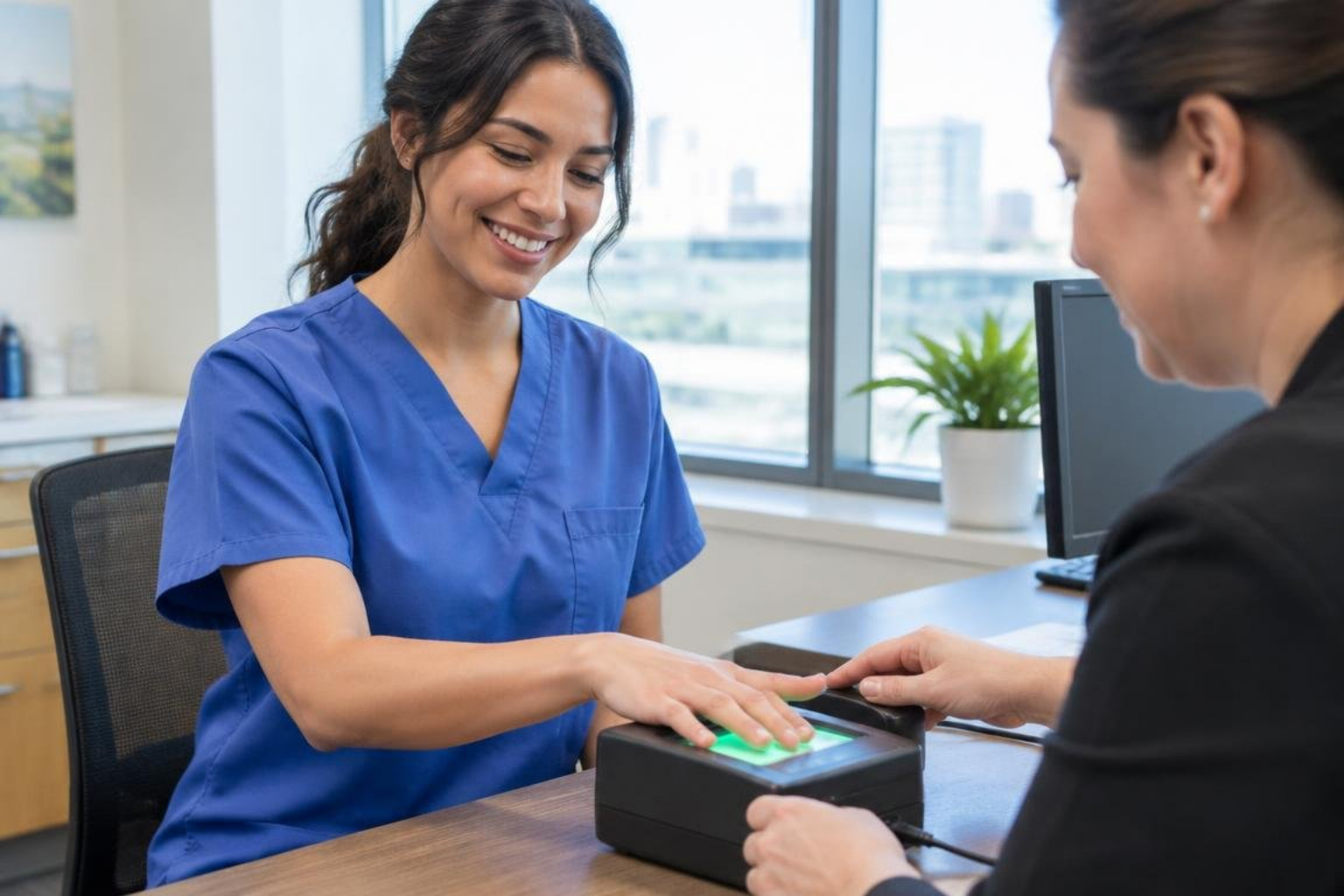
- [ ] Biometric LiveScan Fingerprinting: State repository and FBI Next Generation Identification (NGI) biometric query.
- [ ] Primary-Source License Verification: Confirmation of active licensure, multi-state compact privileges, and disciplinary history directly with state boards.
- [ ] Exclusion & Sanctions Checks: Monthly-matched checks across federal OIG LEIE, SAM.gov, and all state Medicaid exclusion registries.
- [ ] Comprehensive Multi-Panel Drug Screen: 10-panel or custom clinical drug panel testing for non-prescribed controlled substances.
- [ ] Education & Clinical Work History: Direct verification of nursing degrees from accredited institutions and past clinical tenures.
- [ ] FACIS Level 3 / Continuous Sanctions Monitoring: Ongoing monitoring against state disciplinary boards and federal debarment sources.

Mandatory Elements of Clinical Background Checks
A compliant clinical screening protocol combines identity verification, state and national criminal history checks, and professional credential validation:
- Biometric Fingerprint-Based Checks: Electronic LiveScan submissions capture biometrics to query state law enforcement repositories and the Federal Bureau of Investigation (FBI) database.
- State and County Criminal Records: Name-based and biometric searches identify felony and misdemeanor convictions, open indictments, and active warrants across jurisdictions where the candidate has lived or worked.
- Professional License Verification: Direct primary-source checks with state nursing boards confirm active licensure, expiration dates, disciplinary actions, public reprimands, and multi-state compact privileges.
- Education and Employment History: Verification of degrees from accredited nursing programs and validation of prior clinical tenures to confirm clinical competency and prevent credential fraud.
- Comprehensive Drug Screening: Multi-panel urine or saliva drug tests designed to identify non-prescribed controlled substances, standard illicit narcotics, and unauthorized pharmaceuticals.
The National Council of State Boards of Nursing publishes the NCSBN Criminal Background Check Guidelines to help boards and employers systematically evaluate criminal histories while ensuring patient safety.
Exclusions, Sanctions, and Mandatory Disqualifiers
Healthcare employers risk severe financial liability if they deploy clinical staff who are barred from participating in federally funded healthcare programs. Screening must cover the Office of Inspector General (OIG) List of Excluded Individuals and Entities (LEIE) and the System for Award Management (SAM). Employing excluded personnel exposes healthcare systems to civil monetary penalties starting at a statutory base of $10,000 per item or service, adjusted annually for inflation.
Federal databases alone do not capture every state-level disciplinary action. To eliminate compliance blind spots, organizations must check state Medicaid exclusion lists alongside broader sanctions databases like the Fraud and Abuse Control Information System (FACIS) Level 3.
Automatic statutory disqualifiers generally include:
- Convictions for physical abuse, neglect, or financial exploitation of vulnerable populations (e.g., pediatric, geriatric, or disabled patients).
- Direct felony convictions related to the unlawful manufacture, distribution, or dispensing of controlled substances.
- Prior healthcare fraud, grand larceny, or intentional billing falsification.
- Registered sex offenses.
- Active exclusions or license revocations by a state licensing authority.
State-by-State Nurse Background Check Requirements for Licensing Boards
State boards of nursing maintain distinct statutory frameworks governing biometric capture, credentialing validation periods, and fingerprint retention rules. Navigating these requirements requires operational awareness of state-specific administrative procedures outlined in comprehensive healthcare background checks and compliance standards.
| State | Primary Screening Authority / Mechanism | Validity Window | Retention / Registry Rules | Key Licensing Distinctions |
|---|---|---|---|---|
| Maryland | CJIS Central Repository + FBI Fingerprint Card | Initial / Renewal if lapsed >12 mos | Board reviews criminal history via pre-licensure committee | 90-day temporary practice certificates available; NLC compact exempt |
| Florida | AHCA Care Provider Clearinghouse via LiveScan | 90 days post-expiration | Fingerprints retained with renewal window 75–15 days prior | Photo capture required at LiveScan; specific profession ORI codes |
| Delaware | Background Check Center (BCC) | Master List active status | continuous state-level Rap Back; 3-year Master List archive | Centralized system for nursing facilities; requires signed consent |
| Oklahoma | OSBI + FBI Criminal History | Max 90 days old at decision | FBI Rap Back continuous enrollment exempts re-prints | National check required for all licenses under Title 59 § 567.18 |
| Kentucky | KARES Portal (NBCP) + State Police / FBI | Max 5-year retention cycle | Fingerprints retained minimum 5 years; continuous assessment | 60-day provisional employment window with direct supervision |
| Arkansas | Arkansas GovPay + LiveScan / Mail-in Card | Valid within 12 months | Direct FBI search required; non-refundable state fee | In-state residents use LiveScan; out-of-state mail fingerprint cards |
State Board Nurse Background Check Requirements for Initial Licensure
In Maryland , initial applicants for RN, LPN, and CNA credentials must submit state and federal fingerprint-based checks through the Criminal Justice Information System (CJIS) as detailed in the Maryland CHRC Licensure Requirements. Private third-party background screenings cannot substitute for a CJIS submission. Electronic submissions at authorized state facilities return results in roughly one to two weeks, whereas manual ink-and-roll submissions take up to six weeks.
In Florida , initial candidates must register through the Agency for Health Care Administration (AHCA) Care Provider Background Screening Clearinghouse. Candidates must use an approved LiveScan service provider that simultaneously captures biometric fingerprints and a digital photograph. LiveScan transmissions route using statutory Originating Agency Identifier (ORI) codes specific to the nursing credential (e.g., APRN, RN, or LPN).
In Delaware , healthcare staffing operations must navigate the centralized Background Check Center governed by Delaware Regulations Title 16 Section 3105. Facilities must ensure all personnel providing direct care in licensed nursing facilities execute mandatory BCC consent forms, submit fingerprints, and log into the Master List before unmonitored patient contact.

Regional Mandates: Oklahoma, Kentucky, and Arkansas
Specific statutory requirements apply across regional boards:
- Oklahoma: Under Oklahoma Statutes Title 59 Section 567.18, criminal background checks must be no older than 90 days at the time the board issues its licensure decision. Oklahoma mandates fingerprint-based background checks for RN, LPN, APRN, and Advanced Unlicensed Assistant applicants. Continuous enrollment in the FBI Rap Back Service exempts candidates from repeat submissions upon multistate renewal.
- Kentucky: The Commonwealth operates the Kentucky National Background Check Program (NBCP) through the KARES online portal under Kentucky National Background Check Program Regulations. Direct-patient-access providers may leverage a 60-day provisional employment window, provided the candidate is supervised while state police and FBI reviews are finalized.
- Arkansas: First-time applicants must complete a national FBI background check paid via the Arkansas GovPay platform. Arkansas residents complete electronic LiveScan appointments, whereas out-of-state endorsement candidates must mail pre-stamped ink fingerprint cards directly to the board. Background checks remain valid for licensing purposes for 12 months.
Operationalizing Board Workflows: Fingerprints, Retention, and Compacts
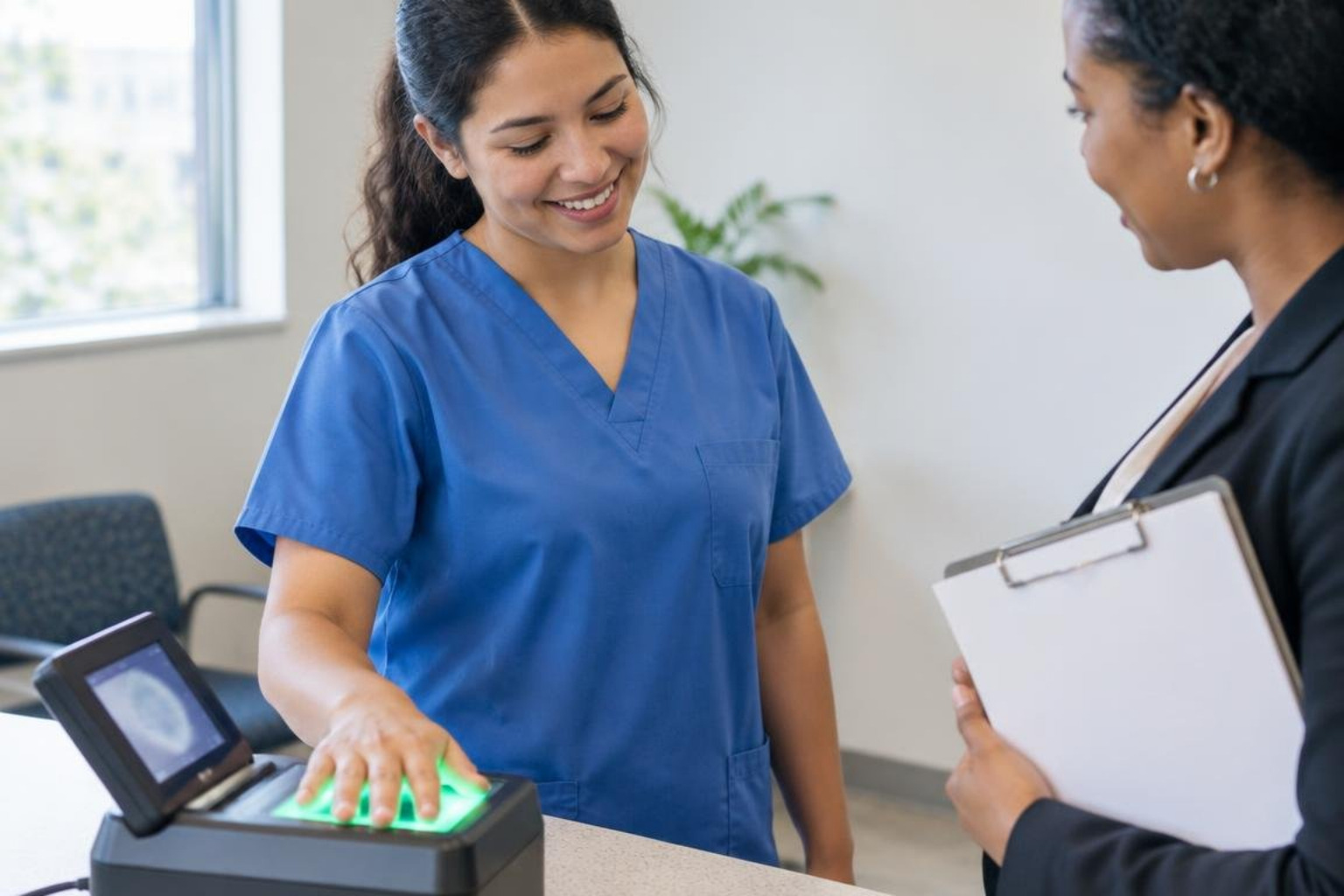
Hiring clinical staff without operational delays requires talent acquisition teams to coordinate background check submissions, fingerprint logistics, and board verifications. Managing these steps concurrently addresses the growing urgency to staff hospitals correctly.
Stage-by-Stage Hiring Breakdown
- Pre-Screening & Conditional Offer: Collect candidate details, issue standalone FCRA disclosure documents, and secure electronic signature authorization.
- Biometric & Credential Collection: Order LiveScan biometric scheduling, dispatch state ORI codes, and initiate primary-source license verifications simultaneously.
- Sanctions & Criminal Search: Run county, state, and federal criminal searches alongside OIG LEIE, SAM.gov, and state Medicaid exclusion lists.
- Board Adjudication & TCN Matching: Track the Transaction Control Number (TCN) to verify that law enforcement results route to the nursing board for licensing clearance.
- Post-Offer Credentialing & Deployment: Complete drug screening, verify health immunization records, review final board approval, and activate continuous monitoring upon hire.
FCRA Adverse Action Workflow
When a consumer report contains potentially disqualifying records that may impact employment, clinical employers must execute a strict two-step FCRA process:
- Step 1: Pre-Adverse Action Notice: Provide the candidate with a written Pre-Adverse Action notice, an exact copy of the background report, and a copy of "A Summary of Your Rights Under the Fair Credit Reporting Act." Allow a reasonable waiting period (typically 5 business days) for the applicant to review the report and dispute inaccurate or incomplete records.
- Step 2: Final Adverse Action Notice: If the candidate does not dispute the findings or cannot resolve the disqualifying issue, issue a written Final Adverse Action notice stating the decision, the Consumer Reporting Agency's (CRA) contact details, and notice of the candidate's right to obtain an additional free report within 60 days.
Common Mistakes in Nurse Background Checks
- Conflating Board Clearance with Employer Due Diligence: Assuming a valid nursing license eliminates the need for independent OIG/SAM sanctions, drug screens, and county criminal searches.
- Failing to Track LiveScan TCN Numbers: Losing transaction reference numbers, leading to unmatched state repository records and prolonged onboarding delays.
- Ignoring State Medicaid Registries: Searching only federal OIG LEIE and missing non-reimbursed state-level exclusions.
- Manual Re-Screening Gaps: Relying on periodic annual reviews instead of automated continuous arrest and sanctions monitoring.
Good vs. Bad Clinical Screening Practices
| Assessment Area | Poor Compliance Practice (Bad) | Compliant High-Speed Practice (Good) |
|---|---|---|
| Disclosures & Consents | Bundling FCRA authorization inside general job application forms. | Providing a clear, standalone FCRA disclosure and electronic signature authorization. |
| License Verification | Accepting a scanned physical license copy from the candidate. | Direct API or automated primary-source verification with state licensing boards. |
| Exclusion Screening | Performing a single federal OIG search at hire and never re-checking. | Comprehensive OIG/SAM + state Medicaid screening with ongoing monthly automated alerts. |
| Biometric Tracking | Relying on candidates to follow up with local law enforcement repositories. | Integrated electronic LiveScan ordering with automated TCN status tracking. |
LiveScan Processing, Tracking Numbers, and Board Adjudication
When a nurse completes an electronic biometric appointment, the LiveScan system generates a Transaction Control Number (TCN) or confirmation receipt (such as a Fieldprint code). Candidates and onboarding coordinators must preserve this tracking number. State boards rely on TCN identifiers to match law enforcement background results with open licensing applications.
If a biometric sample is rejected due to low ridge detail or smudging:
- The applicant receives a formal rejection notice from the state repository or CJIS.
- The nurse must reschedule a secondary fingerprint capture using the original transaction reference.
- If fingerprints are rejected twice for biometric illegibility, state boards typically initiate a manual, name-based state and FBI record search.
When a background check reveals a positive criminal record, state boards route the file to a pre-licensure or administrative review committee. Nursing boards evaluate candidate files using structured criteria:
- Minor Offense Exclusion Lists: Non-violent summary infractions, minor traffic citations, or isolated municipal ordinance violations unrelated to clinical duties are often expedited without full committee hearings.
- Relevance and Nexus to Nursing: Offenses involving assault, theft of narcotics, falsification of records, or patient endangerment trigger formal review.
- Time Elapsed and Evidence of Rehabilitation: Boards evaluate the time elapsed since the conviction, fulfillment of court mandates, letters of clinical reference, and formal personal statements.
- Forensic Evaluations: In cases involving substance use disorders or severe behavioral infractions, boards may mandate a standardized risk assessment by an approved forensic psychologist before granting licensure.
Renewal Retention Windows, Lapsed Licenses, and Compact Rules
Maintaining valid clinical credentials requires managing retention windows and renewal cycles:
- Florida Retention Cycles: Florida mandates that practitioners retain their fingerprints in the AHCA Clearinghouse. The retention window opens 75 days before license expiration and closes 15 days prior. If a nurse misses this window and fingerprints expire, the practitioner must complete a new LiveScan screening. Renewal screenings must be finalized within 90 days post-expiration.
- Maryland Temporary Practice Certificates: To prevent operational bottlenecks, Maryland provides a 90-day temporary practice certificate for endorsement applicants once the board confirms receipt of their fingerprint tracking card. If a Maryland nursing license lapses for more than 12 months, the nurse must complete a fresh Criminal History Record Check.
- Nurse Licensure Compact (NLC) Privileges: The NLC allows registered nurses and practical nurses to hold one multistate license issued by their primary state of residence, authorizing practice across more than 40 participating compact states. Nurses practicing in a compact state under multistate privileges are exempt from undergoing separate, redundant criminal background checks in each secondary state. However, if a nurse permanently relocates and changes their primary state of residence, they must apply for licensure by endorsement and satisfy the new home state's biometric background check requirements.
Continuous Monitoring vs. Point-in-Time Compliance for Health Systems
Traditional pre-employment background checks provide a single snapshot in time, leaving significant operational and legal gaps when clinicians incur disciplinary actions or criminal charges post-hire. Transitioning to automated continuous monitoring eliminates these blind spots by providing ongoing oversight across criminal records, state licensing boards, and federal exclusion sources. To implement a continuous compliance strategy, consult our detailed guide on healthcare sanctions monitoring.
Point-in-time screening models leave major operational gaps:
- Delayed Discovery of Disciplinary Actions: State licensing boards can take months to process interstate reporting. Without real-time alerting, an employer may unknowingly schedule a nurse whose license has been suspended or restricted in an adjacent state.
- Immediate Financial Exposure: Federal healthcare programs prohibit payments to entities employing individuals excluded by the OIG or SAM. Civil monetary penalties starting at a statutory base of $10,000 per item or service, adjusted annually for inflation, accrue for items or services billed during the exclusion period.
- Continuous Biometric Arrest Alerts: Modern compliance workflows leverage the FBI Rap Back service and automated state data feeds to notify compliance officers immediately when an active clinician is arrested or convicted of a disqualifying offense.
Clinical Screening Platform Comparison
Evaluating background check and compliance providers requires comparing screening turnaround, automation, credentialing management, and monitoring capabilities:
| Feature / Capability | Vetty | Sterling | Checkr | HireRight |
|---|---|---|---|---|
| Platform Architecture | Unified all-in-one screening, onboarding & compliance | Healthcare & enterprise screening modules | API-first background screening | Enterprise background screening |
| Screening Suite | VettyVerify, VettyOnboard, VettyComply | Dedicated healthcare screening packages | Checkr Health & standard checks | Enterprise screening solutions |
| Continuous Sanctions & License Monitoring | Automated real-time OIG/SAM & state monitoring | Continuous monitoring add-ons | Continuous monitoring modules | Periodic / continuous re-check options |
| Mobile-Friendly Candidate Workflow | Fully mobile-friendly digital document submission | Mobile candidate portal | Mobile candidate dashboard | Mobile-optimized candidate applicant flow |
| Workflow Setup & Customization | Self-serve setup with no-code workflow customization | Account manager-configured workflows | Developer API & dashboard configuration | Custom enterprise implementation |
| Compliance Certifications | PBSA Accredited, SOC 2 Type 2 Certified | PBSA Accredited, SOC 2 Certified | PBSA Accredited, SOC 2 Certified | PBSA Accredited, SOC 2 Certified |
Frequently Asked Questions About Nursing Background Screenings
What causes a nurse to fail a board background check?
A nurse may fail a board background check if the screening uncovers disqualifying offenses such as felony convictions for violence, patient abuse, sexual misconduct, or drug diversion. Active exclusions on the OIG/SAM lists, unfulfilled court probations, suspended licenses in other jurisdictions, or intentional failure to disclose criminal history on the initial application will also trigger a denial.
Do Nurse Licensure Compact (NLC) multistate licenses require repeat background checks in every state?
No. Under the Nurse Licensure Compact, a nurse who holds an active multistate license is vetted by their declared primary state of residence. They can practice in any participating compact state without completing secondary background checks or paying separate licensing fees in those member states. A new background check is only required if the nurse legally changes their primary residence to a new state.
How long are criminal history checks valid during the clinical hiring process?
Validity windows vary by state statute and institutional policy. States like Oklahoma require criminal background checks to be no older than 90 days at the time of the board's licensing decision. Arkansas considers checks valid for 12 months. For employers, background checks are typically considered valid for onboarding if completed within 30 to 90 days before the hire date, after which continuous monitoring systems maintain ongoing compliance.
Conclusion
Navigating the web of state board nurse background check requirements demands precision, speed, and continuous oversight. For talent acquisition and clinical operations leaders, managing fingerprint deadlines, ORI routing codes, and exclusion tracking manually creates hiring bottlenecks and increases regulatory risk.
Vetty accelerates clinical hiring by unifying background screening, document collection, and continuous compliance into a single platform. Using VettyVerify™, clinical recruitment teams deploy fast, compliant background screens. VettyOnboard™ manages digital license verifications, I-9 workflows, and custom clinical onboarding steps, while VettyComply™ delivers real-time monitoring across criminal registries, state exclusion lists, and federal OIG/SAM databases.
Our mobile-friendly, PBSA-accredited, and SOC 2 Type 2 certified platform offers transparent pricing, real-time tracking, and no-code workflow customization to keep your clinical units fully staffed and compliant.
Connect with our team to discover how our automated healthcare background screening solutions can streamline your clinical onboarding.
To schedule a platform demo and accelerate your clinical hiring, visit Vetty's onboarding portal to get started.