

How to Screen Remote Healthcare Workers Without Missing Compliance Steps

Telehealth expansion and distributed clinical teams allow healthcare organizations to source specialized talent nationwide, but remote workflows introduce multi-jurisdictional compliance complexities. Managing cross-state licensing, federal and state exclusion checks, Form I-9 verification, and HIPAA home-office security requires an integrated, structured approach.
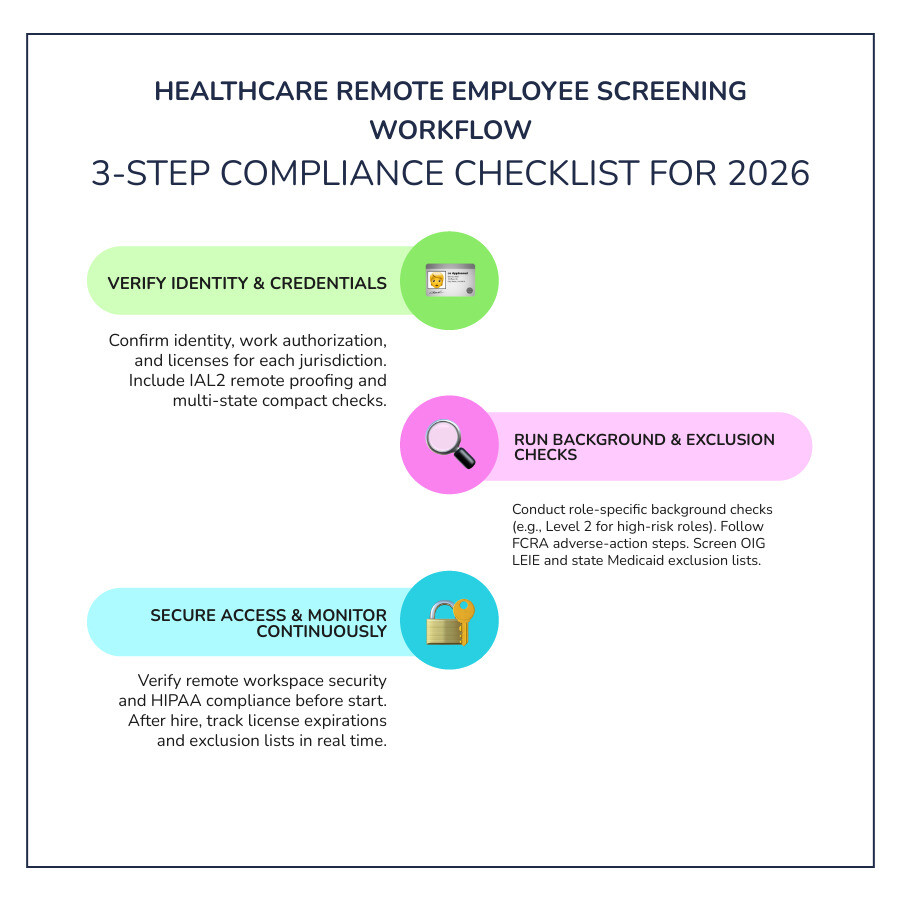
In 2026, healthcare remote employee screening starts with a role- and location-based Compliance Checklist:
- Verify identity, work authorization, licenses, and credentials for every place the worker will serve patients.
- Run job-relevant background and exclusion checks. If you use a consumer report, follow the Fair Credit Reporting Act's disclosure, authorization, and adverse-action steps.
- Check remote access safeguards before work begins, then track license expirations and exclusions after hire.
Keep employee hiring checks separate from CMS and state provider-enrollment screening. Those rules apply to enrolled providers and may require additional checks based on the provider's risk level. Remote work does not remove either obligation.
VettyVerify,™ VettyOnboard™, and VettyComply™ are part of Vetty's mobile-friendly, all-in-one hiring acceleration and screening platform, with self-serve setup, no-code customization, transparent pricing, real-time visibility, and PBSA and SOC 2 certifications. The Vetty Team will walk through how to turn these requirements into a workable process for distributed healthcare teams.
For a deeper look at the underlying requirements, see modern healthcare background check requirements and best practices in 2026 and level 2 background check requirements for healthcare workers explained.
Regulatory Framework and Core Principles of Healthcare Remote Employee Screening

Managing remote clinical operations requires balancing patient safety, regulatory compliance, and hiring velocity. To design a defensible program, you need a firm grasp of foundational screening principles.
In clinical epidemiology, screening refers to evaluating an asymptomatic population to detect unrecognized conditions or risk factors early, whereas diagnostic testing is performed on individuals already exhibiting symptoms. When applied to talent acquisition, background vetting functions as population-level screening. You are proactively assessing your candidate pool to identify hidden risks before granting access to patients, sensitive health data, or prescribing systems.
Classic public health principles—specifically the Wilson and Jungner criteria established by the World Health Organization—state that any screening program must evaluate an important problem, provide an accepted intervention, utilize a valid and reliable testing mechanism, and maintain an acceptable cost-to-benefit ratio. Translating these principles to workforce management:
- Target Meaningful Risk : Focus vetting protocols on vulnerabilities that directly impact patient outcomes, data privacy, and legal compliance.
- Actionable Outcomes : Ensure every check has clear adjudication criteria rather than collecting extraneous data that creates legal liability.
- Valid and Reliable Tools : Deploy verified primary-source integrations to prevent false positives and missed records.
- Economic and Operational Efficiency : Streamline verifications to prevent hiring bottlenecks that stall clinical staffing.
In workforce design, organizations choose between universal screening (applying the exact same checks to every individual) and targeted, risk-based screening (tailoring checks to role responsibilities and exposure levels). While baseline identity verification and national criminal checks should be universal, specialized verifications—such as state-level exclusion lists or clinical skills assessments—must be targeted based on jurisdictional practice scope and direct patient contact. For broader strategies on managing distributed personnel, consult the definitive guide to remote worker screening.

CMS Risk Tiers and State-Mandated Provider Validation
The Centers for Medicare & Medicaid Services (CMS) categorizes healthcare providers into three distinct risk tiers: Limited , Moderate , and High . These classifications dictate provider enrollment vetting and ongoing validation schedules under federal and state programs (such as Minnesota Health Care Programs, or MHCP).
- Limited Risk : Includes physicians, nurse practitioners, medical groups, and hospitals. Screening focuses on license verification, federal exclusion list checks, and standard business documentation. Revalidation occurs every five years.
- Moderate Risk : Encompasses physical therapists, ambulance service providers, and diagnostic testing facilities. In addition to limited-risk checks, screening involves unannounced site visits and pre-enrollment operational verifications. Revalidation occurs every five years.
- High Risk : Includes newly enrolling durable medical equipment (DME) suppliers, home health agencies, and providers with previous adverse sanctions or elevated fraud vulnerabilities. Screening requires mandatory state and federal criminal history checks based on fingerprints, unannounced site visits, and revalidation every three years.
For high-risk remote providers and clinical staff serving vulnerable populations, understanding level 2 background check requirements is critical for maintaining state compliance. Effective January 1, 2026, the institutional provider application fee is $750 per practice location. When state Medicaid agencies or CMS issue revalidation notices, providers have a strict 30-day window to upload all required documentation. Missing this deadline can lead to immediate billing suspensions and enrollment termination.
Multi-Jurisdictional Licensing and Digital Identity Verification
Telehealth clinicians routinely deliver virtual care across state lines. Delivering care into another jurisdiction generally requires an active, unrestricted license in the state where the patient is physically located at the time of the encounter.
Compact systems streamline this process:
- Interstate Medical Licensure Compact (IMLC) : Accelerates multi-state licensing for qualified physicians across participating member states.
- Nurse Licensure Compact (NLC) : Enables registered nurses (RNs) and licensed practical nurses (LPNs) to practice in over 40 participating states under a single multistate license.
Even with compact licensure, you must verify credentials across all jurisdictions where clinicians deliver care. Establishing direct primary-source verification workflows ensures multi-state licenses are validated with official state licensing boards prior to virtual patient encounters.
Identity validation is the cornerstone of remote vetting. Standard document uploads leave organizations exposed to synthetic identity fraud. Implementing National Institute of Standards and Technology (NIST) Identity Assurance Level 2 (IAL2) standards provides high-confidence remote proofing through biometric facial matching and cryptographic verification of government-issued IDs.
For employment eligibility, Immigration and Customs Enforcement (ICE) updated its inspection guidance in March 2026, enforcing strict digital audit trail requirements for remote Form I-9 verification. Employers must either utilize an authorized representative workflow or deploy compliant electronic verification systems connected to E-Verify to satisfy Section 2 requirements.
Essential Protocols for Healthcare Remote Employee Screening
A compliant screening protocol balances legal protections under the Fair Credit Reporting Act (FCRA) with clinical credentialing requirements. Under the FCRA, employers must provide a standalone written disclosure and obtain explicit candidate authorization before procuring a consumer report. If adverse information is uncovered, you must execute the mandatory two-step pre-adverse and final adverse action process, providing the candidate a copy of the report, a summary of their rights, and a reasonable window to dispute inaccuracies.
To avoid hiring bottlenecks, run multi-state license checks, criminal record searches, and exclusion checks in parallel rather than sequentially, following modern healthcare background check requirements and best practices.
| Screening Component | Remote Clinical Providers (MD, NP, RN) | Telehealth Allied Health (Therapy, Dietetics) | Remote Administrative & Billing Staff |
|---|---|---|---|
| Identity Verification | IAL2 Digital Proofing | IAL2 Digital Proofing | Standard Digital Identity Check |
| Form I-9 / E-Verify | Authorized Representative / Digital | Authorized Representative / Digital | Authorized Representative / Digital |
| Criminal Background | Multi-County, State & Federal | Multi-County, State & Federal | Multi-County & Federal |
| Sanctions & Exclusions | OIG LEIE, SAM.gov, All State Lists | OIG LEIE, SAM.gov, State Lists | OIG LEIE, SAM.gov, State Lists |
| License Verification | Primary Source (All Practice States) | Primary Source (All Practice States) | Not Applicable |
| Drug Screening | Rapid Oral Fluid (10+ Panel) | Rapid Oral Fluid (5 to 10-Panel) | Role-Based / Policy-Dependent |
| Workspace & HIPAA | Virtual Security Audit & VPN Check | Virtual Security Audit & VPN Check | Device Endpoint & Network Audit |
Designing a Multi-State Healthcare Remote Employee Screening Workflow
Building a scalable workflow requires automating data collection while maintaining compliance across multiple state jurisdictions. Structuring standardized intake pipelines allows talent acquisition teams to run parallel checks that accelerate candidate onboarding.
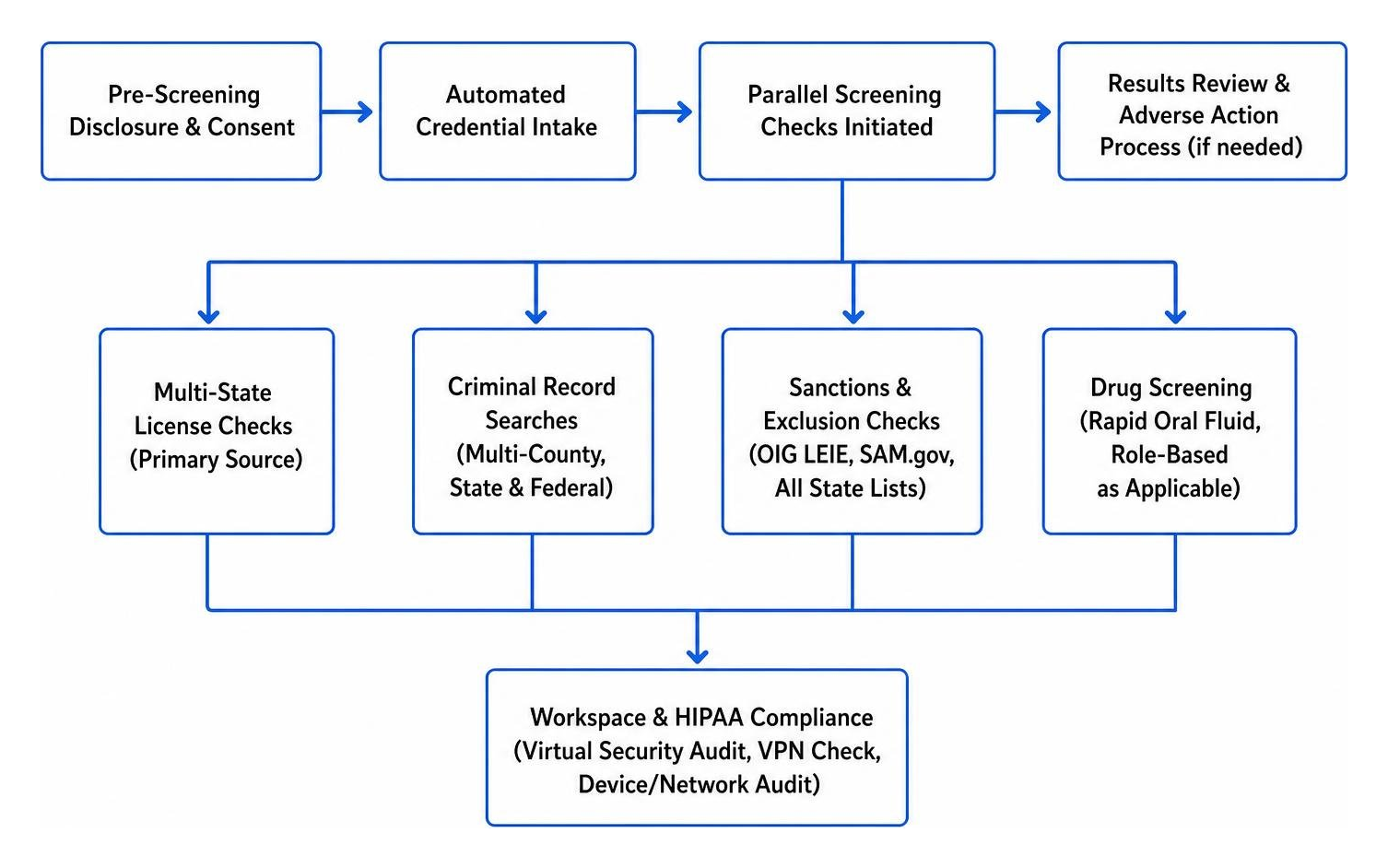
To build an efficient pipeline, structure your screening process around core compliance pillars:
- Pre-Screening Disclosure & Consent : Distribute digital FCRA disclosures and state-specific notices through a secure candidate portal.
- Automated Credential Intake : Collect provider National Provider Identifiers (NPIs), Drug Enforcement Administration (DEA) registrations, and state license numbers via standardized intake templates.
- Primary-Source Verification : Query state licensing databases directly to confirm active status, renewal dates, and public disciplinary actions. For comprehensive steps, see the guide to remote worker hiring compliance.
- Adjudication Matrix : Apply a consistent scoring rubric to evaluate criminal records and license flags, eliminating subjective hiring decisions across remote teams.
Occupational Health, Workspace Security, and Drug Screening
Remote healthcare roles that involve managing patient records, prescribing medications, or triage require specialized occupational and environment checks.
- Oral Fluid Drug Testing : Traditional urine collection requires candidates to travel to brick-and-mortar clinics, introducing scheduling delays. Instant oral fluid testing utilizes observed saliva collection kits delivered directly to the candidate's home. These tests provide 5-panel to 16-panel configurations with rapid turnaround times, minimizing hiring friction while detecting recent substance use.
- HIPAA Home-Office Security Audits : Remote staff handling Protected Health Information (PHI) must maintain a secure physical environment. Conduct structured workspace assessments to verify private rooms with locking doors, sound-masking capabilities for telehealth consults, clean-desk environments free of exposed documents, and secure dual-monitor setups angled away from windows or family members.
- Technical Endpoint Controls : Enforce company-managed virtual private networks (VPNs), full-disk encryption, automated screen timeouts, and biometric or multi-factor authentication (MFA) protocols to safeguard patient data.
- Ergonomic Safety Standards : Remote workers remain covered under workers' compensation laws. Providing ergonomic assessments and workspace checklists helps mitigate repetitive strain injuries and associated liability claims.
Eliminating Gaps: Continuous Sanctions Monitoring vs Point-in-Time Checks
Conducting exclusion checks solely at the time of hire leaves substantial compliance gaps during the remaining 364 days of the year. If an employee faces license revocation, criminal indictment, or federal program exclusion months after onboarding, annual point-in-time checks will leave your organization unaware of the violation.
Federal regulations prohibit healthcare organizations from receiving reimbursement for items or services furnished, ordered, or prescribed by excluded individuals. The Department of Health and Human Services (HHS) Office of Inspector General (OIG) enforces civil monetary penalties starting at a statutory base of $10,000 per item or service, adjusted annually for inflation, alongside mandatory overpayment refunds and potential exclusion of the employer from Medicare and Medicaid.
To prevent non-compliance, implement continuous, automated monitoring across the HHS OIG List of Excluded Individuals and Entities (LEIE), the System for Award Management (SAM.gov), and all individual state Medicaid exclusion registries. For comprehensive implementation strategies, see our breakdown of healthcare sanctions monitoring for HR, or follow our recommendations to establish effective telehealth Medicaid exclusion screening workflows.
Quality Assurance, Risk Mitigation, and Program Evaluation
Evaluating a remote workforce screening program requires measuring both candidate quality and operational efficiency. Just as clinical diagnostic tools must account for statistical biases, talent operations must eliminate systemic friction in workforce vetting.
When interpreting screening data, understand key analytical dynamics:
- Selection Bias : Remote applicant pools may self-select based on digital fluency or geographic factors, requiring standardized assessment tools to ensure equitable hiring.
- Lead-Time and Length-Time Biases : Early identification of compliance risks must result in actionable operational resolutions rather than generating administrative overhead.
- Healthy Screening Effect : Candidates who navigate screening workflows fastest often represent the most technologically prepared segment of your applicant pool, reinforcing the need for intuitive, mobile-friendly onboarding tools.
To safeguard candidate information, manage background checks and credentialing files through platforms certified under SOC 2 Type 2 and fully aligned with HIPAA security rules. For educational checks, verify degrees through the National Student Clearinghouse or accredited registrars by following the guide to remote worker education verification.
Key Compliance Metrics in Healthcare Remote Employee Screening
Track these operational metrics to ensure your remote screening workflow remains efficient and audit-ready:
- Turnaround Time (TAT) : Measure the average days required to complete identity proofing, multi-state primary-source licensing, and background checks across clinical and administrative cohorts.
- Adjudication Consistency Rate : Monitor the proportion of reports cleared through automated scoring rubrics versus those requiring manual compliance reviews.
- Monthly Continuous Monitoring Coverage : Maintain 100% active roster screening against federal OIG LEIE, SAM.gov, and all state Medicaid exclusion registries.
- Form I-9 Compliance Rate : Ensure Section 2 verifications are fully completed and audit-ready within the statutory three-business-day window.
Frequently Asked Questions About Remote Healthcare Screening
How long do remote healthcare worker background checks take to complete?
Standard criminal background checks and identity verifications typically take 1 to 3 business days. However, comprehensive healthcare screening—incorporating multi-state primary-source license verifications, DEA checks, and board certifications—often requires 3 to 7 business days. Deploying parallel verification pipelines prevents slow state licensing boards from delaying the entire screening package.
What are the federal penalties for employing an excluded remote healthcare worker?
Employing or contracting with an excluded individual who provides services billed to federal healthcare programs exposes organizations to severe penalties. The HHS OIG imposes civil monetary penalties starting at a statutory base of $10,000 per item or service, adjusted annually for inflation. Additionally, organizations face mandatory repayment of all claims associated with the excluded individual, trebled damages under the False Claims Act, and the potential revocation of their own Medicare/Medicaid billing privileges.
How does remote Form I-9 verification work for distributed clinical teams?
Under federal regulations and March 2026 ICE guidelines, employers onboarding remote staff must verify Section 2 documents without requiring the employee to travel to a centralized corporate office. Employers can designate an authorized representative (such as a remote notary, trusted agent, or vetted third-party verifier) to physically examine identity and employment authorization documents in the worker's physical presence. Alternatively, employers enrolled in E-Verify who utilize certified digital onboarding platforms can process verifications through compliant electronic Form I-9 workflows.
Conclusion
Building a compliant remote healthcare workforce requires a centralized screening infrastructure that eliminates manual handoffs, enforces multi-state compliance, and safeguards patient care. By combining automated primary-source credential verification, IAL2-compliant identity proofing, and continuous post-hire sanctions monitoring, healthcare organizations can scale virtual clinical teams without sacrificing security or operational speed.
At Vetty, we provide an all-in-one hiring acceleration and screening platform engineered for the complexities of modern healthcare staffing. With VettyVerify™ for rapid, compliant background checks, VettyOnboard™ for automated document collection and electronic I-9 workflows, and VettyComply™ for continuous monitoring against OIG, SAM, and state exclusion lists, you can manage your distributed workforce from a single intuitive dashboard.
Explore how Vetty's healthcare solutions platform simplifies compliance across your remote clinical and administrative operations. Visit our platform setup page to start building your automated screening workflow today.