

Background Checks for Teachers: What Schools Need to Verify

In 2026, background checks for teachers are mandatory under state law, but specific verification requirements vary across states, districts, and job roles. School administrators and talent acquisition teams maintain a strict duty of care to protect students, requiring thorough verification before any educator enters the classroom.
Educator Screening Compliance Checklist
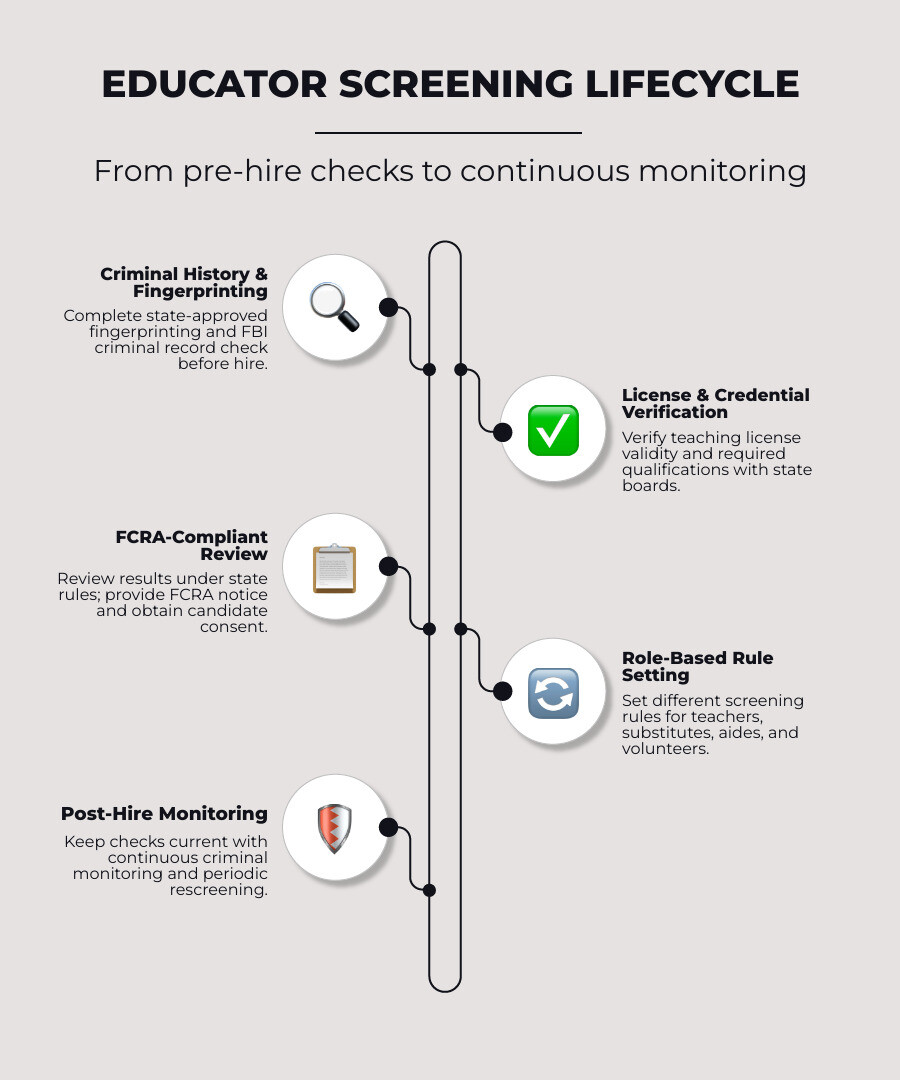
Before extending an unconditional offer or placing a teacher in a classroom, your hiring team must complete:
- State-approved digital fingerprinting and biometric criminal history checks (FBI and state repositories).
- County, state, and federal criminal court record evaluations alongside the National Sex Offender Public Website (NSOPW).
- Direct verification of teaching licenses, endorsements, and academic degrees with primary sources.
- Multi-state disciplinary registry checks (including NASDTEC clearinghouses and state Do-Not-Hire lists).
- Mandatory state pre-employment misconduct affidavits.
- Compliant Fair Credit Reporting Act (FCRA) disclosure, authorization, and adverse action workflows.
Stage-by-Stage Hiring Breakdown
- Application & Pre-Screening : Secure signed standalone FCRA disclosures, state-mandated misconduct affidavits, and identity documentation.
- Biometric Collection : Direct candidates to live-scan digital fingerprinting appointments for state and federal repository matching.
- Multi-Jurisdictional Screening : Order county, state, and federal criminal checks, sex offender searches, and primary-source credential verifications.
- Adjudication & Individualized Assessment : Evaluate findings in accordance with state education codes and EEOC Title VII criteria before issuing final clearance.
VettyVerify™, VettyOnboard™, and VettyComply™ are part of Vetty's mobile-friendly, all-in-one hiring and screening platform, with self-serve setup, transparent pricing, real-time visibility, and no-code customization; Vetty is PBSA-accredited and SOC 2-certified.
If your district also hires athletic staff or transportation personnel, review the specific coach background check requirements and school bus driver background check guidance before extending an offer.
Compliance Standards for Background Checks for Teachers
Educational institutions hold a non-negotiable duty of care toward their students, staff, and communities. Conducting compliant background checks helps school leaders fulfill this obligation while managing organizational risk. Navigating state education board mandates alongside federal hiring guidelines requires a clear approach to personnel management. For school administrators seeking a broad look at staffing workflows, our comprehensive school employee screening guide outlines baseline protocols across public and private learning institutions.
Every state enforces criminal history checks for K-12 certified educators, and 38 states mandate background checks for other school personnel who work directly and unsupervised with children. To prevent hiring liabilities while maintaining hiring speed, talent acquisition teams must align daily practices with federal, state, and local standards.
Federal Regulations: FCRA, EEOC, and Fair Chance Hiring
When partnering with a consumer reporting agency (CRA) to screen educators, federal law establishes mandatory procedural safeguards. Under the Fair Credit Reporting Act (FCRA), school employers must:
- Provide a clear, standalone written disclosure informing the candidate that a background check will be conducted.
- Obtain explicit written consent before ordering any consumer report.
- Adhere to the statutory seven-year reporting restriction on non-conviction arrest records and civil judgments when candidates fall below specific statutory salary thresholds.
Simultaneously, the Equal Employment Opportunity Commission (EEOC) enforces Title VII protections requiring individualized assessments before making employment decisions based on criminal records. Automated, blanket disqualifications for non-statutory offenses can result in legal risk. Hiring teams should assess the nature and gravity of the offense, the time elapsed since conviction or sentence completion, and the direct relevance of the conduct to classroom duties.
Furthermore, state and municipal "Ban the Box" and fair chance hiring laws govern when employers can inquire about criminal history during the interview process, ensuring candidates are evaluated on their qualifications prior to background evaluation.
State Fingerprinting Mandates for Background Checks for Teachers

Fingerprint-based criminal checks form the bedrock of state educator licensing. Unlike simple name-based checks, digital fingerprinting matches biometric data against state law enforcement repositories and FBI Identification Records, eliminating identity confusion caused by common names or aliases.
Fingerprint rules and transmission channels vary significantly across state lines:
- Texas : Under Texas Education Code Chapter 22, certified educators, substitutes, and non-certified staff hired after January 1, 2008, must submit digital fingerprints. Following the official Texas Education Agency fingerprinting process, candidates register through the state's Educator Certification Online System (ECOS) and complete live-scan appointments through authorized state vendors.
- Oregon : The Oregon Teacher Standards and Practices Commission requirements mandate fingerprint clearances for all license, endorsement, and student-teaching candidates using state-specific digital vendor codes.
- Massachusetts : Under state statute H. 4307 and regulation 603 CMR 51.00, public school districts follow strict Massachusetts suitability regulations for school districts, requiring state and national fingerprint checks alongside Criminal Offender Record Information (CORI) verifications before finalizing employment offers.
Fingerprint records are typically non-transferable across state agencies. A clearance obtained for healthcare licensing or real estate cannot legally satisfy state educator licensing mandates.
Pre-Employment Affidavits and Do-Not-Hire Registries
In addition to law enforcement databases, school districts must consult education-specific disciplinary registries to prevent individuals with misconduct histories from moving between districts undetected.
Under the TEA personnel and hiring guidance, Texas school districts require all applicants to execute pre-employment affidavits disclosing any prior investigations, license revocations, or allegations involving student misconduct. Failing to disclose required disciplinary or criminal history on this statutory affidavit carries severe legal consequences, classified as a Class B misdemeanor under state law.
Districts also verify candidates against state Do Not Hire registries and national disciplinary clearinghouses managed by the National Association of State Directors of Teacher Education and Certification (NASDTEC) to ensure credentials remain in good standing across all jurisdictions.
Core Components and Disqualifications in Educator Screening
Designing an educator screening workflow requires multi-layered verification. To understand why relying solely on county court checks creates critical coverage gaps, reviewing why education staffing criminal background checks matter highlights the necessity of multi-jurisdictional searches.
Good vs. Bad Educator Screening Practices
| Screening Area | Good Practice | Bad Practice |
|---|---|---|
| Criminal Verification | Pairing biometric FBI fingerprinting with multi-county and federal searches | Relying solely on a single-county name-based search |
| Credential Validation | Direct primary-source authentication with state licensing boards | Accepting applicant-provided paper certificates without validation |
| Misconduct Tracking | Checking state Do-Not-Hire registries and national disciplinary clearinghouses | Omitting inter-district and out-of-state misconduct checks |
| Ongoing Compliance | Utilizing automated continuous monitoring or state Rap Back systems | Relying on a one-time screening at initial hire for a multi-year career |
Common Mistakes in School Hiring Workflows
- Omitting Pre-Employment Misconduct Affidavits : Failing to collect statutory disclosures regarding past investigations, resignations under inquiry, or license discipline.
- Enforcing Blanket Disqualifications : Automatically barring applicants for non-statutory offenses without conducting an individualized EEOC Title VII assessment.
- Inconsistent Tiered Screening : Permitting aides, volunteers, or third-party contractors unsupervised student access without role-appropriate verification.
- Non-Compliant Adverse Action : Rescinding conditional offers without providing the required FCRA pre-adverse action notice and mandatory dispute window.
Criminal Records, Sex Offender Searches, and Automatic Disqualifications
A thorough educator criminal check evaluates county, state, and federal court records alongside national databases and the Dru Sjodin National Sex Offender Public Website (NSOPW).
Understanding statutory hiring bars helps talent teams separate mandatory disqualifications from discretionary decisions. To better understand these records, review our guide on what shows up on a criminal background check.
State education codes uniformly establish mandatory, non-waivable disqualifications for:
- Registered sex offenses and child exploitation crimes.
- Violent felonies, homicide, and aggravated assault.
- Felonies and misdemeanors involving physical injury or endangerment of minors.
- Felony drug manufacturing or distribution offenses within specified statutory lookback windows.
Credential Authentication and Educational History Verification
Resume discrepancies and unaccredited credentials present administrative and reputational risks. District HR teams verify academic credentials and teaching certificates directly through state licensing bodies.
Implementing automated degree authentication and education verification enables talent teams to validate degrees and dates of attendance while complying with Family Educational Rights and Privacy Act (FERPA) regulations. Combining this with practical employment verification confirms past classroom performance, verifies dates of service, and identifies past formal disciplinary investigations.
Specialized Screenings: MVR and Transportation Staff
Certain school roles require specialized screening protocols beyond the standard classroom educator package:
- Transportation Staff : School bus drivers require rigorous screening. Federal regulations mandate commercial driver license (CDL) verifications, annual Motor Vehicle Record (MVR) reviews, Department of Transportation (DOT) physicals, and FMCSA Clearinghouse drug and alcohol screenings.
- Athletic Coaches : Coaching staff often supervise student-athletes during off-campus travel and non-standard hours, requiring targeted identity verifications, continuous criminal monitoring, and national abuse registry evaluations.
Role-Based Screening: Teachers, Substitutes, Volunteers, and Staff
Educational institutions manage diverse talent pools. Applying a single screening package across all roles leads to compliance gaps or unnecessary administrative costs.
| Education Role | Primary Risk Tier | Core Screening Requirements | Mandatory Fingerprinting | Continuous Monitoring |
|---|---|---|---|---|
| Certified Teachers | High (Unsupervised student access) | Federal & State Criminal, NSOPW, Degree Check, License Verification, Pre-Hire Affidavit | Yes (State Mandated) | Recommended / Mandated in select states |
| Substitute Teachers | High (Direct classroom oversight) | State & County Criminal, NSOPW, Degree Check, Emergency Permit / License Check | Yes | Recommended |
| Paraprofessionals & Aides | Medium-High (Direct student support) | County & Statewide Criminal, NSOPW, Employment Verification, State Registry | Yes (in 38 states) | Recommended |
| School Bus Drivers | High (Transit & safety operations) | CDL Verification, DOT Drug & Alcohol, MVR Search, County/State Criminal | Yes | Continuous MVR Monitoring |
| Athletic Coaches | High (Off-campus & travel access) | Multi-Jurisdiction Criminal, NSOPW, Disciplinary Registry Check, MVR Check | Yes | Recommended |
| Parent Volunteers | Low-Medium (Supervised / Unsupervised) | State Repository / Name-Based Criminal, NSOPW, Identity Verification | Role-Dependent | Optional |
Full-Time Faculty vs. Substitute Teacher Screening Requirements
When sudden vacancies arise, schools must onboard qualified substitutes quickly without bypassing mandatory background checks. Using accelerated screening workflows and smart rescreening logic helps districts maintain staffing continuity without compromising student safety.
Smart rescreening systems allow districts to set business rules for recurring substitutes who return each school term, updating required local checks while preserving primary digital records where permitted by state regulations.
Role-Specific Protocols for Background Checks for Teachers, Aides, and Volunteers
Screening non-instructional personnel and volunteer staff requires balanced protocols:
- Volunteers and Field Trip Chaperones : For parent volunteers under constant staff supervision, name-based state repository searches and national sex offender checks provide an effective balance between risk reduction and accessibility. Review our guide on volunteer background screening requirements to configure appropriate volunteer tiers.
- Contractors and Vendors : Facility maintenance, dining staff, and third-party IT contractors who access school premises outside normal supervision hours should undergo state-mandated criminal screenings matching full-time employee standards.
Screening Timelines, Costs, and Continuous Monitoring Workflows
Balancing turnaround speed, administrative expenses, and student safety requires modern screening technology that automates manual tracking and reduces time-to-hire.
Turnaround Times and Average Screening Costs Across States
Traditional manual background checks take an average of three to five business days, though out-of-state verifications and manual county courthouse searches can take longer. Modern digital platforms complete standard database and criminal record checks within hours, helping hiring teams clear candidates quickly.
District screening expenses include third-party screening platform fees along with mandatory state and local pass-through fees:
- Texas : An initial $42 fingerprinting fee ($40 state fee plus a $2 electronic processing charge) paid via ECOS, plus a $10 live-scan vendor scanning fee.
- Oregon : A $61 state fingerprint fee processed through eLicensing, alongside a $12.50 vendor processing fee.
- Ohio : State Bureau of Criminal Investigation (BCI) checks cost approximately $37, plus applicable FBI submission and internal HR handling costs.
Adopting an automated, paperless candidate invitation workflow significantly reduces administrative hours spent tracking paper disclosures and scheduling appointments.
Continuous Criminal Monitoring vs. Periodic Rescreening
A clean background check on a candidate's first day does not guarantee ongoing safety over a five- or ten-year teaching career. Point-in-time background checks capture historical records only up to the date they are run.
To solve this gap, states are increasingly implementing continuous monitoring programs:
- FBI Rap Back & State Repositories : Programs like the Utah Western Identification Network (WIN) database and the FBI Rap Back system register fingerprints to provide law enforcement notifications whenever an active employee is arrested or charged.
- Self-Reporting Mandates : Many school districts require active employees to self-report any criminal citation, arrest, or indictment within 24 to 48 hours.
- Post-Hire Monitoring : HR teams are adopting continuous criminal monitoring for ongoing safety to receive real-time notifications about court records, license sanctions, or driving violations throughout an employee's tenure.
FCRA Workflow: Managing Adverse Action and Candidate Dispute Workflows
When a background check reveals a disqualifying record or potential hiring concern, employers must follow a structured adverse action process under federal FCRA rules:

- Pre-Adverse Action Notice : Before making a final hiring decision, provide the candidate with written notice of the findings, a copy of the screening report, and a written summary of their rights under the FCRA.
- Mandatory Waiting Period : Allow a reasonable review window (typically five business days) for the candidate to review the report, dispute inaccurate records, or submit mitigating context.
- Adjudication and Review : Review candidate disputes or evidence of rehabilitation in accordance with EEOC Title VII guidelines.
- Final Adverse Action Notice : If you proceed with the adverse decision, issue a formal written Final Adverse Action notice outlining the decision and providing the contact information of the consumer reporting agency.
Following our guide to navigating the FCRA-compliant adverse action process ensures your district maintains audit-ready digital records for every screening decision.
Background Screening Platform Comparison
Choosing the right screening partner requires evaluating compliance capabilities, turnaround times, and ease of use:
| Platform Feature | Vetty | Checkr | Sterling | HireRight |
|---|---|---|---|---|
| Core Architecture | All-in-one hiring acceleration, screening, and monitoring | Background screening and API platform | Enterprise background screening suite | Global workforce screening platform |
| Setup & Configuration | Self-serve setup with no-code workflow customization | API-driven with self-serve options | Enterprise implementation process | Enterprise-led onboarding |
| Candidate Experience | Mobile-friendly document upload and tracking | Mobile web applicant portal | Web-based candidate portal | Web candidate portal |
| Pricing Model | Transparent, predictable pricing | Tiered pricing with add-ons | Enterprise custom contracts | Enterprise custom contracts |
| Accreditation & Security | PBSA-accredited, SOC 2 Type 2 certified | PBSA-accredited, SOC 2 Type 2 certified | PBSA-accredited, SOC 2 certified | PBSA-accredited, SOC 2 certified |
Frequently Asked Questions About Educator Screening
How long does a teacher background check take to complete?
Standard digital background checks processed through modern platforms typically complete within one to three business days. Digital criminal database searches often deliver results within hours, whereas manual county court record reviews or state live-scan processing can take five to seven business days depending on court response times. Mail-in ink fingerprint cards take upwards of four weeks to process through state repositories.
Can teacher background checks and fingerprints transfer between school districts?
Fingerprint clearances generally do not transfer between different state agencies or across state borders. However, within the same state, many education boards allow school districts to verify an active educator's clearance status via a centralized state repository (such as Texas ECOS or Massachusetts DESE) without requiring duplicate fingerprinting, provided the educator maintains continuous credentialing.
What specific criminal offenses automatically disqualify a teacher candidate?
Statutory disqualifications vary by state but consistently bar individuals convicted of:
- Felony offenses against minors, including child abuse, endangerment, and neglect.
- Registered sex offenses, sexual assault, and exploitation crimes.
- Violent felonies, homicide, kidnapping, and aggravated assault.
- Drug distribution or manufacturing offenses within statutory time limits.
- Inclusion on state educator disciplinary databases or active Do Not Hire registries.
Modernize Your Educator Screening Program
Maintaining student safety while meeting modern hiring deadlines requires a comprehensive, compliant screening platform. Vetty provides an all-in-one hiring acceleration and background screening platform that simplifies educator credentialing, onboarding, and continuous compliance across school districts, charter networks, and private institutions.
Our platform combines three core products to support the entire educator lifecycle:
- VettyVerify™ : Run rapid, compliant background checks with two-click deployment, automated candidate communications, and mobile-friendly document collection.
- VettyOnboard™ : Streamline state affidavits, credential uploads, I-9 verifications, and digital signatures from a single dashboard.
- VettyComply™ : Maintain continuous post-hire criminal monitoring, license verification tracking, and automated compliance alerts.
With self-serve configuration, transparent pricing, real-time visibility, and no-code workflow customization, Vetty helps talent acquisition teams accelerate hiring while maintaining safety standards. The platform is PBSA-accredited and SOC 2 Type 2 certified, ensuring enterprise-grade data security for your district.
Discover how our Vetty education background screening solutions can protect your classrooms and simplify hiring compliance. Ready to see the platform in action? You can get started with Vetty to configure tailored screening packages for your schools.