

Why Watchlist Alerts for Staffing Agencies Are a Non-Negotiable in 2026
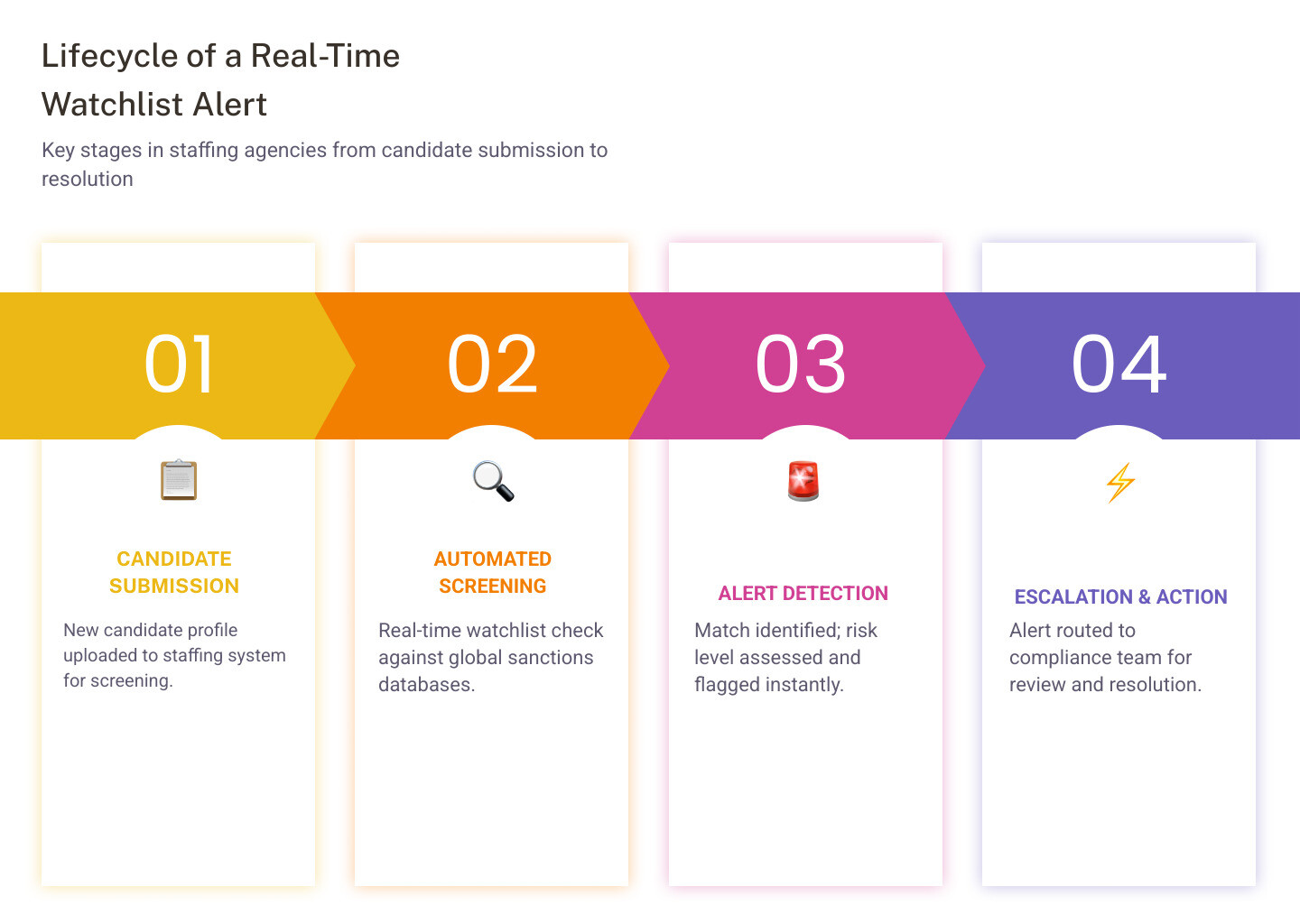
Watchlist alerts staffing agencies rely on are automated notifications triggered when a candidate or placed worker matches a record in a government sanctions list, terrorism database, or law enforcement registry.
Here's a quick breakdown of what that means in practice:
- What they screen against: OFAC SDN List, FBI Terrorist Screening Database (TSDB), HHS OIG exclusions, Interpol Red Notices, UN/EU/UK sanctions, and more
- When they trigger: At the point of placement (pre-hire) and continuously after a worker is deployed
- Who needs them: Any staffing firm placing workers in supply chain, healthcare, aviation, finance, or government-adjacent roles
- What happens on a hit: The alert is flagged, validated against identity data, escalated for review, and — if confirmed — triggers an FCRA-compliant adverse action process
- Why it's not optional: Regulatory frameworks including the Patriot Act, CTPAT, TSA cargo security requirements, and HHS program exclusions all carry real enforcement teeth
The scale of the risk is significant. As of December 2025, the FBI's Terrorist Screening Database contains records on nearly 2 million individuals. That's not a theoretical threat — it's a live operational risk sitting inside every high-volume hiring pipeline.
And the cost of a miss isn't just regulatory. Placing a sanctioned individual with a client can mean fines up to $250,000 per hire under certain federal statutes, plus the reputational damage of a client who holds your agency responsible.
For staffing firms operating at scale — managing hundreds of temporary placements across multiple clients — manual watchlist checks aren't just inefficient. They're a liability.
The good news: modern continuous monitoring platforms have transformed how agencies manage this exposure. AI-powered screening tools now reduce false-positive hit rates by 95–99% , cutting the manual review burden that used to make watchlist programs operationally unsustainable.
This guide walks you through exactly how to build a watchlist alert program that keeps your placements compliant, your clients protected, and your agency competitive.
Staffing Watchlist Compliance Checklist
- Identify high-risk roles (e.g., healthcare, logistics, finance).
- Obtain written FCRA-compliant authorization for both pre-hire and ongoing monitoring.
- Configure screening against OFAC, FBI, and global law enforcement lists.
- Establish a 24-hour validation protocol for all triggered alerts.
- Integrate monitoring with your ATS to ensure real-time visibility.
- Verify identity using SSN and E-Verify to prevent synthetic identity fraud.
Implementing Watchlist Alerts Staffing Agencies Need for Compliance
In 2026, the traditional "one-and-done" background check is no longer sufficient for staffing agencies managing high-volume placements. While a standard background check provides a snapshot of a candidate’s history at a single point in time, watchlist alerts provide a dynamic shield.
The primary difference lies in the source and the frequency. Standard checks focus on local and state criminal records. Watchlist screening monitors global databases for individuals connected to terrorism, major fraud, and international sanctions.
| Feature | Pre-employment Screening | Continuous Monitoring |
|---|---|---|
| Timing | Once, before the first day of work | Ongoing, real-time alerts |
| Scope | Criminal history, MVR, verification | Sanctions, debarments, new charges |
| Primary Goal | Initial qualification | Risk mitigation and retention safety |
| Data Sources | County/State courts | Global watchlists, OIG, OFAC, SAM |
For agencies placing workers in sensitive environments, you must screen against global sanctions like the OFAC Specially Designated Nationals (SDN) list. Failure to do so can result in massive fines under the Patriot Act. Furthermore, programs like the Customs-Trade Partnership Against Terrorism (CTPAT), which has roughly 11,400 certified participants, require strict personnel security protocols. If you provide labor to a CTPAT-certified logistics firm, your screening must meet these federal standards.
Find more about staffing solutions for your agency.
Navigating Regulatory Requirements for Watchlist Alerts Staffing Agencies
Regulatory compliance is the bedrock of staffing operations across the U.S. The Patriot Act mandates that businesses avoid transactions with individuals on the OFAC SDN list. In healthcare, the requirements are even more granular. You must check the HHS OIG List of Excluded Individuals/Entities (LEIE). Hiring a debarred individual for a federally funded healthcare role can lead to fines up to $1 million for repeat offenses.
For comprehensive protection, agencies often utilize FACIS (Fraud and Abuse Control Information System) Level 3 searches. This is the gold standard for healthcare staffing, as it includes nationwide sanctioning boards and federal sources.
In the supply chain sector, the TSA requires 100% screening of cargo on passenger aircraft, which extends to the personnel handling that cargo. If you are staffing port workers or drivers, they must receive screening equivalent to Coast Guard standards, which heavily emphasizes watchlist monitoring. You can find more details on CTPAT Program Information and Certified Participants to ensure your logistics clients are fully protected.
The FCRA Workflow for Watchlist Alerts Staffing Agencies
Even when dealing with high-stakes watchlist alerts, you must remain compliant with the Fair Credit Reporting Act (FCRA). You cannot simply terminate a contractor or rescind an offer the moment an alert triggers.
- Disclosure and Authorization: You must provide a clear, standalone disclosure that you will conduct background checks and continuous monitoring. You must obtain written authorization.
- Real-Time Hit Validation: Watchlists are notorious for "false positives" due to common names. For example, Senator Ted Kennedy was famously flagged on the No-Fly List multiple times due to a name match. You must verify that the individual on the list is actually your candidate using secondary identifiers (DOB, SSN).
- Pre-Adverse Action: If a hit is validated and you intend to take adverse action, you must send a Pre-Adverse Action notice, a copy of the report, and "A Summary of Your Rights Under the FCRA."
- The 5-Day Window: Give the candidate at least five business days to dispute the findings or provide context.
- Final Adverse Action: If the candidate does not dispute the hit or the information is confirmed, you may proceed with the final notice.
For a deeper dive, check out The Essential Guide To Background Screening For Staffing Agencies.
Best Practices for Real-Time Monitoring and Risk Mitigation
Efficiency in staffing comes from automation. In 2026, manual database polling is a relic of the past. High-volume agencies now use AI-powered entity resolution to manage their talent pools. These systems don't just look for name matches; they use reinforcement learning to handle name variants and prevent alert fatigue.
AI-powered platforms can reduce false-positive hit rates by up to 99%, allowing your team to focus only on credible risks. This acceleration is critical when your clients expect placements in hours, not days. By unifying screening, onboarding, and monitoring into a single dashboard, you eliminate the data silos that often lead to compliance gaps.
Stage-by-Stage Breakdown of the Monitoring Process
To maximize safety without slowing down your recruiters, follow this stage-by-stage workflow:
- Step 1: Candidate Onboarding: Collect identity data via a mobile-friendly interface. Use VettyVerify to run the initial global watchlist and criminal search.
- Step 2: Real-Time Monitoring: Once the candidate is placed, enroll them in VettyComply™ for continuous monitoring. This tracks new criminal charges, license suspensions, or additions to sanctions lists in near real-time.
- Step 3: Annual Re-screening: For long-term contractors, supplement continuous monitoring with an annual MVR and criminal re-screen. This catches any "slow-moving" data that might not trigger an immediate alert.
- Step 4: Redeployment Readiness: When a contract ends, your monitoring data proves the worker is still "clear." This allows you to redeploy them to a new client instantly without waiting for a new background check.
See how this worked for others in our Case Study/How Paramount Staffing Sped Up Placements With Vetty.
Common Mistakes in Staffing Watchlist Management
Avoid these pitfalls to keep your agency out of legal trouble:
- Manual Polling: Relying on a recruiter to manually check the OFAC website is a recipe for disaster. It is inconsistent and leaves your agency blind between checks.
- Ignoring Adverse Media: Official watchlists are the baseline, but adverse media (news reports of criminal activity) often provides the first warning sign of a high-risk individual.
- Identity Mismatches: Don't act on a name match alone. Always validate with a second or third identifier to avoid FCRA lawsuits.
- Delayed Response: A watchlist alert is an emergency. If a placed worker appears on a terrorist watchlist, every hour they remain on a client site increases your liability.
Good vs. Bad: Evaluating Your Screening Program
Is your current program helping or hurting your growth?
The "Bad" Legacy Approach:
- Delayed results that cause you to lose candidates to faster agencies.
- High false-positive rates that frustrate recruiters.
- Manual document collection and "wet" signatures.
- Fragmented systems where monitoring is separate from the initial check.
The "Good" 2026 Approach:
- Mobile-friendly candidate experience: Candidates complete their info in two clicks on their phones.
- Real-time visibility: A centralized dashboard showing the status of every worker.
- Automated audit trails: Every alert and action is logged, making audits (like CTPAT or Joint Commission) effortless.
- Transparent pricing: No hidden fees for "added" watchlist sources.
Strengthening Client Trust Through Continuous Vetting
In a competitive market, your agency’s value proposition isn't just "finding people"—it's providing "safe, compliant people." Continuous vetting via VettyComply gives your clients peace of mind that their supply chain, hospital, or office remains secure long after the first day of the assignment.
By automating these complex workflows, you reduce manual review time by up to 80% and staffing resource costs by 60%. This allows your team to focus on what they do best: building relationships and filling roles.
Our platform is built to help you navigate these challenges. How Vetty Helps Staffing Firms Solve Their Biggest Challenges For 2026 explains how we unify the entire lifecycle.
Ensure your agency remains the most trusted partner in the market by automating your compliance with a platform built for speed and precision at https://www.vetty.co/start.