

Why Motor Vehicle Records Screening Is a Critical Part of Your Hiring Process
Motor vehicle records screening is the process of reviewing a candidate's official driving history in 2026 to verify license status and assess risk before they operate a vehicle for your organization.
Compliance Checklist
- What it checks: License validity, traffic violations, DUI/DWI convictions, and accident history.
- Who needs it: Any employee or contractor operating a vehicle for business purposes.
- Legal framework: Governed by the FCRA, DPPA, and DOT/FMCSA regulations.
- Lookback period: Typically 3–7 years, varying by state (e.g., California’s 10-year window).
- Turnaround time: Minutes when using a third-party provider.
- Post-hire: Continuous monitoring is the standard for fleet safety.
This Compliance Checklist walks you through every stage — from pre-employment disclosure to ongoing monitoring — so your program is both compliant and operationally efficient.
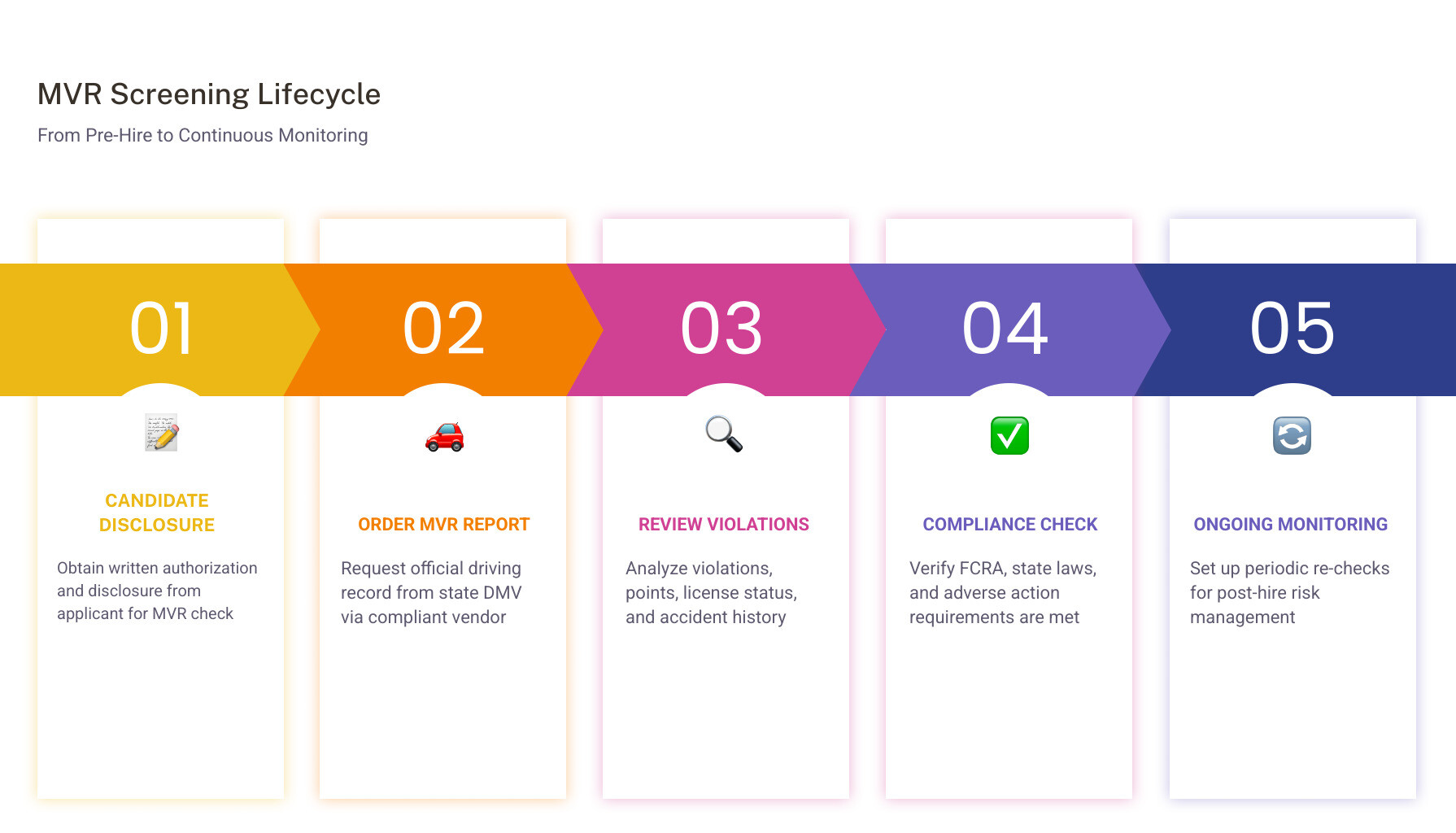
FCRA Workflow: A Stage-by-Stage Hiring Breakdown
Managing a fleet in 2026 requires a standardized workflow that satisfies US federal mandates. The regulatory landscape is anchored by the Fair Credit Reporting Act (FCRA) and the Driver Privacy Protection Act (DPPA). For commercial drivers, DOT and FMCSA regulations add mandatory annual reviews.
Essential MVR Report Components
- Driver Identification: Name, DOB, and identity verification.
- License Status: Current validity, suspensions, or revocations.
- Class and Endorsements: Verification of authorized vehicle types (e.g., Class A CDL).
- Violation History: Moving violations and mechanical issues.
- Major Offenses: DUI/DWI convictions and reckless driving.
Standard MVR vs. CDL Requirements
| Feature | Standard MVR | Commercial Driver's License (CDL) |
|---|---|---|
| Primary Regulation | FCRA / DPPA | DOT / FMCSA / CDLIS |
| Typical Lookback | 3–7 Years | 3–10 Years |
| Drug/Alcohol Clearinghouse | Not required | Mandatory for DOT roles |
The Stage-by-Stage Screening Process
- Disclosure & Authorization: Provide a standalone FCRA disclosure and obtain written consent. Using a mobile-friendly platform like VettyVerify allows candidates to sign instantly.
- Data Collection: Gather the license number and state.
- State-Specific Review: Account for varying fees and lookback periods.
- Adjudication: Compare results against safety standards and follow FCRA adverse action protocols (Pre-Adverse Notice, waiting period, and Final Notice) if necessary.
Optimizing Post-Hire Compliance and Risk Management
A clean MVR on the day of hire does not guarantee safety six months later. In today's world, the industry has moved toward continuous MVR monitoring to eliminate "blind spots" between annual checks.
Good vs. Bad: Common Mistakes in Driver Screening
The "Bad" Approach (Common Mistakes):
- Manual Tracking: Using spreadsheets for expiration dates.
- Non-FCRA Sources: Relying on unaccredited public record websites.
- Ignoring State Nuances: Applying one-size-fits-all rules to different state reporting windows.
The "Good" Approach:
- Automated Alerts: Real-time notifications for license changes.
- Centralized Dashboard: Managing MVRs and background checks in one location.
- Individualized Assessment: Following EEOC guidelines for all candidates.
By moving away from manual tracking, you ensure fleet safety remains high 365 days a year. Learn more in our guide on Motor Vehicle Records Monitoring Explained. For rapid screening, VettyVerify™ and VettyOnboard™ integrate directly into your onboarding flow, while VettyComply™ manages ongoing monitoring automatically.
Conclusion: Scaling Your Fleet Safety
Maintaining a safe fleet is a continuous effort. By implementing a standardized motor vehicle records screening process, you protect your organization from liability and keep insurance premiums manageable in 2026. Modern tools like VettyVerify and VettyComply offer the visibility needed to scale safely while maintaining high standards of compliance. Ensure your workforce remains qualified at https://www.vetty.co/start.