

Post-Hire Background Checks: A Practical Starting Point

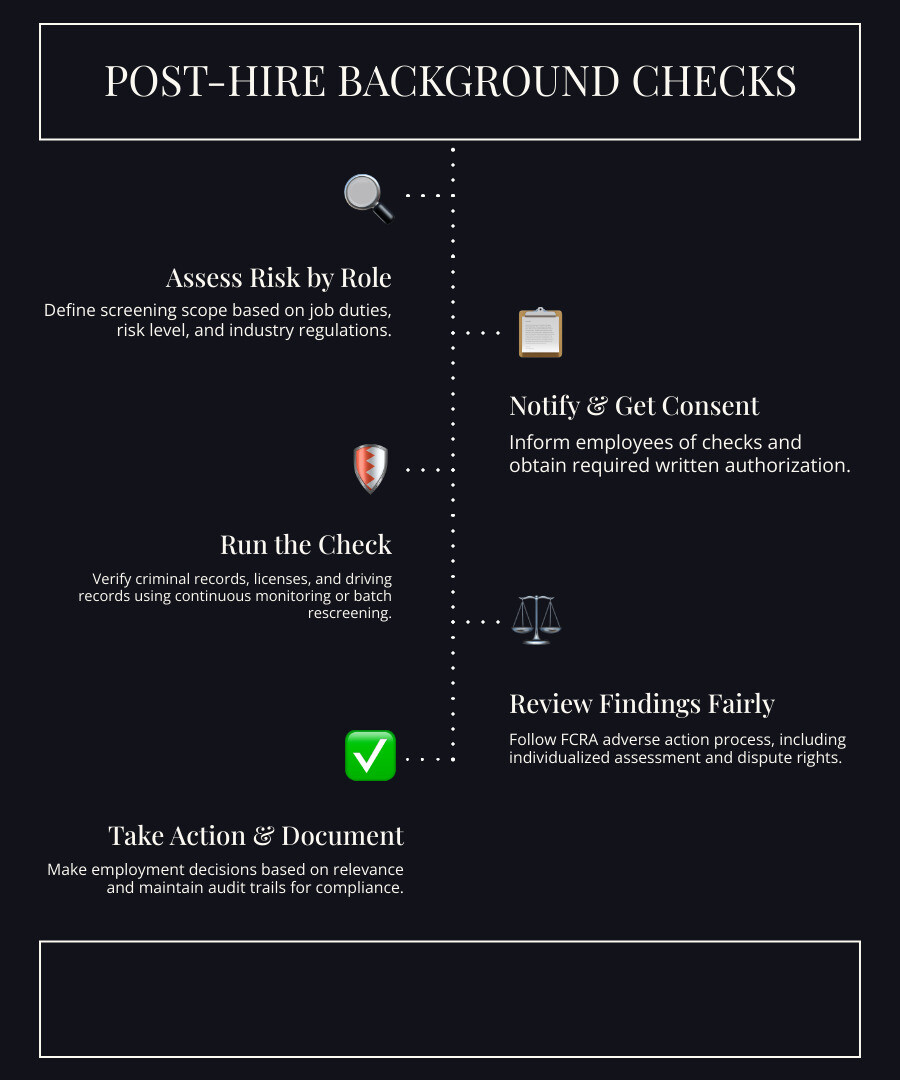
Post-hire background checks screen current employees for changes that matter to their jobs, such as a suspended driving license, an expired professional license, or a new reportable criminal record. Unlike a pre-hire check, they help you manage risk after someone starts work.
Compliance Checklist:
- Set checks by role, risk, and any industry rules.
- Tell employees what you will check and obtain the required authorization.
- Verify findings and follow the required review process before making an employment decision.
For healthcare, staffing, and on-demand teams, the goal is timely insight without turning work into surveillance. VettyVerify™, VettyOnboard™, and VettyComply™ are part of Vetty's mobile-friendly, all-in-one hiring acceleration and screening platform, with self-serve setup, transparent pricing, real-time visibility, and no-code customization. Vetty is PBSA and SOC 2 certified.
The Vetty Team will walk you through how to build a policy that protects people and earns their trust.
For a deeper look at the core concepts behind post-hire screening, you can review Vetty's guide to continuous criminal monitoring, the FCRA compliance rules for continuous monitoring, and a practical comparison of continuous monitoring versus annual rescreening.
Understanding Post Hire Background Checks and Why Pre-Hire Checks Aren't Enough

A traditional pre-employment check provides a static snapshot of an individual's history up to the moment of hire. However, employee risk profiles are dynamic. The assumption that an individual who clears a pre-hire screening will remain risk-free throughout their tenure overlooks standard operational realities.
According to the 2024 Association of Certified Fraud Examiners (ACFE) Report to the Nations, organizations lose an estimated 5% of their annual revenue to occupational fraud, with risks frequently emerging years into employment. When risk management stops at onboarding, organizations develop blind spots regarding insider threats, workplace safety, and regulatory compliance.
The Fundamental Difference Between Pre-Employment and Post-Hire Background Checks
Pre-employment screening answers a single question: Is this candidate qualified and safe to join our organization today? It verifies historical credentials, past employment, and past criminal history.
In contrast, post-hire background screening answers an ongoing operational question: Does this active team member continue to meet the compliance, safety, and licensing standards required for their position?
| Screening Dimension | Pre-Employment Screening | Post-Hire Screening |
|---|---|---|
| Operational Timing | Point-in-time snapshot prior to start date | Recurring intervals or continuous monitoring |
| Primary Objective | Validate qualifications and past history | Identify real-time compliance gaps and legal status shifts |
| Regulatory Triggers | Conditional job offers, initial credentialing | Role promotions, policy intervals, continuous data alerts |
| Worker Context | Applicant or prospective candidate | Active employee, contractor, or credentialed staff |
Rather than acting as a barrier to entry, post-hire screening maintains baseline standards across the workforce lifecycle.
Critical Risks of Relying Solely on Initial Screenings
Relying exclusively on onboarding checks exposes companies to severe legal, financial, and operational vulnerabilities:
- Negligent Retention Liability: If an employee causes foreseeable harm while representing your company, courts examine whether leadership knew—or reasonably should have known—about disqualifying conduct that arose after the hire date.
- Workforce Safety Hazards: The Bureau of Labor Statistics reported 57,610 nonfatal intentional injuries by persons in 2023, and workplace violence remains a persistent concern for employers across industries. Early awareness of violent offenses or protective orders is essential for proactive workplace safety.
- Direct Financial Losses: Internal theft, asset misappropriation, and unauthorized access can compromise operating capital and corporate stability. Periodic financial and criminal oversight helps deter and detect internal malfeasance before losses escalate.
- Regulatory Fines and Sanctions: Operating with unlicensed practitioners or excluded individuals in regulated sectors can trigger immediate loss of operating licenses and severe statutory penalties.
Implementing proactive workforce monitoring for risk management closes these oversight gaps, transforming safety from an annual event into an active organizational control.
Key Triggers, Screening Scope, and Monitoring Methodologies
Ongoing screening programs generally operate on defined operational triggers:
- Scheduled Intervals: Performing annual or biannual audits across an entire department or workforce tier.
- Role Changes and Promotions: Re-evaluating staff moving from entry-level positions into roles with elevated data access, financial authority, or direct client contact.
- Incident-Driven ("For-Cause") Reviews: Initiating targeted screenings following an on-the-job vehicle collision, workplace accident, or substantiated report of policy violation.
- Distributed Workforce Oversight: Implementing tailored remote worker continuous screening strategies to verify compliance for decentralized teams operating outside physical corporate facilities.
Periodic Batch Rescreening vs. Continuous Criminal Monitoring
Organizations traditionally selected periodic batch rescreening, running full background checks every 12 to 24 months. While periodic checks provide broad coverage, they introduce a significant detection lag—a worker could commit a disqualifying offense days after an annual check and remain unflagged for nearly twelve months.
To address this gap, many organizations now implement automated monitoring mechanisms. Adopting a structured continuous background monitoring approach reduces alert timelines from months to days by monitoring primary data sources for reportable activity. Evaluating continuous background checks versus annual rescreening allows HR leaders to align their screening cadence with their specific risk tolerance.
| Program Variable | Periodic Batch Rescreening | Continuous Real-Time Monitoring |
|---|---|---|
| Check Frequency | Set intervals (every 12, 24, or 36 months) | Automated, near-real-time ongoing queries |
| Detection Speed | Latency of up to 12 months between cycles | Alerts surfaced within days of record availability |
| Operational Workflow | High periodic spikes in HR review volume | Evenly distributed, automated exception-only alerts |
| Administrative Workload | High manual coordination per cycle | Reduced workload through automated exception-only alerts |
| Ideal Application | Low-risk, non-safety-sensitive roles | Safety-sensitive, healthcare, driving, and high-access roles |
Essential Screening Components Across Regulated Verticals
Screening programs should be tailored by role requirements and vertical regulations:
- Criminal Record Updates: Tracking county, state, and federal court records alongside sex offender registries. Reviewing continuous criminal monitoring fundamentals clarifies how real-time record scraping surfaces critical safety flags.
- Motor Vehicle Records (MVR): Monitoring driving violations, suspensions, and DUI citations for commercial drivers, mobile delivery workers, and field technicians. The Federal Motor Carrier Safety Administration (FMCSA) mandates at least annual driving record reviews under 49 CFR § 391.25.
- Healthcare Sanctions and Exclusions: Querying the HHS Office of Inspector General (OIG) List of Excluded Individuals/Entities (LEIE) and the System for Award Management (SAM). In the medical sanctions monitoring cluster, point-in-time checks leave dangerous gaps; continuous monitoring ensures uninterrupted compliance. For penalties, federal healthcare regulations enforce civil monetary penalties starting at a statutory base of $10,000 per item or service, adjusted annually for inflation.
- Professional Licensure Tracking: Verifying active status and disciplinary history for credentialed professionals (nurses, attorneys, financial advisors, engineers) through relevant state licensing boards.
Legal Compliance and FCRA Protocols for Post-Hire Screening
Post-hire background checks are consumer reports governed by the Fair Credit Reporting Act (FCRA), Equal Employment Opportunity Commission (EEOC) enforcement guidance, and state consumer reporting laws. Compliance requires standardized operating procedures at every stage.
Reviewing established continuous monitoring compliance rules ensures your screening infrastructure meets federal and state standards.
Standalone Disclosures, Evergreen Consent, and State Restrictions
Under the FCRA, employers must provide a clear, standalone written disclosure that a consumer report may be obtained for employment purposes, alongside a signed written authorization from the employee.
Many employers use "evergreen" clauses—authorizations that permit continuous or periodic checks throughout the worker's tenure. However, compliance varies by jurisdiction. For example, the California Investigative Consumer Reporting Agencies Act (ICRAA) requires fresh, specific disclosures under specific screening circumstances. Organizations must review state statutes to ensure ongoing consent protocols remain legally defensible.
Managing Adverse Action and Individualized Assessments for Existing Staff
When a post-hire screening report surfaces adverse findings that could affect an employee's status (such as reassignment, suspension, or termination), employers must follow the two-step FCRA adverse action framework:
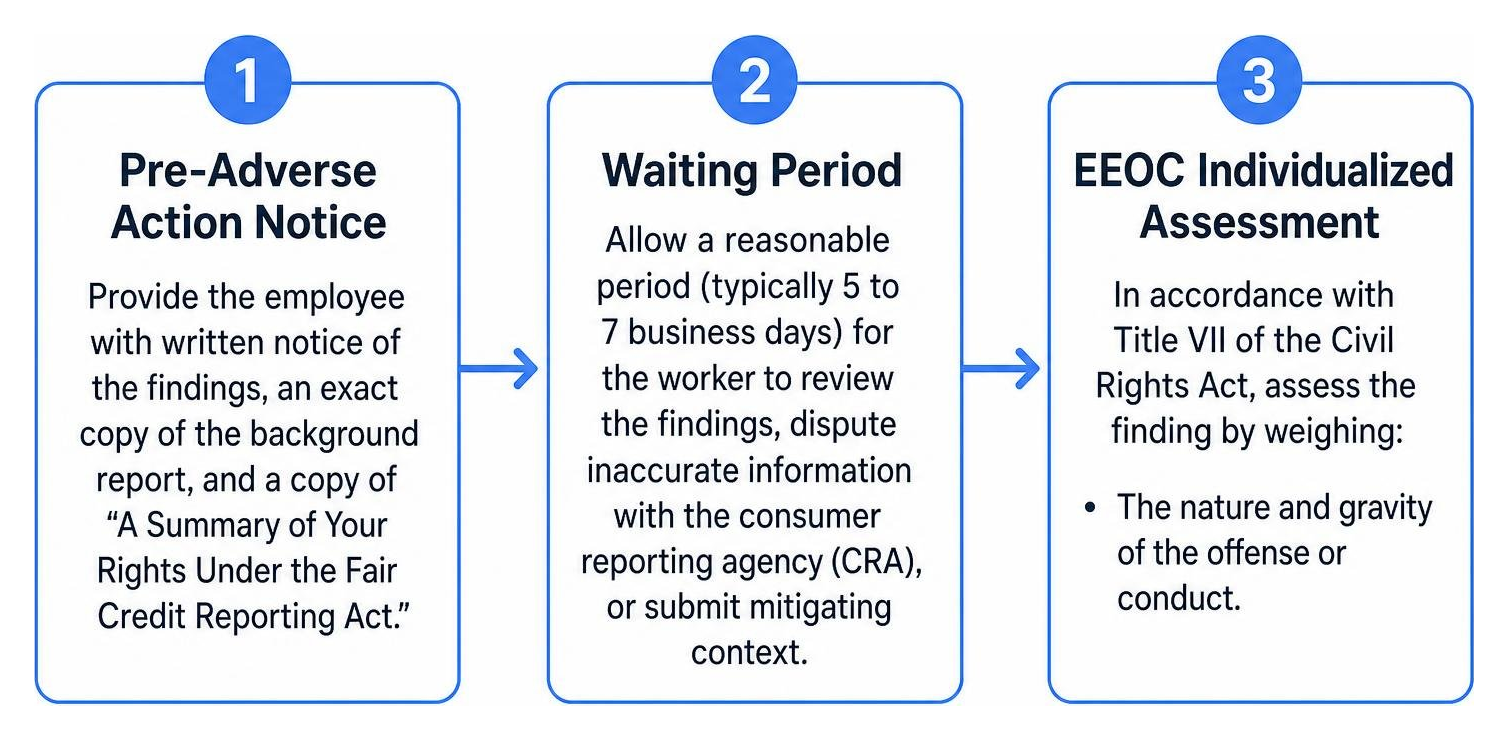
- Pre-Adverse Action Notice: Provide the employee with written notice of the findings, an exact copy of the background report, and a copy of "A Summary of Your Rights Under the Fair Credit Reporting Act."
- Waiting Period: Allow a reasonable period (typically 5 to 7 business days) for the worker to review the findings, dispute inaccurate information with the consumer reporting agency (CRA), or submit mitigating context.
- EEOC Individualized Assessment:
In accordance with Title VII of the Civil Rights Act, assess the finding by weighing:
- The nature and gravity of the offense or conduct.
- The time that has passed since the conduct or completion of the sentence.
- The nature of the job held, including direct duties and access levels.
- Final Adverse Action Notice: If management concludes that adverse action is job-related and consistent with business necessity, issue a formal final notice detailing the decision, CRA contact information, and remaining dispute rights.
Best Practices for Rolling Out an Ongoing Screening Program
Deploying an ongoing screening program requires balancing workplace security with employee morale. When introduced without clear communication, ongoing screening can be misinterpreted as workplace surveillance. However, many employees report feeling safer when they know their employer performs regular screenings.
To build trust and operational efficiency:
- Establish Clear Written Policies: Document exact triggers, review cadences, and adjudication criteria in the employee handbook.
- Implement Self-Reporting Guidelines: Require employees in safety-sensitive or regulated roles to self-report driving suspensions or criminal charges within a defined window (such as 24 to 72 hours).
- Automate Compliance Systems: Leverage modern screening integrations that link with existing ATS and HRIS software. Exploring the advantages of automating onboarding and compliance tools demonstrates how centralizing verification workflows eliminates manual data entry and reduces HR administrative workload.
How to Implement a Modern Policy for Post Hire Background Checks
A successful rollout follows a structured, multi-step implementation:
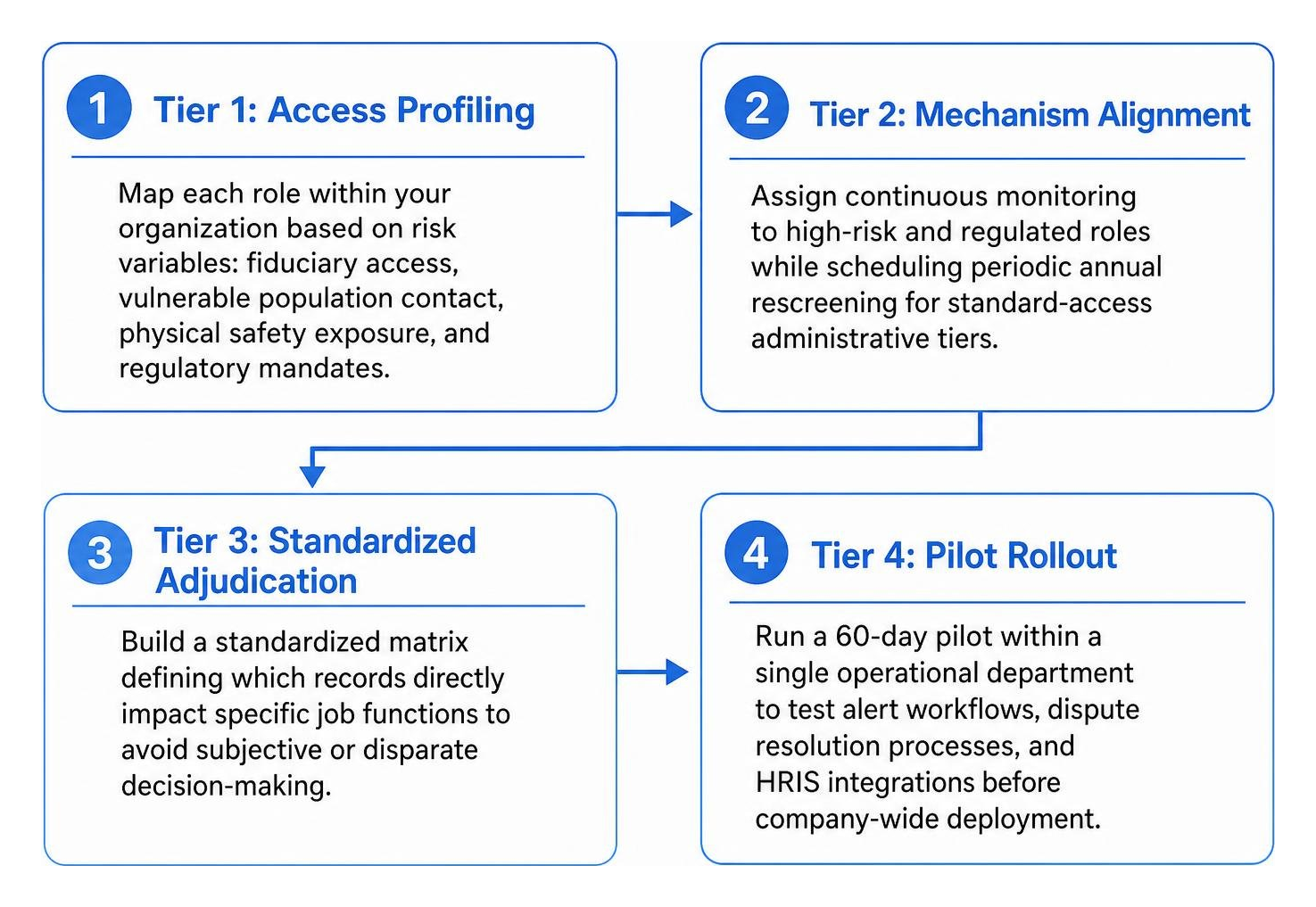
- Tier 1: Access Profiling: Map each role within your organization based on risk variables: fiduciary access, vulnerable population contact, physical safety exposure, and regulatory mandates.
- Tier 2: Mechanism Alignment: Assign continuous monitoring to high-risk and regulated roles while scheduling periodic annual rescreening for standard-access administrative tiers.
- Tier 3: Standardized Adjudication: Build a standardized matrix defining which records directly impact specific job functions to avoid subjective or disparate decision-making.
- Tier 4: Pilot Rollout: Run a 60-day pilot within a single operational department to test alert workflows, dispute resolution processes, and HRIS integrations before company-wide deployment.
Frequently Asked Questions about Post-Hire Background Checks
Do employers need a new consent form every time a post-hire check is conducted?
It depends on state law and how the original disclosure was drafted. If the initial onboarding paperwork included an FCRA-compliant standalone disclosure with clear evergreen authorization language, federal law generally permits recurring checks without a new form. However, certain jurisdictions (such as California) have distinct notice requirements. Many organizations choose to provide recurring notifications or fresh authorizations during annual reviews as a best practice.
What is the difference between continuous criminal monitoring and annual rescreening?
Annual rescreening runs a comprehensive search at a fixed point once every 12 months, leaving an unmonitored window between cycles. Continuous criminal monitoring connects directly to primary court data feeds, law enforcement rosters, and correctional sources to generate automated alerts within days of a new reportable filing. Understanding how to utilize criminal monitoring in modern hiring allows organizations to maintain continuous visibility without running duplicative manual checks.
How does post-hire screening protect companies against negligent retention lawsuits?
Negligent retention claims arise when an employer retains an employee after learning—or after they reasonably should have known—that the individual posed a foreseeable risk of harm to coworkers, customers, or the public. By maintaining a documented, consistent post-hire screening program, organizations demonstrate proactive due diligence and reasonable care, establishing a defensible operational record against liability claims.
Building a Resilient Workforce Strategy in 2026
Modern workforce management requires transitioning from static onboarding verifications to dynamic, lifecycle risk management. By deploying structured, compliant post-hire screening, organizations effectively safeguard their staff, protect their brand, and minimize regulatory liability.
Vetty provides an all-in-one hiring acceleration and screening platform that unites pre-hire verification, onboarding document collection, and post-hire compliance in a single interface.
- VettyVerify™: Deploy fast, compliant pre-hire background checks with two-click ease.
- VettyOnboard™: Streamline digital forms, e-signatures, and I-9 verifications through a mobile-friendly candidate experience.
- VettyComply™: Automate continuous post-hire monitoring across criminal filings, MVR records, and healthcare sanction lists (including OIG/SAM) with real-time visibility and no-code customization.
To design an automated, compliant post-hire screening program tailored to your industry, learn how to get started by visiting Vetty's onboarding portal.